
Tips & Tricks for a successful HORIZON-CL4-2027-01-MAT-PROD-06 proposal
Opening
22 September 2026
Deadline
Keywords
Circular Materials
RIA
Green Materials
SSsbD
recyclable polymers
metal alloys
3D printing
3D printing
research materials
Your microfluidic SME partner for Horizon Europe
We take care of microfluidic engineering, work on valorization and optimize the proposal with you
HORIZON-CL4-2027-01-MAT-PROD-06: Circular innovative advanced materials: facilitating the transition from design to markets - Innovative Advanced Materials for the EU and Made in Europe partnerships
The Commission is seeking innovative materials designed for circularity, not just being sustainable on paper. From lab-level concepts to industrial-level solutions, this call is meant to motivate initiatives aimed at producing circular materials. The Commission will guarantee that at least one project is funded in each of the two strategic areas that we have been looking at: medical devices and mobility. If you have projects involving circular magnets, recyclable polymers, or metal alloys for 3D printing, then this is the call that you ought to be making.
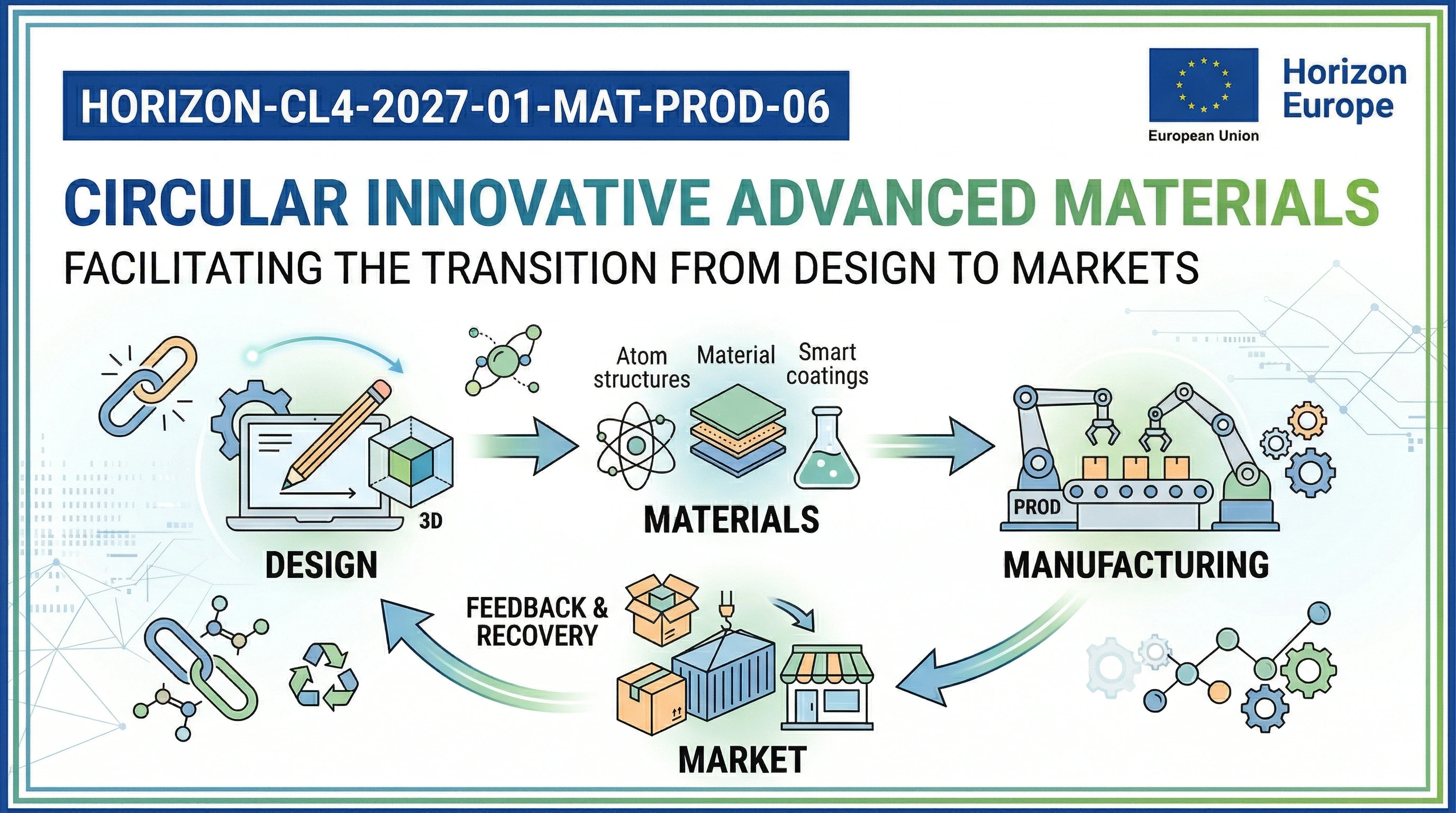
Download the MIC Horizon Europe 2026/2027 Calls Calendar:
Discover more!
Administrative facts: what do we know about the HORIZON-CL4-2027-01-MAT-PROD-06 call?
Which call is it, and when is the opening and the deadline?
- Call name: INDUSTRY
- Call identifier: HORIZON-CL4-2027-01
- Destination: Leadership in materials and production for Europe
- Topic identifier: HORIZON-CL4-2027-01-MAT-PROD-06
- Opening date: 22 September 2026
- Deadline: 02 February 2027 (17:00 Brussels time)
- Type of action: Research and Innovation Action (RIA)
What about the budget and estimated size of the project?
- Overall indicative budget: EUR 36 million
- Number of projects expected: 7
- Indicative EU contribution per project: EUR 5.00 to 6.50 million
- Eligible costs: will take the form of a lump sum contribution
What are the key eligibility and evaluation conditions?
- Standard Horizon Europe eligibility conditions apply (General Annex B)
- MIIT condition: participation of Chinese universities linked to the Ministry of Industry and Information Technology is subject to specific eligibility restrictions
- Page limit in Part B extended by 3 pages to accommodate the mandatory business case and exploitation strategy
- Portfolio approach: grants awarded not strictly in ranking order; at least one highest-ranked proposal from each strategic area (mobility, medical devices) will be funded, provided thresholds are met (note: this procedural rule is confirmed for MAT-PROD-05 and inferred for MAT-PROD-06 at approximately 80% confidence, as the conditions section was incomplete in the retrieved text)
- TRL: activities expected to start at TRL 4-5 and reach TRL 6 by project end (inferred from structural similarity to MAT-PROD-05, confidence approximately 75%)
- Results protection: the granting authority may object to the transfer of ownership or exclusive licensing for up to 4 years after the project end
Scientific range: what does the Commission expect from the HORIZON-CL4-2027-01-MAT-PROD-06 grant?
What outcomes are expected?
New circular advanced materials should be physically demonstrated in industrial contexts by the end of the project, not just characterized in a lab. The Commission wants faster adoption in products, more resource efficiency across the full material life cycle, and circular business models that someone would actually invest in. Quality standards and regulatory pathways are explicitly among the issues to be addressed.
What is within the scope?
The subject of the research is materials and processes, not products. The Commission is not interested in general sustainability research without material-level innovation.
- Composite materials/recyclable polymers with circular design
- Circular magnets with recovery and reuse of materials at end of life
- Alloys with circular potential for additive manufacturing processes
- Tools enabling integration of novel circular materials into industry
- Circular business model with all cost aspects of life cycle considered
- Recycling, end-of-life valuation, and scaling of recovery processes
- AI-based solutions, digital tools, and FAIR data exchange in supplier networks
- Safe and Sustainable by Design (SSbD) framework compliance
- Optional: data sharing through the Common Data Platform for Chemicals
- Cross-sector sharing of developed materials solutions
What are the specifically proposed research directions?
The work schedule obviously indicates a number of particular lines of approach. The complete cycle of innovation, from design to scale-up, is assumed to be covered by projects.
- From the outset, design for circularity and functional integration of new materials
- Design and development of scalable processes for recovery, recycling, and valorization
- Use cases or industrial demonstrators for medical or mobility devices
- SSbD decision-making tools and digital twins in supporting circular product design
- Value chain actors have access to FAIR data sharing tools
- Collaboration on relevant ongoing EU projects and Materials Commons for Europe
Scientific strategy: how can you enhance your chances of being funded through HORIZON-CL4-2027-01-MAT-PROD-06?
What scientific decisions are most important?
- Determine your strategic area in advance: Determine your core application domain, either mobility or medical devices, and make it clear in your proposal. Too much of what is submitted is balancing both domains but not making any commitment. That is what the portfolio approach is: competition in each domain, not across both domains.
- Make SSbD part of your design process, not an afterthought: Rather than seeing it in your proposal in a stand-alone chapter, make it clear that it is used in your decision process. Show visible integration at all levels of innovation.
- Give demonstrators priority over publications: The key thing that the Commission wants to see is evidence of industrialization. More important than any additional study or model is your demonstrator at pilot scale.
- Ensure your digital layer is specifically linked to material circularity: While AI, FAIR data, and digital technologies are beneficial, they need to be linked to the circular shift. The evaluators will not be impressed by a data management plan that is not linked to any decision on circularity.
- Show that your solution is transferable: The work program specifically asks for proposals that explore opportunities in other sectors. The score is improved if there is at least one plausible second application.
- Be direct about business model economics: The evaluators will scrutinize whether or not your circular strategy is economically viable because of the lump sum budgets. The phrase “cost of changes along the life cycle” is often used.
Consortium & proposal-writing plan: what works best with this type of call?
- Try for a range of eight to twelve, or a bit more if clinical or regulatory need dictates.
- You need to have a range of material sciences, process engineers, and a manufacturing industry partner who can host your demonstrator. Without a believable industry partner, your validation argument falls flat.
- Add a creative SME: Not as a tokenistic exercise. A SME that specializes in material processing or recycling tech brings a level of scale-up cred that industry partners simply don’t.
- If your device falls within the medical device space, regulatory and clinical partners are not optional. Reviewers working on that portfolio track will notice your absence.
- Exploitation chapter: the section on your exploitation chapter is in the extended three-page business case section. Think in terms of who’s going to pay for it, who’s going to buy it, and how it’s going to be marketed.
- You should reference any previous or current Horizon programs and make the connection to the Materials Commons for Europe. It’s required under the work program. It also demonstrates that your group is familiar with the area.
- Allocate resources for FAIR data from the start: The evaluators make sure that the commitment to data sharing is actually in the budget and not just the words.
How would microfluidics contribute to this topic?
One of the key challenges with traditional testing of novel circular materials is that it is hard to quickly test dozens of formulations in the lab, much less under conditions of real-world processing. This is no longer the case with microfluidic devices. These devices can mimic conditions of temperature, flow, and chemical environment beyond what batch processes can provide, enabling testing of material characterization tests in parallel with small quantities.
- Suppose you are developing a recyclable polymer composite and wish to understand how it degrades during various processing cycles. Without using kilos of materials per test, a microfluidic flow cell can mimic these conditions and allow testing of degradation in almost real-time.
- SSbD compliance support: before any animal or clinical testing is needed, organ-on-chip or tissue-on-chip technologies can provide biological safety data for new circular materials for medical devices. This is an important contribution to the medical devices portfolio track.
- Digital integration: the digital twin of materials, as well as FAIR data management, by default includes the rich data streams from microfluidic technologies.
- If your project includes safety testing or material screening with SSbD, your collaboration would profit from having microfluidics as an enabling technology partner.
- While microfluidics makes a less direct contribution to the track of mobility, it is still potentially available as a tool to evaluate lubricants, surface treatments, and/or adhesion properties of circular materials in micro-scale format prior to pilot production.
The correspondence is more robust and direct in medical devices. The type of technical distinction that sets a proposal apart in this field is the incorporation of organized, high-throughput experimental capabilities. Microfluidics makes that case concretely, whether your project is screening circular polymers for biocompatibility or building a safety profile for a new magnet alloy.
The MIC already brings its expertise in microfluidics to Horizon Europe:
H2020-NMBP-TR-IND-2020

Microfluidic platform to study the interaction of cancer cells with lymphatic tissue
H2020-LC-GD-2020-3

Toxicology assessment of pharmaceutical products on a placenta-on-chip model

About the author
Céleste Chidiac, PhD
Scientific writer and digital marketing specialist
Céleste Chidiac holds a doctorate in neuroscience and molecular biology from the University of Strasbourg. Since joining the Microfluidics Innovation Center in 2023, she has combined scientific writing with website management. For MIC’s Horizon Europe topic pages, she draws on her research background to explain scientific challenges and clarify funding priorities. Her writing helps prospective applicants understand each topic’s scope, expected outcomes and research directions.
FAQ - HORIZON-CL4-2027-01-MAT-PROD-06
What is this topic really about, in plain terms?
HORIZON-CL4-2027-01-MAT-PROD-06 is a Research and Innovation Actions (RIA) that take the circular advanced materials through the full innovation cycle – design-for-circularity, scale-up (including recovery, recycling, end of life valorization), to industrial demonstrators. It is under two co-programmed partnerships, namely Innovative Advanced Materials to the EU (IAM4EU) and Made in Europe. The 2026 sister topic explicitly prioritizes material families to be recycled: recyclable polymers and composites, magnets, and metal alloys to be additively manufactured – and the 2027 edition.
Who should apply and how much money is on the table?
The applicants should be consortia comprising at least three independent legal entities of at least one EU Member State and two other countries (including Associated Countries). All are welcome: institutions, Universities, SMEs, large industry, government agencies, and non-governmental organizations. Innovate UK Business Connect estimates the approximate envelope at € 5M-6.5M per project across 7 projects. Check the Funding and Tenders Portal for more information.
What four expected results must proposals credibly deliver?
Based on the Work Program, the evaluators anticipate that proposals will show:
- Products are going to adopt innovative advanced materials at a faster rate through accelerated production and the uptake of technology.
- Circular business models of strategic value chains make industrial use of such materials possible.
- A substantial increase in resource efficiency (materials and energy);
- Innovations in quality, harmonization, and equalization of regulations to simplify market transition.
A project that has fantastic materials science, but a bad business model and regulatory pathway – or vice versa – will not be competitive. Each of the four should be addressed credibly.
Which application areas does the portfolio approach prioritize?
This should have one main point of application. Either or both of the two following strategic value chains will have at least one of their proposals funded, as long as they pass all evaluation thresholds:
- Mobility
- Medical devices
It is not a decision but a portfolio rule. It is therefore strategically important to choose your lane and demonstrate the depth of the value chain within it.
What TRL should the project target?
Activities will start with TRL 4-5 and reach TRL 6 at the end of the project. In practice, the proposal must show realistic previous lab or other-environment demonstrations, and the project must organize industrially relevant demonstrations by the time of project completion. Mis-scoped projects have a starting TRL of 3 or a goal of TRL 5.
How should the scientific work be structured to be competitive?
A few helpful structuring guidelines in accordance with the Work Program requirements:
- Design circularity as a main goal, not an epilogue. Show the impact of recyclability, disassembly, and end-of-life valorization on the material choice at the very first.
- Be descriptive of Safe and Sustainable by Design (SSbD) framework – do not just refer to it; explain how it is involved in decision-making at each gate.
- Develop a transparent chain: industrial integration demonstrator business case, new material design, scalable process. This reasoning is what the assessors of the first two pages ought to be in a position to perceive.
- Explicitly plan FAIR data and interoperability – where relevant, sharing of data with the Common Data Platform of Chemicals and collaboration with the Materials Commons of Europe.
What is the microfluidics added value for this topic?
Four tangible contributions microfluidics can make to a HORIZON-CL4-2027-01-MAT-PROD-06 consortium:
- Polymer microfluidic consumables, recyclable: The formulation and processing to chips and cartridges can be bonded, with no solvents, disassembled, and the material recovered – directly in the medical-devices portfolio slot.
- Life-cycle testing systems: microfluidic systems for testing leachables/extractables, and design criteria for reusing or refurbishing the chip.
- Circular business models of single-use devices: cartridge digital product passport, take-back logistics demonstrator, cartridge pay-per-use diagnostics economics.
- Intensification of processes in materials manufacturing: microfluidic reactors to produce active substances through controlled polymer synthesis, active compounds through continuous crystallization, and scalable microchemistry with reduced solvent and energy footprint.
Who should be in the consortium?
Competitive consortia in this topic, other than the formal minimum (three entities in three eligible countries), are:
- Materials chemists / polymer / metallurgy experts (new material designs, SSbD expertise);
- Pilot-line operators (scale-up and industrial integration); process engineers;
- waste-management actors (recovery, valorization, closed-loop demonstration);
- Medical device end-users or mobility (pull along the line of value, regulatory insight);
- Data spaces, data passports (life-cycle assessment, digital), FAIR data partners;
- Standardization and business model professionals (harmonization, market uptake).
- It is common to have an industrial end-user as part of the initial, visible difference.
What are the most common mistakes to avoid?
Based on the comments of the public reviewers of the earlier MAT-PROD subjects and the wording of the Work Program:
- Designing circularity as a driver and not an optional paragraph.
- Unspecified SSbD statements without a decision model, data generation strategy, or relation to the Chemicals Common Data Platform.
- Weak business case: no cost analysis of changes in life cycles, no early adopters.
- Mismatched TRL: starting with too small, or claiming that TRL 8 demonstrators are incompatible with an RIA.
- Violating the portfolio rule: not stating clearly mobility or medical devices as the primary area of application.
- No synergies announced with Materials Commons in Europe or other EU programs.
- Page limit disregarded: Part B: The business case and exploitation strategy comprises 48 pages, and they have included 3 pages. Any proposal exceeding the limit is subject to a fine.