
Tips & Tricks for a successful HORIZON-CL4-2027-01-MAT-PROD-03 proposal
Opening
22 September 2026
Deadline
Keywords
de-manufacturing
re-manufacturing
circular economy
robotics automation
digital twins
circularity agenda
predictive maintenance
Made in Europe
end-effectors
Your microfluidic SME partner for Horizon Europe
We take care of microfluidic engineering, work on valorization and optimize the proposal with you
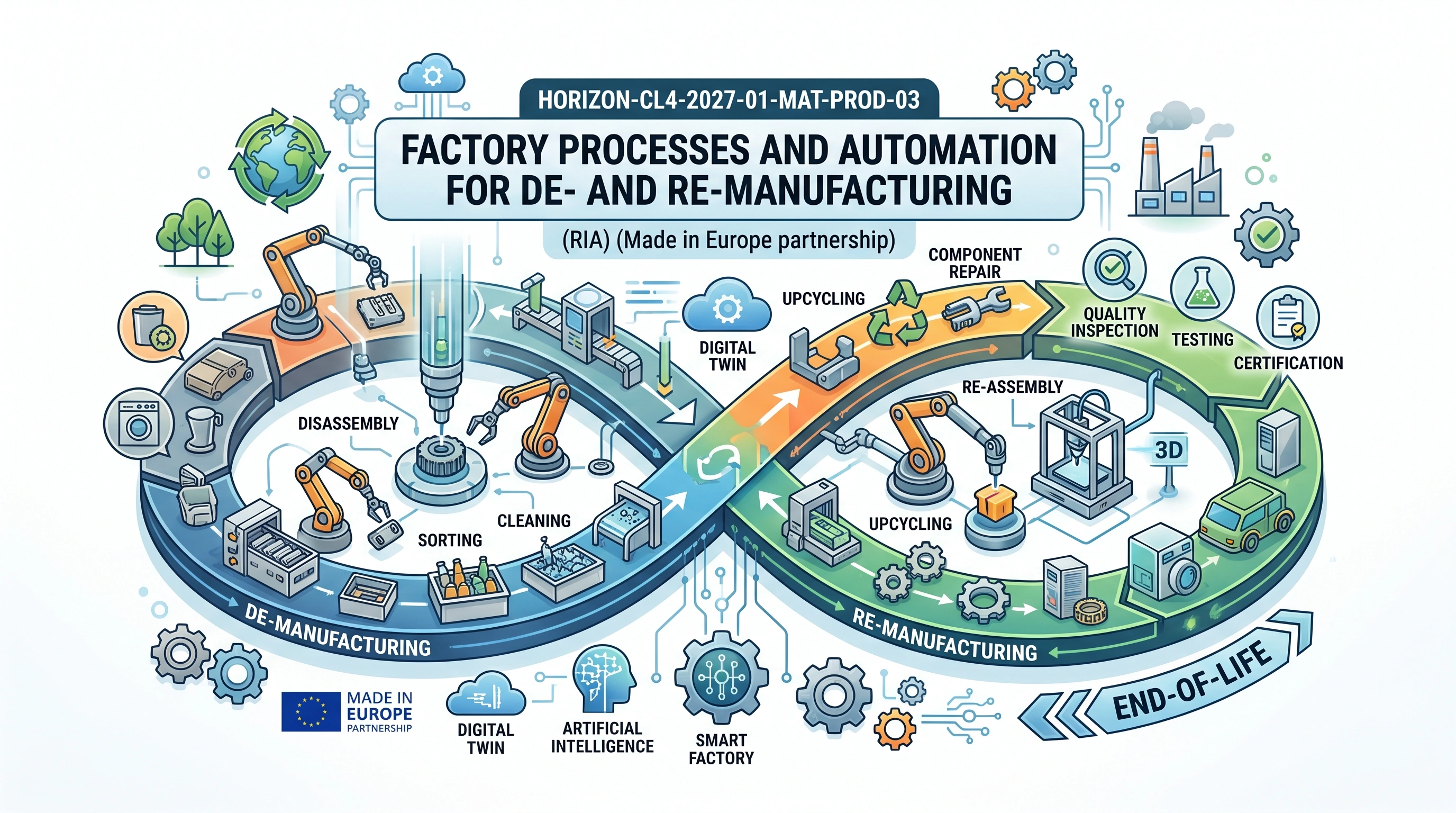
HORIZON-CL4-2027-01-MAT-PROD-03 - Factory processes and automation for de- and re-manufacturing (RIA) (Made in Europe partnership)
End-of-life products should no longer be considered waste in Europe, according to the Commission. Industrial foundations for remanufacturing, the technologies, automation, digital tools, and skills necessary to make it profitable at a factory scale, are the focus of this topic. It sits within the larger circularity agenda and the Made in Europe partnership. Bringing products back to working condition takes precedence over simply recycling materials.
Download the MIC Horizon Europe 2026/2027 Calls Calendar:
Discover more!
Administrative facts: what do we know about the HORIZON-CL4-2027-01-MAT-PROD-03 call?
Which call is it, and when is the opening and the deadline?
- Call name: INDUSTRY
- Call identifier: HORIZON-CL4-2027-01
- Destination: Leadership in materials and production for Europe
- Topic: Factory processes and automation for de- and re-manufacturing
- Opening: 22 September 2026
- Deadline: 2 February 2027, 17:00 Brussels time
- Type of action: Research and Innovation Action (RIA)
What about the budget and estimated size of the project?
- Topic indicative budget: EUR 36 million
- Projects expected to be funded: 6
- Budget per project: EUR 6 million on average, with a Commission range of EUR 5 to 6.5 million
- Overall INDUSTRY call budget: EUR 224 million
What are the key eligibility and evaluation conditions?
- TRL 4 to 5 at start, TRL 6 at the end
- Legal entities established in China are not eligible in RIAs and IAs under this Destination
- Part B page limit extended by three pages for the business case and exploitation strategy
- Cooperation with the JRC will be requested from funded consortia
- Lump sum funding
- Standard General Annex eligibility, award criteria and thresholds apply
Scientific range: what does the Commission expect from the HORIZON-CL4-2027-01-MAT-PROD-03 grant?
What outcomes are expected?
The project should end with the availability of industrial-grade functional de-manufacturing and remanufacturing technologies that have been factory-tested, as well as the standards and skills needed to operate them at an industrial level. The Commission is interested in a robust industrial ecosystem for circularity in manufacturing, rather than just lab-bench prototypes. The emphasis is on demonstrating products that instead of being thrown away, have their functions kept, adapted, or enhanced.
What is within scope?
Proposals must address at least three of the following:
- Technologies that combine multimodal sensor data, artificial intelligence, and human input to evaluate the state of parts and support predictive maintenance for components
- AI and robot-assisted de-manufacturing tools with cutting-edge end-effectors for extended logistics and sorting
- A larger digital ecosystem for remanufacturers made possible by model-based systems based on CAD and digital twins of original parts
- On-site remanufacturing or repair of costly parts like wind turbines, airplanes, and ships
- Planning and sequencing operations based on the characteristics of incoming products
Battery production is not included in this call (it is covered elsewhere). The emphasis is clearly at the factory level, not focused on material chemistry.
What are the specifically proposed research directions?
- Condition monitoring and predictive maintenance are essential measures to ensure the optimum functionality of used parts, especially low-value parts where economics are tougher
- End-effector design for robotic disassembly: an area where very little exists at industrial scale
- Digital twin integration for operators who may not have access to the original design information
- On-site, local remanufacturing of large infrastructure assets (wind energy, aviation, marine), still an underexplored area
- Managing flow variability: the problem of running a remanufacturing facility with an uncertain input stream of products
The work programme is pretty much set out in detail on this. There is an obvious operational and logistics element that many people forget to consider when working on their proposal.
Scientific strategy: how can you enhance your chances of being funded through HORIZON-CL4-2027-01-MAT-PROD-03?
What scientific choices matter most?
- Clearly state at least three scope elements. It’s a call requirement. Don’t just state them – allocate your work packages to the elements clearly so that reviewers can see and approve. Quantify the industrial economics.
- The EC wants a credible industrial environment. This should not be perceived as a pilot that can be scaled up later. Your business plan should present how you address the obstacles of implementation, how you integrate into the existing manufacturing base, and the risks related to changing inputs. This is the Achilles heel of many technically feasible applications.
- Choose an industry and go deep. Wind turbines, aircraft, vessels or automotive parts are all mentioned. Attempting to be general to all of them at once will surely be superficial. At least by our experience, very few reviewers will value proposals that are too generic. Proposals that are specific to a single industry receive higher ratings in reviews.
- Digital twins matter, but not as the main focus. Models are expected to become part of a digital ecosystem to support operators, not the primary research object.
- Do not omit skills and standards. Skills development and standardisation are listed as expected outcomes. It is very likely that proposals will overlook this. Reviewers will value work linking technical results to pre-normative activities.
- Robotics integration should go beyond simple pick-and-place. The call specifically expects novel end-effectors, they are looking for innovation beyond what already exists.
Consortium & proposal-writing plan: what works best with this type of call?
- Somewhere between eight and twelve partners, maybe a couple more if you cover several product families.
- At least two industrial end users who own the parts. Without them the demonstration has nowhere to live.
- Bring in an innovative SME or two for the sensing and automation layer. They move faster than large integrators.
- A standards or certification partner. Safety and standards sit in the expected outcomes.
- If your coordinator has never run a lump sum grant, plan the work package budgeting early.
- Write the impact section for a reader who will ask who buys this in 2032.
How would microfluidics contribute to this topic?
Judging whether a used part is still good usually means sending fluid samples to a lab. Days pass. Microfluidic analysers do that measurement in place, in minutes, on a few microlitres.
- Gearbox and hydraulic oil tell you a lot about a part before you open it. A microfluidic particle counter reads wear debris on the spot. You learn whether the component is worth re-manufacturing before taking it apart.
- Cleaning and degreasing baths drift over time. On-chip monitoring of bath chemistry keeps the de-manufacturing line stable, and gives your AI models a clean input stream.
- Coolants, lubricants, surface treatment baths: same idea, different fluid.
- For on-site work on wind turbines or vessels, portability is everything. You cannot bring a lab offshore. A chip and a reader fit in a case.
- Microfluidic chips are themselves products designed for disassembly. Modest point, but it exists.
So the contribution here is sensing, mostly. If your proposal claims to assess part condition from multimodal data, fluid analysis is one of those modalities, and it is usually the missing one.
The MIC already brings its expertise in microfluidics to Horizon Europe:
H2020-NMBP-TR-IND-2020

Microfluidic platform to study the interaction of cancer cells with lymphatic tissue
H2020-LC-GD-2020-3

Toxicology assessment of pharmaceutical products on a placenta-on-chip model

FAQ – HORIZON-CL4-2027-01-MAT-PROD-03
What is the main objective of HORIZON-CL4-2027-01-MAT-PROD-03?
It will be centered on the development of factory-level de-manufacturing and re-manufacturing technologies and processes, which would make it economical to re-use products by fixing them back to their working condition rather than scraping them. It is aimed at industrial circularity: maintaining the functions of products alive, rather than restoring raw materials.
What does 'de-manufacturing' mean in the context of this call?
De-manufacturing is the systematic dismantling of a product or a part to ascertain its state, and can be used to reuse or re-manufacture parts. It comes before re-manufacturing, and it involves certain technologies condition sensing, robotics, sorting, logistics which this call is specifically aiming to address.
What is the predicted level of TRL at the start and at the end of the project?
Activities will start at TRL 4-5, and finish with TRL 6 at the end of the project. This means a change between proven prototypes in the laboratory to proven prototypes in a suitable industrial environment. At factory level and testing.
What is the number of projects to be financed and the average budget per project?
All-encompassing indicative budget of the subject appears to be EUR 36 million. Six projects are expected to be funded, and the EU funds will be between EUR 5.00 and 6.50 million per project. Qualified expenses are in form of lump sum contribution.
What are the targeted technologies of this topic?
At least three of the following should be covered by proposals: condition monitoring and predictive maintenance based on multimodal sensor data and AI; AI and robotic-assisted de-manufacturing with novel end-effectors; digital twins and model-based systems to remanufacture operators; on-site remanufacturing of high-value parts; and sequencing and planning tools to manage changing incoming product streams.
Check the Funding and Tenders Portal for more information.
What is Made in Europe partnership and how it relates to this call?
Made in Europe is a co-programmed European alliance between industry and the European Commission, that deals with high-tech manufacturing technologies. Themes that put this partnership in action should be in line with its goals and preferably, should be extensions or referrals to other projects that have already been supported by the partnership. It is pleasant to have references to previous or ongoing Made in Europe projects in your proposal.
What industrial areas are the most pertinent to MAT-PROD-03 proposals?
On-site remanufacturing is wind turbines, aircraft ships in the work programme. The increased range suggests automotive parts. These are the areas in which the component worth is large enough to justify the economics of re-manufacturing and this is what the Commission is working on.
Can SMEs and startups take part in this call?
Yes. There is no restriction on the SME involvement; there is a general positive attitude of the evaluators towards the involvement of an innovative SME in the consortium. In particular, it concerns SMEs operating in the field of robotics or digital twins, sensor integration or remanufacturing services. There is a special pilot access scheme of SMEs on a different call.
What is lump sum financing and does it alter the way you write the budget?
The EU contribution is lump sum financing and is predetermined as regards agreed work plan and budget and not reimbursable on actual costs. It is simple to report on and has a very detailed and believable budget justification in the early stages. The breakdown should be able to associate the costs of each work package to enable reviewers determine whether the lump sum is reasonable.
What can microfluidics do to help a MAT-PROD-03 project?
Microfluidic sensors can be also incorporated into condition-based monitoring systems to measure fluids, contamination, or wear at a component scale – on the production or maintenance line. Lab-on-chip platforms are used to support quick microlevels of characterization of materials, which may be used to decide go/no-go regarding remanufacturability. The digital twin condition models are also directly fed with sensor data of these platforms in order to improve its accuracy and real-time appropriateness.