
HORIZON-CL4-2027-01-MAT-PROD-02: Manufacturing technologies for key products
Opening
13 October 2026
Deadline
Keywords
Advanced Manufacturing
Critical Raw Materials
Innovation Action
Made in Europe
Digital Twins
Safe & Sustainable by Design
Material Circularity
Your microfluidic SME partner for Horizon Europe
We take care of microfluidic engineering, work on valorization and optimize the proposal with you
HORIZON-CL4-2027-01-MAT-PROD-02: Advanced manufacturing for key products (IA) (Made in Europe partnership)
What can a manufacturing process change besides a component’s shape?
It can change the internal structure that gives a material its properties. Wang and colleagues combined 6063 aluminium scrap with copper, zinc and a magnesium alloy through friction extrusion, a process that consolidates and mixes material without bulk melting. The resulting rods contained refined grains and nanoscale strengthening features, with higher tensile strength than rods made from the scrap alone. These findings concern the tested feedstock and processing conditions. [1]
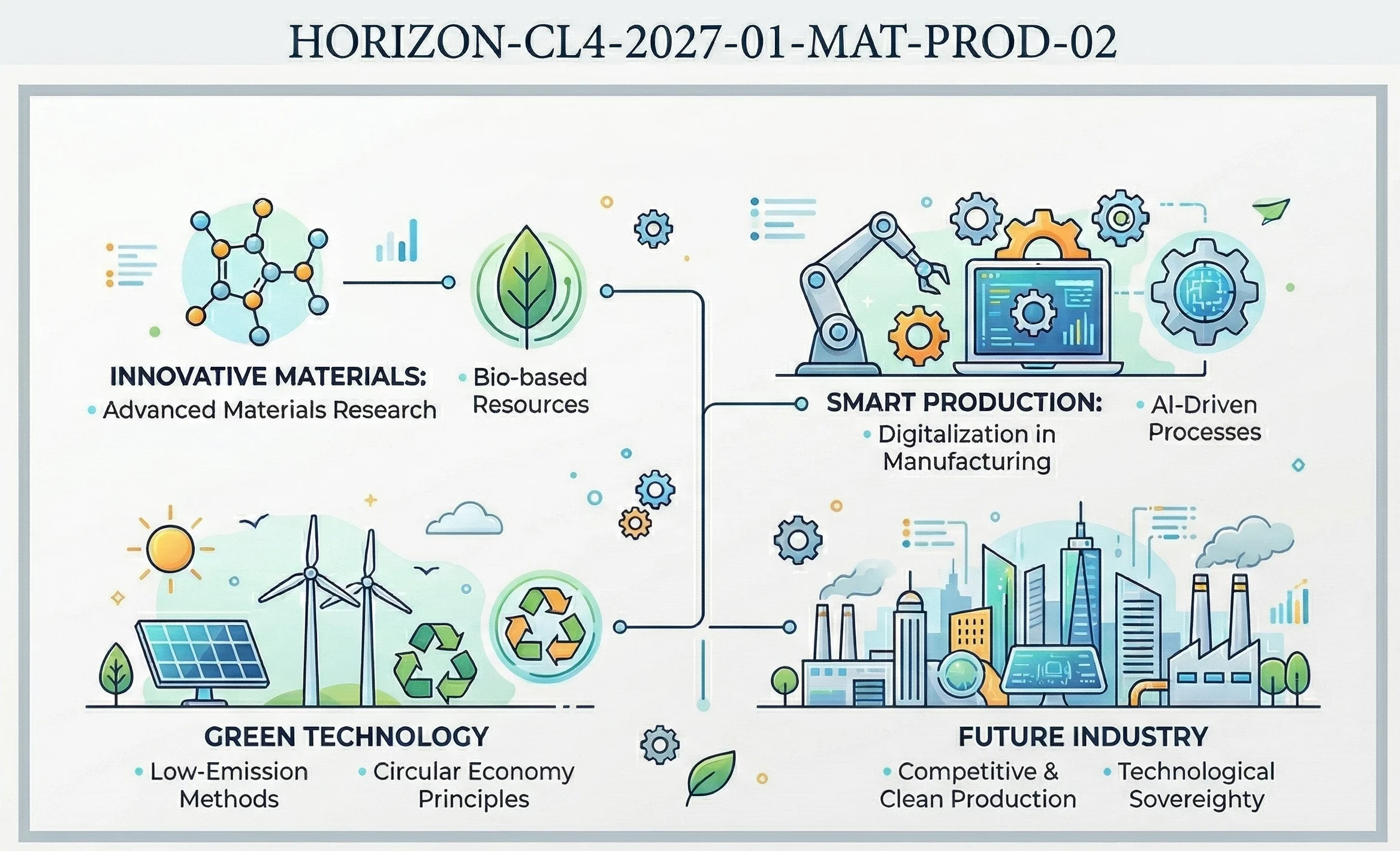
For HORIZON-CL4-2027-01-MAT-PROD-02, this illustrates how manufacturing can create value from secondary materials. The wider challenge is to develop technologies and machinery for high-performance products whose manufacture is at risk in Europe or depends heavily on external supplies. Materials adaptation must serve that manufacturing objective.
Download the MIC Horizon Europe 2026/2027 Calls Calendar:
Discover more!
Administrative facts: what do we know about the HORIZON-CL4-2027-01-MAT-PROD-02 call?
Which call is it, and when is the opening and the deadline?
- Call name: INDUSTRY
- Call identifier: HORIZON-CL4-2027-01
- Destination: Leadership in materials and production for Europe
- Topic: HORIZON-CL4-2027-01-MAT-PROD-02 — Advanced manufacturing for key products (IA) (Made in Europe partnership) (Official topic page)
- Type of action: Innovation Action (IA)
- Opening date: 13 October 2026
- Deadline: 02 February 2027
- Partnership: Made in Europe
What about the budget and estimated size of the project?
- Total indicative topic budget: EUR 36.00 million.
- Indicative number of projects expected to be funded: 6.
- Expected EU contribution per project: EUR 6.00–8.00 million. Proposals requesting different amounts may also be submitted and selected.
What are the key eligibility and evaluation conditions?
- The eligibility conditions in General Annex B apply.
- Additional eligibility restriction: entities established in an eligible country cannot participate if they are directly or indirectly controlled by China or by a legal entity established in China.
- Battery production is explicitly out of scope and is addressed separately under HORIZON-CL5-2026-05-D2-03.
- Technology readiness level (TRL): activities are expected to start at TRL 5 and achieve TRL 7 by the end of the project.
- Proposals should include a business case and exploitation strategy. The proposal page limit is extended by three pages for this purpose.
- Where data and their exchange are relevant, proposals should follow the findable, accessible, interoperable and reusable (FAIR) data principles and adopt appropriate data-sharing standards and practices.
- International cooperation is encouraged, particularly with Japan or Taiwan.
The Digital, Industry and Space work programme sets out the topic’s scope and specific conditions.
Scientific range: what does the Commission expect from the HORIZON-CL4-2027-01-MAT-PROD-02 grant?
What outcomes are expected?
The topic seeks advanced manufacturing technologies and machinery that enable European production of key high-performance components and products. Projects are expected to improve material and energy efficiency, productivity, competitiveness and industrial resilience. Where relevant, circularity should increase through secondary raw materials, and advanced materials should improve product performance and quality.
The targeted products may already be manufactured in Europe: the issue is a risk of losing that manufacturing capability, or dependence on raw materials or parts supplied mainly from outside Europe.
What is within scope?
- Advanced manufacturing technologies and machinery for key high-performance components and products.
- Reducing the use of critical or imported materials through increased use of secondary raw materials, bio-based materials or revalorised components.
- Innovative advanced materials, such as lightweight, functionalised or self-healing materials, adapted to manufacturing applications; materials development should not be the primary focus.
- Where appropriate, digital twins for materials and Safe and Sustainable by Design (SSbD) steps.
- Examples of technologies include innovative additive manufacturing, hybrid manufacturing combining additive and subtractive methods, photonics, advanced joining, polymer composite manufacturing, surface treatment and structuring, lightweight component manufacturing, and in-line testing. The list is not exhaustive.
- Applications in the automotive industry may be considered.
- Battery production, including production for automotive use, is outside the scope.
Which research directions could support the manufacturing objective?
These are possible approaches to select according to the chosen product and manufacturing challenge:
- Develop manufacturing processes and machinery that reduce the use of critical or imported materials.
- Increase the use of secondary raw materials, bio-based materials or revalorised components while meeting the application’s performance requirements.
- Adapt innovative advanced materials to the manufacturing process where they improve product performance or quality.
- Integrate in-line testing where it supports process control and component quality.
- Demonstrate improvements in resource efficiency and productivity against a defined manufacturing baseline.
Scientific strategy: connect manufacturing innovation to industrial need
What scientific choices matter most?
- Define the industrial need. Identify the component or product, its intended use and the manufacturing capability or supply dependency that the project will address. Support this choice with evidence.
- Explain the manufacturing advance. Describe what the proposed process or machinery changes and how this contributes to the expected product performance, resource efficiency or production capability.
- Keep materials development tied to manufacturing. Where advanced materials are needed, explain the adaptations required for the application. Digital twins for materials and Safe and Sustainable by Design (SSbD) steps are possible approaches where appropriate.
- Plan the progression from TRL 5 to TRL 7. Identify the starting evidence, development milestones and final demonstration in an operational environment. Define acceptance criteria suited to the selected technology and product.
- Develop the business case and exploitation strategy. Identify intended users, adoption requirements, production costs, commercialisation routes and the resources needed after the project.
- Measure the expected improvements. Specify baselines, indicators and methods for assessing material use, energy consumption, productivity and product quality.
- Make international cooperation purposeful. Cooperation with Japan or Taiwan is encouraged. Where included, explain the partner’s technical contribution and how it supports the project objectives.
Consortium & proposal-writing plan: what works best with this type of call?
- Build the consortium around the selected manufacturing demonstrator. Combine the expertise needed to develop the process or machinery, manufacture the component and assess its performance in the intended application.
- Choose consortium size and coordination arrangements according to the work plan and applicable participation rules. Assign responsibilities according to each partner’s relevant experience and capacity.
- Involve manufacturers, technology providers, research organisations and component users where their contribution is needed. Include SMEs for specific capabilities that strengthen the technical work or exploitation pathway.
- Define the interfaces between partners: material specifications, equipment requirements, test methods, data exchange and responsibility for accepting the demonstrator’s results.
- Connect the business case to the technical demonstration. Explain the intended market, adoption conditions, cost assumptions and route to exploitation.
- Where international partners contribute, clarify their tasks, access to facilities or data, and arrangements for using project results.
Manufacturing validation: from variable feedstock to usable components
Build the demonstration around a named component and the decision its intended manufacturer or customer needs to make. Define the incoming material specifications, production conditions and component acceptance criteria together. This turns a general circularity ambition into a testable manufacturing proposition.
A useful validation plan compares the proposed process with a relevant production baseline, then tests whether performance is maintained across representative material batches and operating conditions. Select measurements for the application: dimensional accuracy, mechanical behaviour, surface condition or other properties that determine whether the component can perform its intended function. Record rejected parts, rework and finishing operations alongside production output.
Plan the handover between the feedstock supplier, machinery developer and component user. Suggested outputs include an agreed material specification, a verified range of process settings, a component test report and operating instructions. Assign responsibility for each acceptance decision and explain how deviations will be investigated. These are practical design recommendations; the test programme should follow the chosen product and process.
The MIC already brings its expertise in microfluidics to Horizon Europe:
H2020-NMBP-TR-IND-2020

Microfluidic platform to study the interaction of cancer cells with lymphatic tissue
H2020-LC-GD-2020-3

Toxicology assessment of pharmaceutical products on a placenta-on-chip model
About the author

Céleste Chidiac, PhD
Scientific writer and digital marketing specialist
Céleste Chidiac holds a doctorate in neuroscience and molecular biology from the University of Strasbourg. Since joining the Microfluidics Innovation Center in 2023, she has combined scientific writing with website management. For MIC’s Horizon Europe topic pages, she draws on her research background to explain scientific challenges and clarify funding priorities. Her writing helps prospective applicants understand each topic’s scope, expected outcomes and research directions.
FAQ: materials, monitoring and manufacturing validation
These questions address technical choices behind reliable production with secondary and advanced materials.
Does adding recycled material remove dependence on primary inputs?
Not necessarily. A recycled feedstock may still need alloying additions or other inputs to meet the target specification. Wang and colleagues’ aluminium upcycling study, for example, combined scrap with additional alloying materials. Assess the origin and quantity of every input before claiming reduced supply dependence. [1]
Is tensile strength enough to establish component suitability?
No. Select tests for the component’s service conditions. Depending on its use, fatigue, corrosion, wear, temperature resistance or dimensional stability may determine acceptance. A tensile result supports a specific mechanical claim; it does not establish all of these properties.
Can a test coupon qualify a complete component?
A coupon provides evidence for the material and processing conditions it represents. Plan additional checks wherever the component introduces different geometry, surfaces, joints or loading. Connect the specimen results to the finished part’s acceptance criteria instead of treating them as interchangeable.
Does an inline signal prove that a part is defect-free?
No. A process signal needs a validated relationship to the defect or property being assessed. Compare it with suitable reference measurements and establish detection limits and missed-defect rates. The US National Institute of Standards and Technology’s additive-manufacturing metrology programme addresses this relationship between process signatures and finished-part quality.
What separates process monitoring from closed-loop control?
Monitoring observes the process; closed-loop control uses measurements to adjust it. A proposed control system therefore needs an explicit adjustment rule, response-time requirements and operating limits. Validate the resulting part quality as well as the controller’s response.
How should a manufacturing digital twin be validated?
Define the decision it supports, then compare its predictions with independent measurements over the intended operating range. Quantify uncertainty and set acceptable prediction errors. The National Institute of Standards and Technology’s digital-twin programme treats verification, validation and uncertainty as essential to model credibility.
What should happen when a sensor drifts?
Define how drift will be detected, when the sensor must be checked against a reference, and what happens to affected production data. Keep sensor condition separate from process condition so that an instrument change is not automatically interpreted as a material change.
How should resource efficiency be compared between manufacturing routes?
Compare routes that deliver equivalent component function and quality. Count material and energy used for rejected parts, rework and finishing within the stated boundary. For environmental comparisons, the European Commission’s Environmental Footprint methods provide a framework for assessing impacts across the life cycle.
Are bio-based materials automatically safe and sustainable?
No. Biological origin alone does not establish safety or environmental performance. Assess hazards, exposure and impacts across sourcing, manufacture, use and end of life. The European Commission’s Safe and Sustainable by Design framework brings these dimensions into material-development decisions.
How can joining choices affect material recovery?
Include the joint in the recovery assessment. Test whether separation damages reusable components or leaves residues in the recovered material. Evaluate the recovered output against its next intended use; the strength of the assembled joint alone does not establish recoverability.
References
[1] Wang, T., Li, X., Li, Z., Liu, T., Wang, X., Devaraj, A., Powell, C. A., & dos Santos, J. F. Upcycled high-strength aluminum alloys from scrap through solid-phase alloying. Nature Communications, 15, 10664 (2024). https://doi.org/10.1038/s41467-024-53062-2.