
Tips & Tricks for a successful HORIZON-CL3-2027-01-SSRI-01 proposal
Opening
05 May 2027
Deadline
Keywords
Civil Security
SME Innovation
Innovation Action
Cluster 3
Security Practitioners
Technology Transfer
Lump Sum
EU security
open proposals
Your microfluidic SME partner for Horizon Europe
We take care of microfluidic engineering, work on valorization and optimize the proposal with you
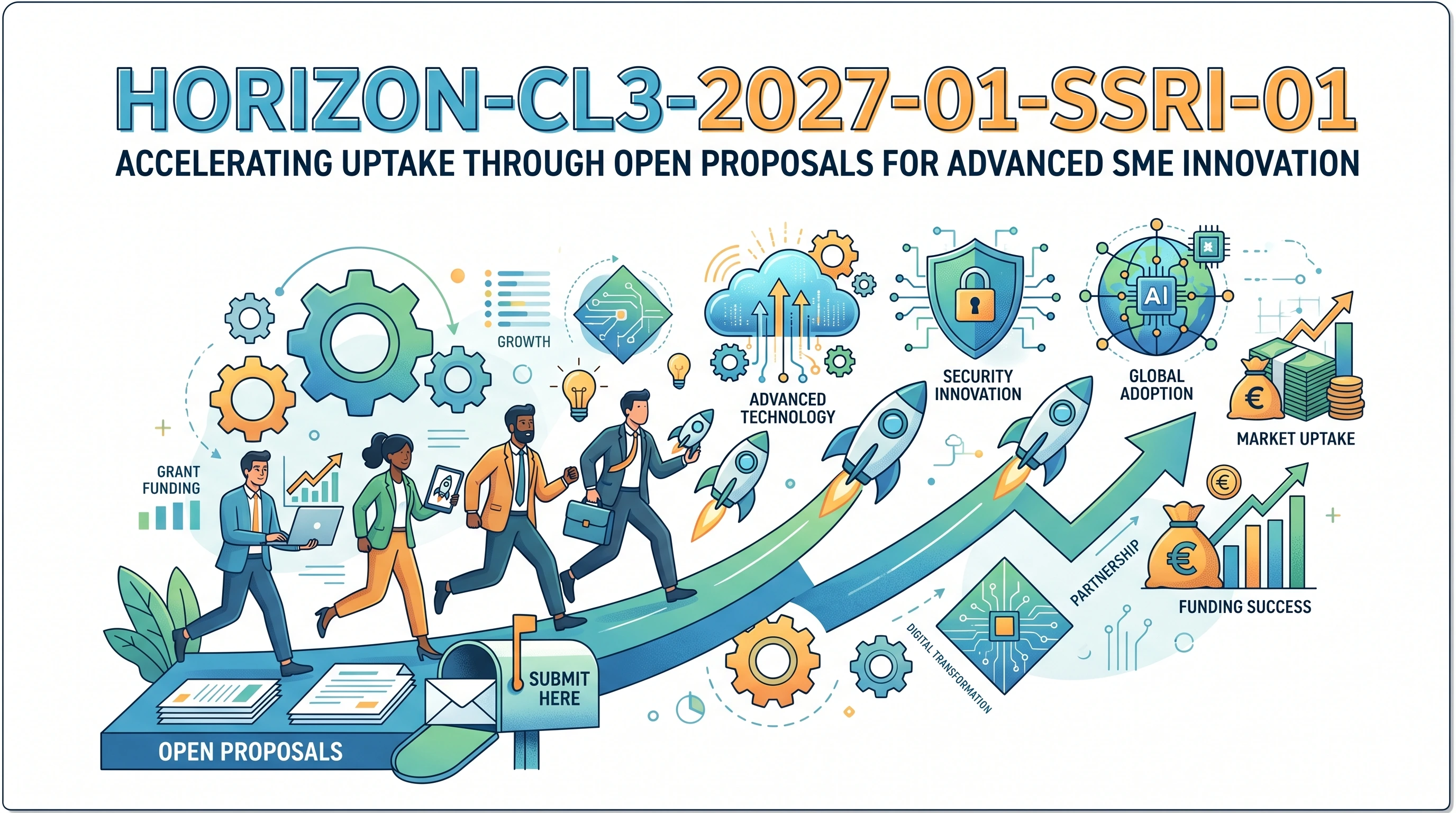
HORIZON-CL3-2027-01-SSRI-01: Accelerating uptake through open proposals for advanced SME innovation
The Commission wants innovative SMEs to get closer to security buyers. That’s the core message here. This topic is not about early research; it’s about taking technology that already works at a reasonable readiness level and pushing it into the hands of the people who actually need it in the field. If you’re a small company with a security product that’s almost market-ready, or a consortium that can build a bridge between SME innovators and civil security practitioners, this call was written for you.
Download the MIC Horizon Europe 2026/2027 Calls Calendar:
Discover more!
Administrative facts: what do we know about the HORIZON-CL3-2027-01-SSRI-01 call?
Which call is it, and when is the opening and the deadline?
- Call name: Civil Security for Society 2027
- Call identifier: HORIZON-CL3-2027-01
- Destination: Strengthened Security Research and Innovation
- Topic: HORIZON-CL3-2027-01-SSRI-01: Accelerating uptake through open proposals for advanced SME innovation
- Opening date: 05 May 2027
- Deadline: 04 November 2027, 17:00:00 Brussels local time
- Type of action: Innovation Action (IA)
What about the budget and estimated size of the project?
- Overall topic budget: EUR 4.50 million
- Number of projects expected to be funded: 3
- Budget per project: around EUR 1.50 million
What are the key eligibility and evaluation conditions?
- Consortium size: minimum 3, maximum 7 partners
- At least 2 SMEs from 2 different EU Member States
- At least 1 end-user organisation in one of four areas: fighting organised crime and terrorism (Option A), disaster-resilient society (Option B), resilient infrastructure (Option C), or border management (Option D)
- At least 50% of the proposed budget must be allocated to SMEs
- Non-SME industries and RTOs can participate, but their share is capped at 15% of the budget
- Entities controlled by China are not eligible (restriction on control in Innovation Actions in critical technology areas)
- Subject to restrictions for the protection of European communication networks
- TRL expected at end of project: 6 to 8
- Eligible costs as lump sum
- Maximum project duration: 2 years
- Proposals exceeding all evaluation thresholds receive a STEP Seal
- If satellite-based services are used, Copernicus and/or Galileo/EGNOS are mandatory
- SME coordinator is encouraged; a non-SME coordinator requires justification
Scientific range: what does the Commission expect from the HORIZON-CL3-2027-01-SSRI-01 grant?
What outcomes are expected?
By the end of the project, the Commission wants to see a mature technological solution that addresses a real security policy priority within Cluster 3’s scope. But the deliverable is not just a product. They also expect evidence that the collaboration between SMEs, research partners, and academia has produced real knowledge transfer and that the SMEs involved are better positioned to access new markets and new financing. In so many words, the project should leave the SMEs stronger, not just the technology more advanced.
What is within scope?
- Mature technological solutions (TRL 6 to 8) that address EU security priorities across all four Cluster 3 destinations: crime and terrorism, disaster resilience, border management, resilient infrastructure
- Cross-border collaboration between SMEs from different Member States, building joint capacity around a shared security challenge
- End-user validation: security practitioners must be involved as validators and, ideally, as first adopters of the innovations proposed
- Technology transfer schemes between small companies and RTOs or larger industrial players, provided the focus stays on supporting the SMEs and not on the RTO’s own development agenda (worth reading that condition twice)
- Business-side activities: assimilating market requirements, approaching potential public buyers, assessing the competitive landscape, supporting innovation management, IP management and exploitation, planning for expansion into future markets
- Synergies with CERIS activities and other EU or national programmes are encouraged but not mandated
One thing the call is not after: basic research. Proposals that position themselves at low TRL or that present the innovation as still in the lab won’t fit here.
What are the specifically proposed research directions?
The work program keeps this deliberately open. There are no named technologies or predefined security challenges. What the commission is pointing toward, when you read between the lines:
- SMEs bringing security products from prototype stage toward operational deployment, validated by at least one real end-user organisation
- Collaborative models that help small innovators overcome the specific barriers of the security market (procurement red tape, limited customer access, IP issues in regulated markets)
- Solutions that address the diverse needs of citizens regardless of gender, age, or ability, which is a Commission priority across the entire SSRI destination
- Projects that combine product development with innovation management and market strategy, not just technology push
Scientific strategy: how can you enhance your chances of being funded through HORIZON-CL3-2027-01-SSRI-01?
What scientific choices matter most?
- Pick a security domain with a visible procurement gap. Evaluators will respond better to proposals that name the gap and explain why current market offerings don’t fill it, even briefly.
- Show the end-user validation path early. Don’t wait until WP5 to involve your practitioner partner. We’ve seen proposals scored down because end-user involvement looked like an afterthought.
- Keep the RTO role supportive, not central. The work program says it explicitly: RTOs should accelerate technology transfer for the SMEs, not pursue their own development. If an RTO dominates the work plan, that’s a red flag.
- Frame the innovation management activities as concrete milestones. IP strategy, market access plan, competitive positioning: these are not side tasks here; they are core deliverables.
- Address the lump sum format from the start. Your work packages need to be clearly scoped and deliverable-bound, because adjustments mid-project are harder under lump sum rules.
- TRL 6 to 8 means demonstrating in a relevant or operational environment. If your technology is below TRL 5 today, this call probably isn’t the right fit.
- Gender and diversity in design: the Commission expects your solution to consider the diverse needs of users. A sentence or two showing you’ve thought about accessibility or gender-specific operational needs goes a long way.
Consortium and proposal-writing plan: what works best with this type of call?
- Consortium of 3 to 7 partners. Given the EUR 1.50 million budget, we’d say four or five is the sweet spot. Enough to cover cross-border collaboration and small enough to keep management costs reasonable.
- Two SMEs minimum, from two different member states. But three SMEs is better, because it strengthens the SME-innovation narrative and gives you more flexibility with the 50% budget rule.
- One practitioner partner is mandatory. If you can include two (from different security domains), your end-user engagement story becomes much more convincing to evaluators. Think law enforcement agencies, border guards, civil protection organizations, and critical infrastructure operators.
- If you bring in an RTO or a non-SME industry partner, keep their budget share well under the 15% cap. Evaluators will check this carefully.
- An innovative SME as coordinator sends the right signal for this topic. The work program encourages it. If you place a non-SME as coordinator, you’ll need a written justification, and evaluators will read it with some skepticism.
- Write the proposal in a way that foregrounds the market problem and the deployment pathway. This is an innovation action with a business acceleration mindset. Your impact section should read like a go-to-market plan, not like a research agenda.
- On top of all that, budget 2 to 3 days for aligning your lump sum costing. Mistakes in the financial annex are common with lump sum IAs, especially for first-time applicants.
How would microfluidics contribute to this topic?
Civil security is one of those fields where conventional detection and diagnostic tools are large, slow, or stuck in a lab somewhere. Microfluidics changes that equation. You get portable platforms that run field-level analyses in minutes instead of hours, with minimal training required from the operator.
- Say you’re developing a field-deployable sensor for chemical hazard identification at a disaster site. A microfluidic chip can process air or liquid samples on the spot, giving first responders an answer before the hazmat team finishes suiting up. That kind of speed matters when people are evacuating.
- Border security applications: document fraud detection, trace-level substance screening, or biometric sample processing. A microfluidic device runs the assay at the checkpoint; there is no need to send samples back to a central laboratory and wait for results.
- For CBRN threats, microfluidic platforms can handle multiplexed detection of biological or chemical agents from a single sample. The device fits in a case, the consumables are cheap, and you get consistent results across operators.
- Water and food safety monitoring at critical infrastructure sites. Conventional testing means taking samples, shipping them, and waiting days. A microfluidic system gives you same-day data, and your infrastructure operator can act on it before a contamination event spreads.
Your consortium could position a microfluidic SME as a technology provider, with an end-user organization validating the platform in operational conditions. This fits the call’s emphasis on SME-driven innovation that solves a real practitioner need. The Microfluidics Innovation Center, as an innovative SME with direct experience supporting Horizon Europe proposals in this exact space, brings both the technical platform and the consortium-building track record that this kind of compact project needs.
The MIC already brings its expertise in microfluidics to Horizon Europe:
H2020-NMBP-TR-IND-2020

Microfluidic platform to study the interaction of cancer cells with lymphatic tissue
H2020-LC-GD-2020-3

Toxicology assessment of pharmaceutical products on a placenta-on-chip model

FAQ – HORIZON-CL3-2027-01-SSRI-01
What is the HORIZON-CL3-2027-01-SSRI-01 call about?
The present call will finance mature SME-led security innovations at TRL 6-8 and connect innovative SMEs with civil security practitioners across all four destinations of Cluster 3. The aim is not research output but technology uptake
Who is eligible and what consortium is required?
What is the budget per project and how many will be funded?
The total budget is EUR 4.50 million, and 3 projects are planned to be financed, with funding of around EUR 1.50 million per project over a period not exceeding 2 years. The costs are financed in a lump sum.
What TRL is expected at the end of HORIZON-CL3-2027-01-SSRI-01?
The end result should be projects at TRL 6 or 8. TRL 6 to 8 is an implication of demonstration in a working or relevant setting. Unless your current technology level is TRL 5 or higher, this is not the call that you want.
Can a non-SME coordinate the consortium?
An SME coordinator is promoted by the work program. When you have a non-SME as a coordinator, you will be asked to write a justification, which will be read by the evaluators with a certain degree of suspicion.
What role should end-user organisations play?
Security practitioners must be validators and hopefully the first people to accept the innovations being proposed. Do not postpone your inclusion of your partner practitioner until WP5; end-user involvement should not seem like something thrown in at the end.
How does the lump sum modality affect proposal writing?
Your work packages should be scoped and deliverable-bound as it is more challenging to amend lump sum rules. Give your lump-sum costing 2 or 3 days to coordinate. The lump-sum IAs are linked with inaccuracies in the financial annex, especially when first-time applicants are involved.
What does the 50% SME budget allocation rule mean in practice?
SMEs should be allocated at least half of the proposed budget. Non-SME industries and RTOs are allowed to participate, but not exceed 15% of the budget. This should be done up front, before the building work packages are drawn up.
Is microfluidics relevant for this call?
Yes. Traditional detection and diagnostic devices within civil security are usually large or limited to a lab. Field-level analysis can be performed in minutes using portable microfluidic platforms. It is used for chemical hazard screening, CBRN threat screening, border security, and critical infrastructure monitoring.
What makes a strong impact section for this Innovation Action?
The impact section should be a go-to-market plan, rather than a research agenda. The Commission also requires that the partnership has resulted in actual knowledge transfer and that SMEs are left stronger, not merely with more advanced technology.