
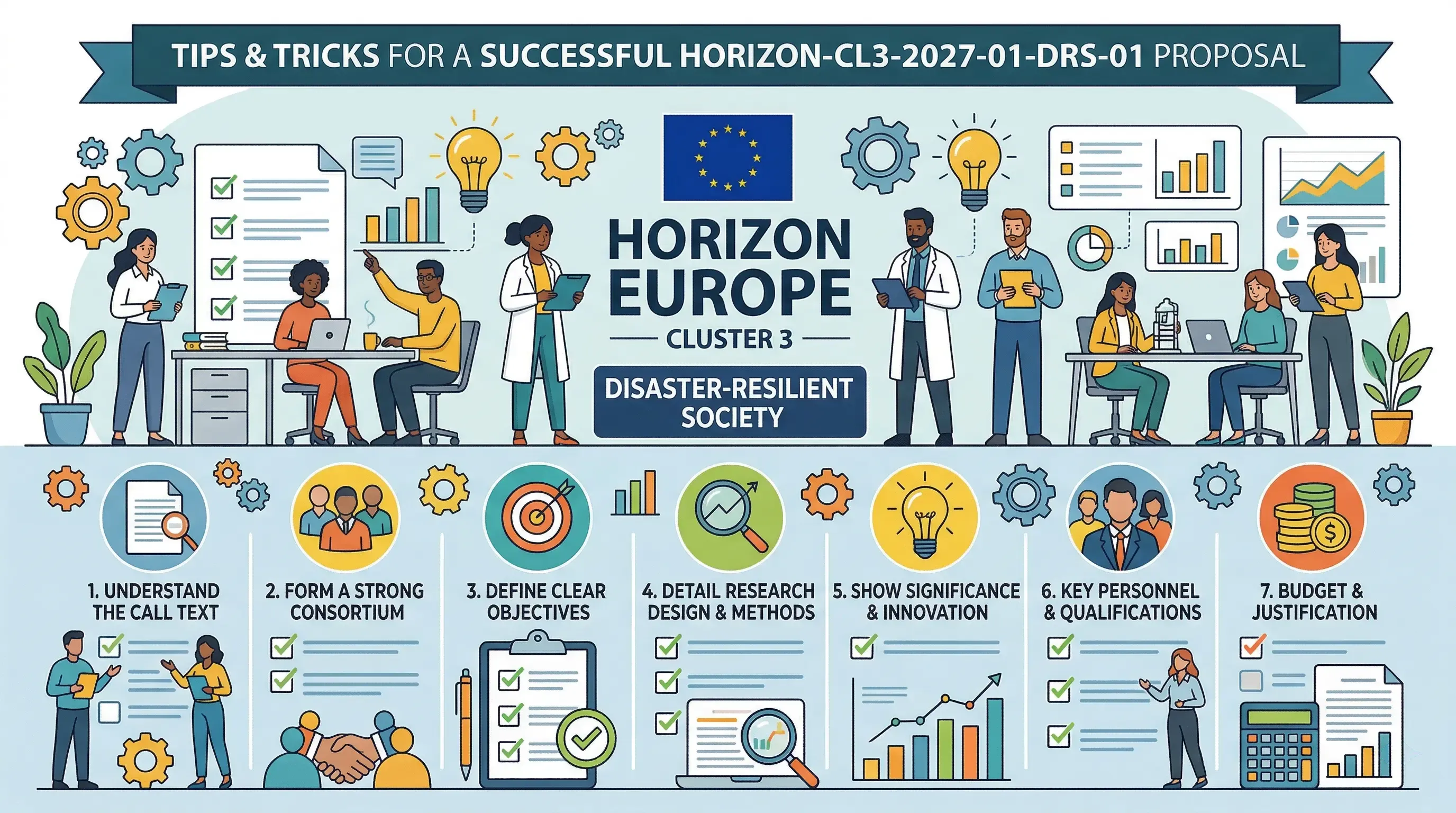
Tips & Tricks for a successful HORIZON-CL3-2027-01-DRS-01 proposal
Opening
05 May 2027
Deadline
Keywords
protective equipment
IA
Disaster response gear
Emergency responder equipment
Smart PPE
CBRN protection
resilient society
hazard detection
Your microfluidic SME partner for Horizon Europe
We take care of microfluidic engineering, work on valorization and optimize the proposal with you
HORIZON-CL3-2027-01-DRS-01: Open Topic on advanced protective equipment (optimized to CBRN-E (Chemical, Biological, Radiological, Nuclear, Explosives) handling and operation) and the next generation of smart protective equipment against disaster responders
The Commission desires new generation protective equipment that is actually used in CBRN-E conditions. Not a more bulky suit or a more effective filter, but equipment that thinks as well as the responder: detects threat in real time, checks the condition of the person wearing it, and relays information back to command. This is an Innovation Action, so there are prototypes near to the market, with tested practitioners.
Download the MIC Horizon Europe 2026/2027 Calls Calendar:
Discover more!
Administrative facts: what do we know about the HORIZON-CL3-2027-01-DRS-01 call?
Which call is it, and when is the opening and the deadline?
- Call: Civil Security for Society 2027 (HORIZON-CL3-2027-01)
- Destination: Disaster-Resilient Society for Europe
- Topic: HORIZON-CL3-2027-01-DRS-01
- Opening date: 05 May 2027
- Deadline: 04 November 2027
- Type of action: Innovation Action (IA)
What about the budget and estimated size of the project?
- Overall indicative budget for the topic: EUR 7.67 million
- Number of projects expected to be funded: 2
- Budget per project: around EUR 3.835 million
What are the key eligibility and evaluation conditions?
- Consortium must include as beneficiaries at least 2 Training Centres located in EU Member States or Associated Countries, plus at least 2 practitioners involved in training, validation and testing of CBRN-E tools and technologies from at least 2 EU MS or Associated Countries
- If satellite-based observation or positioning data is used, beneficiaries must use Copernicus and/or Galileo/EGNOS
- TRL expected at end of project: 7-8
- Eligible costs take the form of a lump sum
- Granting authority may object to transfer of ownership or exclusive licensing of results up to 4 years after end of action
- Security sensitive topic: some activities may involve classified background and/or producing security sensitive results (EUCI and SEN)
- Standard thresholds apply (General Annex D)
Scientific range: what the Commission expects from the HORIZON-HLTH-2026-01-DISEASE-03 grant
The work programme is clear concerning what it’s after. This concerns no fringe benefits to current suits. The Commission desires CBRN-E protective equipment to be ground-on-the-ground designed. And to go with it, an entire new line of intelligent equipment.
What that means concretely:
- New materials and design elements that enhance safety whilst maintaining the comfort and mobility of the responder (the work programme claims: inclusive and user-centric approach, which means: gear that works with all body shapes, all ability levels)
- Real-time situational awareness, automated hazard detection, environmental monitoring, and communication
- Intelligent, dynamic solutions able to dynamically respond to the threat as it changes. Consider sensors that are fed back to the suit itself, not necessarily to the control room.
- Adherence to safety standards, and with proven increases in comfort, ease of use and responsiveness
Proposals are also required to generate a stakeholder or market analysis and an uptake roadmap. The Commission specifically requests you to consider the gaps in the capacity of the UCPM and the rescEU strategic reserve. Unless you relate your prototypes to the actual work requirements, you will lose marks.
Worth flagging: it should be proposed to develop on the work done elsewhere within the Horizon Europe Cluster 4. The Commission does not want you to begin at the bottom. Preparedness Union Strategy is mentioned as an important source. KAPP operational grants synergies are encouraged.
Scientific strategy: How can you enhance your chances of being funded through HORIZON-HLTH-2026-01-DISEASE-03?
Which scientific decisions are the most important?
- Aspire to integrated demonstrators, not component studies. At TRL 7-8, assessors intend to have an operating system that has been tested under near-operational conditions.
- Select a sub-domain of CBRN-E and dive in. Proposals that make an attempt to balance the five types of threat end up being thin. Pay attention to one or two and demonstrate that you have mastered the operating reality.
- It has a tight budget with EUR 3.835 million per project. Choose carefully the demonstrators you construct. Two highly validated prototypes triumphed over six half-baked ones.
- Make the user-centric design visible. Provided your consortium has ergonomics or human factors researchers, mention this early. Evaluators will look for it.
- Tie your roadmap to actual procurement avenues. The Commission would like your prototype to have a line to the rescEU reserve or a national procurement programme. No vague exploitation plans will do.
- And remember the data dimension. When your gear generates data, demonstrate how it is shared with command-and-control systems that are actually in use by responders.
Consortium & proposal-writing plan: what works best with this type of Health RIA?
- On a IA of EUR 3.835 million take between 8 to 12 partners. Smaller, and you are unable to cover the necessary practitioner activity. Bigger, and you’ll waste money in organization.
- The eligibility criteria is that there must be at least 2 Training Centres and 2 CBRN-E practitioners in no less than 2 countries. This is no box to be filled in at the eleventh hour. These partners must influence the use cases at the beginning.
- Innovation comes to fabrics, sensors, coatings in material science laboratories or technical universities. At minimum one of your partners must have a history of involvement in protective equipment production. A new SME dealing with wearable sensors or smart fabrics provides an air of authenticity to the uptake plan.
- Provided that your consortium also contains a civil protection authority or fire brigade training centre, you not only have eligibility but a credible test environment as well.
- Seeing that it is a security sensitive part, ensure that all partners are able to process EUCI/SEN classified information. This comes as a surprise to people, particularly smaller organisations.
- Lump sum format implies that your financial planning must be lean before you submit it. Realistically budget the work packages. We would say that this is where most CL3 proposals falter.
- With regards to writing, lead with the gap of operation. What can responders not do today due to equipment failure? Then demonstrate how your solution will bridg that gap.
How would microfluidics contribute to this topic?
The existing CBRN threat detection equipment is often too bulky, slow, or detects only a single type of agent. Microfluidic technology alters the balance: on a chip smaller than a suit or wristwatch, the complete analytical chain: collection of the sample, sample preparation, detection, readout, all in a chip.
- Suppose your responder is in an area where an agent has been suspected, but the chemical is not known. The gear has a microfluidic sensor array that can perform a number of simultaneous assays on air or skin swab samples within minutes. No waiting for a remote lab.
- Screening of biological agents in the field. Traditional biodetection kits involve manual procedures and personnel. The entire workflow is automated by using a microfluidic cassette. That is all you need to do: load the sample, and the chip does the rest. And you get twice the same answer, since the fluidic paths are not made up, but made out.
- The continuous physiological monitoring of the wearer is also possible on microfluidic platforms. A chip with a sensor that measures the amount of sweat can be used to monitor stress indicators, dehydration or even toxic exposure biomarkers in real-time.
- Small footprint sensor fusion. Chemical and biological detection channels can be integrated on the same chip, a feat that would be difficult with conventional instruments, which would add bulk.
With a proposal intended to focus on HORIZON-CL3-2027-01-DRS-01, microfluidics fills the gap between passive protection and active threat intelligence incorporated within the gear. The technology brick that your consortium acquires is something that can be traced by evaluators, to a work programme requirement, a demonstrable prototype, which is precisely what a TRL 7-8 Innovation Action requires.
The MIC already brings its expertise in microfluidics to Horizon Europe:
H2020-NMBP-TR-IND-2020

Microfluidic platform to study the interaction of cancer cells with lymphatic tissue
H2020-LC-GD-2020-3

Toxicology assessment of pharmaceutical products on a placenta-on-chip model

FAQ - HORIZON-CL3-2027-01-DRS-01
What is this call about, in one sentence?
The Commission desires near-market smart protective gear that will actively assist CBRN-E responders in sensing danger, tracking their own conditions, and communicating in real time, rather than a superior passive suit.
What type of action is it, and why does that matter?
It is a type of Innovation Action (IA). That difference is a weight to bear:
- It has to be a prototype, rather than research-driven work.
- At project end, TRL 7 to 8, i.e., field-tested demonstrators, is expected.
- Evaluators will censure those proposals that remain at the component or concept stage.
What are the key dates and budget figures?
- Opening date: May 5, 2027
- Deadline: November 4, 2027
- Overall indicative budget: EUR 7.67 million.
- Projections of projects: 2.
- Budget per project: around EUR 3.835 million.
Who must be in the consortium to pass eligibility?
There are two things that are not negotiable:
- Minimum of 2 Training Centers in EU Member States or Associated Countries.
- At least 2 CBRN-E trainers, validators, and testers, at least 2 of which are of at least 2 EU MS or Associated Countries
The two types must exist as formal beneficiaries, not merely as advisors.
Are there any other eligibility conditions worth flagging early?
Three aspects that teams should not forget about:
- Using satellite data, the sources must be Copernicus and/or Galileo/EGNOS.
- Any partners involved in security-sensitive outputs should have the capability to handle EUCI and SEN classified information; smaller organizations should ensure this is checked at the very beginning.
- The funding is in the form of a lump sum thus, funding must be sound prior to submission and not after.
What concrete outcomes is the Commission looking for?
The work program identifies four families of deliverables:
- Emerging materials and design features that enhance safety, and do not compromise mobility or comfort, in a specifically inclusive and user-focused manner.
- Situational awareness — automated hazard detection, environmental monitoring and communication built into the gear.
- Dynamic, adaptive solutions – sensors that feed back into the suit itself, not just to a remote control room.
- Proven compliance with safety requirements, as well as objective changes in ease of use.
What strategic choices will separate competitive proposals from weak ones?
- Not an isolated component study, but Target TRL 7-8 with integrated demonstrators.
- Focus on less: select one or two types of CBRN-E threats and learn them – dividing them up and making them all thin.
- Two well-proven prototypes will score higher than six half-developed prototypes with a limited sum of EUR 3.835 million.
- Develop the user-centric design argument, not as an afterthought.
- Connect the exploitation roadmap to actual procurement channels – rescEU reserve or national procurement programs – fuzzy plans will cost points.
What is the ideal consortium shape and size?
- The recommended number of partners for this budget level is 8 to 12.
- The basic scientific capability must be provided by materials science laboratories or technical universities with a history of protective equipment.
- An SME involved in the creation of wearable sensors or smart fabrics helps lend the uptake plan some credibility.
- An eligibility asset and a credible test environment are a civil protection authority or a fire brigade training center.
- Early naming should be done for human factors or ergonomics researchers who will seek them.
How should proposals connect to the broader EU policy framework?
This is expressly requested by the Commission. Three references matter:
- Recognize the capacity limitations of UCPM (EU Civil Protection Mechanism) and rescEU strategic reserve.
- Continue on the previous work (Horizon Europe Cluster 4) – do not reinvent the wheel.
- Consider the Preparedness Union Strategy and discuss synergies with KAPP operational grants.
What does the data dimension require?
When your smart equipment produces data (which it will), assessors will demand a straightforward response to a question: how does that data get to the command-and-control systems that will be the reality on the ground by responders? An independent, non-integrated sensor is not a competitive solution.
Where does microfluidics fit into this call?
Microfluidics helps address one of the fundamental weaknesses of existing CBRN detection equipment: bulkiness, slow response time, and single-agent capability. Concrete contributions include:
- On-chip chemical or biological detection, multiplexed and directly incorporated into the suit or a wristband-sized device.
- Biological screening of agents is performed automatically through microfluidic cassettes, eliminating manual operations and errors.
- Constant physiological surveillance of the wearer – stress markers, dehydration, or poison exposure biomarkers – via sweat sensors.
- Single-chip sensor fusion, integrating chemical and biological detection channels without increasing bulk.
All these are directly related to a specified work program requirement, which is precisely what a TRL 7-8 IA assessor wants to observe.
What is the one writing mistake that will almost certainly cost a team funding?
Going technical and methodological before stating the operational gap. Evaluators read fast. The reasoning should be apparent on the very first page:
- What can responders fail to do today due to the failure of equipment?
- In what way does your prototype address that?
- Who, in what circumstances, and to what standard was it tested?
Instead of burying those answers in Section 3, proposals that do so lose the reader before they do so.