
Tips & Tricks for a successful HORIZON-CL3-2027-01-BM-03 proposal
Opening
05 May 2027
Deadline
Keywords
Cluster 3
Border security
Customs
RIA
Cargo inspection
CBRN-E detection
Illicit trafficking
Your microfluidic SME partner for Horizon Europe
We take care of microfluidic engineering, work on valorization and optimize the proposal with you
HORIZON-CL3-2027-01-BM-03: Detection and characterization of threats or illegal/smuggled goods in cargo
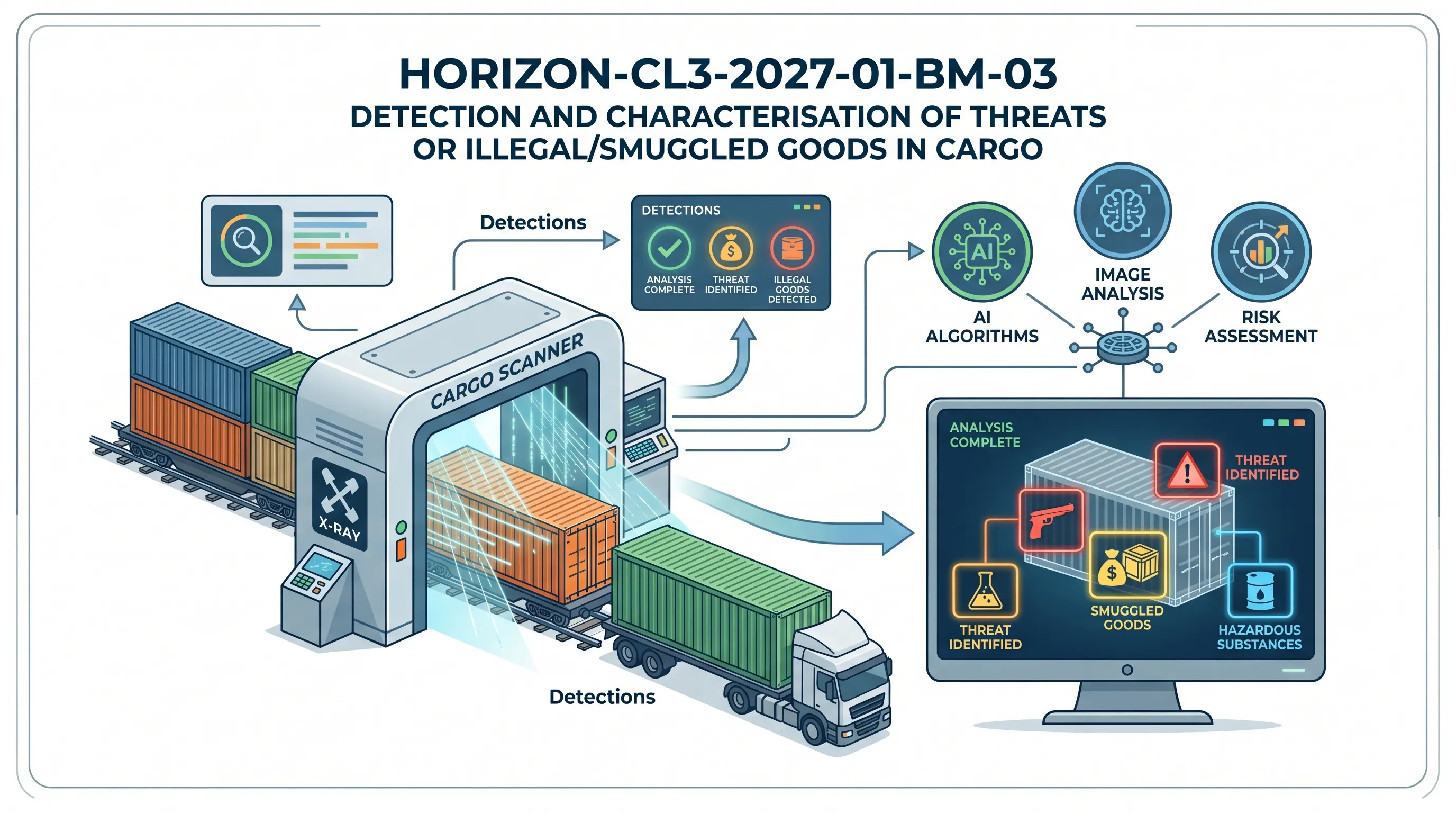
Every day, millions of containers move through European ports, airports, and logistics hubs. Organized crime hides inside that flow. This call is the Commission’s attempt to give customs authorities the tools to find threats without grinding trade to a halt. The Commission wants field-ready detection and characterization systems, not lab prototypes, and the mandatory involvement of customs practitioners from at least two Member States makes that operational intent very clear.
Download the MIC Horizon Europe 2026/2027 Calls Calendar:
Discover more!
Administrative facts: what do we know about the HORIZON-CL3-2027-01-BM-03 call?
Which call is it, and when is the opening and the deadline?
- Call name: Civil Security for Society 2027
- Call identifier: HORIZON-CL3-2027-01
- Destination: Effective management of EU external borders
- Topic: HORIZON-CL3-2027-01-BM-03 – Detection and characterization of threats or illegal/smuggled goods in cargo
- Opening date: 05 May 2027
- Deadline: 04 November 2027 at 17:00 Brussels time
- Type of action: Research and Innovation Action (RIA)
What about the budget and estimated size of the project?
- Total indicative budget: EUR 14.00 million
- Indicative number of projects: 4
- Expected EU contribution per project: around EUR 3.50 million
What are the key eligibility and evaluation conditions?
- At least 2 Customs Authorities from at least 2 different EU Member States or Associated Countries must be active beneficiaries (not just associated partners)
- Subject to restrictions for the protection of European communication networks
- If satellite data is used, only Copernicus and/or Galileo/EGNOS is permitted (other sources may supplement)
- Target TRL: 4 to 5 by project end
- Two options must be explicitly selected: Option a (security of cargo) or Option b (detection of smuggled/trafficked goods or materials in cargo)
- Portfolio rule: at least one grant awarded to the highest-ranked proposal in each option, provided it passes all thresholds
- Financial support to third parties allowed, capped at EUR 100,000 per third party
- Security-sensitive topic: classified background and sensitive results may be involved
Scientific range: what does the Commission expect from the HORIZON-CL3-2027-01-BM-03 grant?
What outcomes are expected?
By the end of the project, the Commission wants working detection and characterization systems tested across at least one transport mode—maritime, air, postal, road, or rail—and validated in real supply chain conditions. The point is not a sensor. Customs authorities should be able to pick up the result and start thinking about deployment. Interoperability with existing customs systems and with systems used by other Member States is part of the required picture.
What is within scope?
The call covers both Option a (cargo security broadly) and Option b (smuggled or trafficked goods), so the scope is wide. Note that proposals must pick one option—covering both simultaneously is not the intent.
- Explosives, incendiary devices, and CBRN-E materials or their precursors in cargo
- Illicit drugs and drug precursors
- Trafficked weapons
- Illegally traded wildlife species (CITES-protected) and deforestation-linked products
- Contraband and smuggled consumer goods (cigarettes, F-gases, etc.)
- Illegally traded cultural property
- Detection technologies: sensors, non-intrusive inspection, automated threat recognition, AI-driven screening
- Tracking and tracing systems, distributed ledger technologies, smart active systems
- Air and maritime cargo environments specifically, though land, postal, and rail are also acceptable
- Reducing response time between sampling and expert assessment when container opening is required
What are the specifically proposed research directions?
The work program does not spell these out in detail, which gives you some framing flexibility. That said, from what we read between the lines, evaluators are being pushed toward:
- Developing scalable, mobile customs equipment that can be deployed at multiple border crossing points without major infrastructure changes
- AI-driven automated threat recognition that reduces the need for manual inspection
- Interoperability with existing European customs systems and future cross-border information-sharing environments
- Faster characterization workflows—especially for biological materials or species that currently require lab confirmation after container opening
- Supply chain tracking from load to delivery, not just point-of-entry detection
- Cross-agency data sharing and evidence-collection pipelines that support criminal prosecution downstream
Scientific strategy: how can you enhance your chances of being funded through HORIZON-CL3-2027-01-BM-03?
What scientific choices matter most?
- Choose your option explicitly and early: Evaluators are scoring Option a and Option b separately. A proposal that hedges between the two looks unfocused. Pick the one your consortium is best equipped to address.
- Frame everything around what customs officers can actually do with the result: A TRL 4-5 target means you need to demonstrate function in a relevant environment, not just in controlled lab conditions. Reviewers will look for realistic test scenarios at actual cargo inspection points.
- Cover more than one type of threat: The work program says detection capabilities should target “one or more” types of dangerous goods. Single-threat proposals are allowed but less likely to be funded if competing proposals offer broader coverage at similar cost.
- Interoperability is not optional: Solutions must be compatible with existing customs equipment and with systems deployed across different Member States. Design this in from the start, not as a late integration task.
- Address the environmental angle: The work program explicitly requires that solutions contribute to energy and cost efficiency. Air cargo solutions must not incentivize higher-emission transport modes. We’ve seen this kind of requirement trip up proposals that ignored the sustainability framing entirely.
- Build your evidence pipeline: Tracking and tracing that produces data usable in investigation and prosecution is a specific outcome the Commission names. If your consortium includes legal or forensics expertise, make that visible in the proposal.
- Don’t underestimate the financial support to third parties mechanism: It exists to bring in additional national customs authorities for testing and validation. Use it.
Consortium & proposal-writing plan: what works best with this type of call?
- Somewhere between ten and fourteen partners, maybe a few more if cross-border validation activities require broader customs coverage. This is an RIA with four expected projects and a relatively focused budget per project, so lean toward efficiency over size.
- Two customs authorities are the floor, not the ceiling. Having three or four customs agencies from different countries signals genuine cross-border operational intent.
- Technology providers are central here—detection systems, AI platforms, and sensor hardware. You need at least two or three industrial or SME partners with actual product development capability, not just research groups building demonstrators. Including an innovative SME with field-relevant detection technology would strengthen the proposal considerably.
- Research and technology organizations can cover the AI, data fusion, and sensor integration layers.
- A legal or forensics partner adds value if you are building evidence-collection pipelines.
- If you’re in Option b (smuggled goods), consider whether a CITES-related authority or an environmental crime unit could serve as a practitioner stakeholder. The Commission named wildlife trafficking explicitly.
- On writing: the evaluation will look hard at the operational scenario. Don’t write the scientific work package in isolation. The customs practitioners in your consortium need to validate the operational assumptions in the proposal itself, not just show up to test things in year two. Show that feedback loop early.
- The mid-term practitioner assessment is a required deliverable — plan it explicitly in your work plan.
What role would microfluidics play in this subject?
Standard bulk scanning—X-ray, gamma imaging, trained sniffer dogs—works for large concealed quantities. But organized crime has gotten better at small-quantity concealment, and the real challenge now is rapid identification of trace amounts without slowing down the freight. That’s exactly where microfluidics fits in.
- Say customs officers open a container flagged by a scan. They suspect fentanyl precursors, or a CITES-protected species product. Right now, confirmation often means sending a sample to a lab and waiting. A microfluidic field analysis cartridge can run that confirmation at the inspection point in minutes. Your consortium could integrate that capability directly into the detection-to-characterization workflow.
- For liquid and powder contraband (drug precursors, F-gases), lab-on-chip platforms enable chemical fingerprinting at concentrations that conventional field tests miss. Same compound, different dilution, same answer.
- Miniaturized biosensors built on microfluidic substrates are well-suited to detecting protein-based markers from biological materials—including protected species or products banned under deforestation regulations. This is an underexplored angle for option B proposals.
- Environmental monitoring of cargo hold air is another use case. Microfluidic gas-phase sensors can continuously sample air in sealed containers for volatile markers from drugs, explosives, or degrading biological materials—without opening anything.
- The portability argument matters here too. Microfluidic systems are small, low-power, and easy to deploy at mobile customs units. The call specifically asks for mobility and agility of customs resources. That’s a practical advantage your consortium can make concrete.
In the case of HORIZON-CL3-2027-01-BM-03, microfluidics is not a problem-solving technology. The issue is posed by the call for faster, more precise characterization at the border, without disrupting legitimate trade. MIC‘s experience in field-deployable detection systems makes it a credible partner for any consortium tackling the challenge through either Option A or Option B.
The MIC already brings its expertise in microfluidics to Horizon Europe:
H2020-NMBP-TR-IND-2020

Microfluidic platform to study the interaction of cancer cells with lymphatic tissue
H2020-LC-GD-2020-3
Toxicology assessment of pharmaceutical products on a placenta-on-chip model

FAQ – HORIZON-CL3-2027-01-BM-03
What is this call really about?
The Commission desires detection and characterization systems that operate at actual cargo inspection points. Ports, airports, road crossings, postal hubs, rail. The idea is to enable the customs officials to identify threats and contraband goods without stopping trade. It is not a sensor-paper call. It is a cry of instruments that can be picked and used.
Who needs to be in the consortium for the proposal to be eligible?
You must have two Customs Authorities in at least two different EU Member States or Associated Countries and must be active beneficiaries and not just associated partners. Practically, three or four customs agencies render the cross-border intent a reality among evaluators.
What is the difference between Option a and Option b?
Option A encompasses the security of cargo in general. Option B involves the detection of smuggled or trafficked goods or materials in cargo. You must choose one and devote yourself to it. Bid proposals hedging in either direction tend to appear disoriented to the reviewers. The portfolio rule ensures that there is at least one grant per option, provided the thresholds are met.
What TRL does the Commission expect by project end?
Demonstrate TRL 4-5 by the end of the project. Lab validation is not sufficient. The Commission desires pilot-ready equipment to be tested under actual supply chain conditions on at least one of the transport modes in the topic.
Which threats and goods fall within the scope?
The list is wide: CBRN-E materials and precursors, explosives, drugs and drug precursors, trafficked weapons, CITES-protected species and products related to deforestation, counterfeit consumer goods (such as cigarettes and F-gases), and the illegal trade of cultural property. The table-based detection technologies comprise sensors, non-invasive inspection, AI-based screening, and distributed ledger tracking. Check the Funding and Tenders Portal for more information.
How does microfluidics fit into a border-security topic?
Detection of suspicious substances in the present day typically involves sending a sample to a laboratory and waiting. That confirmation can be done in minutes at the inspection point by a microfluidic cartridge. Similar to trace detection of drug precursors, F-gases, or species-specific biological markers. The portability and low power consumption also correspond with the Commission’s request for mobile customs resources.
What role should an innovative SME play in the consortium?
A product mindset is what an innovative SME typically lacks: research groups. Hardware detection, sensor integration, and field cartridges. This is precisely the type of partner that will transform a TRL 4 prototype into something a customs officer can use. We would say that the offer is much more substantial when one is on board.
What are the rules around satellite data and security-sensitive content?
When using satellite data, Copernicus and/or Galileo/EGNOS are only allowed as primary sources (with other sources being a supplement). Security-sensitive is also the topic of concern and as such, background and sensitive results may enter the scene as well. Include that in your data management and dissemination strategy.
How should the work plan handle the mandatory practitioner assessment?
A mid-term practitioner assessment is one of the required deliverables. You must have it visible on the work plan, and not hidden. The feedback loop with the customs practitioners within the consortium must be visible in the first year and not emerge as an eye-opener in the second year.