Tips & Tricks for a successful HORIZON-CL3-2026-01-DRS-04 proposal
Opening
06 May 2026
Deadline
Keywords
Disaster resilience
Innovation uptake
Civil protection
High-TRL solutions
EU security
Interoperability
Deployment barriers
disaster risk solutions
IA
Your microfluidic SME partner for Horizon Europe
We take care of microfluidic engineering, work on valorization and optimize the proposal with you
HORIZON-CL3-2026-01-DRS-04: Open topic on driving innovation uptake of disaster risk solutions
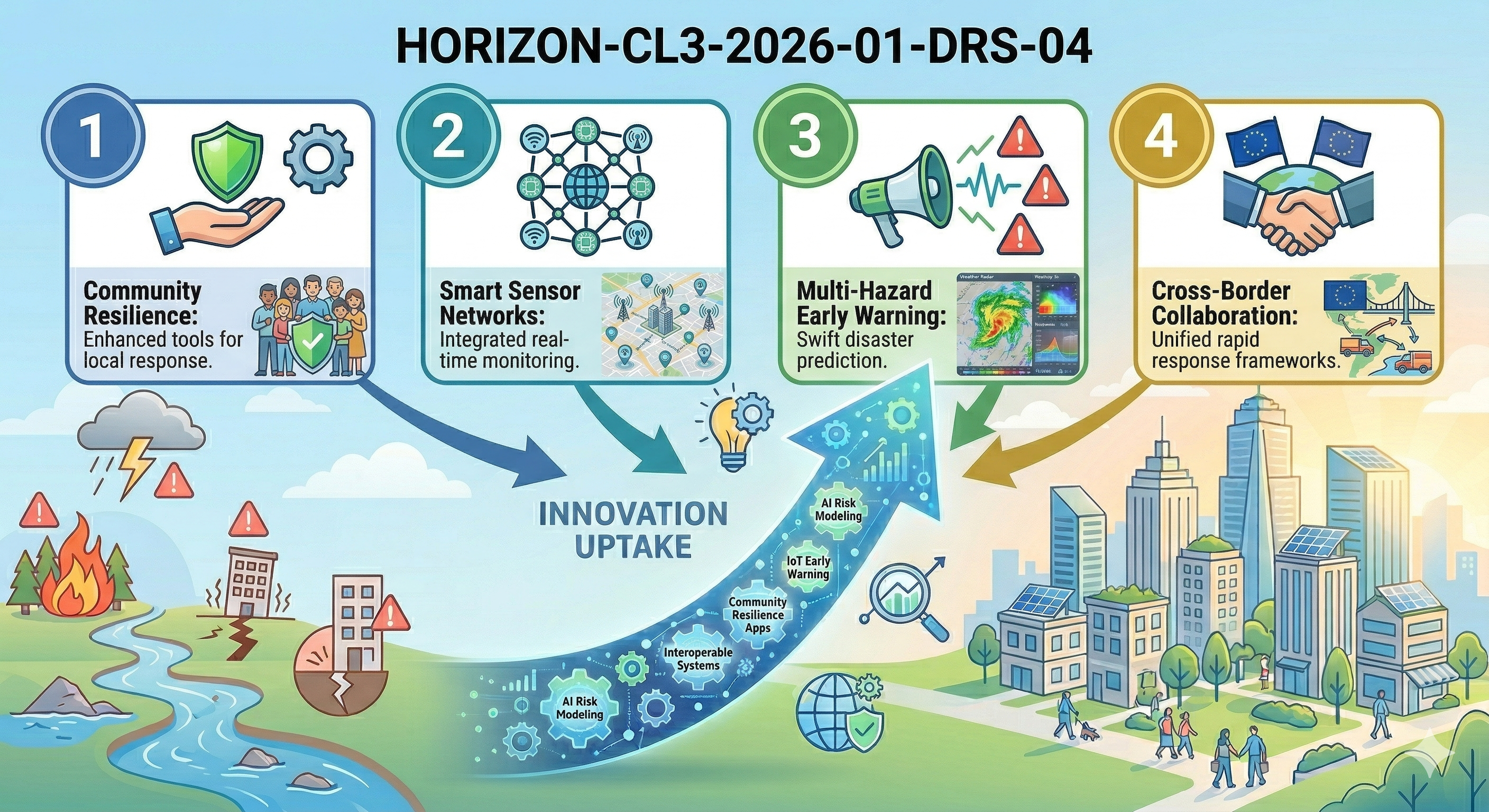
The Commission is interested in the high-TRL disaster risk solutions, in fact, reaching those who need them. This is not a conversation on the creation of new technologies. It is about bringing in solutions that are existing, validated solutions that are adopted in sectors, eliminating the hindrances that ensure they remain in shelves, and establishing synergies with the current EU preparedness programmes. In case your consortium can prove actual deployment pathways and the argument of scalability, it is a contender worth consideration.
Download the MIC Horizon Europe 2026/2027 Calls Calendar:
Discover more!
Administrative facts: what do we know about the HORIZON-CL3-2026-01-DRS-04 call?
Which call is it, and when is the opening and the deadline?
- Call name: Civil Security for Society 2026
- Call identifier: HORIZON-CL3-2026-01
- Destination: Disaster-Resilient Society for Europe
- Topic: HORIZON-CL3-2026-01-DRS-04
- Opening date: 06 May 2026
- Deadline: 05 November 2026
- Type of action: Innovation Action (IA)
What about the budget and estimated size of the project?
- Overall topic budget: EUR 6.00 million
- Number of projects expected to be funded: 2
- Estimated EU contribution per project: around EUR 3.00 million
What are the key eligibility and evaluation conditions?
- Lump sum funding applies.
- Entities controlled directly or indirectly by China or by a Chinese legal entity are not eligible.
- Security sensitive topics provisions may apply (EUCI and SEN).
- Standard Horizon Europe evaluation thresholds and award criteria (General Annexes B and D).
- No specific practitioner involvement requirement identified in the conditions box for this topic (unlike neighbouring DRS-03). Worth double-checking on the Funding & Tenders Portal once the call opens.
- No explicit TRL target found in the specific conditions. The scope text refers to “high-TRL” solutions throughout, so projects are expected to work with mature technologies.
Scientific range: what does the Commission expect from the HORIZON-CL3-2026-01-DRS-04 grant?
What outcomes are expected?
The Commission pursues expedited, quantifiable uptake of pre-existing solutions to disaster risks which are already effective. Not prototypes, not reports. At the project’s close, the funded consortia must have shown a real-life adoption, come up with interoperability standards on how to integrate these solutions into their national and EU civil protection systems, and come up with evidence solid enough to persuade the decision-makers. The visibility is also important: they desire that the larger audience and the political community should see what EU security research provides.
What is within scope?
- Methods of scaling and commercializing high-TRL technologies of disaster risks to the end-users effectively.
- Combined governance and coordination frameworks of disaster preparedness, response and recovery in the multi-sector and multi-level levels.
- Interoperability requirements and rules of plugging new solutions to the existing civil protection systems.
- Deployment barriers: regulatory, financial, social, and identification and mitigation.
- Pilot projects and demonstrations on a large-scale basis to test solutions in practice.
- Digital applications, AI-based analytics, digital twins (Destination Earth is called so), IoT
- Synergy links with KAPP funding within the Union Civil Protection Mechanism.
- The communication strategies aimed at the European Civil Protection Forum and the DRMKC platform.
- Gender dimension was only considered when necessary. Don’t force it.
Which are the specifically proposed research directions?
- Co-ordination with other disaster resilience projects to assist in its adoption as well (this is peculiar and is worth recording: the Commission expressly requests funded projects to be uptake accelerators to the wider DRS portfolio)
- Establishing synergies with UCPM capacity gap analysis and Preparedness Union Strategy, particularly its chapter on the collaboration between the private and the public.
- Illustrating the way in which high-TRL technologies can be used to augment or even eliminate existing frameworks in multi-hazard and cascading risk conditions.
- The language is generalized. It is a broad subject, and you can craft your strategy around it, though there can be no doubt about the focus on evidence of deployment and stakeholder cooperation.
Scientific strategy: how can you enhance your chances of being funded through HORIZON-CL3-2026-01-DRS-04?
What scientific choices matter most?
- Be deployment-led, development-led. Assessors will seek believable uptake routes, rather than a new round of lab validation.
- Demonstrate that you are familiar with the UCPM capacity gaps. Refer to the Preparedness Union Strategy directly and describe how your project seals certain gaps in the existing system.
- Construct liaison role in other DRS projects. This was spelled by the Commission; plans that do not take this into consideration are likely to score low.
- Select pilot sites that cut across two or more Member States. It is the cross-border applicability that sells.
- Don’t simply lay out digital technologies: describe how they relate to real practices of practitioners. It talks about AI and IoT, but what the Commission desires is usability, not a technological display.
- Add stakeholder/market analysis and a sensible post-project uptake roadmap.
Consortium & proposal-writing plan: what works best with this type of call?
- Maintain lean consortium at EUR 3 million per project. Between six and ten partners, perhaps two more in case the pilot coverage needs it.
- Partners, not just advisors, will be required in this instance, which includes civil protection authorities or emergency management agencies. Although the HORIZON-CL3-2026-01-DRS-04 does not feature any formal practitioner requirement, the fact that first responders or local authorities are present within the consortium, as opposed to being outside of it, will reinforce your assessment significantly.
- Incorporate at least one capable solution by an innovative SME which is near market. The Commission is seeking commercialization potential and that is what an SME offers.
- The logical structure of this call is a combination of publicly funded research organizations, technology suppliers, and consumer agency. Even better, added to the interoperability angle, is the ability to add a policy or standardisation body.
- Get the deployment story at the head of each section in the proposal writing. The study is the end to a means. Assessors will not read descriptions of generic tools; they will read when it is demonstrated that real barriers to adoption have been surmounted and the users are convinced.
- On impact, be specific. Indicate civil protection systems that your solution interconnects with. Name the Member States. Assign the number on possible coverage.
How would microfluidics contribute to this topic?
The management of disaster risks is increasingly based on fast, on-the-ground detection and monitoring. And that is exactly where microfluidic platforms come in: the traditional lab-based analysis is too fast to be useful in an emergency response: the situation has changed before the results returned. Portable microfluidic devices assume a different equation altogether.
- Monitoring of water quality following a flood or a spill by an industry. With a chip-based sensor in hand, you can have the readings of the chemical contamination within minutes, at the very center of the disaster site. Your response teams base their decisions on real data rather than waiting on the lab.
- Detection of biological threats in multi-hazards. Suppose a cascading event is a mix of a flood and a sewerage overflow. A microfluidic device would be able to detect oligonucleotide markers of pathogens at the spot to aid responding officers in deciding whether to provide health warnings or run the evacuation.
- Determination of soil contamination during recovery. Once a NaTech event has taken place, you would like to know whether the ground is safe before crews are sent in or before an area is opened. Such microfluidic chips that are intended to detect heavy metal or organic pollutants can offer that solution in a fast and reliable manner.
- Incident perimeter screening of air quality. The existing responder’s equipment can be integrated with miniaturized sensors based on microfluidic principles to detect airborne hazards in near real time.
In the case of a proposal under HORIZON-CL3-2026-01-DRS-04, it is not merely the fact that these devices exist. The thing is that they are high in terms of TRL, they are portable, and they reduce the gap between data acquisition and decision-making: just the uptake and deployment logic this call is pursuing. It would be beneficial to your consortium to have a microfluidics partner willing to demonstrate field-ready analytical solutions that can be integrated into civil protection workflows.
FAQ – HORIZON-CL3-2026-01-DRS-04
What does the HORIZON-CL3-2026-01-DRS-04 call entail?
This call focuses on the adoption and implementation of already proven disaster risk solutions. New technology development is not being funded by the Commission. Rather, it desires to observe the high-TRL tools implemented into practice in civil protection systems, and the evidence of adoption and interoperability at the project completion.
What types of disasters or hazards are in scope?
It is wide-ranged and not limited to a particular type of hazard. It encompasses natural disasters, industrial accidents, cascading risks, and multi-hazard situations. It focuses on the generalist solution that will be effective in various kinds of emergencies, rather than specialized tools to address a single risk.
What four results are assessors seeking?
The Commission expects real-life adoption of disaster risk solutions, interoperability standards for integration into civil protection systems, evidence packages convincing enough for policy-makers, and visible communication of results through the European Civil Protection Forum and the DRMKC platform.
What do we do to organize the scientific work wisely?
Organize your work packages around the deployment chain: identification of barriers, pilot testing among Member States, interoperability testing, stakeholder engagement, and post-project uptake planning. The deployment is not driven by research, but rather the other way round. There should be a separate activity of the liaison with other DRS projects.
What is the microfluidics value-add for this call?
Microfluidic systems are fast, portable analytical systems used to detect chemical, biological and environmental pollutants on-site. They minimise the distance between data collection and decision-making, precisely what the deployment logic this call seeks to achieve in the context of disaster response.
What can a competitive consortium look like?
A powerful consortium on DRS-04 integrates research organisations, technology providers, civil protection authorities as full partners, and at least one innovative SME close to market. The interoperability aspect is enhanced by the inclusion of a standardisation or policy body. Be lean with the group of six to ten partners.
What is in and out of scope?
In volume: scaling solutions with high TRL, governance models, interoperability, mitigation of barriers to deployment, large-scale pilots, digital tools such as AI and IoT, synergies with UCPM and KAPP funding. Not in scope: technology development at an early stage, purely theoretical research, or solutions that cannot be easily put into operational use.
What are the common flaws of the DRS Innovation Action proposals?
Mistakes to avoid are placing too much emphasis on technology development, instead of deployment, not realizing the explicit need to coordinate with other DRS projects, proposing pilots in a single country only, and considering practitioner engagement as an afterthought, instead of an initial part of the consortium structure.
What do timelines and milestones reflect?
The reviewers will seek realistic timelines that capture the deployment focus. The initial milestones should include stakeholder mapping and analysis of barriers. The pilot demonstrations should be running in mid-project milestones. Concluding milestones should provide evidence of adoption and interoperability. It is advisable not to back-load all deployment activities to the final six months.