
Tips & Tricks for a successful HORIZON-CL3-2026-01-DRS-03 proposal
Opening
06 May 2026
Deadline
Keywords
Civil Security
Search and Rescue
Innovation Action
Disaster Response
Autonomous Systems
Robotics
First Responders
hazardous conditions
resilience
Your microfluidic SME partner for Horizon Europe
We take care of microfluidic engineering, work on valorization and optimize the proposal with you
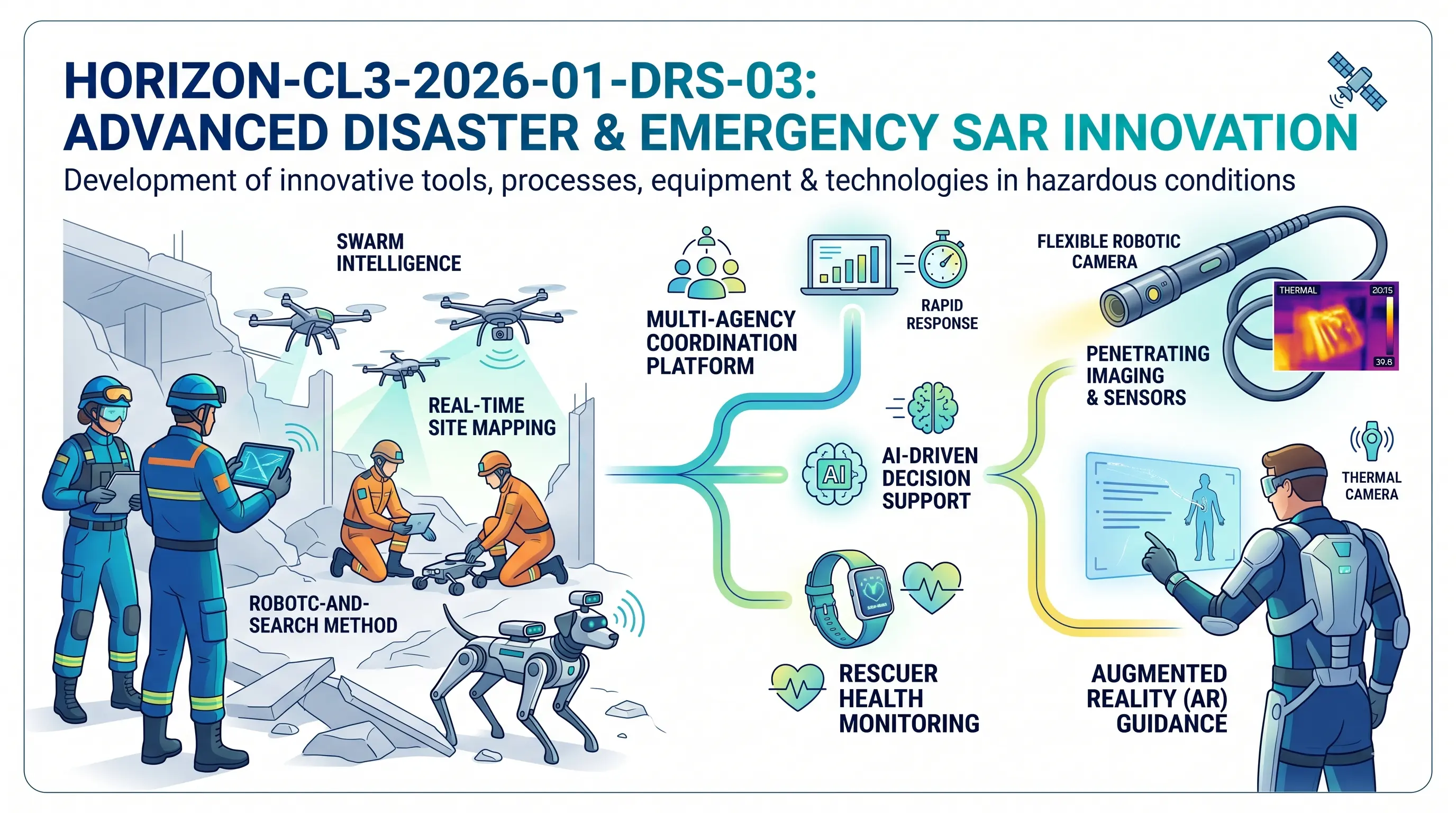
HORIZON-CL3-2026-01-DRS-03: Development of innovative tools, processes, equipment and technologies through responses to disasters and emergencies for search and rescue in hazardous conditions
This subject concerns providing first responders with superior equipment to survive and work in extreme disaster environments. The Commission hopes that robotics, autonomous systems, protective gears and AI will unite in solutions that will work in the field. Not in paper nor in a controlled laboratory, but in burning forests and in fallen buildings. This call is for you in case your consortium can design, test and validate technology to ensure search and rescue teams are safer and to enhance the speed at which they locate survivors.
Download the MIC Horizon Europe 2026/2027 Calls Calendar:
Discover more!
Administrative facts: what do we know about the HORIZON-CL3-2026-01-DRS-03 call?
Which call is it, and when is the opening and the deadline?
- Call name: Civil Security for Society 2026
- Call identifier: HORIZON-CL3-2026-01
- Destination: Disaster-Resilient Society for Europe
- Topic: HORIZON-CL3-2026-01-DRS-03
- Opening date: 06 May 2026
- Deadline: 05 November 2026 (17:00 Brussels time)
- Type of action: Innovation Action (IA)
What about the budget and estimated size of the project?
- Overall topic budget: EUR 8.00 million
- Number of projects expected to be funded: 2
- Estimated EU contribution per project: around EUR 4.00 million
What are the key eligibility and evaluation conditions?
- Standard Horizon Europe thresholds apply (General Annex D).
- Entities controlled directly or indirectly by China are not eligible to participate.
- Subject to restrictions for the protection of European communication networks.
- Mandatory consortium composition: at least 2 practitioner organisations (first responders) and 2 medical emergency authorities, from at least 3 different EU Member States or Associated Countries. Practitioners must fill in the dedicated table in the application form.
- If satellite-based observation or navigation is used, Copernicus and/or Galileo/EGNOS must be part of it.
- TRL target: 7 to 8 by end of project.
- Lump sum funding model.
- Security sensitive: some activities may involve classified background or produce EUCI/SEN results.
- Transfer of ownership or exclusive licensing of results may be blocked by the granting authority up to 4 years after the action ends.
- Relevant international organisations headquartered in a Member State or Associated Country are exceptionally eligible.
Scientific range: what does the Commission expect from the HORIZON-CL3-2026-01-DRS-03 grant?
What outcomes are expected?
The Commission wants working technology that keeps search and rescue teams safer and faster in disaster zones. Intelligent protective devices, robotics, autonomous platforms, remote sensing, communication tools and human sensor systems are all on the list. Not as isolated prototypes, but as integrated solutions that plug into command-and-control systems already used by civil protection agencies. Offers must demonstrate the ability to deal with harsh conditions: extreme temperatures, wobbly terrain, barely visible surroundings. A command-and-control solution that brings all activities together in a single location is explicitly required, with a clear plan of uptake upon project completion. A stakeholder and market analysis plus an uptake roadmap are also anticipated. The roadmap should take into consideration the capacity gaps of the European Civil Protection Pool, the rescEU strategic reserve and the EU Stockpiling Strategy.
What is within scope?
- Real-time autonomous navigation and the use of AI in decision-making. The Commission seeks systems that assist responders to act faster whenever information is disjointed and the clock is ticking.
- Inter-platform interoperability, across response teams and crisis management systems. International and inter-industry data-sharing.
- Field trials and simulations in real life situations, not just demonstrations under safe conditions.
- Inclusivity and accessibility. Solutions should work for people irrespective of their age, gender or ability.
- Heavier equipment is also included: flood control, high-capacity pumping, shelters, power generators, firefighting trucks, aerial platforms. The work programme specifically opens that door.
- Ethical and legal aspects cannot be an add-on. Privacy of data, cybersecurity, societal trust of autonomous systems, regulatory compliance. All need to be addressed.
- Synergies with KAPP grants within the Union Civil Protection Mechanism and alignment with the Preparedness Union Strategy are also requested.
What are the specifically proposed research directions?
- Design, testing and validation of autonomous drones, robotics and other platforms specifically built for search and rescue in hazardous conditions such as wildfires, earthquakes and large-scale trauma events.
- Smart protective equipment incorporating sensors and communication capabilities that feed real-time data back to coordination centres.
- AI-driven situational awareness tools that process fragmented information from multiple sources and translate it into actionable guidance for field teams.
- A unified command-and-control architecture that organises all response activities and ensures coordination across agencies and borders. This is not a side deliverable; the work programme spells it out as a standalone requirement.
- Innovation for heavier civil protection assets: the work programme points toward mobile shelters, high-capacity pumping, transport or response aircraft, ground firefighting vehicles and aerial firefighting helicopters. Most proposals will default to drones and sensors, so this is a differentiation angle worth exploring.
- Remote sensing and human sensor technologies adapted to extreme environments (high heat, unstable terrain, low visibility) with seamless data-sharing across platforms.
Scientific strategy: how can you enhance your chances of being funded through HORIZON-CL3-2026-01-DRS-03?
What scientific choices matter most?
- Choose a disaster situation and possess it. In the text, wildfires, large-scale events of trauma are mentioned. A proposal that attempts to be comprehensive is likely to persuade no one. Prefer to concentrate on one or two situations in which your technology stack is evidently differentiated.
- Present the system, not the component. Assessors at this destination would like to have their drone speak to the tablet that is in the ground team and that speaks to the command centre. Technology demonstrations alone will not be popular.
- Construct the command-and-control layer early in the project. The Commission referred to it directly, and out of what we have witnessed in previous DRS assessments, any proposal that views C2 as a side product has a way of losing points on being struck.
- Make your validation in the field believable. Name the exercise sites. Describe the scenarios. State what the practitioners will be and what they will really test. Unspecified mentions of pilot activities in WP5 sign the red light to the reviewers.
- The heavier assets dimension should not be disregarded. Provided that your consortium is an expert in mobile shelters, pumping systems or fire fighting vehicles, that is a differentiator. The vast majority of the propositions will revert to drones and sensors.
- Treat the uptake roadmap as a serious matter. Associate with the gaps of the Civil Protection Pool. Practitioner reviewers (and practitioner reviewers will be numerous) are quite familiar with those gaps.
- Review of ethics will be stringent. Independent systems in life and death context bring actual concerns. Provide your plan in regards to human control, information administration and regulation avenues.
Consortium & proposal-writing plan: what works best with this type of security IA?
- Somewhere between eight and fourteen partners, perhaps. This will finance two projects, and thus the competition will not be massive, but the requirements of the practitioners are quite high, and you require a geographic presence in at least three countries.
- The two first-responder organisations and two medical emergency authorities are no decoration. They must also be incorporated into the design circle at the very beginning and not merely as a member of an end-user advice board who appear every six months. The description of the role of evaluators will be checked.
- In case you are able to invite a fire service with field exercise infrastructure that is a good card. Same with civil protection agencies which conduct cross border exercises.
- A new SME that has a product that is near market with autonomous systems, sensors or protective equipment is natural here. The Destination introduction points specifically to an active role of SME and the scoring point of view indicates a commercial potential.
- One of the partners must at least be directly exposed to the rescEU reserve or UCPM active grants on operational basis. The uptake roadmap is far more realistic with that connection.
- Keep the writing concrete. This is a TRL 7-8 Innovation Action. Engineering is preferred instead of research visions by the reviewers. Label the drones, the sensors, explain the integration architecture.
- Lump sum funding implies that your budget table has to be clean and realistic in the first place. No post-award renegotiation. Get the work packages and breakdown of cost right before you submit.
- Due to the sensitivity of this area of security, it is necessary to check early if any partner is dealing with classified data or an offer is likely to be classified. Arrange the consortium contract in the same manner (we have already taken over a team or couple of teams to the negotiation table).
How would microfluidics contribute to this topic?
The first responders on the scene of a disaster are faced with one of the greatest bottlenecks trying to determine what they are handling. Is the air safe to breathe. Are the victims of a toxic or a trauma shock. Are there water pollution problems. Conventional laboratory tests require hours or days. A delay in the field may cost lives. Miniature analytical systems developed on the basis of the microfluidic chip can compress such analysis to a couple of minutes, where it is required.
- Mobile chemical detection. A microfluidic sensor array has the capability of detecting airborne toxins, volatile substances or fire-related gases in a fallen building. You insert a little piece of air to the chip and receive an output that can be taken upon by the rescue team. No heavy equipment, no professional lab worker needs to be hired.
- Triage diagnostics of mass casualty emergencies. Suppose you have a location of an earthquake with fifty victims and two medics. A microfluidic point-of-care system has the capability of performing simple blood tests, lactate levels or coagulation test within less than ten minutes, which would assist the medics in determining who should be evacuated first.
- Screening of the water and soil contamination. When there is a flood or an industrial accident, you want to know quickly, whether the water is safe. It can be run on site on a handheld reader using microfluidic chips capable of multiplex chemical or biological detection, and this is the type of tool the UCPM capacity gap analysis identifies the need to have.
- Health monitoring of the first responders. Wearable biomarker biomimicking microfluidic patches are capable of real-time monitoring of sweat biomarkers: indicators of dehydration, indicators of heat stress, cortisol. That is not a luxury when your team is working in the perimeter of a wildfire hours on end and there is a necessity to understand who should rotate out before collapsing.
- Embedding with autonomous platforms. Attach a microfluidic detection unit to a drone and air or water in areas too harmful to human beings can be sampled. The information is fed back to the command-and-control tier that your proposal is constructing anyway.
In the case of a DRS-03 proposal, microfluidics is not the highlight. Nonetheless, it seals a gap that will be left by most rival consortia: rapid, mobile, dependable environmental and medical analysis of the disaster location. Having a microfluidics partner in your consortium provides a tangible diagnostic and sensing layer that lends more weight to the innovation narrative and the pathway toward civil protection stockpiling uptake.
The MIC already brings its expertise in microfluidics to Horizon Europe:
H2020-NMBP-TR-IND-2020

Microfluidic platform to study the interaction of cancer cells with lymphatic tissue
H2020-LC-GD-2020-3

Toxicology assessment of pharmaceutical products on a placenta-on-chip model

About the author
Céleste Chidiac, PhD
Scientific writer and digital marketing specialist
Céleste Chidiac holds a doctorate in neuroscience and molecular biology from the University of Strasbourg. Since joining the Microfluidics Innovation Center in 2023, she has combined scientific writing with website management. For MIC’s Horizon Europe topic pages, she draws on her research background to explain scientific challenges and clarify funding priorities. Her writing helps prospective applicants understand each topic’s scope, expected outcomes and research directions.
FAQ - HORIZON-CL3-2026-01-DRS-03
What is this call actually about?
The call aims to build a consortium that can develop and certify technology to perform search and rescue operations under extreme conditions: wildfires, collapsed buildings, mass-scale traumas. Civil protection agencies, fire service and emergency medical staff in the EU Member States and Associated Countries are also the end users. A minimum of 2 practitioner organisations and 2 medical emergency authorities should be consortium members.
Who will apply and what will be the budget?
8 to 14 partners is the right number of partners in this type of IA. The geographic coverage of at least 3 countries is required, the mandatory inclusion of practitioner and medical emergency authority, and preferably one partner with direct UCPM or rescEU operational exposure. An SME with a near-market product in robotics, autonomous systems or protective equipment is a good complement, which is particularly promoted by the Destination introduction.
What types and technologies of disasters are covered?
The call encompasses a wide spectrum of the types of disasters: wildfires, earthquakes, mass industrial accidents, flooding and mass casualty incidents. At least one of these conditions requires that technologies should be tested under realistic conditions. The work programme paves the way in particular to heavier civil protection resources than drones and sensors, such as flood control equipment, mobile shelters, fire fighting vehicles and aerial platforms.
What are the real outcomes that evaluators are seeking?
The Commission anticipates four classes of outcomes, namely, the safety of responders with wearable and protection technologies, quicker survivor identification with autonomous and sensing systems, a completely sensible command-and-control layer that connects all the assets in the field and a plausible uptake roadmap that matches the capacity gaps in the Civil Protection Pool. Everything should be proved to TRL 7-8 in the field conditions at the end of the project.
What is the way you are going to organize the scientific work?
Integration of systems at day one, rather than component development. The evaluators desire the drone, the wearable, the sensor array, and the command interface to cooperate. Construct C2 layer as soon as it is possible in the project timeline. Test on named exercise sites and actual practitioner cases. Designate one of the partners to the uptake roadmap and relate it directly to rescEU reserve gaps and the Preparedness Union Strategy.
What is the value-added of microfluidics to HORIZON-CL3-2026-01-DRS-03?
It has four tangible contributions.
- Mobile chemical and environmental detection: microfluidic sensor arrays are capable of detecting on-site airborne toxins, gases or waterborne contaminants in minutes.
- Point-of-care triage diagnostics: fast blood and coagulation diagnostics of mass casualties, which can be used by non-specialist medics.
- Wearable health-monitoring of responders: real-time sweat biomarker patches of dehydration, heat stress and cortisol.
- Connection to autonomous systems: microfluidic sensor units to a drone to sample the environment remotely supplying the C2 layer.
What constitutes good practitioner involvement?
The engagement of the practitioners should be functional and not nominal. The first responders and medical emergency authorities ought to co-design validation situations, establish the performance requirements of each technology and take an active part in field tests. Evaluators, who in most cases are practitioners, will scrutinize their description of the role in the proposal. A partner who only sits in a steering committee two times a year is not an asset but a liability.
What is literally in and out of scope?
In scope: search and rescue solutions in extreme disaster conditions such as wildfire, collapsed buildings and mass disaster situations. Smarter protective devices, robotics, self-driving platforms, remote vision, communication infrastructure, Artificial Intelligence-based decision support, larger civil protection resources (pumping, shelters, firefighting vehicles), interoperability solutions with UCPM and rescEU. Other applications: ethical and legal considerations of autonomous systems, data privacy, cybersecurity and regulatory compliance.
Out of scope: pre-phase research with no obvious way to TRL 7-8. Technologies that fail to prove to be interoperable with current civil protection systems. The unavailability of the obligatory practitioner and medical emergency authority consortium members in proposals. Check the Funding and Tenders Portal for more information.
What are some of the pitfalls that kill HORIZON-CL3-2026-01-DRS-03 proposals?
-Considering the C2 layer as a final work package deliverable instead of an architectural workhorse.
-Presenting technology components without demonstrating system integration.
-Imprecise field validation schemes where the locations of the exercises have not been specified or the practitioners have not been given any commitment.
-Ignoring the dimension of the heavier assets altogether and defaulting to a drone-and-Sensor proposal that appears just like any other submission.
-A roadmap of uptake, which is generic, as opposed to the civil protection pool gaps.
-Ethics sections which consider problems without laying down mitigation plans.
What should the work packages and milestones be like?
Organize work packages around the system integration architecture not the technology components.
A sensible division: WP1 requirements and architecture, WP2 component development and subsystem validation, WP3 system integration and C2 layer, WP4 field trials and scenario validation, WP5 uptake roadmap and exploitation, WP6 ethics, legal and societal aspects, WP7 project management.
Integration gates have to correspond to budget milestones and not publication deliverables. In the lump sum rules, each euro needs to be assigned to a tangible job, and therefore make the work package breakdown accurate prior to submission.