Tips & Tricks for a successful HORIZON-MISS-2027-03-OCEAN-05 proposal
Opening
09 February 2027
Deadline
Keywords
Mission Ocean & Waters
blue carbon ecosystems
seagrass & kelp restoration
sea basin lighthouse
Nature Restoration Regulation
EMODnet monitoring
Your microfluidic SME partner for Horizon Europe
We take care of microfluidic engineering, work on valorization and optimize the proposal with you
HORIZON-MISS-2027-03-OCEAN-05: Large-scale demonstration of protection, restoration and management of blue forest ecosystems in European sea basins
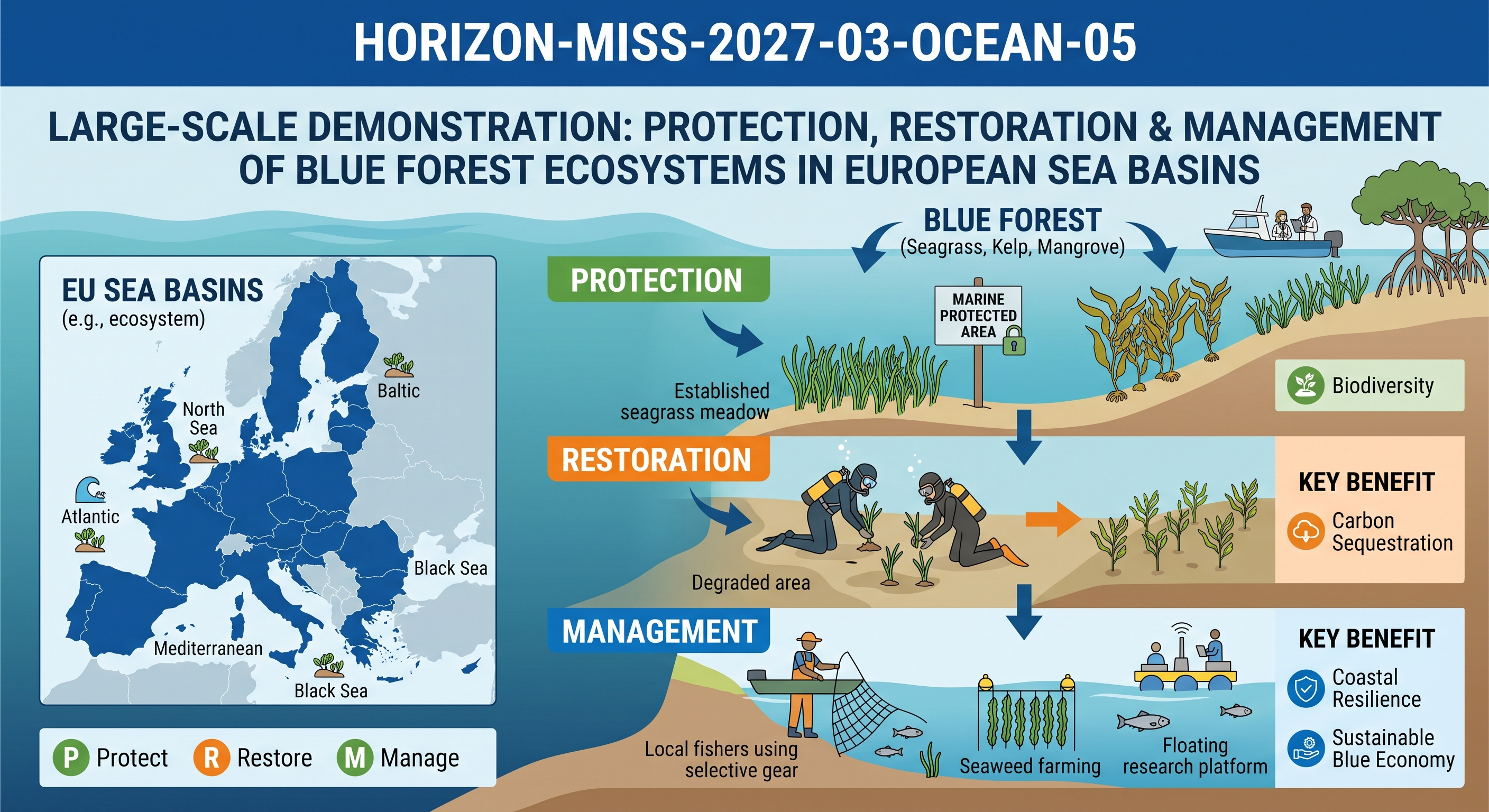
Seagrass meadows, kelp beds, saltmarshes. The Commission wants them protected, replanted and managed at a scale that shows up in national restoration plans. It is an Innovation Action: demonstration first, papers second. Each proposal picks one sea basin and commits to it.
Download the MIC Horizon Europe 2026/2027 Calls Calendar:
Discover more!
Administrative facts: what do we know about the HORIZON-MISS-2027-03-OCEAN-05 call?
Which call is it, and when is the opening and the deadline?
- Call name: Supporting the implementation of the Restore our Ocean and Waters Mission
- Call identifier: HORIZON-MISS-2027-03
- Destination: Restore our Ocean and Waters by 2030
- Topic: HORIZON-MISS-2027-03-OCEAN-05
- Opening date: 09 February 2027
- Deadline: 21 September 2027, 17:00:00 Brussels time
- Type of action: Innovation Action (IA)
What about the budget and estimated size of the project?
- Topic budget: EUR 15.90 million
- Indicative number of projects: 4
- Expected EU contribution per project: EUR 3.50 to 3.975 million
- Topic budget divided by number of projects: EUR 3.975 million
- Overall indicative budget of the call: EUR 100.40 million
What are the key eligibility and evaluation conditions?
- Standard General Annex conditions apply. No topic level derogation on award criteria or thresholds.
- Satellite data: if the project uses earth observation or positioning data, Copernicus and Galileo/EGNOS are mandatory. Others may be added.
- In situ data and marine observations must go openly to EMODnet, FAIR principles.
- Portfolio rule: at least one grant to the highest ranked proposal in each of the four Mission basins, thresholds permitting.
- One basin per proposal, named explicitly: Atlantic/Arctic, Mediterranean, Baltic/North Sea, or Danube with the Black Sea.
Scientific range: what does the Commission expect from the HORIZON-MISS-2027-03-OCEAN-05 grant?
What outcomes are expected?
More vegetated seabed, in better condition, inside EU waters. Carbon storage that holds, biodiversity coming back with it. On top of that, financing mechanisms that survive the grant and communities still involved once the money stops. Publication series are not what they are after.
What is within scope?
- Active restoration: replanting, re-establishment of habitats, prevention of Invasive Alien Species
- Passive restoration through removal of environmental pressures
- Conservation: helping authorities set up and manage marine protected areas and EU Blue Parks, plus the regulatory measures
- Innovative financing: nature credits, carbon removal certification, blended public and private money, scientifically assessed
- Research and monitoring with multi-sensor platforms, long term
- Community engagement, education, stakeholder work aimed at replication
No hard exclusion line in the text. But a proposal spread across several basins is off scope by construction.
What are the specifically proposed research directions?
- Cumulative impact of stressors, invasive species and climate change on habitat condition
- Monitoring of restoration success and of natural carbon sequestration potential
- Integration of blue carbon ecosystems into national restoration plans under the Nature Restoration Regulation
- Data harmonisation and participatory monitoring across sea basins
- Continuity of monitoring beyond project duration, plugged into networks such as EMODnet
- Viability, soundness and integrity of the business models, tested
Scientific strategy: how can you enhance your chances of being funded through HORIZON-MISS-2027-03-OCEAN-05?
What scientific choices matter most?
- Pick your basin early. Everything else follows from it, partner geography included.
- Name the restoration sites. Hectares, coordinates, baseline condition.
- Put the Nature Restoration Regulation inside the work plan, not in the introduction. Most proposals we see stop at citing it.
- Measure carbon properly. Sequestration claims without sediment and water column data get picked apart.
- Build monitoring that outlives the grant. This one trips people up more than you would expect.
- Treat the financing work package as science. The call asks for viability and integrity assessed, not a business plan.
- Copernicus and Galileo are conditions, not options.
Consortium & proposal-writing plan: what works best with this type of call?
- Somewhere between ten and fifteen partners, a couple more if your basin spans many countries. Budget sits under 4 million, so a bloated consortium starves everyone.
- Authorities in the consortium, not on an advisory board. The topic says involvement is strongly encouraged. Read that as expected.
- Mix marine ecologists with a monitoring technology provider, an economist for the credits work, NGOs with real local presence, and one innovative SME. SMEs usually carry the sensor side well.
- If ERDF, LIFE or EMFAF money is already lined up for replication, say so early.
- Write impact around Mission targets: 30% protected, 10% strictly protected. Use their numbers.
- Keep the replication roadmap concrete. Who does what after month 48.
How would microfluidics contribute to this topic?
Ship sampling plus lab analysis gives you a snapshot, weeks later, and it is expensive to repeat. Microfluidics moves the analysis into the water. Tiny reagent volumes, months of autonomous running on a mooring or a glider.
- eDNA on chip. Say a meadow starts losing ground and nobody knows whether an invasive alga arrived first. A microfluidic PCR unit sampling weekly tells you, while there is still time to act.
- Lab-on-chip nutrient analysers for nitrate and phosphate, already deployed in European waters. Cheap enough to place several across a site.
- Carbonate chemistry: pH, dissolved inorganic carbon, alkalinity. Claiming blue carbon gains means measuring continuously, not four times a year.
- Porewater in sediment is hard to sample. Microfluidic extraction handles the tiny volumes.
- Contaminant and microplastic screening on the same platform.
Microfluidics is not the story of this call. But it makes your monitoring claims credible and your EMODnet data stream real. Worth a work package of its own.
The MIC already brings its expertise in microfluidics to Horizon Europe:
H2020-NMBP-TR-IND-2020

Microfluidic platform to study the interaction of cancer cells with lymphatic tissue
H2020-LC-GD-2020-3

Toxicology assessment of pharmaceutical products on a placenta-on-chip model

About the author
Julia Sepulveda Diaz, PhD
Chief Executive Officer, Microfluidics Innovation Center
Julia holds a PhD in glycobiology and neurobiology from Université Paris-Est Créteil. Before moving into microfluidics, she spent several years as a postdoctoral researcher at the Paris Brain Institute, on Parkinson’s disease, neuroinflammation, and the role of heparan sulfate in protein aggregation. Today she leads the Microfluidics Innovation Center as CEO, steering its researchers and engineers and its collaborative research and innovation projects.
FAQ - HORIZON-MISS-2027-03-OCEAN-05
What exactly does this topic fund?
Large-scale demonstration of protection, restoration and management of blue forest ecosystems: seagrass meadows, kelp beds, saltmarshes and other marine vegetated habitats. It is an Innovation Action, so the Commission expects on-site work with measurable habitat gains, not another mapping exercise.
Check the Funding and Tenders Portal for more information.
How much money is on the table and for how many projects?
The topic budget is EUR 15.90 million, split across 4 projects. Expected EU contribution per project runs from EUR 3.50 to 3.975 million. The whole HORIZON-MISS-2027-03 call carries EUR 100.40 million.
When does the call open and when is the deadline?
Opening on 09 February 2027, deadline 21 September 2027 at 17:00:00 Brussels time. Standard clause applies: the Director-General may shift the opening by a month and push the deadline by up to two months.
Do we have to choose one sea basin?
Yes. Each proposal addresses one basin only, stated explicitly: Atlantic and Arctic, Mediterranean, Baltic and North Sea, or Danube including the Black Sea. Activities have to be tailored to that basin. River basins flowing into the sea basin count as part of it.
What is the portfolio rule and why does it matter?
Grants are not awarded on ranking alone. At least one grant goes to the highest ranked proposal within each of the four Mission basins, provided thresholds are attained. In practice, your competition is mostly the other proposals targeting your basin.
Are there special conditions on data and satellite services?
Two. If you use earth observation, positioning or navigation data, Copernicus and Galileo/EGNOS are mandatory, though other sources may be added. And any in situ data or marine observation you collect must be made openly available through EMODnet, following FAIR principles.
How does this connect to the Nature Restoration Regulation?
Directly. The topic asks you to integrate blue carbon ecosystems into marine biodiversity frameworks, in particular the national restoration plans under the regulation. Proposals that only cite the regulation in the introduction miss the point.
What kind of consortium works for this topic?
Somewhere between ten and fifteen partners. Marine ecologists, national or regional authorities as full beneficiaries, NGOs with local presence, an economist for the financing work, and a technology SME partner for the monitoring side. Direct involvement of authorities is strongly encouraged by the topic.
Does microfluidics have a place in a blue forest restoration project?
In the monitoring work package, yes. In situ lab-on-chip analysers cover nutrients, carbonate chemistry and eDNA detection of invasive species, running autonomously for months. It is not the core of the call, but it is what turns restoration claims into a defensible data stream.
What are the common mistakes on this kind of Mission topic?
Spreading the work across several basins. Naming no restoration sites. Claiming carbon gains without sediment and water column measurements. Treating the financing work as a business plan annex rather than an assessment. And leaving monitoring to stop the day the grant ends.