
Tips & Tricks for a successful HORIZON-MISS-2027-02-CANCER-04 proposal
Opening
10 February 2027
Deadline
Keywords
Cancer Mission
health economics
outcomes research
cost-effectiveness
health equity
RIA
cancer control
health systems
equitable access
quality of life
Your microfluidic SME partner for Horizon Europe
We take care of microfluidic engineering, work on valorization and optimize the proposal with you
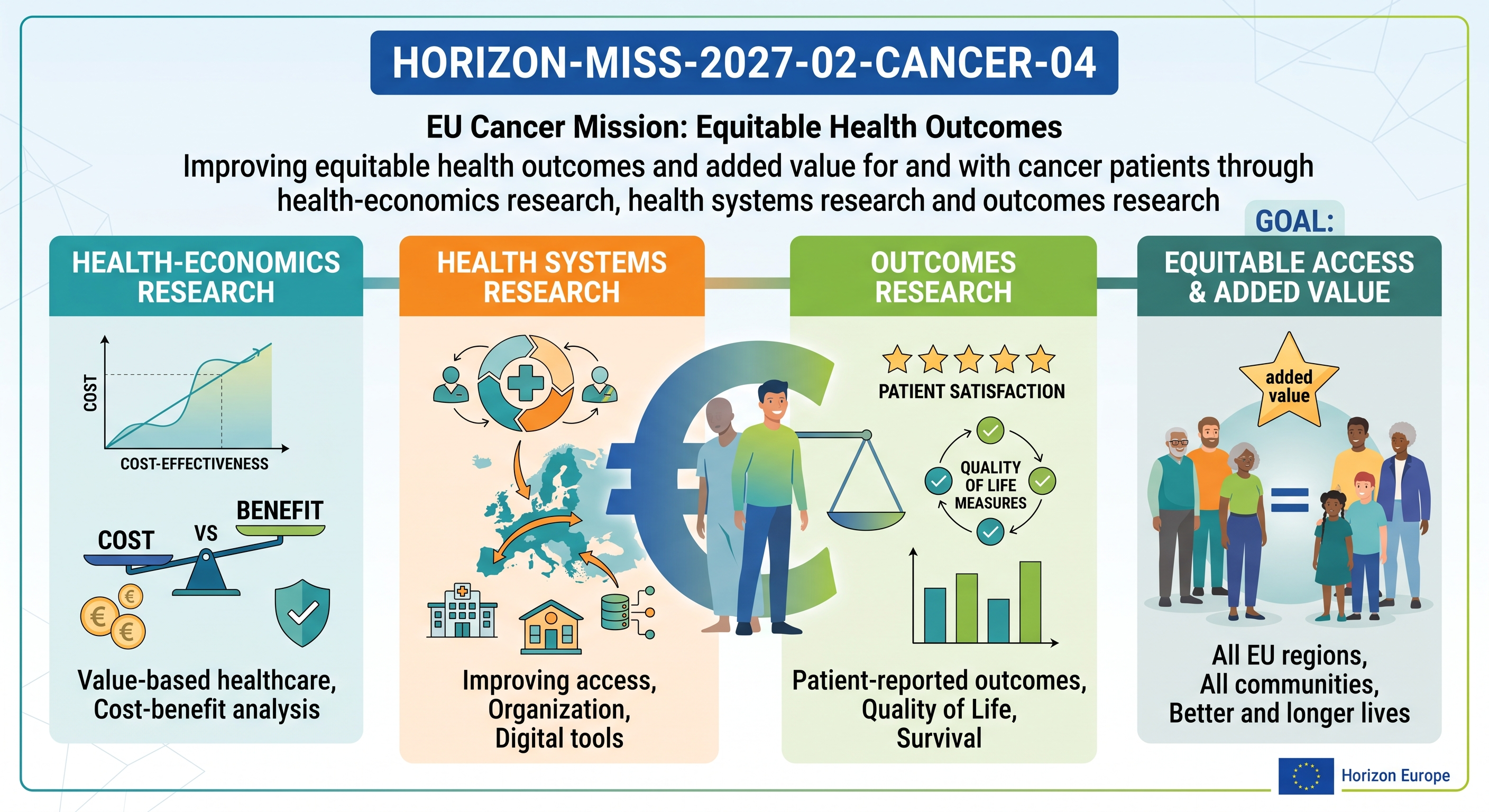
HORIZON-MISS-2027-02-CANCER-04: Improving equitable health outcomes and added value for and with cancer patients through health-economics research, health systems research and outcomes research
The Commission wants proof that cancer care can be fairer and cheaper at the same time. This topic sits inside the EU Cancer Mission and asks for health-economics research, health systems research and outcomes research, not new drugs or devices. What matters is showing which cancer control programmes deliver real value across regions that look nothing alike. In short, evidence a health system can act on. You can place HORIZON-MISS-2027-02-CANCER-04 against the wider Horizon Europe calls calendar.
Download the MIC Horizon Europe 2026/2027 Calls Calendar:
Discover more!
Administrative facts: what do we know about the HORIZON-MISS-2027-02-CANCER-04 call?
Which call is it, and when is the opening and the deadline?
- Name of the call: Supporting the implementation of the Cancer Mission
- Identifier: HORIZON-MISS-2027-02
- Destination: EU Cancer Mission
- Topic: HORIZON-MISS-2027-02-CANCER-04
- Opening: 10 February 2027
- Deadline: 21 September 2027, 17:00 Brussels time
- Type of action: Research and Innovation Action (RIA). If the instrument is new to you, here is what an RIA involves.
What about the budget and estimated size of the project?
- Overall topic budget: EUR 10.00 million
- Projects expected: 3 (indicative)
- Budget per project by simple division: about EUR 3.3 million
- Note: the work programme itself expects EUR 5.00 to 7.00 million per project, which cannot fit three grants inside a 10 million envelope. Plan for one, maybe two, funded projects.
What are the key eligibility and evaluation conditions?
- Thresholds are raised: 4 for Excellence, 4 for Impact, 4 for Implementation, cumulative 12. The Horizon default is 3/3/3 and 10, so the bar sits higher than usual.
- Standard RIA eligibility: at least three independent legal entities from three different Member States or Associated Countries.
- Funding is a lump sum.
- Clustering is mandatory. Winners join the ‘Understanding’ cluster of the Cancer Mission and must budget for networking and joint meetings.
- JRC link: build on the Knowledge Centre on Cancer (KCC), plus the ECIS and ECIR data resources.
- The granting authority may object to a transfer of ownership or exclusive licensing of results for up to 4 years after the project ends.
Scientific range: what does the Commission expect from the HORIZON-MISS-2027-02-CANCER-04 grant?
What outcomes are expected?
Publication series are not what the Commission is after. It wants tools and evidence that patients, health systems and policymakers can use directly: cost-effective cancer control programmes, real access to spending and registry data, and a clear reading of which interventions actually pay off. When the grant ends, someone should be able to make an organisational or funding decision with it.
What is within scope?
- Health-economics, health-systems, epidemiological and outcomes research methods and models
- Comparative cost-effectiveness analyses of cancer control
- Work on healthcare expenditure and its link to value-driven care
- Participative research that puts patients and caregivers inside the study
- Demonstrations of better access to cancer control in hospitals, dedicated centres, at home, or in community settings
This is not a bench-science topic. New molecules or devices belong elsewhere in the Mission.
What are the specifically proposed research directions?
- Build or refine models that compare the value of interventions across regions with very unequal resources
- Quantify direct and indirect costs of cancer, then tie them to survival and quality of life
- Factor in socio-economic inequality and behavioural change, including primary prevention and precision medicine
- Reuse existing data: registries, reimbursement records, drug pricing and sales, longitudinal epidemiology
The wording leans hard on equity and on data that already exists. We read that as a quiet preference for proposals that connect scattered datasets rather than build new ones from scratch.
Scientific strategy: how can you enhance your chances of being funded through HORIZON-MISS-2027-02-CANCER-04?
What scientific choices matter most?
- Anchor everything in equity. Every method should show how it narrows the gap between rich and poor regions.
- Prove your data access. Reviewers will check whether you can really reach the registries and reimbursement data you name.
- Design the patient involvement properly. It is scored here, not a box to tick (this one catches people off guard).
- Show cross-country validity. A model that works in one health system only will not convince.
- Wire in the KCC early.
Consortium & proposal-writing plan: what works best with this type of call?
- Aim for somewhere between eight and twelve partners, a couple more if broad country coverage demands it.
- You will want health economists, epidemiologists, health-systems researchers, and clinicians who actually run cancer programmes.
- Bring in payers or regional health authorities. Their spending and reimbursement data is the raw material of the whole project.
- Patient organisations belong in as partners, not subcontractors.
- If you can add an innovative SME working on health data or affordable diagnostics, do it. It sharpens both the exploitation story and the intersectoral balance. The MIC sets out how it joins consortia as a technical SME partner.
- Writing tip: open your Impact section with the equity gap you close. Above all, that is what this Mission gets measured on.
How would microfluidics contribute to this topic?
Let us be straight. This is an economics and data topic, so microfluidics plays a supporting role, not the lead. There is still one real link. Cost-effectiveness depends on what the interventions cost, and affordable diagnostics move that number.
- Take screening. A low-cost microfluidic test can cut the per-patient cost of a colorectal or cervical programme. That cost drop is the exact figure your health-economics model feeds on.
- At-home and community testing shows up in the scope. Point-of-care microfluidic devices make that setting realistic, and your outcomes research can weigh it against the hospital pathway.
- Say you want to know whether cheaper monitoring changes survival or just saves money. A liquid-biopsy-on-chip pathway hands you a concrete intervention to price and to follow.
So microfluidics will not be the heart of your CANCER-04 proposal. But if part of your cost-effectiveness case rests on cheaper testing, having someone who builds those devices makes the numbers credible. Your consortium can point to a real, priced intervention instead of a hypothetical one.
The MIC already brings its expertise in microfluidics to Horizon Europe:
H2020-NMBP-TR-IND-2020

Microfluidic platform to study the interaction of cancer cells with lymphatic tissue
H2020-LC-GD-2020-3

Toxicology assessment of pharmaceutical products on a placenta-on-chip model

FAQ – HORIZON-MISS-2027-02-CANCER-04
So what is this call actually about?
It funds health-economics research, health systems research and outcomes research to make cancer care fairer and more cost-effective across the EU. The focus is evidence for decisions, not new treatments.
When does it open and when is the deadline?
Opening is 10 February 2027. The single-stage deadline is 21 September 2027 at 17:00 Brussels time. Type of action is RIA.
How much money is on the table, and for how many projects?
The topic budget is EUR 10.00 million. The work programme names 3 indicative projects at EUR 5.00 to 7.00 million each. Those figures do not add up, so expect one or two grants in practice.
Check the Funding and Tenders Portal for more information.
What outcomes do the evaluators want to see?
Cost-effective cancer control programmes, open access to spending and registry data, and evidence that health systems can use to improve equitable health outcomes. Deliverables people can act on.
What is in scope and what is out of scope?
In scope: economics, epidemiology, outcomes methods, cost-effectiveness analyses, participative research. Out of scope: new drugs, new devices, bench science. Those live elsewhere in the Mission.
Do we have to work with the other funded projects?
Yes. Winners join the ‘Understanding’ cluster of the Cancer Mission and must budget for networking and joint activities. You are also expected to build on the Knowledge Centre on Cancer.
What consortium works best for this topic?
Roughly eight to twelve partners. Health economists, epidemiologists, clinicians running cancer programmes, and payers or regional authorities who hold the data. Patient organisations as full partners.
Where does microfluidics fit in a health-economics call?
On the edge, honestly. Its value is affordable diagnostics. A cheaper point-of-care test lowers programme cost, which is exactly what your cost-effectiveness model measures.
What are the common mistakes that sink these proposals?
Naming data you cannot actually access. Treating patient involvement as decoration. Building a model that works in one country only. The raised 4/4/4 thresholds punish weak spots.
How should we frame the Impact section?
Lead with the equity gap you close. Tie every method to a decision a health system could make. That is the yardstick this Mission uses.