
Tips & Tricks for a successful HORIZON-MISS-2027-02-CANCER-02 proposal
Opening
10 February 2027
Deadline
Keywords
Cancer Mission
Comprehensive Cancer Infrastructures
patient outcomes
common cancers
clinical research
lump sum
health equity
european cooperation
Your microfluidic SME partner for Horizon Europe
We take care of microfluidic engineering, work on valorization and optimize the proposal with you
HORIZON-MISS-2027-02-CANCER-02: Clinical research by Comprehensive Cancer Infrastructures for the benefit of patients with common cancers
Lung, bowel, breast and prostate cancer drive most of the burden in Europe. Care in a top Western centre and care further east are not the same thing. Comprehensive cancer infrastructures are asked here to run clinical research together, then deploy it across borders. Innovation Action, so the ask is a programme piloted and upscaled, not a study protocol.
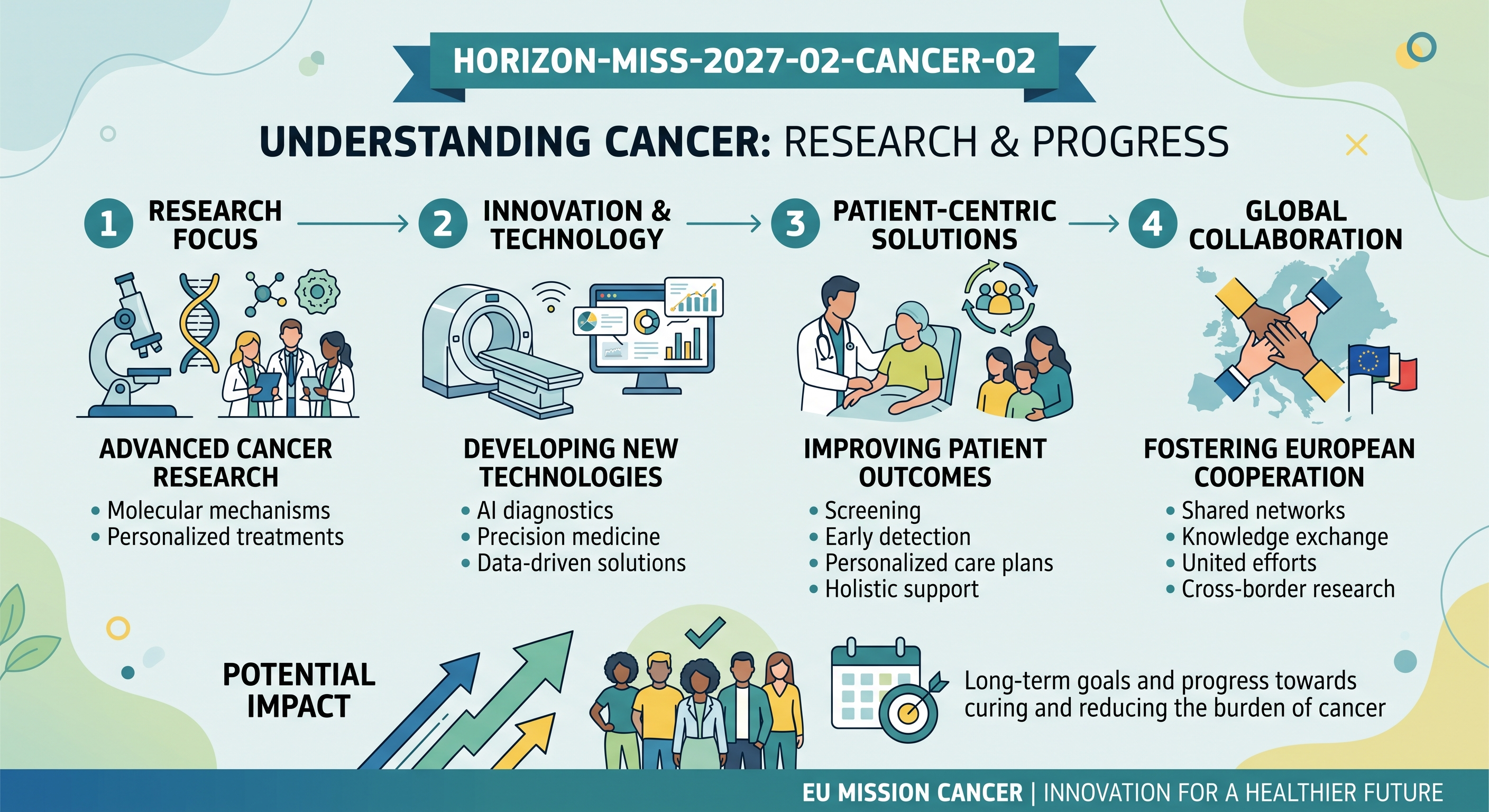
Download the MIC Horizon Europe 2026/2027 Calls Calendar:
Discover more!
Administrative facts: what do we know about the HORIZON-MISS-2027-02-CANCER-02 call?
Which call is it, and when is the opening and the deadline?
- Call name: Supporting the implementation of the Cancer Mission
- Call identifier: HORIZON-MISS-2027-02
- Destination: Cancer Mission, Work Programme Part 12
- Topic: HORIZON-MISS-2027-02-CANCER-02
- Opening: 10 February 2027
- Deadline: 21 September 2027, 17:00:00 Brussels time
- Type of action: Innovation Action (IA)
What about the budget and estimated size of the project?
- Topic budget: EUR 20.00 million
- Projects expected: 3
- Budget divided by projects: about EUR 6.67 million
- Commission range per project: EUR 7.00 to 10.00 million
- Overall call budget: EUR 115.32 million
What are the key eligibility and evaluation conditions?
- Raised thresholds: 4 Excellence, 4 Impact, 4 Implementation. Cumulative 12
- Lump sum funding
- Standard eligibility, General Annex B
- Piloting in at least four Member States or Associated Countries, one of them with weak cancer infrastructure
- Clustering: join the Diagnosis and treatment cluster, and budget for it
- Granting authority may object to transfer of ownership or exclusive licensing, up to 4 years after
- Clinical study details go in the dedicated annex template
Scientific range: what does the Commission expect from the HORIZON-MISS-2027-02-CANCER-02 grant?
What outcomes are expected?
Patients with one of the four common cancers should end up with diagnosis or treatment programmes that are affordable and reachable, not just clinically sound. Payers and regional authorities need evidence to keep funding it after your grant closes. Publication series are not what they are after.
What is within scope?
Pick at least one of these areas:
- Innovative diagnostics
- Radiotherapy, surgery, chemotherapy
- Therapeutic cancer vaccines, covering early stage, advanced, metastatic or minimal residual disease
- Rolling out clinical practice guidelines where comprehensive cancer infrastructure is limited or absent
Common cancers only. Rare cancers sit in CANCER-03.
What are the specifically proposed research directions?
- Co-design with patients and carers, through participative models fitted to local realities
- Data disaggregated by sex, gender, age, socio-economic status, ethnicity
- Metadata in the European Health Data Space catalogue, open science, tools via UNCAN.eu
- Additional money mapped: ERDF, Technical Support Instrument, RRF, philanthropy, EIB and EIF
- Building on EUNetCCC, on ESFRI infrastructures (BBMRI, EATRIS, ELIXIR, ECRIN) and the Knowledge Centre on Cancer
Scientific strategy: how can you enhance your chances of being funded through HORIZON-MISS-2027-02-CANCER-02?
What scientific choices matter most?
- Pick one area and go deep. Covering diagnostics and vaccines and guidelines reads as unfocused.
- Name your four countries early. And say which one is the under equipped one, using the Cancer Inequalities Registry.
- Design for the weakest site. A protocol that only runs in a fully equipped centre kills your equity claim.
- Show who pays after the grant ends.
- Sex and gender disaggregation is not a checkbox. Build it into the statistical plan.
- Thresholds are 4/4/4. A merely good Implementation section will sink you.
- The wording on comprehensive cancer infrastructures is vague, which leaves room to frame things your way.
Consortium & proposal writing plan: what works best with this type of call?
- Somewhere between eight and fourteen partners, maybe a couple more if the clinical coverage requires it.
- Anchor on comprehensive cancer infrastructures. Cancer centres, university hospitals, public health facilities.
- The under equipped country’s partner goes in as a full beneficiary, not a linked third party. This trips people up.
- Health economists and implementation scientists. Payers or insurers if you can get them.
- Patient organisations need a real work package, not an advisory board seat.
- Including an innovative SME usually pays off. It carries the technology and gives exploitation something concrete.
- Lump sum means your work package structure is your budget. Write the clinical annex early.
How would microfluidics contribute to this topic?
Tissue biopsy tells you about one place at one moment. Across four countries with uneven pathology capacity, that is a problem. Microfluidic tools work on a few drops of blood and run on a benchtop. So they go where a genomics platform cannot.
- Liquid biopsy chips capture circulating tumour cells and ctDNA. Say you want to know whether a bowel cancer patient in a smaller centre is relapsing. Blood every six weeks, same chip in all four countries, and you get the same answer twice.
- Droplet systems for digital PCR. Cheap per test, low sample volume, fine for minimal residual disease.
- Tumour on chip models let you try a drug combination on the patient’s own cells first.
- Going the vaccine route, microfluidic mixing is how lipid nanoparticles get made consistently. You’d need it for any mRNA candidate anyway.
- Point of care formats. Small, cheap, no cold chain.
Point is, microfluidics gives your proposal a piece of the programme that is portable and affordable by design. Those two words show up all over this topic.
The MIC already brings its expertise in microfluidics to Horizon Europe:
H2020-NMBP-TR-IND-2020

Microfluidic platform to study the interaction of cancer cells with lymphatic tissue
H2020-LC-GD-2020-3
Toxicology assessment of pharmaceutical products on a placenta-on-chip model

FAQ - HORIZON-MISS-2027-02-CANCER-02
What is HORIZON-MISS-2027-02-CANCER-02 about?
It funds comprehensive cancer infrastructures that team up across borders to run clinical research on lung, bowel, breast or prostate cancer. The point is not a single trial. The point is a diagnosis or treatment programme that gets piloted and upscaled in at least four countries, including one where cancer infrastructure is thin.
When does the call open and when is the deadline?
Opening is 10 February 2027. The deadline is 21 September 2027 at 17:00:00 Brussels time. The Director-General may shift the opening by a month either way and delay the deadline by up to two months, so keep an eye on the Funding and Tenders Portal.
How much money is available per project?
The topic carries EUR 20.00 million and three projects are expected. The Commission signals EUR 7.00 to 10.00 million per project, which does not divide neatly into 20. Read it as a range, not a ceiling. Proposals asking for different amounts are still eligible.
Which cancers are covered?
Lung, bowel, breast and prostate. Any age group, any subtype. Rare and very rare cancers are handled by HORIZON-MISS-2027-02-CANCER-03, so do not stretch your indication list here.
What counts as a comprehensive cancer infrastructure?
The work programme defines it broadly: national or regional structures providing resources and services for cancer care, research, training and patient education. Public or private. A cancer centre, a hospital, a university medical centre, a research institute, a company, a public health facility. That breadth is useful when you build the partner list.
How many countries do we need for the piloting?
At least four Member States or Associated Countries. One of the four must be a country without a comprehensive cancer infrastructure, or with a less developed one. Treat that partner as a full beneficiary with real tasks, not a demonstration site bolted on at the end.
What do the raised evaluation thresholds change?
Each criterion needs a 4 out of 5 and the cumulative threshold is 12, instead of the usual 3/3/3 and 10. In practice that means a strong Excellence section is not enough. Weak Implementation alone will take you out.
What does lump sum funding mean for the work plan?
Your budget is agreed up front and paid against completed work packages, not against actual costs. So the work package structure has to be finished before the narrative is written. Split packages so each one has a clear, verifiable end point. Ambiguity here costs you at grant preparation.
Where does microfluidics fit into this topic?
Mostly in the innovative diagnostics strand, and in vaccine manufacturing if you go that way. Liquid biopsy chips, droplet digital PCR and organ-on-chip models are cheap, portable and need very little sample. That is a good fit for a programme that has to run in a hospital without a genomics platform.
Why include an innovative SME in the consortium?
An SME partner carries the technology, handles prototyping and gives the exploitation section something concrete to point at. Evaluators on Impact look for who will actually build and maintain the thing after the project. Academic partners rarely answer that question well on their own.