
Tips & Tricks for a successful HORIZON-CL5-2027-03-D5-04 proposal
Opening
15 December 2026
Deadline
Keywords
Cluster 5
fleet demonstration
zero emission bus
shared charging
2ZERO Partnership
road transport
long distance mobility
intercity bus
climate neutrality
Your microfluidic SME partner for Horizon Europe
We take care of microfluidic engineering, work on valorization and optimize the proposal with you
HORIZON-CL5-2027-03-D5-04: Demonstration of zero emission coaches and buses in long distance operations (2ZERO Partnership)
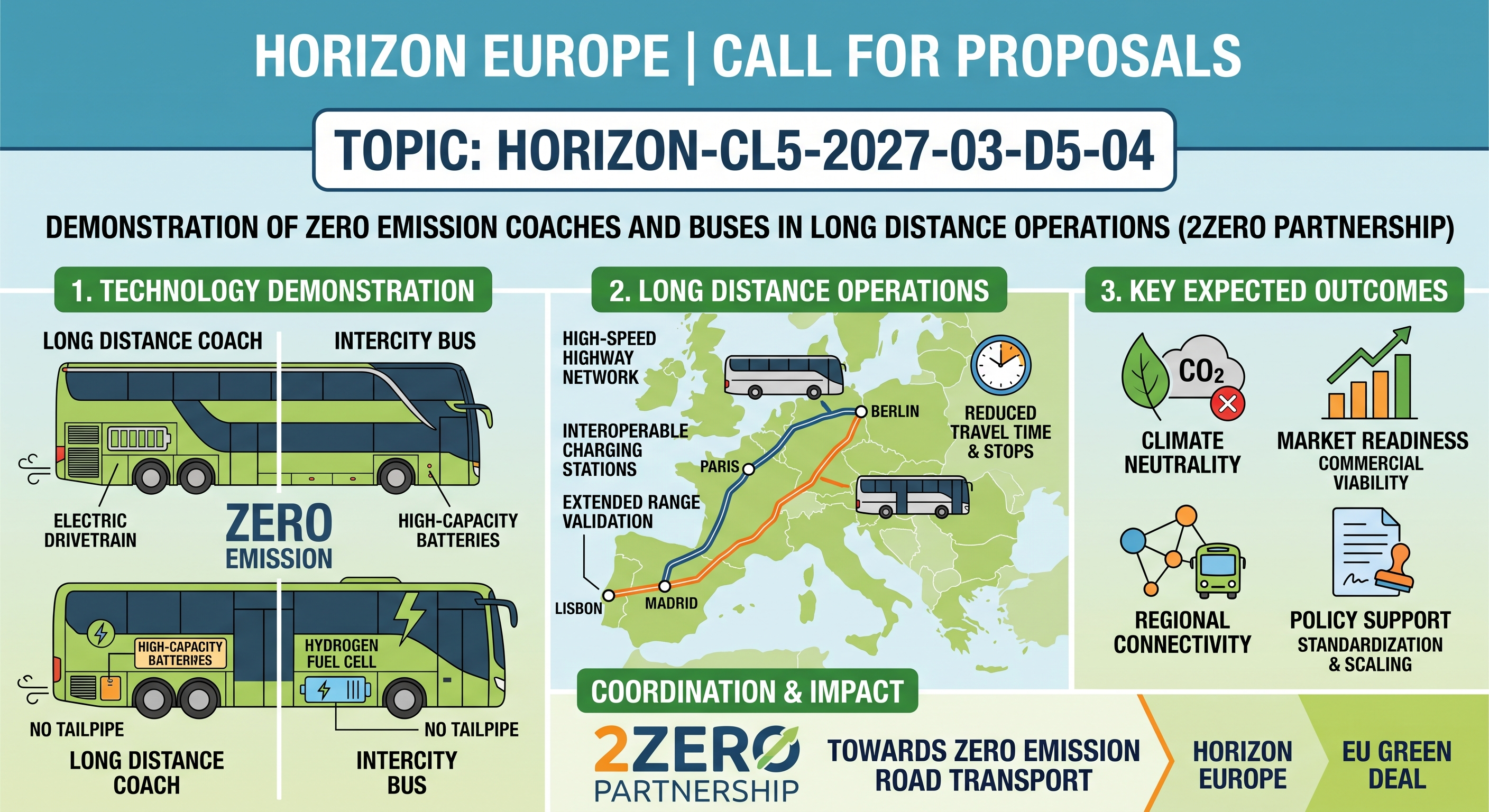
Zero emission buses already work in European cities. Long distance is a different animal: weight, range, charging windows. The Commission wants vehicles on real routes with real passengers, not a feasibility study. One project will be funded, and it has to run.
Download the MIC Horizon Europe 2026/2027 Calls Calendar:
Discover more!
Administrative facts: what do we know about the HORIZON-CL5-2027-03-D5-04 call?
Which call is it, and when is the opening and the deadline?
- Call name: MOBILITY
- Call identifier: HORIZON-CL5-2027-03
- Destination: Clean and competitive solutions for all transport modes (Destination 5)
- Topic: HORIZON-CL5-2027-03-D5-04, zero emission coaches and buses in long distance operations
- Opening: 15 December 2026
- Deadline: 14 April 2027, 17.00 Brussels time
- Type of action: Innovation Action
What about the budget and estimated size of the project?
- Overall MOBILITY call budget: EUR 131.00 million
- Topic budget: EUR 13.50 million
- Number of projects expected: 1
- EU contribution per project: around EUR 13.50 million
What are the key eligibility and evaluation conditions?
- General Annexes A to G apply, with two topic exceptions
- Minimum consortium: three independent legal entities from three different Member States or Associated Countries
- Award thresholds: 3/5 per criterion and 10/15 overall
- Satellite data: if you use earth observation, positioning or navigation services, Copernicus and Galileo/EGNOS must be used
- TRL 7-8 at the end of the project, any starting TRL accepted
- The granting authority may object to a transfer of ownership or exclusive licensing of results, up to 4 years after the action
- Reporting to the 2ZERO partnership KPIs is expected
- No JRC participation and no clustering obligation appear in the topic fiche
Scientific range: what does the Commission expect from the HORIZON-CL5-2027-03-D5-04 grant?
What outcomes are expected?
By the end of the grant, long distance zero emission coaches should run reliably and enter the regular service of transport operators. Replication beyond the demo partners is expected too, with recommendations and shared best practice. Comfort and intermodality count as outcomes here, which is unusual for a Cluster 5 mobility topic.
What is within scope?
- Long distance people mobility: regional, national and cross border
- Buses and coaches, any zero emission powertrain
- At least 5 vehicles on several operational routes, average 500 km or more in extra urban patterns
- Shared charging solutions usable by several operators and other vehicle types
- Grid impact, rush hour at charging stations, seasonal demand
- Interior design and passenger experience, based on user needs
- New business models, fleet management, legal barriers
Urban only demonstrations are out. The call treats the city case as solved.
What are the specifically proposed research directions?
- Affordable solutions with viable business cases, not just technical proof
- The switch between long distance and urban legs, intermodal hubs, park and ride
- Optimised charging schedules against driving time regulations
- Cross border trips, where charging standards and operator practices diverge
- Links with other 2ZERO projects on buses and heavy duty vehicles
The fiche is dense but not prescriptive on technology. Room to pick your powertrain and defend it.
Scientific strategy: how can you enhance your chances of being funded through HORIZON-CL5-2027-03-D5-04?
What scientific choices matter most?
- Secure the vehicles first. Five coaches on real routes is a procurement and homologation problem before a research one.
- Pick routes already commercially operated. Evaluators trust a line with paying passengers more than a test corridor.
- Treat charging as the core scientific question. Weight, range and charging window are coupled, and the call says so repeatedly.
- Quantify grid impact with the network operator, not with a model alone.
- Do not underinvest in the comfort work package. It looks soft, it is scored.
- Cross border operation is where most consortia stay vague. We would put a concrete bilateral corridor in the proposal.
Consortium & proposal-writing plan: what works best with this type of call?
- Somewhere between ten and fifteen partners, a couple more if you cover several countries. Single project, large budget, so it has to look credible on day one.
- Must have: a vehicle manufacturer, two or three operators, a charging infrastructure provider, a grid or energy partner.
- Add a public authority or regional transport organiser. They open route access and help on legal barriers.
- If you can bring an innovative SME on components, monitoring or data tools, do it. Evaluators read SME participation as a sign the results will reach the market. There is more on that in our note on working with the MIC on Horizon Europe proposals.
- Write the demonstration plan as a timetable, not as ambition. Routes, vehicles, kilometres, dates.
How would microfluidics contribute to this topic?
Let us be straight. This is a demonstration call at TRL 7-8, and microfluidics sits upstream of that. Pack level testing tells you a battery got hot, not where or why, and rebuilding a pack to find out costs weeks. Small channel test benches give the answer in days.
- Microchannel cold plates are how large packs are cooled. If your project touches megawatt charging on a hot afternoon, channel geometry deserves a look before the design is frozen.
- Coolant and dielectric fluid screening at small scale. Same fluid, different channel, different hot spot. Our microfabrication workshop turns a channel drawing into a testable part in days.
- For hydrogen coaches, water and gas management inside bipolar plates is a small scale flow problem. That is our home ground.
- Cabin air quality sensing on long trips. Passenger comfort is an outcome here, and compact sensing fits.
Your consortium won’t win this call on microfluidics. But if a thermal or fuel cell issue shows up mid project, having that capability in house saves months. We ranked the whole Cluster 5 2026-2027 work programme by microfluidic relevance if you want to see where this topic sits.
The MIC already brings its expertise in microfluidics to Horizon Europe:
H2020-NMBP-TR-IND-2020

Microfluidic platform to study the interaction of cancer cells with lymphatic tissue
H2020-LC-GD-2020-3

Toxicology assessment of pharmaceutical products on a placenta-on-chip model

FAQ - HORIZON-CL5-2027-03-D5-04
What exactly does HORIZON-CL5-2027-03-D5-04 fund?
It funds one Innovation Action that demonstrates zero emission coaches and buses in long distance operations. The grant is about running vehicles on real routes, not about building a prototype powertrain. Expect a EUR 13.50 million project reaching TRL 7-8.
When does the call open and close?
Opening is 15 December 2026. The deadline is 14 April 2027 at 17.00 Brussels time. The Director-General may shift the opening by up to one month and delay the deadline by up to two months, so check the Funding and Tenders Portal before you plan your writing schedule.
How many projects will be funded?
One. The work programme gives a topic budget of EUR 13.50 million and an indicative number of projects of one, with an EU contribution per project of around EUR 13.50 million. Single winner, so a weak consortium has nowhere to hide.
How many vehicles do we need in the demonstration?
At least five coaches and buses, on several operational routes or corridor segments, in one or more Member States or Associated Countries. Average operation should be 500 km or more in extra urban patterns. Secure vehicle availability early, because homologation timing kills demonstration schedules more often than technology does.
Check the Funding and Tenders Portal for more information.
Is the topic restricted to battery electric vehicles?
No. The work programme speaks of zero emission solutions without naming a single powertrain. Battery electric and hydrogen fuel cell routes both fit. What you must defend is why your choice works for the weight and energy demand of long distance operation.
Does the call cover urban bus operations?
Not as the main object. The fiche states that zero emission buses for urban and sub-urban use are already implemented in Europe. What is in scope is the long distance case, plus the transition from long distance to urban legs, intermodal hubs and park and ride.
What is the 2ZERO Partnership requirement?
This topic implements the co-programmed European Partnership 2ZERO, Towards zero emission road transport. Selected projects are expected to report results to 2ZERO in support of its KPI monitoring. Plan a small reporting and liaison task in your work plan.
Are there special eligibility conditions?
Two exceptions to the General Annexes apply. If the project uses satellite based earth observation, positioning, navigation or timing data, it must use Copernicus and/or Galileo/EGNOS. And the granting authority may object to a transfer of ownership or exclusive licensing of results for up to four years after the action.
What consortium size makes sense here?
Somewhere between ten and fifteen partners is a reasonable target, more if you demonstrate across several countries. You need at least one vehicle manufacturer, several operators, a charging infrastructure provider and a grid or energy partner. An innovative SME on components, sensing or data tools strengthens the exploitation story.
Where does microfluidics fit in a bus demonstration project?
Upstream, and honestly as a supporting role. Microchannel cold plates and small scale coolant screening shorten thermal debugging during megawatt charging. Fuel cell bipolar plate water management is a micro scale flow problem. Cabin air quality sensing links to the comfort outcomes of the call.