
Tips & Tricks for a successful HORIZON-CL5-2027-03-D5-03 proposal
Opening
15 December 2026
Deadline
Keywords
battery passports
circular economy
lifecycle data
reuse, recycle
e-mobility
digital product passport
2ZERO Partnership
smart charging
ecodesign
Your microfluidic SME partner for Horizon Europe
We take care of microfluidic engineering, work on valorization and optimize the proposal with you
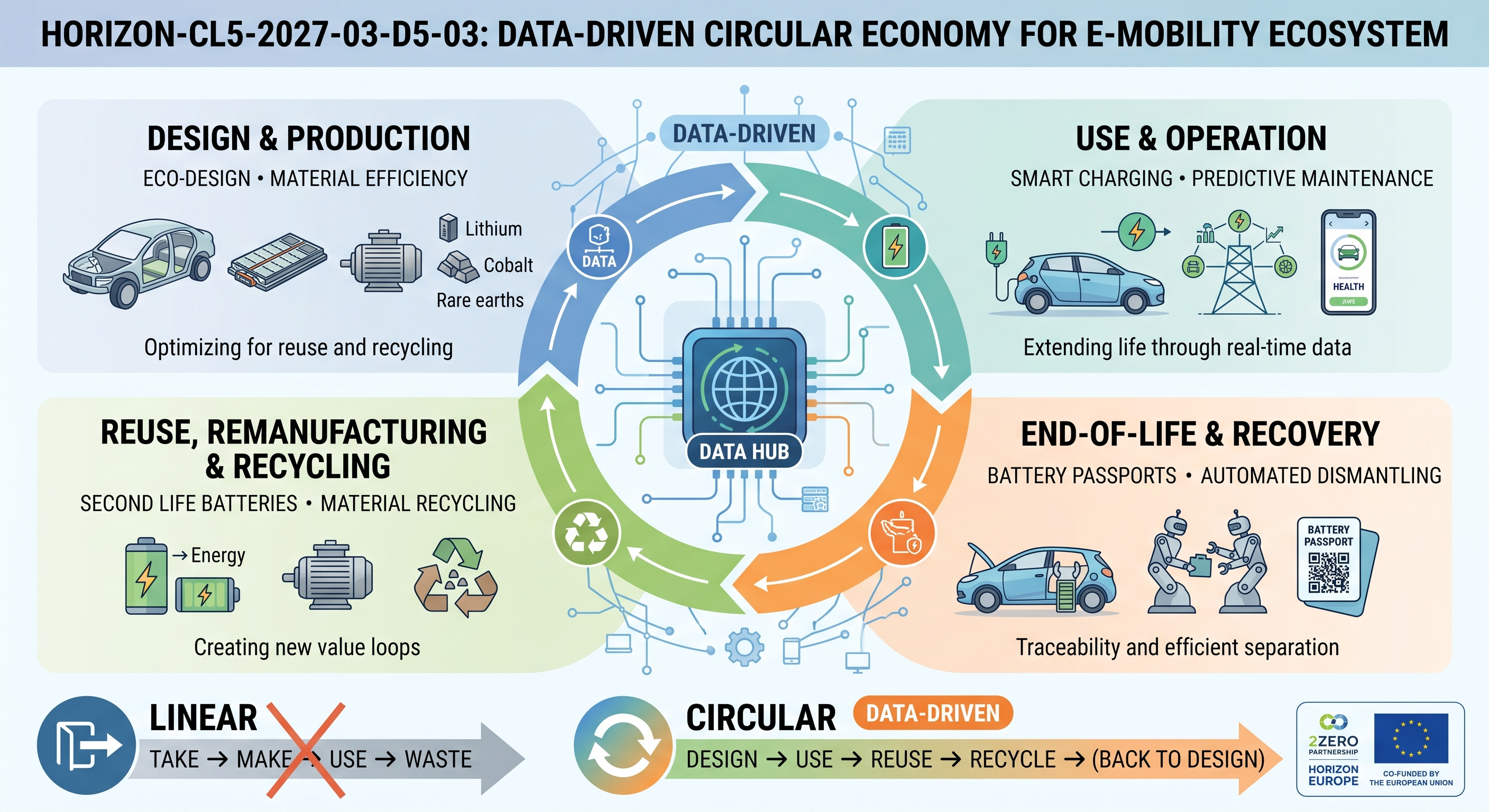
HORIZON-CL5-2027-03-D5-03: Data-driven circular economy for e-mobility ecosystem (2ZERO Partnership)
How can a digital product passport change which components are recovered?
It can guide the choice to inspect, repair or discard a product before it is dismantled. In a controlled experiment with simplified gearboxes exchanged between two laboratories, passport information shortened remanufacturing time. However, the rule used to reject whole gearboxes also prevented some reusable parts from being recovered. [1] HORIZON-CL5-2027-03-D5-03, “Data-driven circular economy for e-mobility ecosystem (2ZERO Partnership)”, addresses this connection between information and physical recovery through circular component design and data-driven lifecycle management. The challenge is to connect reliable component assessments with decisions that preserve function, reduce resource demand and support further use of electric vehicle components.
Download the MIC Horizon Europe 2026/2027 Calls Calendar:
Discover more!
Administrative facts: what do we know about the HORIZON-CL5-2027-03-D5-03 call?
Which call is it, and when is the opening and the deadline?
- Call name: MOBILITY
- Call identifier: HORIZON-CL5-2027-03
- Destination 5: Clean and competitive solutions for all transport modes, zero-emission road transport
- Topic: HORIZON-CL5-2027-03-D5-03, Data-driven circular economy for e-mobility ecosystem
- Opening date: 15 December 2026
- Deadline: 14 April 2027, 17.00 Brussels time
- Type of action: Innovation Action (IA)
What about the budget and estimated size of the project?
- Topic indicative budget: EUR 24.00 million
- Projects expected: 4
- Budget per project: EUR 6.00 million on average, quoted as EUR 5.00 to 7.00 million
- Note: the scope text quotes EUR 7 million for Area A and EUR 5 million for Area B
What are the key eligibility and evaluation conditions?
- Eligibility per General Annex B
- Copernicus and/or Galileo/EGNOS required if satellite observation, positioning or timing data are used
- TRL 6 to 7 expected at the end, any starting TRL
- Portfolio rule: the two highest ranked proposals in each Area get funded, if thresholds are met
- Lump sum funding
- Transfer of ownership or exclusive licensing can be blocked up to 4 years after the action
- Thresholds per General Annex D, 3 out of 5 per criterion, 10 out of 15 overall
Scientific range: what does the Commission expect from the HORIZON-CL5-2027-03-D5-03 grant?
What outcomes are expected?
Area A should end with drivetrain and charging hardware whose footprint is measurably lower across the whole life, plus a credible read on remaining useful life. Area B should deliver a vehicle level passport on digital twins, with track and trace that survives a real supply chain. Studies are not what the Commission is after.
What is within scope?
Battery cells are out. Nearly everything around them is in.
- Power electronic converters, motor rotors and stators, gear assemblies
- Thermal management of the battery system
- Electric Vehicle Charging Infrastructure
- Design for longer life, lower critical raw material content, automated dismantling
- Digital twins and passports interoperable with the battery passport and the ESPR
- API based data management, FAIR data, GDPR compliant sharing
- Light duty and heavy duty vehicles both qualify
What are the specifically proposed research directions?
- Component health monitoring and remaining useful life, covering wear, fatigue and thermal stress
- Design concepts cutting dependency on critical raw materials, or enabling alternatives
- Standardised assessment methods and interfaces, so refurbishment becomes commercially real
- Real world mechanical, electrical and thermal loads measured in the use phase
- Passport concepts connected to IDIS, IMDS and Catena-X
- Cost and benefit of tracing each data point. Easy to skip. Evaluators notice.
Scientific strategy: how can you enhance your chances of being funded through HORIZON-CL5-2027-03-D5-03?
What scientific choices matter most?
- Pick one Area and commit. A proposal straddling A and B usually weakens both.
- Build on the named predecessors. HORIZON-CL5-2021-D5-01-04, HORIZON-CL5-2022-D5-01-09 and HORIZON-CL5-2025-04-D5-04 are cited explicitly. Area A must match the 2022 motor performance under real conditions.
- Show the demonstration environment early.
- Treat data governance as engineering, not a legal annex. Ownership, access and consent need a named owner.
- Quantify circularity. Not in adjectives.
- Keep the LCA honest. We see proposals where it lands in month 40 and confirms what the consortium already believed.
Consortium & proposal-writing plan: what works best with this type of call?
- Somewhere between ten and fourteen partners, a couple more if you need several vehicle platforms
- An OEM or Tier 1 supplier is near mandatory for Area A. Without one, dismantling claims stay theoretical.
- Area B needs a recycler or dismantler from month one, not on an advisory board
- Touching passports? Bring someone already inside a data space or a standardisation body
- Add an innovative SME with an instrumentation speciality. Lump sum rewards partners who deliver a defined thing.
- Write the impact section against 2ZERO KPIs. You report to them anyway.
- Work packages must read as deliverable objects. Under lump sum, vague tasks cost money.
How should circularity solutions be demonstrated for electric vehicles?
Demonstrate a traceable chain from component condition to a circularity decision and its measured outcome. Define the intended next use, the acceptance criteria and the baseline against which the proposed improvement will be assessed.
For Area A, test representative drivetrain components or charging equipment through the relevant inspection, dismantling, repair or refurbishment operations. Measure retained functionality, damage introduced during recovery, material demand and processing effort. Verify performance under representative mechanical, electrical and thermal loads, and validate remaining useful life estimates for the intended duty. Battery cells are excluded from this area’s scope.
For Area B, demonstrate that a component can be identified, its operational history retrieved, and its record updated after repair or replacement across the participating organisations. Test permissions, shared data meanings and interfaces, including incomplete or conflicting records. Show how the vehicle-level passport and digital twin support a concrete lifecycle decision. Check compatibility with the battery passport and other relevant product passports.
Assess costs and lifecycle impacts alongside recovery performance. A modelling study of electric vehicle traction motors showed that collection and recovery assumptions affected the results and that use-phase energy remained important to environmental impacts. [2] Use measured demonstrator data where available and test the sensitivity of conclusions to subsequent service life, collection rates and replacement assumptions.
The MIC already brings its expertise in microfluidics to Horizon Europe:
H2020-NMBP-TR-IND-2020

Microfluidic platform to study the interaction of cancer cells with lymphatic tissue
H2020-LC-GD-2020-3

Toxicology assessment of pharmaceutical products on a placenta-on-chip model

About the author

Julia Sepulveda Diaz, PhD
Chief Executive Officer, Microfluidics Innovation Center
Julia holds a PhD in glycobiology and neurobiology from Université Paris-Est Créteil. Before moving into microfluidics, she spent several years as a postdoctoral researcher at the Paris Brain Institute, on Parkinson’s disease, neuroinflammation, and the role of heparan sulfate in protein aggregation. Today she leads the Microfluidics Innovation Center as CEO, steering its researchers and engineers and its collaborative research and innovation projects.
FAQ – HORIZON-CL5-2027-03-D5-03
These questions explore component assessment, data continuity and the interpretation of circularity results.
What is the difference between a circularity passport and a digital twin?
A passport organises information that can be accessed and exchanged about an identified product. A digital twin maintains a digital representation of its physical counterpart and can incorporate models of condition or behaviour. For circularity, distinguish stored observations, model outputs and the decisions made using them.
Is component health the same as remaining useful life?
No. Health describes the component’s current condition; remaining useful life estimates how long it can continue meeting a defined requirement under specified future use. A useful estimate identifies the failure criterion, assumed duty, model validity and uncertainty. A current inspection result alone does not establish future service life.
Can the same lifetime model be applied to different power converters?
Its applicability needs checking. Alavi and colleagues found that established lifetime models required adjustment against power-cycling tests on discrete insulated-gate bipolar transistors used in photovoltaic inverters. [3] For an electric vehicle application, validate the device packaging, failure mechanism and stress range before transferring model parameters.
How should reuse be compared with material recycling?
Compare the function retained, expected further service, recovery effort and outputs of each route. In a model of electric traction motors, Pérez-Cardona and colleagues represented reuse, disassembly, recycling and disposal as different outcomes with different lifecycle consequences. [2] Confirm the condition and intended use of recovered parts before selecting a route.
What should happen to a component’s record after repair or replacement?
Record the intervention, date, responsible organisation, inspection results and the identities of retained and replacement parts. Preserve the link between the previous and current configuration. The gearbox demonstrator studied by Abdel-Aty and colleagues updated the bill of materials with new and reused components after remanufacturing. [1]
How can a consortium identify the minimum useful dataset?
Start with a specific decision, such as whether a returned converter needs further inspection. Identify which data could change that decision and the precision they require. Test performance with reduced datasets, and compare the benefit of each retained field with the costs of measurement, storage, maintenance and access.
What does interoperability require beyond sending a data file?
The receiving system must interpret the information consistently. Test identifiers, units, timestamps, component configuration, parameter definitions and schema versions, together with access permissions. A useful test follows one component between organisations and verifies that each system reaches the same interpretation without undocumented manual corrections.
How should missing or conflicting lifecycle data be handled?
Make the gap explicit and preserve the source of each conflicting value. Define when the decision requires another inspection, a conservative estimate or human review. The gearbox passport experiment assumed accurate data, so its results do not establish robustness to unreliable records. [1] Test those cases separately.
How can automated dismantling be assessed without overlooking component damage?
Measure successful recovery as well as task completion. Record tool access, operator intervention, process time and damage to components or interfaces. Test recovered parts against their intended next-use requirements. Completing a dismantling sequence is only one part of demonstrating that the recovered output remains usable.
Does a higher recovery rate guarantee a lower environmental impact?
No. Recovery rate alone omits processing burdens, subsequent efficiency and what the recovered output replaces. In the traction-motor modelling study, use-phase energy strongly influenced environmental results despite circularity improvements. [2] Compare equivalent service and state assumptions about further lifetime, collection, replacement and material quality.
References
[1] Abdel-Aty, T. A., Doliman, B., Negri, E., Brooks, S., McFarlane, D., & Macchi, M. (2025). Evaluation of the Digital Product Passport for Remanufacturing: A Case Study Using Asset Administration Shell. IFAC-PapersOnLine, 59(10), 867–872. https://doi.org/10.1016/j.ifacol.2025.09.147
[2] Pérez-Cardona, J. R., Shakelly, N., Triebe, M. J., & Sutherland, J. W. (2025). Optimizing electric traction motor design: Analyzing the benefits of a circular economy. Journal of Cleaner Production, 486, 144522. https://doi.org/10.1016/j.jclepro.2024.144522
[3] Alavi, O., De Ceuninck, W., & Daenen, M. (2024). Optimizing Insulated-Gate Bipolar Transistors’ Lifetime Estimation: A Critical Evaluation of Lifetime Model Adjustments Based on Power Cycling Tests. Energies, 17(11), 2616. https://doi.org/10.3390/en17112616