Tips & Tricks for a successful HORIZON-CL5-2027-02-D3-09 proposal
Opening
03 December 2026
Deadline
Keywords
wave energy
tidal energy
ocean energy
SET Plan
IA
cascade funding
biodiversity
optimized control
competitive energy supply
next-gen power
Your microfluidic SME partner for Horizon Europe
We take care of microfluidic engineering, work on valorization and optimize the proposal with you
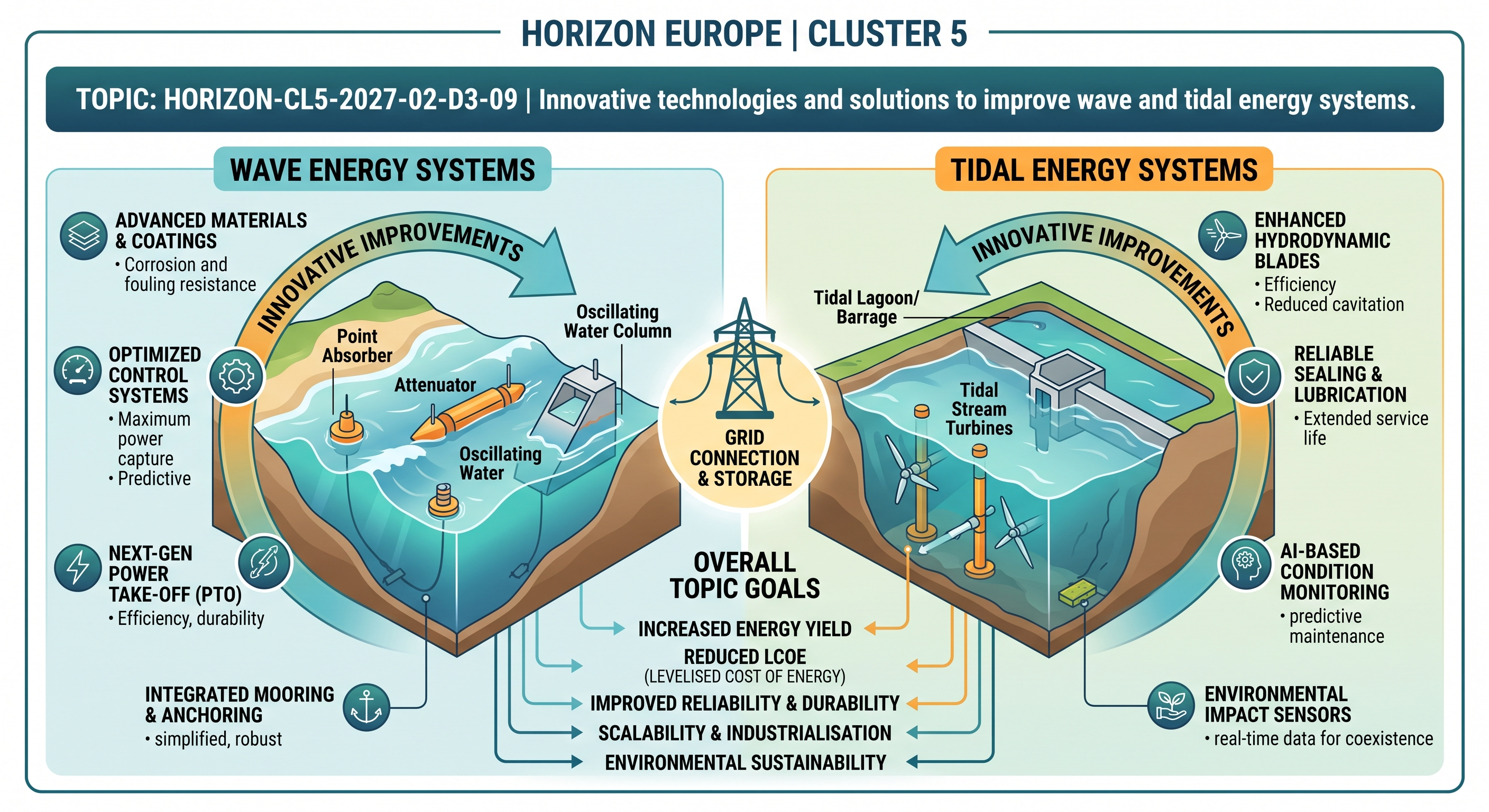
HORIZON-CL5-2027-02-D3-09: Innovative technologies and solutions to improve wave and tidal energy systems
The Commission wants ocean energy to stop being a niche. One large Innovation Action, pushing wave and tidal devices to market, with survival in a harsh sea as the real test. Cost, reliability and biodiversity sit in the same paragraph of the work programme. And a big slice of the money leaves the consortium through cascade funding.
Download the MIC Horizon Europe 2026/2027 Calls Calendar:
Discover more!
Administrative facts: what do we know about the HORIZON-CL5-2027-02-D3-09 call?
Which call is it, and when is the opening and the deadline?
- Call name: Batteries and Energy
- Call identifier: HORIZON-CL5-2027-02
- Destination: Sustainable, secure and competitive energy supply
- Topic: HORIZON-CL5-2027-02-D3-09
- Opening: 03 December 2026
- Deadline: 31 March 2027, 17:00:00 Brussels time
- Type of action: Innovation Action
What about the budget and estimated size of the project?
- Topic budget: EUR 43.00 million
- Projects expected: 1
- EU contribution per project: around EUR 43.00 million
- Demonstration challenge: capped at EUR 24 million
- FSTP: up to EUR 3 million (breakthrough), up to EUR 6 million (validation)
- Maximum per third party: EUR 800 000
- Project management: 7% of EU funding maximum
- Duration: around 5 years
What are the key eligibility and evaluation conditions?
- Thresholds: General Annex D, no exception declared
- Page limit raised to 60 pages
- TRL 6 to 7 by the end, any starting TRL
- Copernicus and/or Galileo/EGNOS mandatory if satellite data is used
- Financial support to third parties is compulsory, grants only
- Advisory Board required, including SET Plan Ocean Energy and Commission representatives
Scientific range: what does the Commission expect from the HORIZON-CL5-2027-02-D3-09 grant?
What outcomes are expected?
Devices that survive, produce, and cost less. The Commission is after hardware in the water and progress against SET Plan targets, not another round of concept studies. Fragmentation is the second target, so alignment across the European ocean energy community counts too.
What is within scope?
- Innovative wave devices and next generation tidal devices, demonstrated in a controlled environment
- Sustainable materials for converters, moorings and foundations, with structural integrity and circularity kept in view
- Moorings and transmission: combined mooring and electrical connectors, shared anchors in arrays, quick connection without divers
- Condition monitoring and predictive maintenance instrumentation, including AI
- Advanced manufacturing, installation, maintenance, decommissioning
Controlled environment means test tanks, semi-enclosed basins, or instrumented sea sites. Open water trials with no monitoring plan won’t qualify.
What are the specifically proposed research directions?
- Three challenges structure the work: breakthrough, validation, demonstration
- At least three demonstration activities, clearly different, each with a go/no go milestone
- Before that milestone: permits, engineering plans, a full business plan
- Stage gate metrics from IEA OES Task 12, plus SET Plan KPI reporting
- Two waves of cascade calls, breakthrough in year one, validation later
The work programme lists these areas without ranking them. Our reading: moorings, connectors and monitoring are where the cost curve actually moves.
Scientific strategy: how can you enhance your chances of being funded through HORIZON-CL5-2027-02-D3-09?
What scientific choices matter most?
- Pick demonstrations that can realistically get permits. Consenting timelines sink ocean energy projects more often than engineering does.
- Put the stage gate framework in the proposal, not in a future deliverable. Europewave normalised this, evaluators will look for it.
- Survivability evidence beats efficiency curves here.
- Keep the three demonstrations genuinely different. Two variants of one converter read as a single demonstration with a spare.
- Budget the FSTP work properly (this one catches people off guard). Two cascade schemes over five years is a job, not a task.
- The topic asks for TRL 6 to 7. What evaluators respond to is a credible route to a grid connected unit, not a tidy TRL claim.
Consortium & proposal-writing plan: what works best with this type of call?
- Somewhere between twelve and twenty partners, more if you cover several sea basins
- Device developers, materials suppliers, test centres, a utility or offshore contractor, marine ecologists
- At least one beneficiary with proven cascade funding experience, evaluators will check this
- Innovative SMEs matter twice here: inside the core consortium, and as the audience for your FSTP calls
- If your test site is not in the consortium, secure written access before submission. Marinerg-i and RISEnergy are named in the topic.
- Sixty pages feels generous until you add FSTP procedures, the risk plan and three demonstrations.
How would microfluidics contribute to this topic?
Checking what a farm does to the water around it usually means sending a boat, filling bottles, waiting weeks for a lab result. Microfluidics offers another route. Lab on chip analysers sit on the structure and measure seawater chemistry in place, on tiny reagent volumes.
- Say you need to show your array does not shift nutrient levels or pH nearby. A chip based analyser logs it continuously. No boat, no cool box, no sample degrading on the way back.
- eDNA capture on chip. Filter and preserve genetic material in situ, then match biodiversity data to real operating periods. Measurements land better than models.
- Antifouling coatings. Flow cells grow biofilms under controlled shear, so your team compares surfaces in weeks instead of a season in the water.
- Wear particles in gearbox oil say a lot about what is failing. Small flow through counters do this online, straight onto the condition monitoring line in the scope.
Microfluidics will not build your turbine. It turns two weak spots into hard evidence: environmental impact, and condition monitoring. Both sit in the expected outcomes.
The MIC already brings its expertise in microfluidics to Horizon Europe:
H2020-NMBP-TR-IND-2020

Microfluidic platform to study the interaction of cancer cells with lymphatic tissue
H2020-LC-GD-2020-3
Toxicology assessment of pharmaceutical products on a placenta-on-chip model

FAQ - HORIZON-CL5-2027-02-D3-09
What is HORIZON-CL5-2027-02-D3-09 about?
It funds one large Innovation Action to develop and demonstrate wave and tidal energy systems that survive a harsh sea, cost less, and keep impacts on health, the environment and biodiversity to a minimum. The work is framed around the SET Plan research and innovation priorities for ocean energy.
How much money is available and how many projects will be funded?
The topic budget is EUR 43.00 million and one project is expected, with an EU contribution of around EUR 43.00 million. Up to EUR 24 million of that is reserved for the demonstration challenge, and up to EUR 9 million goes out through financial support to third parties.
When does the call open and when is the deadline?
Call HORIZON-CL5-2027-02 (Batteries and Energy) opens on 03 December 2026 and closes on 31 March 2027 at 17:00:00 Brussels time. The Director-General may open the call up to one month earlier or later, and may delay the deadline by up to two months. Other Horizon Europe deadlines are listed on our calls for proposals page.
What technology readiness level is expected?
TRL 6 to 7 by the end of the project. Activities may start at any TRL, so a consortium can bring in early stage concepts as long as the demonstration path is credible.
How does financial support to third parties work in this topic?
FSTP is compulsory and can only take the form of grants. The maximum per third party is EUR 800 000, which is high on purpose since one entity may receive more than one grant across successive calls. Up to EUR 3 million supports the breakthrough challenge and up to EUR 6 million the validation challenge.
Check the Funding and Tenders Portal for more information.
What are the three challenges the project must organise?
Breakthrough, validation and demonstration. The first two can run inside the core consortium or through cascade calls. The demonstration challenge stays with the core consortium alone.
How many demonstration activities are required?
At least three, each with a clearly different focus and each with a go/no go milestone. Before that milestone the project has to show permits, complete engineering plans compliant with applicable standards, and a full business and implementation plan.
What does controlled environment mean for this call?
Monitored and reproducible conditions. That covers test rigs and test tanks, semi-enclosed basins, or dedicated real sea demonstration sites fitted with instrumented monitoring infrastructure.
Are there admissibility or eligibility exceptions?
Two worth noting. The page limit for proposals is raised to 60 pages. And if the project uses satellite earth observation, positioning, navigation or timing data, beneficiaries must use Copernicus and/or Galileo/EGNOS.
Where can microfluidics fit into a wave and tidal energy proposal?
Mainly on the environmental monitoring and condition monitoring side. In situ lab on chip analysers track seawater chemistry around an array, eDNA capture supports biodiversity claims, and microfluidic flow and particle instruments help with antifouling screening and oil debris counting. The Microfluidics Innovation Center joins consortia as a technical partner on that kind of work.