
Tips & Tricks for a successful HORIZON-CL5-2026-10-D2-03 proposal
Opening
04 June 2026
Deadline
Keywords
Lithium batteries
Battery production
Mobility batteries
Next-gen batteries
Sustainable materials
Battery innovation
BATT4EU
lithium-based cells
Your microfluidic SME partner for Horizon Europe
We take care of microfluidic engineering, work on valorization and optimize the proposal with you
HORIZON-CL5-2026-10-D2-03: Integrated production and product development for next-generation Lithium-based batteries for mobility (BATT4EU and Made in Europe partnerships)
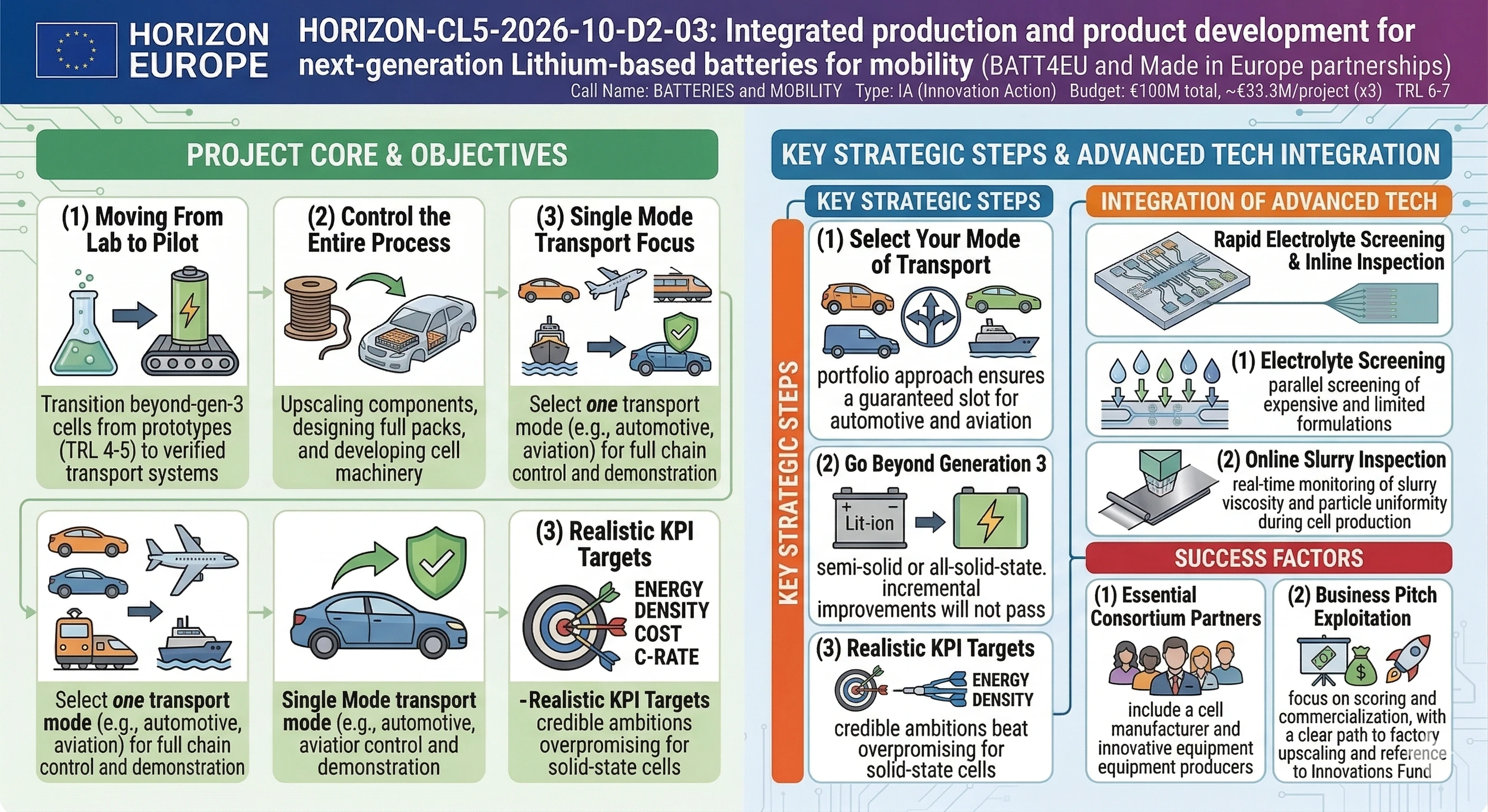
The Commission desires that Europe cease to be an observer in next-generation battery production. This is the matter of moving beyond-generation-3 lithium-based cells out of the laboratory to pilot production lines all the way to module and pack integration to actual transport systems. Choose a single mode of transport, control the entire production process, from cell to vehicle, and demonstrate scaleability. That’s the core ask.
Download the MIC Horizon Europe 2026/2027 Calls Calendar:
Discover more!
Administrative facts: what do we know about the HORIZON-CL5-2026-10-D2-03 call?
Which call is it, and when is the opening and the deadline?
- Call name: BATTERIES and MOBILITY
- Call identifier: HORIZON-CL5-2026-10
- Destination: Cross-sectoral solutions for the climate transition
- Topic: HORIZON-CL5-2026-10-D2-03
- Opening date: 04 June 2026
- Deadline: 08 October 2026
- Type of action: Innovation Action (IA)
What about the budget and estimated size of the project?
- Overall budget for this topic: EUR 100 million (of which EUR 15 million from the Digital, Industry and Space budget)
- Number of projects expected to be funded: 3
- Estimated EU contribution per project: around EUR 33.3 million
What are the key eligibility and evaluation conditions?
- Standard thresholds apply (General Annex D).
- Page limit is extended to 60 pages due to topic complexity.
- Target TRL at project end: 6 to 7.
- Portfolio approach: at least one automotive project and one aviation project will be funded, provided they pass all thresholds. This means sector choice directly affects your competition pool.
- JRC may join as a zero-funded beneficiary or associated partner. JRC will not take part in proposal preparation.
- If projects use satellite-based earth observation, positioning, navigation, and/or related timing data and services, beneficiaries must make use of Copernicus and/or Galileo/EGNOS.
- IP restriction: the granting authority can block transfer of ownership or exclusive licensing up to 4 years after the action ends.
- Projects must report KPIs to both Batt4EU and Made in Europe partnerships.
- Safe and Sustainable by Design (SSbD) framework applies.
- Exploitation plan must include a feasibility study and business plan, with reference to possible Innovation Fund follow-up.
Scientific range: what does the Commission expect from the HORIZON-CL5-2026-10-D2-03 grant?
Full demonstration chain is what the Commission is after. At TRL 4 or 5 you begin with cell prototypes, and at TRL 9 or 10 you have verified modules or packages installed to a vehicle or an environment of interest. Not a lab report.
A project should focus on only one mode of transport: automotive, aviation, rail, or waterborne. No mixing. The work programme makes it clear and the portfolio mechanism is rewarding the decision: automotive and aviation are allocated a slot of guaranteed funding.
The following is the coverage of the projects:
- Up-scaling of component manufacture, i.e., anode and cathode material to operate with next-generation electrolytes, manufactured on a pilot scale.
- Cell production machines and equipment. Consider flexible, high-throughput strategies: laser patterning, vacuum sintering, high-tech calendaring, solid electrolyte deposition, high-precision stacking.
- Module and pack design integrated into the target vehicle or environment, with battery management systems, thermal management, safety and durability validation under realistic conditions.
- Battery requirements in the case of aviation must satisfy the minimum of EASA CS.23 level 4 and CS.27 and optimally CS.25. That’s not a soft preference.
- Performance KPIs set in advance by the Commission are also anticipated: energy density (volumetric and gravimetric), power density, C-rate, cycle life, and cost. You set your targets and then you provide them.
Scientific strategy: how can you enhance your chances of being funded through HORIZON-CL5-2026-10-D2-03?
Which scientific options are the most important?
- Choose your mode of transport first and base the whole proposal on the mode of transport. The portfolio mechanism implies that you will be competing in your industry and not four.
- Go beyond generation 3. The work programme invokes semi-solid and all-solid-state directly. Welcome to Generation 5 ideas. Repackaged suggestions to improve the current lithium-ion by a little bit will not pass the scale, at least in our case.
- Cover the full chain. The proposals that concentrate on either cell chemistry or the pack integration are likely to miss the mark. The Commission desires component upscaling, cell manufacturing and system-level demonstration within a single project.
- Demonstrate you are able to construct the machines, not to operate them. The next-generation production machinery development is a particular request. Innovative equipment is a plus.
- Be specific in the definition of your KPIs and do not promise too much. At TRL 6-7, evaluators in this space are aware of what is realistic with solid-state cells. Credibility beats ambition.
- Cover extreme conditions of safety testing. Runaway, vibration, mechanical stress. This does not happen to be optional but it is expected in the validation package.
- SSbD is not a decoration, it is a framework reference. Practice it, say it, relate it to your choice of materials.
Consortium & proposal-writing plan: what works best with this type of Innovation Action?
- Make it about 10 to 15 partners, possibly even more in case the industrial validation chain dictates such. The projects are EUR 33 million, so can have a good consortium but do not slack governance.
- It requires a pilot line operator, a coordinator, or a key partner as a cell manufacturer. Otherwise, the proposal will not work in support of an IA of this magnitude.
- Include equipment manufacturers. The call particularly requests production machinery development. The very presence of an SME/mid-cap that produces battery manufacturing tools is a good indicator (and it is worth considering in case an innovative SME would take its place).
- Materials science and electrochemistry academic collaborators, but make them focused. It is not a research project.
- Tier-1 supplier or OEM of your selected mode of transport. In the case of aviation, an aircraft integrator or a certified aviation partner is nearly obligatory depending on the conditions of EASA.
- Add a partner that has LCA and techno-economic evaluation knowledge. The exploitation plan should include a business case in terms of follow-up pathways with Innovation Fund.
- In case your proposal targets automotive, you should mention that this topic is specifically a part of the EU industrial action plan of the automotive sector. Prepare your impact in this way.
- Write the exploitation section as business pitch, rather than an educational dissemination plan. Scoring, commercialisation, deployment. The Commission is interested in having a plausible road between pilot line and factory.
How would microfluidics contribute to this topic?
It is one thing to scale up next-generation battery cells to pilot production. Another thing is a detailed knowledge of what goes on in those cells in the manufacturing process. Traditional characterisation systems are slow and tend to be offline. Microfluidic platforms introduce real-time and inline functionality that manufacturing lines in this TRL actually require.
- Screening and optimisation of electrolytes. Suppose that you are experimenting on five solid electrolyte formulations in terms of ionic conductivity and stability. A microfluidic system provides the ability to screen in parallel with small amounts of material, important when your next-generation materials are costly and limited.
- Online electrode coating inspection. Microfluidic sensors are capable of checking slurry viscosity, particle distribution and uniformity of mixes at the production line. You detect defects when they are still cells in waste.
- Small-scale thermal management validation. You can also simulate the patterns and dissipation of coolant flow through microchannels before you construct the complete pack. Equal physics, half the price.
- Interface characterisation. Most next-gen cells fail at the solid-electrolyte-to-electrode interface. Microfluidic cells will enable you to study degradation processes in controlled conditions, providing your BMS design team with real data rather than the guesses.
In the case of a proposal for TRL 6-7 pilot production, a microfluidics partner with the ability to provide inline quality tools or rapid material screening is a tangible advantage. It is the type of partner that will make your manufacturing innovation narrative concrete to the assessors.
The MIC already brings its expertise in microfluidics to Horizon Europe:
H2020-NMBP-TR-IND-2020

Microfluidic platform to study the interaction of cancer cells with lymphatic tissue
H2020-LC-GD-2020-3

Toxicology assessment of pharmaceutical products on a placenta-on-chip model

FAQ - HORIZON-CL5-2026-10-D2-03
What is this call actually asking for?
The focus of this call is the entire chain – cell chemistry and manufacturing processes to final product integration – of next-generation lithium-based batteries in mobility applications (EVs, two-wheelers, heavy transport). It is located at the crossroads of two EU partnerships: BATT4EU and Made in Europe. The dualism is not artificial; it indicates that the assessors truly desire both breakthroughs in battery performance and manufacturable, scalable solutions based on European industrial capacity.
What do BATT4EU and Made in Europe actually mean for my proposal?
Two things in practice:
- BATT4EU will satisfy the scientific ambition: new chemistries in solids, solid-state or semi-solid electrolytes, silicon or lithium-metal anodes, and better cathode materials.
- Made in Europe: your output will need to fit the European logic of industrial: your output should plausibly be compatible with European manufacturing preparedness, supply chain sovereignty, and industrial scalability.
Any proposal that is an academic study of chemistry without a manufacturing route, or an academic study of process engineering without material innovation, will not fare well under both lenses at the same time.
Who is the ideal consortium for this call?
The most powerful teams are those that have a combination of at least three profiles:
- Electrochemists and materials scientists (cell-level knowledge)
- Process, manufacturing engineers (pilot line or pre-industrial experience)
- Automotive or mobility OEM or Tier-1 (end-use validation, requirements definition)
There is a lot of credibility in the inclusion of a European battery cell manufacturer or a partner aligned with Gigafactory. The industrial relevance score is also enhanced by SMEs that have specialized equipment or characterization capabilities.
What TRL range is this call targeting?
In CL5 with BATT4EU, calls of this nature are typically made to TRL 3-5 at entry and intended to achieve TRL 5-6 at project end. Other calls extend to TRL 6-7 in case of manufacturing integration at the core. Pick up the Work Program with a careful eye, this particular subject can give fewer limits. Check the Funding and Tenders Portal for more information.
What are the core outcomes evaluators are looking for?
Strong proposals are more likely to be characterized by four categories:
- An objective increase in battery performance (energy density, cycle life, safety, fast-charging capability)
- Evidence that the new chemistry or architecture can be produced at a suitable scale, and not only in the lab.
- Life-cycle and sustainability analysis: non-negotiable requirements in the context of the EU battery regulation.
- A plausible course to European supply chain integration and de facto reliance on non-EU vital raw materials.
How should you handle the sustainability and raw materials angle?
This is no longer optional framing. Considering the EU Critical Raw Materials Act and the Battery Regulation (Regulation 2023/1542), the proposals are failing to deal with:
- Less dependence on cobalt or responsible sourcing policies.
- Second-life and recyclability.
- Carbon footprint in cells and packs.
Will be penalized at evaluation. Develop them into your work packages at the beginning, not as an addition to the impact section.
What role can microfluidics play in a battery proposal?
There are three tangible entrances:
- Electrolyte formulation and characterization: microfluidic systems enable high-throughput screening of electrolyte formulations, solvent ratios, and additive interactions at small scales, speeding up formulation cycles by many times.
- Analysis of electrode slurry and quality control of coating: Inline microfluidic sensors can measure particle size distribution and rheology during the manufacturing process.
- SEI interface studies: microreactor systems enable controllable, repeatable SEI formation, which would be challenging at the standard laboratory scale.
When microfluidics is your business, make it a tool to speed-to-result and quality manufacturing, but not the topic of your proposal.
What mistakes kill good proposals?
The most typical structural failures:
- Thinking of the manufacturing integration as a work package at the end of the project and not as a thread running through the whole project.
- Inventory characterization techniques without relating them to decision points (what will you do differently based on the result?)
- Oversimplified exploitation schemes that do not identify specific European manufacturing routes or industrial partners.
Impact sections that quote statistics on market size without demonstrating how this project will alter the competitive environment of the European battery industry in particular.
How should the work plan be structured?
One of the logics that invariably succeeds:
- WP1: Materials and chemistry development (TRL entry point is clearly indicated)
- WP2: Cell design and assembly (bridging materials to device)
- WP3: Process development and scale-up (the Made in Europe aspect)
- WP4: Performance validation and testing (against actual mobility use cases)
- WP5: Sustainability, LCA, and regulatory alignment.
- WP6: Dissemination, exploitation, and IP management.
Not only does each WP require deliverables, but it also requires measurable milestones. Evaluators seek go/no-go decision points.
What does a strong impact section look like here?
Discuss the changes to the European battery landscape in case this project is successful. Be specific:
- What is the performance gap that is closed (e.g., energy density to X Wh/kg at pack level)
- What is the manufacturing bottleneck that is solved?
- Which is the EU policy goal directly supported (Battery Regulation compliance, CRM dependency reduction)
Then how, or on what path of exploitation, with which partner, at what time after the project? An unspecified “industry partners will exploit results is not enough.
What is the single most important thing to get right?
The integration argument. The title of this call is “integrated production and product development” – the word is working. Proposals that treat materials science and manufacturing as two tracks that meet at the end are not going to score as well as proposals where every scientific decision is taken with manufacturing constraints in mind, and every manufacturing decision is based on the underlying chemistry. Demonstrate that communication is occurring in your consortium, not only during the final review meeting.