
Tips & tricks for a successful HORIZON-CL4-2027-01-MAT-PROD-16 proposal
Opening
13 October 2026
Deadline
Keywords
Critical raw materials
Innovative processing
Mineral processing
Mining waste recovery
Circularity
Pilot-scale demonstration
High-value products
Your microfluidic SME partner for Horizon Europe
We take care of microfluidic engineering, work on valorization and optimize the proposal with you
HORIZON-CL4-2027-01-MAT-PROD-16: Technologies for innovative processing of raw materials (IA)
Why can a promising extractant recover too little metal in a flowing process?
Because favourable extraction equilibrium does not establish how quickly a metal transfers between two liquids. Diffusion, interfacial reactions and contact time determine the extraction achieved before the liquids leave the contactor. Fernández-Maza and colleagues combined experiments and modelling to examine these effects in a dysprosium–lanthanum system using Cyanex 572. Their study concerned a defined laboratory mixture. [1]
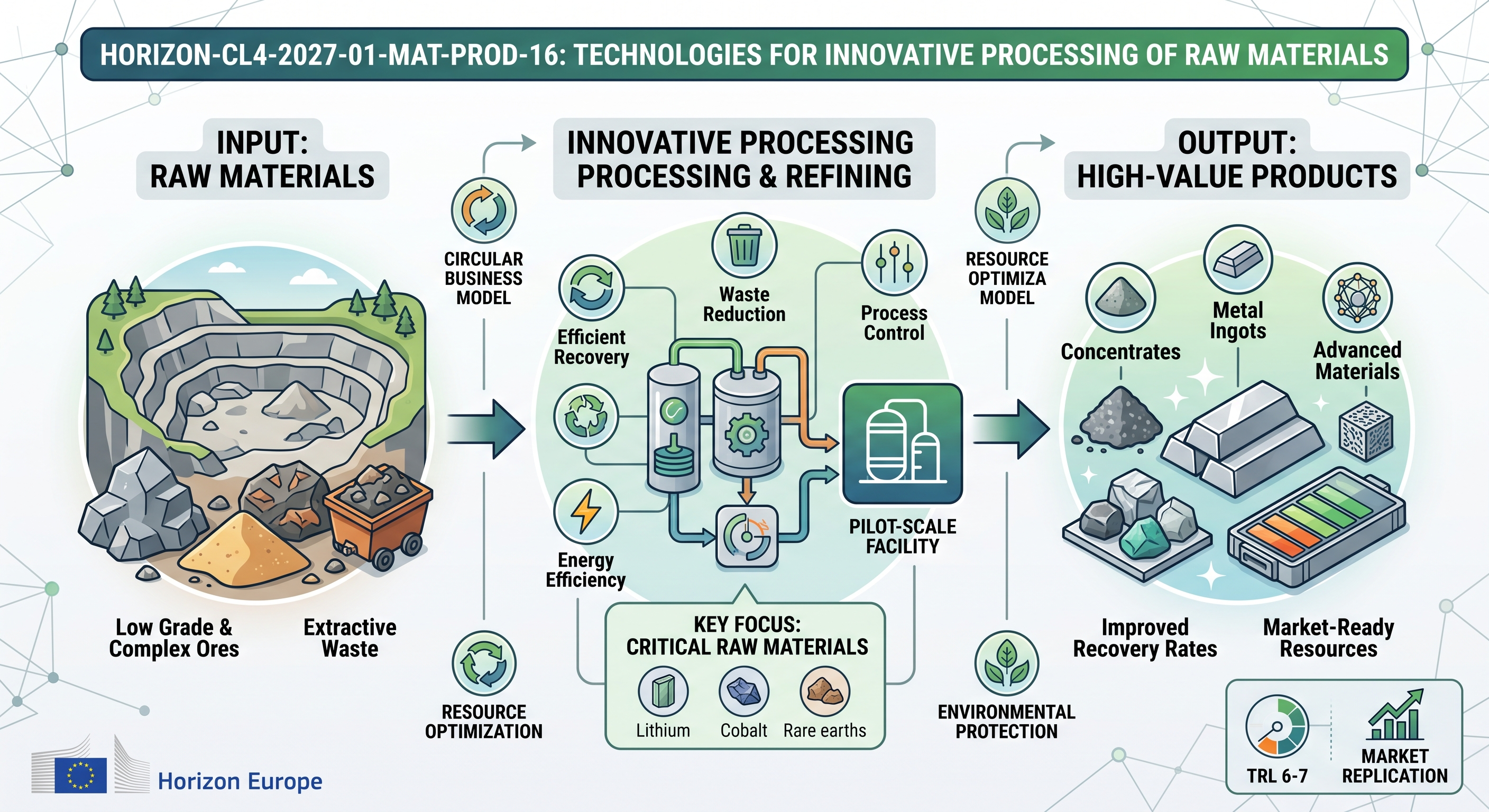
For hydrometallurgical routes under HORIZON-CL4-2027-01-MAT-PROD-16, this connects extraction chemistry to the development of flexible, resource-efficient processing. The wider topic seeks EU pilot facilities that improve recovery from low-grade or complex ores and extractive wastes.
Microfluidics Innovation Center (MIC) develops controlled liquid-handling systems. Its droplet generator pack combines pressure control, flow measurement and microfluidic droplet formation. These capabilities provide an engineering basis for targeted solvent-extraction experiments with metallurgical partners.
Download the MIC Horizon Europe 2026/2027 Calls Calendar:
Discover more!
Call facts and participation conditions
Which call is it, and when is the opening and the deadline?
- Call: INDUSTRY – HORIZON-CL4-2027-01.
- Destination: Leadership in materials and production for Europe, Raw Materials area.
- Topic: HORIZON-CL4-2027-01-MAT-PROD-16 – Technologies for innovative processing of raw materials (IA). (Official page)
- Type of action: Innovation Action (IA).
- Opening: 13 October 2026. Single-stage deadline: 2 February 2027, 17:00 Brussels time.
What about the budget and expected project size?
- Total indicative topic budget: EUR 49.00 million.
- Indicative number of projects expected to be funded: 4.
- Expected EU contribution per project: EUR 10.00–12.50 million. Proposals requesting different amounts may also be submitted and selected.
What are the key participation and implementation conditions?
- Activities are expected to start at technology readiness level (TRL) 5 and achieve TRL 7 by the end of the project.
- Participation is limited to legal entities established in EU Member States, associated countries, OECD countries, African Union Member States, MERCOSUR, CARIFORUM, the Andean Community, and countries with EU strategic partnerships on raw materials or qualifying trade, association, economic-partnership or equivalent agreements containing raw-materials cooperation provisions.
- Entities established in an eligible country but directly or indirectly controlled by a non-eligible country or a non-eligible-country entity cannot participate. Proposals including entities outside the permitted countries are ineligible.
- The proposal page limit is extended by three pages to include the business case and exploitation strategy.
- Plan clustering with relevant selected projects through a dedicated work package and/or task, with appropriate resources earmarked.
- The granting authority may object to a transfer of ownership or exclusive licensing of results for up to four years after the action.
The Digital, Industry and Space work programme and applicable General Annexes set out the full conditions.
Scientific scope: recovery, resource efficiency and EU pilot demonstration
What outcomes are expected?
Projects should increase recovery of valuable minerals and metals, particularly critical raw materials, from low-grade or complex ores and/or mining waste. They should improve material, water, energy and cost efficiency, process flexibility, and health, safety and environmental performance across the life cycle considered.
What is within scope?
- Develop and validate or demonstrate a pilot-scale facility located in the EU, integrating relevant processing and refining technologies.
- Address low-grade or complex ores and extractive waste streams, with solutions able to adapt to variable feed grades and supported by efficient, robust process control.
- Develop intelligent, innovative production systems that minimise losses during waste-rock separation, improve energy efficiency and minimise water use.
- Reduce waste, wastewater and air pollution, while addressing land and sea-use change, habitat loss, degradation and fragmentation.
- Actions may also reduce toxic elements or compounds in material products. Where relevant, include appropriate management of the hazardous substances removed.
- Recycling of end-of-life products is excluded.
Which technologies should be selected?
Choose technologies according to the feed characteristics and recovery challenge. Beneficiation and hydrometallurgical processing are possible routes; the topic does not prescribe either as a mandatory choice. Explain how the selected operations work together in the pilot and contribute to the expected outcomes.
Scientific strategy: connect feed characterisation to pilot validation
Build the proposal around a defined processing problem and evidence that the integrated solution can address it. The following are design recommendations:
- Characterise the feed. Identify the ore or extractive-waste source, mineral composition, grade variability and relevant impurities. Explain how test samples represent the intended operation.
- Define the comparison. Establish baselines and targets for recovery, product quality, material use, water, energy, costs and emissions, with consistent measurement boundaries.
- Integrate process control. Identify the measurements and operating adjustments needed to handle changes in feed composition and grade.
- Plan pilot validation. Connect the starting TRL 5 evidence to the integrated EU pilot demonstration and TRL 7 objective. Define operating conditions and acceptance criteria.
- Follow the removed fractions. Where toxic substances are removed, assess their subsequent handling and treatment alongside the recovered product.
- Connect validation to deployment. Use the business case and exploitation strategy to address users, costs, financial opportunities and replication. For TRLs 6–7, explain the credible route to full-scale EU deployment and leading partners’ post-project commitments.
Consortium and exploitation: cover the relevant value chain
The topic calls for an industrially and user-driven multidisciplinary consortium covering the relevant value chain. EU-based industry and users of recovered secondary raw materials should have prominent roles supported by adequate resources.
- Build around responsibilities. Cover feed supply and characterisation, processing and refining technologies, pilot operation, product assessment, environmental performance and exploitation. Select organisations according to the chosen route.
- Choose size and leadership from the work plan. The topic specifies no preferred partner count, SME quota or requirement for a mining or metallurgy company to coordinate.
- Define partner interfaces. Agree sample specifications, process data, analytical methods, equipment interfaces and responsibility for accepting pilot results.
- Plan uptake. Include standardisation where relevant and analyse financial opportunities for market exploitation and replication of the circular business model.
- Resource cooperation. Allocate effort to clustering, shared results, joint meetings and communication events with relevant selected projects.
- Make international cooperation purposeful. Cooperation with EU strategic raw-materials partner countries, especially Ukraine, is encouraged. Check each organisation against the topic’s participation and control restrictions.
Microfluidic testing for solvent-extraction process development
Microfluidic contactors can help investigate a solvent-extraction step within a hydrometallurgical processing route. Yang and colleagues studied stacked microfluidic chips for metal extraction and their integration into a three-stage counter-current circuit, in which the aqueous and organic phases move through successive stages in opposite directions. Their work connects small-channel extraction with questions of throughput and process integration. [2]
MIC’s droplet generator pack controls immiscible liquid flows and has been used to generate water-in-oil droplets. MIC could contribute as a consortium partner by adapting this fluid-handling expertise to extraction experiments linked to the selected pilot process:
- Develop a two-phase flow setup for controlled comparisons of phase-flow ratios and contact times.
- Record flow rates and droplet behaviour alongside metal-concentration measurements performed by the analytical partners.
- Produce a repeatable test protocol and a dataset relating operating conditions to extraction performance, for comparison with batch tests and the pilot extraction stage.
The experimental design must establish compatibility with the chosen acids, extractants and solvents, including the chip, tubing, seals and flow measurements. The consortium would need to provide representative leachates, extraction chemistry, reference analytical methods and access to pilot validation.
The proposed contribution is useful where solvent-extraction performance affects recovery, selectivity or reagent use in the chosen processing route. Its value should be demonstrated through the decisions it enables at pilot scale.
The MIC already brings its expertise in microfluidics to Horizon Europe:
H2020-NMBP-TR-IND-2020

Microfluidic platform to study the interaction of cancer cells with lymphatic tissue
H2020-LC-GD-2020-3

Toxicology assessment of pharmaceutical products on a placenta-on-chip model

About the author
Céleste Chidiac, PhD
Scientific writer and digital marketing specialist
Céleste Chidiac holds a doctorate in neuroscience and molecular biology from the University of Strasbourg. Since joining the Microfluidics Innovation Center in 2023, she has combined scientific writing with website management. For MIC’s Horizon Europe topic pages, she draws on her research background to explain scientific challenges and clarify funding priorities. Her writing helps prospective applicants understand each topic’s scope, expected outcomes and research directions.
FAQ — Raw-material processing and microfluidic extraction
Practical questions about extraction measurements, experimental design and transfer to pilot operation.
What is the difference between leaching and solvent extraction?
Leaching dissolves metals from a solid into a liquid. Solvent extraction transfers dissolved metals between immiscible liquid phases. Testing an extraction step therefore does not establish how effectively the preceding leaching step releases metals from an ore.
Does high metal recovery guarantee a pure product?
No. A process can recover the target metal while also extracting unwanted elements. Recovery and selectivity need separate assessment, followed by checking whether the recovered product meets its intended user’s composition requirements. [1]
What should accompany a reported extraction percentage?
Can reducing solvent consumption make extraction harder?
Yes. Increasing the aqueous-to-organic phase ratio reduces solvent use per unit of aqueous feed, but can lower extraction performance. Chen and colleagues investigated this trade-off using a prepared neodymium solution and a P507 extractant system. [3]
Do more stable droplets always improve metal extraction?
No. In Chen and colleagues’ neodymium experiments, excess interfacial nanoparticles stabilised droplets but impeded metal transfer. The study also used a magnetic field to separate the liquid phases after extraction. Droplet stability and downstream phase separation therefore require joint assessment. [3]
Can MIC’s flow sensor measure dissolved metal concentrations?
No. The flow sensor in MIC’s droplet generator pack measures liquid flow. Metal concentrations require a separate analytical method validated for the chosen elements and sample composition. Flow control alone cannot establish extraction efficiency.
What needs checking before using acidic leachates in a microfluidic setup?
Check the compatibility of every wetted component with the acid, solvent and extractant. Establish how suspended solids, sample preparation and deposits affect flow and sample representativeness. Calibration must also be appropriate for the liquids used.
Are tests with a synthetic metal solution sufficient?
They help isolate mechanisms, but do not establish performance with the intended process feed. A useful validation plan follows them with representative leachates and a defined range of feed compositions, including relevant impurities, using the same reference analysis.
What does numbering-up mean for microfluidic extraction?
It means operating multiple extraction channels or devices in parallel to increase throughput. Yang and colleagues investigated stacked chips and parallel modules. Their work highlights flow distribution and integration between extraction stages as practical scaling questions. [2]
Does using less reagent in laboratory tests prove a greener pilot process?
No. Laboratory consumption and pilot-process performance have different boundaries. Assess water, energy, reagents, solvent losses and waste treatment across the relevant processing chain, using a defined baseline and a consistent quantity of recovered product.
References
[1] Fernández-Maza, C., González-Lavín, G., Gómez-Coma, L., Fallanza, M., and Ortiz, I. High performance flow-focusing droplet microreactor. Extractive separation of rare earths as case of study. Chemical Engineering Journal. 2024;486:150136. https://doi.org/10.1016/j.cej.2024.150136
[2] Yang, D., Navvab Kashani, M., and Priest, C. Pilot-scale microfluidic solvent extraction of high-value metals. Minerals Engineering. 2022;182:107536. https://doi.org/10.1016/j.mineng.2022.107536
[3] Chen, Z., Yuan, J., Dong, Y., Liu, H., Liang, F., Yang, Z., Wang, Y., and Xu, J. Efficient recovery and enrichment of rare earth elements by a continuous flow micro-extraction system. Fundamental Research. 2022;2(4):588–594. Published online in 2021. https://doi.org/10.1016/j.fmre.2021.06.019