
Long-duration batteries: demonstrating performance beyond eight hours
Opening
05 May 2027
Deadline
Keywords
BATT4EU
long-duration storage
redox flow batteries
market deployment
grid stabilization
thermal storage
renewable energy
European supply chain
SSD
Your microfluidic SME partner for Horizon Europe
We take care of microfluidic engineering, work on valorization and optimize the proposal with you
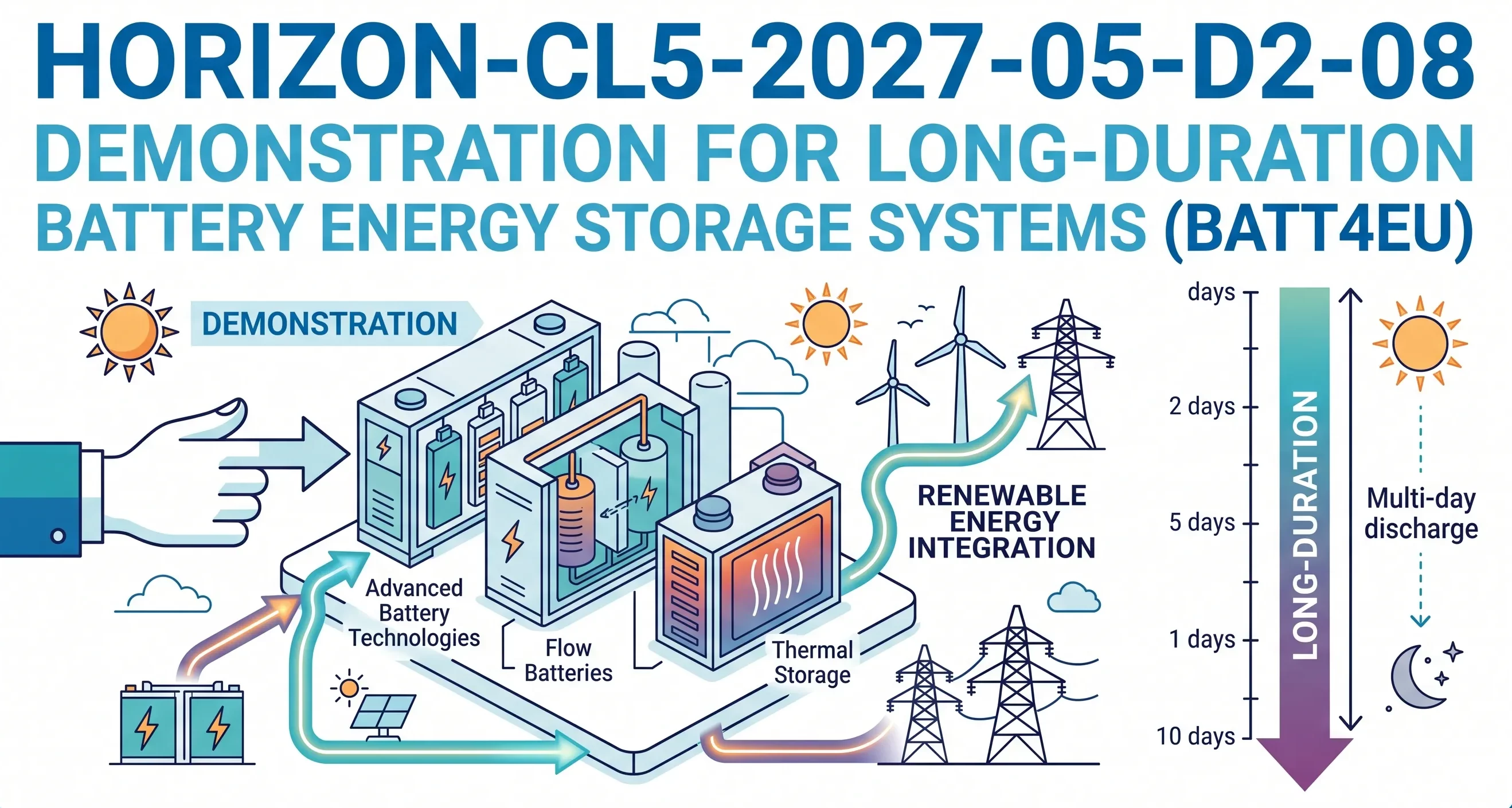
HORIZON-CL5-2027-05-D2-08: Demonstration for Long-duration Battery Energy Storage Systems (BATT4EU Partnership)
Why can electrolyte storage change the cost of a flow battery?
For a given electrolyte formulation, storing more energy requires more liquid and suitable containment, so tank selection affects a flow battery’s capital cost and installation. Using manufacturers’ quotations for sulfuric-acid storage tanks, Reber’s 2025 analysis showed that tank costs can be underestimated in flow-battery economic models. The estimates depend on tank specifications and electrolyte assumptions; they are not field measurements of battery profitability. [1] This illustrates a system-design challenge for HORIZON-CL5-2027-05-D2-08: demonstrate innovative battery storage lasting more than eight hours, while assessing the performance, safety and costs of the complete installation.
Download the MIC Horizon Europe 2026/2027 Calls Calendar:
Discover more!
Call facts and eligibility conditions
Topic: HORIZON-CL5-2027-05-D2-08 — Demonstration for Long-duration Battery Energy Storage Systems (BATT4EU Partnership). This Innovation Action belongs to the BATTERIES and ENERGY call, HORIZON-CL5-2027-05, within the destination Cross-sectoral solutions for the climate transition. Official topic page
- Schedule: opening on 5 May 2027; deadline on 15 September 2027 at 17:00 Brussels local time
- Indicative topic budget: €18.80 million. The expected EU contribution is around €9.40 million per project, with two projects indicatively expected. Different requested amounts remain possible.
- Technology readiness: activities are expected to achieve technology readiness level (TRL) 6–7 by project completion. Activities may start at any TRL.
The General Annexes apply. The standard consortium minimum is three independent legal entities in three different countries: at least one in an EU Member State and at least two others in different Member States or Associated Countries. Affiliated entities do not count towards this minimum.
General Annex B excludes legal entities established in China from Innovation Actions, subject to its case-by-case exception provision. This topic additionally excludes entities established in an eligible country that are directly or indirectly controlled by China or by a legal entity established in China.
If satellite-based Earth observation, positioning, navigation or related timing data and services are used, beneficiaries must use Copernicus and/or Galileo/EGNOS; other data and services may additionally be used.
The Joint Research Centre (JRC) may join the selected consortium as a beneficiary requesting zero funding or as an associated partner, subject to agreement after evaluation. It cannot participate in preparing or submitting the proposal.
The granting authority may object to transfers of ownership or exclusive licensing of results for up to four years after the action ends. Projects are expected to report results to the BATT4EU Partnership for monitoring its key performance indicators.
Scientific scope and expected outcomes
The HORIZON-CL5-2027-05-D2-08 topic seeks system-level demonstrations of innovative battery storage lasting more than eight hours, serving utility-scale energy systems or industrial consumers. Projects are expected to contribute to all four outcomes: stronger grid stability, resilience and flexibility; reduced dependence on critical raw materials; insights for a coherent European stationary-storage deployment strategy; and reproducible operational data for technoeconomic analysis.
The demonstration should address advanced technologies not yet on the market. Examples include novel redox flow batteries with standard or mediated electrolytes, high-temperature battery systems, metal-air systems, multivalent organic or aqueous chemistries, and other non-commercialised battery technologies or architectures.
Projects are expected to cover all the following areas:
- Use cases and quantified impacts: define front-of-meter grid storage, behind-the-meter industrial storage or renewable-generation firming applications. Quantify effects on grid resilience, emissions, safety and storage cost.
- Hybridisation: assess whether complementary storage technologies can improve performance and system life for the intended use case. Building a hybrid system is not a universal requirement.
- Materials and production: use abundant, low-cost and sustainable materials, prioritising reliable and scalable European supply chains. Set out realistic routes to production at scale.
- Digital integration: develop accurate state-of-charge (SOC), state-of-health (SOH) and lifetime predictions to improve battery management systems (BMS), energy management systems (EMS) and component performance.
- Technoeconomic analysis: assess capital expenditure (CAPEX) and operating expenditure (OPEX) using measured performance, including self-discharge, calendar life, cycle life, round-trip efficiency and necessary safety investments. Compare with a commercial incumbent serving the intended use case.
- System safety: assess flammability, toxicity and explosion potential, with mitigation measures ahead of wider adoption.
The emphasis on demonstration makes integration and operational evidence central. Component development should support those system objectives.
Develop a credible demonstration and exploitation plan
Start from the service the installation must deliver. Specify the user, operating profile and commercial technology used for comparison. The following are proposal-design recommendations, rather than additional eligibility conditions.
- Connect innovation to the demonstration: explain what is new in the battery technology or architecture and why the selected maturity and work plan support the end-of-project target.
- Build the cost model alongside the test plan: identify which assumptions will be replaced by measurements and which remain projections. Test sensitivity to utilisation, energy costs, replacement intervals and material supply.
- Substantiate production choices: identify material quantities, sourcing options and scale-up constraints. Document supplier capabilities and realistic delivery assumptions when assessing production feasibility.
- Assess hybridisation on a common basis: compare the proposed configuration with a single-technology alternative delivering the same service.
- Consider safety and sustainability early: use the Commission’s Safe and Sustainable by Design (SSbD) framework as a reference when choosing materials and processes.
Where results will be exploited through a product, process or service, the exploitation and dissemination plan must include a strategy for that exploitation. The topic expects preliminary scalability, commercialisation and deployment plans, supported by a feasibility study and business plan. Identify potential subsequent funding sources, particularly the Innovation Fund. Present financing assumptions and deployment milestones as a reasoned pathway.
Build the consortium around delivery responsibilities
For the HORIZON-CL5-2027-05-D2-08 topic, choose partners according to the expertise, facilities and operating access needed for the demonstration. Beyond the general eligibility minimum, the topic sets no preferred partner count, small and medium-sized enterprise (SME) quota or mandatory university leadership.
- Battery developers and system integrators: connect the innovative concept to the assembled installation, component interfaces and commissioning.
- Demonstration operators and users: define the intended service, provide access to the relevant operating setting and identify constraints on testing and data collection.
- Materials and manufacturing expertise: assess supply-chain reliability, production routes and scaling constraints.
- Power electronics and digital specialists: integrate conversion equipment, monitoring, battery management and energy management with the operating strategy.
- Safety, cost and sustainability expertise: connect test evidence to hazard assessment, economic comparison and exploitation decisions.
These are useful functions to cover, not a prescribed list of organisations. Define responsibility for facilities, data access, maintenance, intellectual property and validation before assigning work packages. Use evidence of user needs, operating constraints and potential purchasing decisions to substantiate the adoption pathway.
A proposed JRC contribution may concern experimental or desk-based research on battery performance or safety, within the participation conditions above. Its inclusion is optional and should address a defined technical need.
How should a long-duration battery demonstrator be validated?
Start with a defined use case and a repeatable operating profile. Specify the delivered power, discharge duration, initial state of charge, temperature range and operating limits. Record charging and standby periods alongside discharge tests. These choices provide a practical basis for the topic’s requirement for reproducible operational data.
Keep time-stamped records of energy flows, operating conditions, control settings, maintenance and interruptions. Preserve raw measurements alongside processed results so another analyst can reconstruct the calculations. Evaluate state-of-charge, state-of-health and lifetime predictions against independent measurements or test periods excluded from model fitting. Separate observed degradation from projected service life, and report the conditions and uncertainty of those projections.
Use the measured performance to compare costs with a commercial incumbent serving the same use case. Include auxiliary consumption, maintenance, replacement assumptions and necessary safety investments. The system-level safety assessment should document hazards and mitigation measures. Assess whether hybridisation improves the intended service; combining technologies is an option to evaluate, not an assumed benefit.
The MIC already brings its expertise in microfluidics to Horizon Europe:
H2020-NMBP-TR-IND-2020

Microfluidic platform to study the interaction of cancer cells with lymphatic tissue
H2020-LC-GD-2020-3

Toxicology assessment of pharmaceutical products on a placenta-on-chip model

About the author

Julia Sepulveda Diaz, PhD
Chief Executive Officer, Microfluidics Innovation Center
Julia holds a PhD in glycobiology and neurobiology from Université Paris-Est Créteil. Before moving into microfluidics, she spent several years as a postdoctoral researcher at the Paris Brain Institute, on Parkinson’s disease, neuroinflammation, and the role of heparan sulfate in protein aggregation. Today she leads the Microfluidics Innovation Center as CEO, steering its researchers and engineers and its collaborative research and innovation projects.
FAQ - HORIZON-CL5-2027-05-D2-08
These questions explain how measurement boundaries, operating conditions and system design affect the interpretation of long-duration battery demonstrations.
Does long discharge duration also imply a fast response?
No. Discharge duration describes how long a battery can sustain a specified power; response time describes how quickly it reaches that power. At constant output, duration follows usable energy divided by delivered power. These are separate characteristics in battery-storage guidance and system-performance definitions.
Can cell efficiency be used as whole-system round-trip efficiency?
No. Cell measurements can exclude pumping, cooling and power-conversion losses. Bailey and colleagues explicitly excluded pumping losses from their laboratory flow-cell comparison. [2] For the complete installation, round-trip efficiency compares energy delivered with energy supplied to restore the same starting state of charge, including the loads inside the stated measurement boundary.
How do calendar life and cycle life differ?
Calendar life concerns ageing with elapsed time; cycle life concerns repeated charging and discharging. Neither is a universal material constant. Battery lifetime definitions identify temperature and state of charge as relevant to calendar life, and depth of discharge as relevant to cycle life. Report these conditions with any lifetime estimate.
Is self-discharge the same as standby electricity consumption?
No. Self-discharge is the loss of stored charge without useful delivery, including through internal chemical reactions. Standby electricity consumption powers equipment such as controls or temperature management. Record both over a defined idle period: an auxiliary load supplied from the grid can consume energy without reducing the battery’s stored charge.
Why must flow-battery results include the test-cell configuration?
Electrolyte chemistry alone does not describe a flow-cell experiment. Bailey and colleagues compared all-iron cells with different flow arrangements, electrodes and electrolyte volumes, finding different performance and capacity retention. Their laboratory comparison supports reporting those configuration details; it does not establish a universally superior architecture or isolate geometry as the only cause. [2]
Are two large electrolyte tanks necessarily the cheapest arrangement?
No. Reber’s quotation-based analysis found that several smaller tanks could reduce estimated tank expenditure in a particular vanadium-flow-battery example. [1] That calculation does not establish the cheapest complete installation. Tank selection also needs to account for chemical compatibility, transport, installation and containment requirements.
How can a hybrid storage system be compared fairly with a single technology?
Use the same demand profile, delivered service and evaluation period for both configurations. Compare total costs, losses and degradation, including the added equipment and controls. This is a practical way to examine the topic’s hybridisation objective: whether complementary storage technologies improve performance and system life for the intended use case.
Is electrolyte testing enough to establish battery-system safety?
No. A material-level test cannot establish the safety of the assembled installation. The system-level safety assessment must address potential flammability, toxicity and explosion concerns, together with mitigation strategies. A useful assessment identifies how components interact during normal operation and credible faults, and what evidence supports each protective measure.
Does using abundant materials automatically make a battery sustainable?
No. Material availability does not establish low toxicity or low environmental impact. The Commission’s Safe and Sustainable by Design framework considers safety and sustainability across sourcing, production, use and end of life. For a battery, material choice should therefore be assessed alongside manufacturing requirements, operating conditions and end-of-life pathways.
Why is installed cost per kilowatt-hour insufficient for comparing storage systems?
It relates upfront expenditure to rated capacity, without showing how much useful energy the system will deliver over its life. Levelised cost of storage also considers lifetime, cycling, maintenance and replacements. Comparisons need consistent operating assumptions and explicit cost boundaries; a lower purchase price alone does not establish lower lifetime cost.
References
[1] Reber, D. Electrolyte tank costs are an overlooked factor in flow battery economics. Nature Energy. 2025;10:23–27. doi:10.1038/s41560-024-01677-6
[2] Bailey, J. J.; Pahlevaninezhad, M.; Gunaratne, H. Q. N.; O’Connor, H.; Thompson, K.; Sharda, P.; Kavanagh, P.; Istrate, O. M.; Glover, S.; Klusener, P. A. A.; Roberts, E. P. L.; Nockemann, P. All-iron redox flow battery in flow-through and flow-over set-ups: the critical role of cell configuration. Energy Advances. 2024;3(6):1329–1341. doi:10.1039/D4YA00179F