
Tips & Tricks for a successful HORIZON-CL4-2027-01-MAT-PROD-22 proposal
Opening
22 September 2026
Deadline
Keywords
Critical Raw Materials
Advanced Materials
IA
Safe & Sustainable by Design
IAM4EU Partnership
Processes4Planet
Supply Chain Resilience
TRL 7
Your microfluidic SME partner for Horizon Europe
We take care of microfluidic engineering, work on valorization and optimize the proposal with you
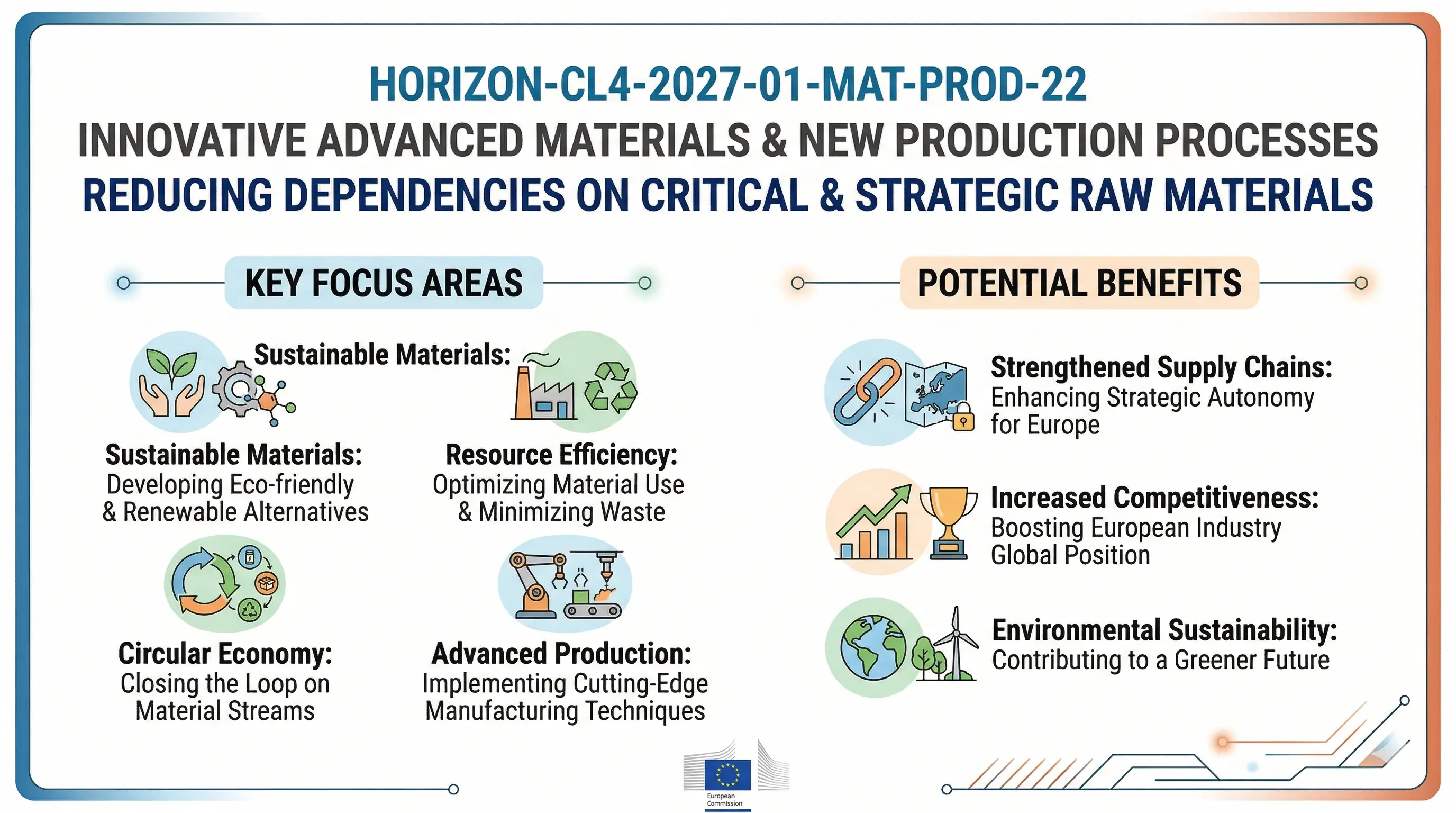
HORIZON-CL4-2027-01-MAT-PROD-22: Innovative advanced materials and new production processes – reducing dependencies on critical and strategic raw materials
Europe’s industrial base largely depends on a few raw materials that it does not mine. That demand is to provide financing for projects that develop breakthrough materials or drastically change production methods to reduce the use of strategic and vital raw materials across the main industrial sectors. The scope is practical rather than research-oriented. Projects with a solid business case and a Technology Readiness Level (TRL) of 7 are expected. Unless you’re an early-stage material scientist who doesn’t have a deployment story or an industry partner, this is most likely not the program for you.
Download the MIC Horizon Europe 2026/2027 Calls Calendar:
Discover more!
Administrative facts: what do we know about the HORIZON-CL4-2027-01-MAT-PROD-22 call?
Which call is it, and when is the opening and the deadline?
- Call name: INDUSTRY
- Call identifier: HORIZON-CL4-2027-01
- Destination: Leadership in materials and production for Europe
- Topic: HORIZON-CL4-2027-01-MAT-PROD-22
- Partnerships: Innovative Advanced Materials for the EU (IAM4EU); Processes4Planet
- Opening date: 22 September 2026
- Deadline: 02 February 2027 (17:00 Brussels time)
- Type of action: Innovation Actions (IA)
What about the budget and estimated size of the project?
- Overall topic budget: EUR 36.00 million
- Number of projects expected: 6
- EU contribution per project: EUR 6.00 to 7.50 million (indicative)
What are the key eligibility and evaluation conditions?
- TRL range: start at TRL 5, achieve TRL 7 by the end of the project
- Legal entities established in China are not eligible for this IA (full destination-level restriction)
- MIIT eligibility condition applies (Chinese universities linked to the Ministry of Industry and Information Technology)
- Ownership/licensing restriction: granting authority may object to transfer of ownership or exclusive licensing of results for up to 4 years after project end
- Page limit for Part B extended by 3 pages for the business case and exploitation strategy
- JRC participation: not explicitly mentioned for this topic specifically
- Clustering with other relevant selected projects is expected
- Cooperation with EU Innovation and Substitution Hub(s) encouraged
Scientific range: what does the Commission expect from the HORIZON-CL4-2027-01-MAT-PROD-22 grant?
What outcomes are expected?
The proposed substitution should be real and demonstrated by the project’s final outcome, not merely mimicked. The Safe and Sustainable by Design (SSbD) approach, when followed thoroughly, should yield experimentally proven innovative advanced materials (IAMs) or innovative production methods that reduce the use of strategic or critical raw materials in a given industrial application, and should also indicate a feasible market-entry strategy. The main aims are European industrial autonomy and resilience of supply chains. Not only should innovation cycles lead to publication, but they should also speed up.
What is within scope?
- Designing, developing, and producing innovative and sustainable materials (IAMs) that replace or reduce the use of critical and strategic raw materials (CRM/SRM)
- Re-engineering of industrial processes aimed at reducing CRM/SRM consumption, mainly through introducing flexibility, scalability, and cost-efficiency
- Co-development of IAMs together with adapted production processes
- Main sectors to be targeted: energy, mobility, construction, electronics, medical devices, and chemical industries
- Integration into industrial manufacturing, including adaptation of existing production lines when necessary
- Following the application of the SSbD framework and the sharing of FAIR data with the Common Data Platform for Chemicals
- Identify the obstacles to substitution and propose a method to triple substitution in the targeted value chain, as per the clear call wording
What are the specifically proposed research directions?
- Cross-material demonstrability is, according to the Commission, among the most persuasive strategies, since it shows value across material types rather than just in a single use case
- Design with verified safety and sustainability goals and performance parity with the CRM/SRM-based solution
- Process optimization path: process control flexibility and scalability are among the key performance indicators; industrial processes are phased out to reduce CRM/SRM inputs
- Co-development path: simultaneity in the generation of innovative materials and innovative procedures, exemplified by specific industrial applications that have broader applicability
Scientific strategy: how can you enhance your chances of being funded through HORIZON-CL4-2027-01-MAT-PROD-22?
What scientific choices matter most?
- Select a particular sector and CRM/SRM. Proposals that try to cover a few essential raw materials in different industries might appear too scattered. The reviewers want to see that you know exactly which substitution barrier you are tackling.
- Demonstrate that TRL 7 can be reached. It is conceivable to start at TRL 5 and reach TRL 7 within 3 or 4 years, but only if the fundamental material science is very solid. Any proposal that, even indirectly, requires TRL 4 work to get there should not be submitted.
- Make the SSbD framework enhance your project’s functionality, rather than mere ornament. SSbD is mentioned in the introduction of some proposals, but the word doesn’t appear again. Reviewers certainly notice such things. Work it into your work packages.
- You must have a business case. Three additional pages are allowed only to clarify the purpose. The Commission panel members will carefully look at your exploitation plan. Who is the buyer of this product? What is the price? What are the typical regulatory hurdles?
- Show co-development at every possible place. Materials and processes being developed together can be quite challenging to write about but, at the same time, highly fundable.
- Engage with the EU Innovation and Substitution Hub(s) right from the start, or at the very least include them in your proposal as a plan. Sharing such insight will make the panel see that you are aware of the ecosystem.
Consortium & proposal-writing plan: what works best with this type of call?
- Twelve partners, and possibly a few more, can participate if work across two sectors with strong science support is required.
- Industry needs to lead or co-lead the effort. A consortium dominated by academics only will be hardly productive. At least half of the partners, including those who will use the substituted material, must be from the private sector.
- The bare-bones triangle consists of a material developer, an end user, and a process engineer. One more person, a regulatory or standardization expert, is needed, especially if the target industry is electronics or medical devices.
- It is a good idea to have a partner with the necessary domain expertise if the industry your business strategy intends to focus on (medical devices, electronics) requires specific safety standards.
- Many people are surprised by this aspect. It can be beneficial to include an innovative SME, not just to look good. Reviewers are well aware that SMEs are typically the most agile when it comes to process changes.
- While not strictly necessary for this topic, international collaboration is a possibility. Efforts should be focused on the European value chain.
- A demonstrator or an industrial use case that could be applied to another industry should be included in your proposal. Clearly state the relevant work package. Clarity is appreciated by evaluators.
How would microfluidics contribute to this topic?
Discovering new, advanced materials is a slow, labor-heavy process. The biggest disadvantage of conventional testing methods is their inefficiency, especially when testing several potential substitutes for a single critical raw material (CRM) application. Microfluidics changes the whole picture. If your consortium performs the synthesis, formulation, and functional testing of small quantities, produces reliable results much faster, and directly interfaces with digital tools and FAIR data pipelines, then you are meeting the call’s integration requirements in a particularly direct way.
- Assume you are developing a novel magnetic material free of rare earth elements for use in electric motors. If you wish to scale up, it is crucial that you describe how the material interacts with mechanical and thermal factors in a controlled manner. You can accomplish that with milligram quantities and multiple compositions simultaneously using a microfluidic platform, before committing to expensive pilot production.
- In our full reactor campaigns, the team can explore the processing parameters for IAM production using synthesis-on-chip approaches. This directly supports the call’s “process flexibility and scalability” requirements.
- Organ-on-chip or tissue-on-chip models can be an excellent addition to your experimental toolbox if your intended application is medical devices. These models allow you to screen material candidates for biocompatibility under realistic conditions, helping you advance clinical validation, and they provide your consortium with a ready-made data generation engine. See our organ-on-chip overview for more detail.
- By design, microfluidic platforms produce experimentally generated data in machine-readable format. That is more than just a policy exercise; it’s a direct contribution to your FAIR data obligations under the Common Data Platform for Chemicals.
- The project team must work fast and generate reliable data at every stage when the call requires reaching TRL 7 within a single project. Microfluidics can be a true asset to the proposal rather than merely a technological afterthought, because it can expedite both the material screening and process integration phases.
MIC brings verified platform expertise from comparable projects in industrial materials and can provide your consortium with a data generation engine that supports both the technical and the FAIR data dimensions of this call. For adjacent calls where we have mapped similar contribution pathways, see our Cluster 5 microfluidic relevance overview.
The MIC already brings its expertise in microfluidics to Horizon Europe:
H2020-NMBP-TR-IND-2020

Microfluidic platform to study the interaction of cancer cells with lymphatic tissue
H2020-LC-GD-2020-3

Toxicology assessment of pharmaceutical products on a placenta-on-chip model

FAQ – HORIZON-CL4-2027-01-MAT-PROD-22
What is the TRL requirement for HORIZON-CL4-2027-01-MAT-PROD-22?
The projects should be initiated at TRL 5 and should reach TRL 7 by the end of the project. This is a firm requirement. If the underlying material science is not yet at TRL 4-5, the schedule is not plausible, and the project will not be allowed through.
Are Chinese institutions eligible to apply?
No. This Innovation Action does not apply to legal entities created in China. It is a destination restriction that is used on the entire HORIZON-CL4-2027-01 call. Another eligibility requirement of MIIT is the connection of the Chinese universities with the Ministry of Industry and Information Technology.
What is the budget per project?
The total budget of the topic is EUR 36 million over 6 anticipated projects. This amounts to about EUR 6.00-7.50 million per project as a suggested EU contribution. To verify the specific figures in the call documentation.
Check on the Funding & Tenders Portal for more information.
What sectors does this call target?
The call is made to the energy, mobility, construction, electronics, medical devices, and chemical industries. Projects need to find one major industry and one particular target of CRM/SRM substitution instead of attempting to address the entire spectrum.
What is the SSbD framework and is it mandatory?
Safe and Sustainable by Design (SSbD) is a Commission framework to ensure that safety and sustainability are built into the design of materials and chemicals at the beginning. In this call, the implementation of SSbD is not only welcome but should be embedded in the work packages, with measurable milestones that are referenced in the introduction and not forgotten.
How many partners should the consortium have?
Ten to fourteen partners is a fairly good number, perhaps a little more in case cross-sector coverage really needs it. The industry needs to be on the front line or a co-leader. Academic partners are welcome, but not to be dominant. Include at least one innovative SME for process agility and credibility in the exploitation plan.
What is the role of the EU Innovation and Substitution Hub?
It is a call to collaborate with one or more EU Innovation and Substitution Hub(s). This is by no means compulsory, but mentioning them in your proposal, or ideally involving them as associated partners, will indicate that your consortium is cognizant of the bigger picture. Evaluators observe the lack.
Is co-development of materials and processes required?
Co-development is not a checkbox requirement, but the most powerful positioning strategy possible. Projects that evolve both materials and adapted processes, not as sequential workstreams, are much more in line with what the Commission seeks.
What is the page limit for the business case?
The Part B page limit has been increased by 3 pages to provide the business case and exploitation strategy. These three pages are important. The commission panel will peruse them: Who is the buyer? What is the price point? What are the regulatory hurdles to market entry?
Can microfluidics play a role in this type of project?
Yes, and practical. Microfluidic platforms can speed up material screening and process integration, allowing projects to move quickly from TRL 5 to TRL 7. They also produce machine-readable data on experiments by default, and this is directly usable in FAIR data commitments under the Common Data Platform on Chemicals.