
Tips & Tricks for a successful HORIZON-CL3-2026-01-SSRI-01 proposal
Opening
05 May 2026
Deadline
Keywords
technological innovations
SSRI
civil security
TRL 1-4
microfluidic chip
AI-powered prediction
disruptive tech
threat detection
resilient entities
Your microfluidic SME partner for Horizon Europe
We take care of microfluidic engineering, work on valorization and optimize the proposal with you
HORIZON-CL3-2026-01-SSRI-01: Open topic on supporting disruptive technological innovations for civil security
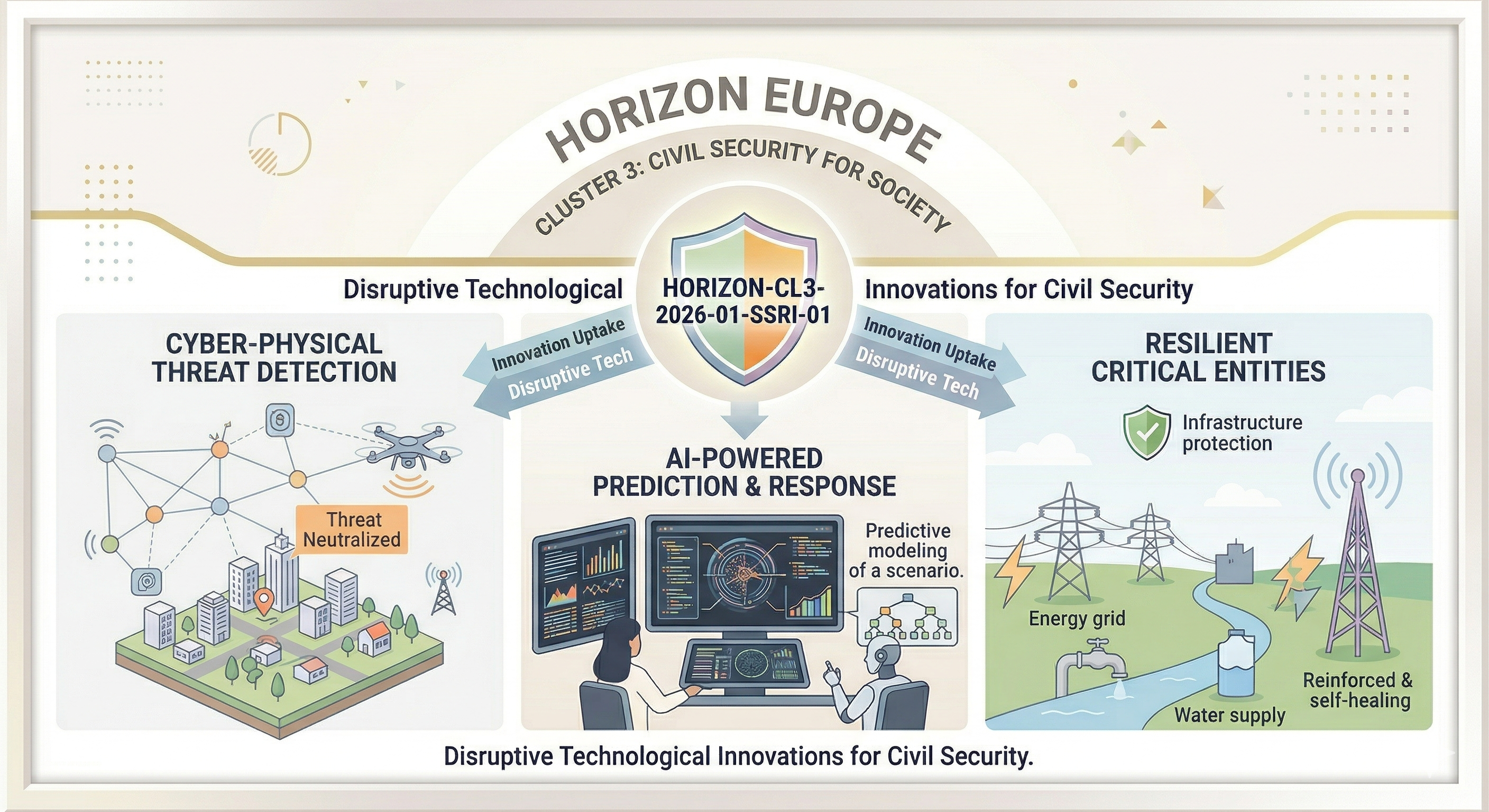
The Commission desires new technologies at an early stage that can transform the way civil security activities are done. Not gradual enhancements. Not TRL 6 ideas. We are discussing breakthrough ideas at TRL levels below 4 that, when developed, would transform the paradigm in preparedness, threat identification, or crisis response. It is an open topic where you choose what security challenge, you must prove to the evaluators that the potential of the disruption is real.
Download the MIC Horizon Europe 2026/2027 Calls Calendar:
Discover more!
Administrative facts: what do we know about the HORIZON-CL3-2026-01-SSRI-01 call?
Which call is it, and when is the opening and the deadline?
- Call name: Civil Security for Society 2026
- Call identifier: HORIZON-CL3-2026-01
- Destination: Strengthened Security Research and Innovation
- Topic: HORIZON-CL3-2026-01-SSRI-01
- Opening date: 05 May 2026
- Deadline: 05 Nov 2026
- Type of action: Research and Innovation Action (RIA)
What about the budget and estimated size of the project?
- Overall topic budget: EUR 3.00 million
- Number of projects expected to be funded: 2
- Budget per project: around EUR 1.50 million
What are the key eligibility and evaluation conditions?
- Standard eligibility conditions as per General Annex B.
- Subject to restrictions for the protection of European communication networks.
- Legal entities established in China are not eligible to participate in RIAs under this destination.
- Some activities may involve classified background or security-sensitive results (EUCI and SEN). Refer to General Annex B provisions.
- Synergy-building and clustering with other successful proposals in the same area is expected, in coordination with CERIS activities.
- No specific TRL target is stated. The call explicitly targets technologies starting below TRL 4.
Scientific range: what does the Commission expect from the HORIZON-CL3-2026-01-SSRI-01 grant?
In the title, the word “open” provides you with the liberty of choosing your security domain. Border control, disaster response, counter-terrorism, infrastructure protection, CBRN detection, you name it. However, the work programme is explicit on one point, which is technologies that are yet to be implemented in their operational form. What the Commission seeks is the potential to change the paradigm, not slight improvements.
- What evaluators will look for, from what we’ve seen in similar calls:
Technologies with low TRL (under 4) which provide an indication of a possible way of transforming the way in which a security operation is being conducted, whether by improving performance or by reducing costs considerably. - A graded pathway of transition. You must demonstrate the flow of your idea out of the lab into a testable product by an end-user. Already at this early stage, the Commission would like to know that you have considered validation, safety, and interoperability.
- Actual cooperation with security professionals. Governmental and law enforcement organizations, first responders, and civil security. Not in the position of advisory boards. Being partners who create the technology itself.
- Moral competence, openness, availability. Those are not discarded paragraphs in your proposal. Cluster 3 evaluators put this into consideration.
- Europe oriented technology foresight. This has been explicitly stated in the work programme thus refer to the corresponding JRC or Europol foresight reports.
The projected results are enhanced preparedness due to tested disruptive technology, enhanced ability to reduce risks, and accelerated implementation of new tools in civil security systems. Publication lists will not suffice in this case. Even low-TRL research should be demonstrably relevant to operations that the Commission desires.
Scientific strategy: how can you enhance your chances of being funded through HORIZON-CL3-2026-01-SSRI-01?
Which scientific decisions are the most important ones?
- Choose a security challenge where the gap is apparent. Proposals to which evaluators give answers must be concrete as to the disruption, rather than vague about changing security.
- Show the paradigm shift. It is not this call to get a technology that mimics what other tools are doing, but 20% faster. Explain what is possible that was not previously possible.
- Don’t shy away from low TRL. The call specifically focuses on sub-TRL-4 concepts. Attempts to make a TRL 5 product appear disruptive are likely to backfire amongst reviewers.
- Establish your validation strategy. Even in early research, draw a testing scheme that a practitioner would believe. There are far too many cases of proposals that failed because they had validation as an epilogue.
- Look at EU foresight reports of emerging security threats. These are pushed upon you in the work programme. Disregard that warning at your peril.
- Cluster plan activities initially. Estimate a budget to coordinate with other SSRI project and with CERIS. Critics can tell when it is not there.
Consortium and proposal-writing plan: what works best with this type of Security RIA?
- EUR 1.50 million is a minor project. Have a small consortium, between five and eight partners, perhaps fewer, depending on the narrowness of the research.
- Have at least one security end-user (police, civil protection, border agency) full partner. This destination does not have enough advisory roles.
- The exploitation narrative will be further enhanced by a newer SME with technology related to the subject. Assessing the SME, in the event that the prototype platform or a sensing concept they bring feeds into the security use case, would draw attention.
- The basic research should be covered by academic partners. But not five, two or three labs only.
- Write the impact section in reverse: begin with the operational scenario, then how the technology alters it, then how the research will be required. This structure reads better for Cluster 3 evaluators than the traditional “we will progress science and will see what will happen”.
- You have a tight budget, hence you require a cut-throat work plan. No padding.
- If your topic is sensitive to the EUCI and SEN provisions, address them in the first place.
How would microfluidics contribute to this topic?
Traditional analysis is time-consuming, labor-intensive, and does not travel easily. In the case of civil security when you require responses in the field (consider CBRN events, forensic sampling at a crime scene, environmental contamination after a disaster), that delay can be life and evidence.
- Suppose you have to find a chemical agent that you do not know about during an evacuation. With a microfluidic chip running multiplexed detection on a handheld reader, you receive results as an event is occurring and not hours after in a lab truck.
- On-scene sampling: Forensic microfluidic systems can process biological evidence without extensive handling, reducing the risk of contamination. Your consortium yields uniform results on small samples, and this counts when there is little to be found.
- To screen pathogens at the border or during a disaster, you can use organ-on-chip and lab-on-chip systems to test on the spot. No cold chain. Minimal training needed.
- Platforms that have been miniaturized are naturally scalable and, in the realm of this range of TRL, perfectly suit the “disruptive” framing that the call demands.
Having a microfluidics partner will provide your proposal with a tangible technology piece that your evaluators can envisage in a security situation. And since the call is post-paradigm shifts at low TRL, a miniaturized sensing or analysis platform is precisely the sort of technology that the Commission was referring to when they wrote this topic.
The MIC already brings its expertise in microfluidics to Horizon Europe:
H2020-NMBP-TR-IND-2020

Microfluidic platform to study the interaction of cancer cells with lymphatic tissue
H2020-LC-GD-2020-3
Toxicology assessment of pharmaceutical products on a placenta-on-chip model

FAQ - HORIZON‑CL3‑2026‑01‑SSRI‑01
What is the purpose of this call, in plain language?
The European commission is interested in financing break through technologies to civil security that are not currently operational.
It focuses on game changers, not incremental enhancements on already work tools.
Consider ideas that would transform the ways first responders identify threats, how border agencies identify dangerous situations, or how civil protection forces would respond to CBRN incidents.
This is a Research and Innovation Action (RIA) under the “Strengthened Security Research and Innovation” destination of Cluster 3.
The subject is broadly selected: you choose the security challenge. But you need to demonstrate that the disruption possibility is real.
What Technology Readiness Level is expected?
It is at this point that the call differs with most Cluster 3 topics.
Work programme explicitly focuses on technologies with a starting point below TRL 4.
It is not necessary to have a particular TRL by the conclusion of the project.
The Commission is seeking ideas that are indeed early-stage but have a plausible way to operational relevance.
This is not your call in case your technology is already at TRL 5 or 6. Attempting to present a mature solution as disruptive is possibly going to be flagged by reviewers.
What security domains are eligible?
The subject is free, i.e. you select the security field.
International border control, combination of disaster response, counter-terrorism, CBRN sensors, security of critical infrastructure, forensic intelligence, response to environmental contamination: everything is fair.
The liberty is actual, yet it comes at a cost: you should be able to explain why the selected sphere has a real gap of capabilities.
Assessors encourage accuracy and not boldness. An expert offer on a single security situation is superior to a hazy pitch that involves five areas simultaneously.
What do evaluators actually look for?
According to the work programme text, and historic Cluster 3 evaluation patterns, the reviewers will look at four things in detail:
- Paradigm shift. Is it an actual change in the technology? Not a faster variant of an existent thing but an ability not possible or convenient before.
- Transition pathway. Is there a plausible path between lab concept and working test? The proposal should demonstrate sensitivity to validation, safety and interoperability even at low TRL.
- Practitioner involvement. Are they real partners, not advisory board names, security professionals? The technology should be co-designed with the police, civil protection, border agencies, or first responders.
- Moral and social approval. They are not scrappy paragraphs. They are rated seriously by cluster 3 evaluators.
Who should be in the consortium?
Bring the team close with EUR 1.5 million. A powerful consortium could consist of:
- Two/three academic laboratories to encompass the main research.
- A single SME that introduces a physical technology (another sensing device, a miniaturized analytical solution, an AI module).
- At least one security end-user as a full partner (not subcontractor): police, civil protection or border agency.
- Probably a systems integrator or standardization body when it is needed in your domain.
Do not put too many research institutions with overlapping work on the stack of the proposal. Each partner should possess a role that the evaluator can distinguish in less than thirty seconds and is non-redundant.
Are there restrictions on who can participate?
The legal entities formed in China cannot be involved in the RIAs under this destination.
General Annex B, describes the requirements to be met by Standard Horizon Europe.
There are EUCI and SEN triggers in some project activities that may contain classified background information or yield security-sensitive results.
Subject to restrictions for the protection of European communication networks.
In case your consortium brings along your partners of Associated Countries, check with them beforehand. Always compare with the Funding and Tenders Portal.
What is the clustering obligation, and how does it work?
The work program anticipates that funded projects get involved in synergy-building and clustering operations with other successful proposals in the same region.
This coordination occurs via CERIS (Community for European Research and Innovation to Security).
Practically, allocate time and money to a common workshop, knowledge sharing and cross-project coordination.
This is not to be considered as an afterthought. It is possible to assess when the clustering paragraph is penned at the last moment.
A plausible clustering strategy demonstrates that you are aware of the larger SSRI ecosystem and are prepared to be a part of it.
How should the proposal be structured to score well?
- Impact section: reverse write it. Begin by describing the operational scenario you are interested in changing, and how the suggested technology is changing that scenario, then describe the research you have to do to get there.
- Excellence section: specify what is disruptive about the concept. Demonstrate in concrete terms what is possible now, which was not possible previously and why the existing approaches are unable to bridge the gap.
- Work plan: you must have a cut-throat plan with EUR 1.5 million. No padding, no unneeded work packages.
- Foresight anchoring: the work programme gives particular emphasis to applicants having a look at EU foresight reports on threats to security. Proposals based on recorded capability gaps are rated higher.
- EUCI and SEN: when you have a sensitive subject, you have to discuss the security arrangements as an initial part, and not in an annex.
- Lesson learned in previous assessments: proposals that start with the so what and proceed to how always do better than those that start with how and proceed to the so what.
What role can microfluidics play in a proposal targeting this call?
The microfluidic technologies can be easily placed within the framework of disruptive at low TRL. There are four contributions:
- Field-deployable detection. Microfluidic chips that can perform multiplexed assays on a handheld reader can provide results in the middle of a CBRN event and not hours later in a mobile laboratory. It is a paradigm change to first responders who are relying on lab logistics at the moment.
- On-scene forensic sampling. Microfluidic systems have the ability to handle trace biological evidence with minimal handling which helps in minimizing contamination. This is important in situations where the sample volume is small and the chain of custody is stringent.
- On-Chip organ and infection models. Microphysiological toxicity and pathogen test platforms under controlled conditions, free of cold chains, and with minimal training of operators, well suited to a decentralized security environment.
- Scalability. By definition, miniaturized platforms are cost-effective at the production level. To evaluators, the disruption claim is a reality because it is possible to imagine the mass deployment within the field.
What are the most common mistakes that sink proposals in this type of call?
- Oversizing the consortium. The overhead generated by twelve partners sharing the EUR 1.5 million suffocates the actual research.
- Making unsubstantiated claims of disruption. It is not the same to say that our approach is disruptive as it is to describe what is now possible that was before. Evaluators view through misty statements soon.
- Taking validation as an epilogue. The Commission anticipates a sketch of how the technology will ultimately be tested under realistic conditions, even at TRL below 4. Delays validation to the final work package.
- Bypassing the foresight literature. The work programme particularly invites the applicants to consult EU foresight reports on new security threats. Proposals based on documented gaps also score more points than those who creates their own threat narrative.
- Passing on morality and social approval. In Cluster 3, they are not boxes to be ticked. They are rated and they can make the difference between funded and not funded.