
Tips & Tricks for a successful HORIZON-NEB-2026-01-REGEN-03 proposal
Opening
05 May 2026
Deadline
Keywords
New European Bauhaus
vertical space
IA
affordable housing
urban greening
vertical greening
circular construction
rooftop farming
biodiversity
Your microfluidic SME partner for Horizon Europe
We take care of microfluidic engineering, work on valorization and optimize the proposal with you
HORIZON-NEB-2026-01-REGEN-03: Innovative solutions for the sustainable and beautiful use of vertical space
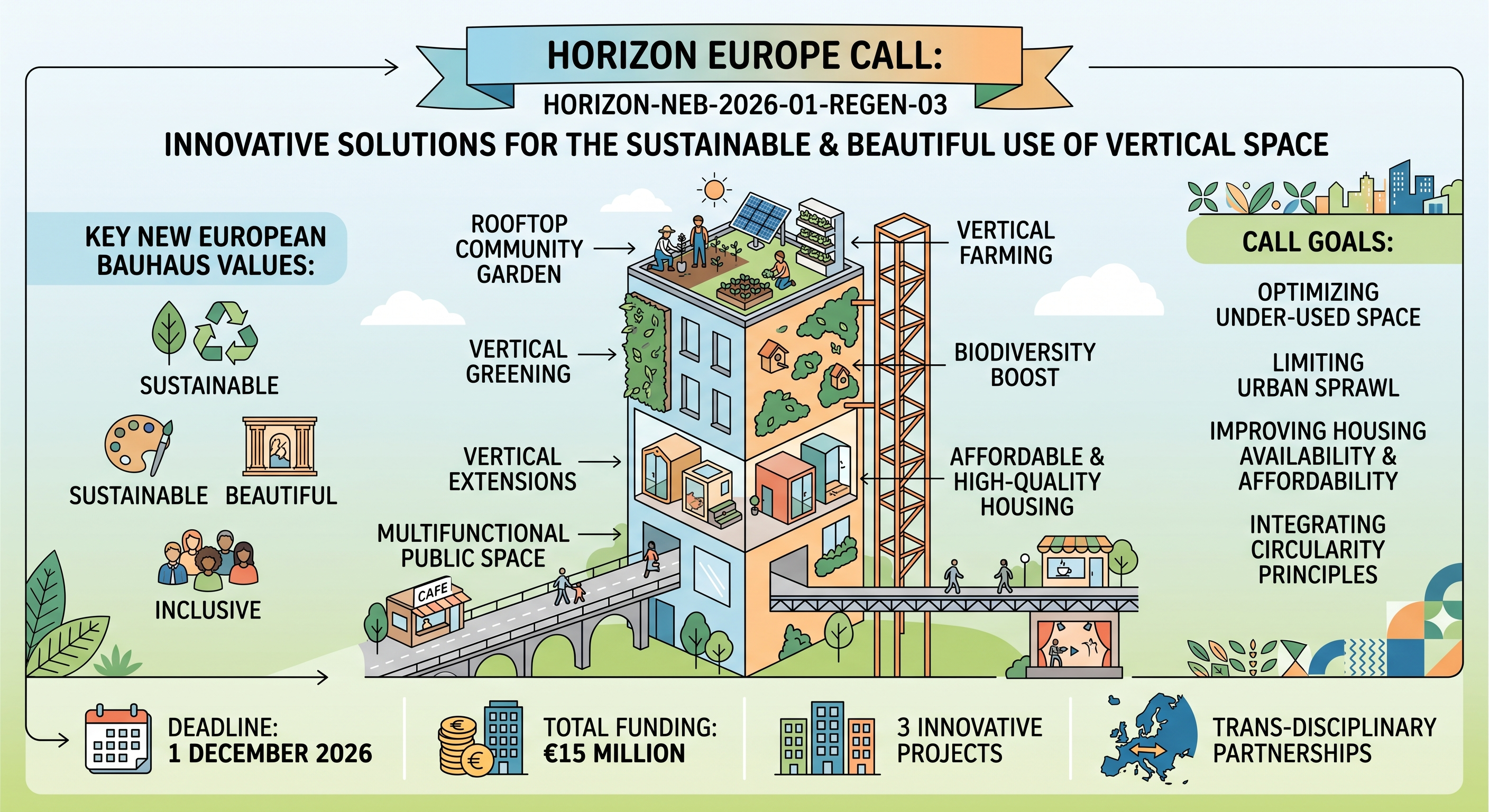
Cities need housing and green space, and the land for both is running out. So the Commission is looking up. This topic funds solutions that occupy the unused layer above existing buildings, streets and infrastructure. It is an Innovation Action: something must be built and demonstrated before the end.
Download the MIC Horizon Europe 2026/2027 Calls Calendar:
Discover more!
Administrative facts: what do we know about the HORIZON-NEB-2026-01-REGEN-03 call?
Which call is it, and when is the opening and the deadline?
- Call name: Beautiful, inclusive and sustainable neighbourhoods for communities
- Call identifier: HORIZON-NEB-2026-01
- Destination: Circular and regenerative approaches for the built environment
- Topic: HORIZON-NEB-2026-01-REGEN-03
- Opening: 05 May 2026
- Deadline: 01 December 2026, 17.00 Brussels time
- Type of action: Innovation Action, lump sum funding
What about the budget and estimated size of the project?
- Overall call budget: EUR 101.10 million
- Topic budget: EUR 15.00 million
- Number of projects expected: 3
- EU contribution per project: around EUR 5.00 million
What are the key eligibility and evaluation conditions?
- TRL 6 to 8 by the end of the project; activities may start at any TRL
- Admissibility, eligibility, award criteria and thresholds: General Annexes A, B and D
- Effective contribution of social sciences and humanities is required
- At least 0.8% of the budget allocated to the New European Bauhaus hub for results and impact
- Participatory and transdisciplinary approach, with co-creation involving the local community
- International cooperation encouraged
- No JRC involvement or clustering obligation stated for this topic
Scientific range: what does the Commission expect from the HORIZON-NEB-2026-01-REGEN-03 grant?
What outcomes are expected?
Two outcomes, both market-facing: more vertical space solutions available to buyers, and evidence that they make the existing built environment work harder while delivering green space or affordable housing. A report series is not what the Commission is after.
What is within scope?
- Solutions using un-used or under-used vertical space above buildings and streets
- Vertical extensions, rooftop community gardens, urban vertical farming, other multifunctional structures
- Circularity principles integrated into the solution itself
- Life cycle environmental, social and economic assessment
- Regulatory, technical and societal barriers, and ways to remove them
Ground-level infill or a straight renovation with no vertical component sits outside the topic.
What are the specifically proposed research directions?
- Develop and demonstrate at least one solution. One is the floor, not the target.
- Minimise and mitigate the negative effects of densification, where relevant
- Assess how far the solution cuts demand for land
- Contribute where possible to the urban greening goals of the Nature Restoration Regulation
- Beauty is in the text and it is assessed, so treat it as a design objective with a method
Scientific strategy: how can you enhance your chances of being funded through HORIZON-NEB-2026-01-REGEN-03?
What scientific choices matter most?
- Name your sites. Letters from building owners or the municipality beat any generic demonstration plan.
- Structural feasibility first. Adding mass on top of an existing building is the first thing a reviewer questions.
- Measure, don’t model. Instrument the demonstrator and feed real data into the LCA.
- Permitting is a work package, not a risk line.
- The call says “identify and address” barriers. What scores is a barrier actually removed in one real city.
- Lump sum funding means your work package split is your budget. Get it right at submission.
Consortium & proposal-writing plan: what works best with this type of call?
- Somewhere between eight and fourteen partners, a couple more if you demonstrate in several countries.
- Architects, structural engineers, a construction company, a city or a housing cooperative, plus a genuine SSH team. Not one bolted on at the end.
- An innovative SME brings the technology and the route to market. With TRL 8 expected, exploitation has to be credible, and usually the SME carries that. Partners with a track record in European collaborative research projects make that part of the story easier to defend.
- If your demonstrator sits on someone’s roof, that owner belongs in the consortium.
- Write the impact section around who buys the solution afterwards. Cities, developers, housing associations. Name them.
How would microfluidics contribute to this topic?
Testing water or material samples on a rooftop normally means shipping them to a lab and waiting a week. By then your irrigation loop has drifted. Microfluidic devices run the same measurement on a few microlitres, on site, in minutes, so monitoring becomes daily instead of quarterly.
- Rooftop farming and green roofs depend on water chemistry. Microfluidic sensors track nitrate, phosphate and pH in a recirculating loop and catch a drift before the crop shows it. Most of these assays rely on optical detection on chip.
- Rainwater harvesting is attractive on paper. Then someone asks about heavy metals and bacteria. Contaminant screening chips give you a number on site, as often as you want.
- Reused construction materials come with a question mark. Take a small leachate sample, run it through a screening chip, and within the hour you know whether the batch suits a rooftop garden.
- Droplet generation produces microcapsules with a tight size distribution: self-healing agents, phase-change materials, slow-release nutrients for lightweight substrates. Weight is always the constraint on a vertical extension. MIC runs several encapsulation projects of this kind.
What this buys your proposal is evidence. Your life cycle assessment stops being a modelling exercise and rests on measured values from the demonstrator. That is the difference evaluators notice. Our overview of the Horizon Europe 2026-2027 calls ordered by microfluidic relevance gives the wider picture.
The MIC already brings its expertise in microfluidics to Horizon Europe:
H2020-NMBP-TR-IND-2020

Microfluidic platform to study the interaction of cancer cells with lymphatic tissue
H2020-LC-GD-2020-3

Toxicology assessment of pharmaceutical products on a placenta-on-chip model

FAQ - HORIZON-NEB-2026-01-REGEN-03
What does HORIZON-NEB-2026-01-REGEN-03 fund exactly?
It funds the development and demonstration of at least one solution that uses the un-used or under-used vertical space above buildings and streets. The aim is more affordable housing or more green space, without eating further into land.
When does the call open and when is the deadline?
The call HORIZON-NEB-2026-01 opens on 05 May 2026 and closes on 01 December 2026 at 17.00 Brussels time. Single deadline. The Director-General may delay it by up to two months, so keep an eye on the Portal.
How much funding is available per project?
The topic budget is EUR 15.00 million, split across around three projects. The Commission estimates roughly EUR 5.00 million per project. Asking for a different amount is allowed, but you have to justify it.
What does the work programme mean by "vertical space"?
The glossary defines it as the currently unused or under-used spatial layer above existing buildings, streets and infrastructure, in cities, towns and rural settlements alike. Rooftops, air rights above streets, that kind of layer.
Is this a research topic or a demonstration topic?
Demonstration. It is an Innovation Action and activities are expected to reach TRL 6 to 8 by the end. You may start lower, but a project without a real built demonstrator will struggle.
What does the lump sum change for our budget?
Eligible costs take the form of a lump sum. Payments follow completed work packages, not actual costs, so the work package structure and the amounts you propose at submission are what you live with.
Check the Funding and Tenders Portal for more information.
Do we really need social sciences and humanities partners?
Yes. The topic explicitly requires effective contribution of SSH disciplines and the involvement of SSH experts. Social acceptance and regulatory barriers are central here, so this is not a box-ticking requirement.
What are the participation and co-creation requirements?
Proposals are expected to follow a participatory and transdisciplinary approach, to involve the local community and, where relevant, cultural and creative industries in the co-creation of the solutions.
Is there any obligatory budget allocation?
Yes. At least 0.8% of the budget must go to engaging with the Horizon Europe-funded New European Bauhaus hub for results and impact, for sharing results and contributing to impact assessment.
Where does microfluidics fit into a vertical space project?
Mostly in the measurement layer: water chemistry in rooftop farming loops, screening of rainwater and of leachates from reused materials, plus droplet-based encapsulation of additives for lightweight components. It turns your life cycle numbers into measured ones.