
Tips & Tricks for a successful HORIZON-NEB-2026-01-REGEN-01 proposal
Opening
05 May 2026
Deadline
Keywords
thermal comfort
nature-based solutions
NEB
bioclimatic design
vernacular knowledge
buildings
frugal innovation
life cycle emissions
sustainability
Your microfluidic SME partner for Horizon Europe
We take care of microfluidic engineering, work on valorization and optimize the proposal with you
HORIZON-NEB-2026-01-REGEN-01: Sustainable, inclusive, affordable and beautiful solutions for thermal comfort in buildings
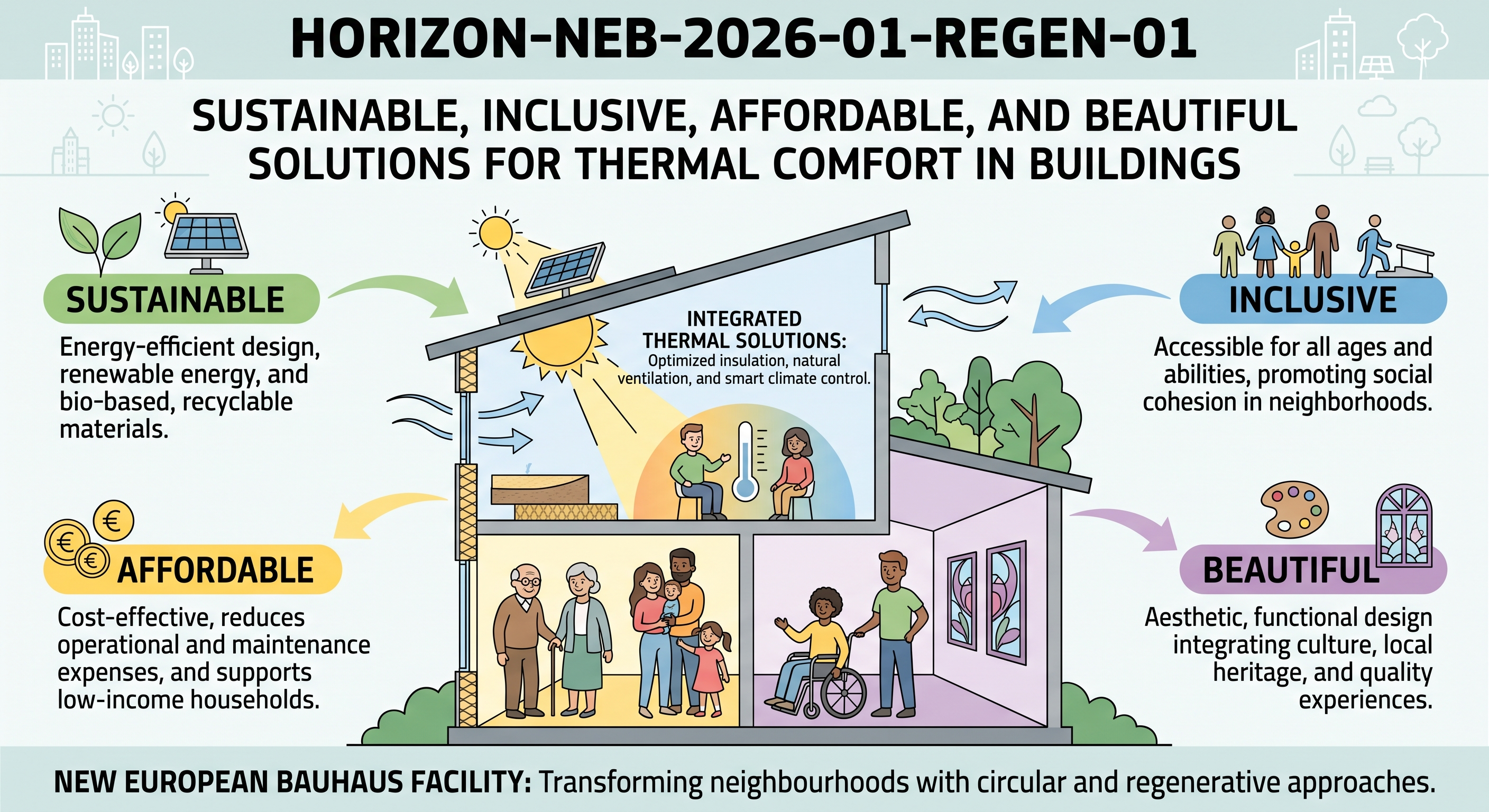
The Commission wants buildings that stay comfortable without burning energy. It is looking back at older building know-how, nature-based solutions, bioclimatic design and frugal innovation. The aim is comfort you can afford, that looks good, and that cuts emissions across the whole life cycle. Beauty and inclusion are not optional extras here. They sit at the core of the New European Bauhaus.
Download the MIC Horizon Europe 2026/2027 Calls Calendar:
Discover more!
Administrative facts: what do we know about the HORIZON-NEB-2026-01-REGEN-01 call?
Which call is it, and when is the opening and the deadline?
- Call name: Beautiful, inclusive and sustainable neighbourhoods for communities
- Call identifier: HORIZON-NEB-2026-01
- Destination: Circular and regenerative approaches for the built environment
- Topic: HORIZON-NEB-2026-01-REGEN-01, Sustainable, inclusive, affordable and beautiful solutions for thermal comfort in buildings
- Opening date: 05 May 2026
- Deadline: 01 Dec 2026, 17.00 Brussels time
- Type of action: Innovation Action
What about the budget and estimated size of the project?
- Topic budget: EUR 12.00 million
- Projects expected: 3
- Budget per project: around EUR 4.00 million (12 divided by 3)
What are the key eligibility and evaluation conditions?
- Standard admissibility and eligibility per General Annexes A and B
- Award criteria and thresholds per General Annex D
- Funding is a lump sum, so the budget is fixed at grant signature
- Demonstration required in at least two different climatic zones, in different Member States or Associated Countries
- At least one cultural heritage building among the demo sites
- Set aside at least 0.8% of the budget to work with the NEB hub for results and impact
- TRL 5 to 7 by project end
Scientific range: what does the Commission expect from the HORIZON-NEB-2026-01-REGEN-01 grant?
What outcomes are expected?
The Commission wants construction actors to actually notice these lower-tech, nature-led options and take them seriously. By the end, your solutions should hold thermal comfort while cutting life cycle energy use, emissions and cost against what dominates the market today. Demonstrated, not just modelled.
What is within scope?
- Solutions rooted in vernacular principles, nature-based solutions, bioclimatic design or frugal innovation
- At least two comfort solutions, tested on new or existing buildings
- Cultural heritage buildings as legitimate demo sites (this one is explicit, do not skip it)
- Life cycle assessment of emissions and cost, plus a real affordability comparison
- Accessibility for people in vulnerable situations, and yes, aesthetic quality counts
- Barrier mapping, regulation included, with recommendations to overcome them
Air-conditioning and other energy-hungry fixes are exactly what the Commission is trying to move away from.
What are the specifically proposed research directions?
- Passive cooling and heating drawn from local, older building traditions
- Bio-based or bio-fabricated materials and coatings that help regulate heat
- Bioclimatic retrofits that respect heritage fabric
- Comfort measured across seasons and climates, not lab-only claims
- Regulatory and replication pathways, so the solution spreads past the demo
The wording leans toward demonstration and social value over hard technical novelty. Read that as a signal.
Scientific strategy: how can you enhance your chances of being funded through HORIZON-NEB-2026-01-REGEN-01?
What scientific choices matter most?
- Demonstrate in two contrasting climates. Non-negotiable, so lock the sites early.
- Include a heritage building. Reviewers will check.
- Prove the life cycle numbers. A credible assessment with real data beats an optimistic model.
- Design with residents, not for them. The participatory angle is scored, not decorative.
- Affordability is in the title for a reason. Show it, do not assert it.
- Ugly-but-efficient loses points under the New European Bauhaus.
Consortium & proposal-writing plan: what works best with this type of call?
- For an Innovation Action this size, somewhere between eight and twelve partners usually fits, maybe a couple more if the climatic coverage needs it.
- Mix architects, building physicists, material developers, social scientists, and local authorities or housing bodies.
- If you can bring a heritage site owner or manager on board, do it early.
- Besides the public labs, an innovative SME with real product or sensing capability strengthens both the demonstration and the exploitation story.
- Transdisciplinary is not decoration here. Social sciences and humanities partners carry real weight in the NEB.
- Write the impact section around uptake and replication. Not publications.
How would microfluidics contribute to this topic?
Conventional indoor climate monitoring is often coarse. A handful of sensors, averaged readings, seasons you never quite capture. Microfluidic sensing and lab-on-chip testing add finer, cheaper measurement and faster material screening.
- Low-cost microfluidic sensors can track humidity, air quality and pollutants room by room, which helps when you have to prove comfort across many spaces and seasons.
- Lab-on-chip setups speed up screening of bio-based coatings or heat-storing materials. Test many small samples, get the same answer twice, move on.
- Say you want to know how a bio-fabricated material copes with repeated moisture cycles. A small microfluidic rig lets you run that cheaply, before you commit to a full wall.
Microfluidics will not be the centre of a thermal comfort project. It sharpens the measurement and materials-testing side, which is usually where soft claims get picked apart. If your proposal leans on demonstrated comfort and validated materials, a microfluidics partner earns its place.
The MIC already brings its expertise in microfluidics to Horizon Europe:
H2020-NMBP-TR-IND-2020

Microfluidic platform to study the interaction of cancer cells with lymphatic tissue
H2020-LC-GD-2020-3

Toxicology assessment of pharmaceutical products on a placenta-on-chip model

FAQ: HORIZON-NEB-2026-01-REGEN-01
What is HORIZON-NEB-2026-01-REGEN-01 actually about?
It funds solutions that keep buildings thermally comfortable without heavy energy use, drawing on vernacular principles, nature-based solutions, bioclimatic design and frugal innovation. The goal is affordable, beautiful comfort with lower life cycle emissions.
Who runs this call and when does it open and close?
It sits under the New European Bauhaus Facility call HORIZON-NEB-2026-01, Destination Circular and regenerative approaches for the built environment. Opening is 05 May 2026, deadline 01 Dec 2026 at 17.00 Brussels time.
How much money is available and for how many projects?
The topic budget is EUR 12.00 million, expected to fund 3 projects, at around EUR 4.00 million each. Funding is a lump sum, so the amount is fixed once the grant is signed.
What type of action is it, and which TRL?
An Innovation Action. Activities should reach TRL 5 to 7 by the end of the project, and may start at any TRL.
What must a project actually demonstrate?
At least two thermal comfort solutions, tested on new or existing buildings, including at least one cultural heritage building, across at least two different climatic zones in different Member States or Associated Countries.
Which approaches are in scope, and what is not?
Solutions inspired by vernacular principles, nature-based solutions, bioclimatic design or frugal innovation. Energy-hungry fixes such as conventional air conditioning are what the Commission wants to move away from.
Check the Funding and Tenders Portal for more information.
What outcomes will evaluators look for?
Higher awareness among construction actors of these low-impact solutions, plus demonstrated thermal comfort with clear cuts in life cycle energy use, emissions and cost compared to today’s market options.
Do aesthetics and inclusion really matter for scoring?
Yes. Beauty and accessibility for people in vulnerable situations are written into the topic. A solution that works but ignores aesthetics or inclusion will struggle under New European Bauhaus criteria.
What kind of consortium fits best?
A transdisciplinary mix: architects, building physicists, material developers, social scientists, local authorities or housing bodies, and ideally a heritage site owner. Social sciences and humanities carry real weight here. An innovative SME strengthens the demonstration.
Where could microfluidics help in this topic?
Mostly on measurement and materials testing. Low-cost microfluidic sensors can monitor humidity and air quality across many rooms and seasons, and lab-on-chip setups can speed up screening of bio-based coatings or heat-storing materials.