Tips & Tricks for a successful HORIZON-NEB-2026-01-PARTICIPATION-01 proposal
Opening
05 May 2026
Deadline
Keywords
New European Bauhaus
homelessness
lump sum
housing-led approaches
IA
green transition
neighbourhoods
social inclusion
policy change
Your microfluidic SME partner for Horizon Europe
We take care of microfluidic engineering, work on valorization and optimize the proposal with you
HORIZON-NEB-2026-01-PARTICIPATION-01: Addressing homelessness through housing-led approaches aligned with the New European Bauhaus
The Commission wants housing-led approaches that put people into permanent homes, not another diagnosis of the problem. Homelessness is framed here as a structural failure of the green transition. Two projects will be funded, and both must prove something on the ground. It is an Innovation Action paid as a lump sum, so the demonstration is the deliverable.
Download the MIC Horizon Europe 2026/2027 Calls Calendar:
Discover more!
Administrative facts: what do we know about the HORIZON-NEB-2026-01-PARTICIPATION-01 call?
Which call is it, and when is the opening and the deadline?
- Call name: Beautiful, inclusive and sustainable neighbourhoods for communities
- Call identifier: HORIZON-NEB-2026-01
- Destination: Connecting the green transformation, social inclusion and local democracy
- Topic: HORIZON-NEB-2026-01-PARTICIPATION-01
- Opening: 05 May 2026
- Deadline: 01 December 2026, 17.00.00 Brussels time
- Type of action: Innovation Action, lump sum grant
What about the budget and estimated size of the project?
- Topic budget: EUR 12.60 million
- Number of projects expected: 2
- EU contribution per project: around EUR 6.30 million
- Overall call budget: EUR 101.10 million
What are the key eligibility and evaluation conditions?
- General Annexes apply, with no topic-level exception on eligibility or award criteria
- Thresholds follow General Annex D defaults: 3 per criterion, 10 cumulative
- The China participation restriction covers the built environment Destination of this call, not this one
- No JRC clause for this topic
- At least 0.8% of the budget goes to the New European Bauhaus hub for results and impact
- Demonstration in at least three neighbourhoods, in different Member States or Associated Countries
- Social sciences and humanities input is required, not encouraged
Scientific range: what does the Commission expect from the HORIZON-NEB-2026-01-PARTICIPATION-01 grant?
What outcomes are expected?
Two things, both usable by people outside the consortium. Housing-led approaches aligned with New European Bauhaus values, handed to the organisations that actually work on homelessness. Plus evidence solid enough to move policy on prevention and early intervention. A publication series is not what the Commission is after.
What is within scope?
- Immediate and permanent access to housing, with needs-based support services around it
- Prevention and early intervention, including people temporarily hosted by family or acquaintances
- Green transition of that housing: renewable energy, nature-based solutions, climate mitigation and adaptation
- Urban, peri-urban and rural neighbourhoods
- Co-creation with the targeted populations, families with minor children especially
- Measures against institutional barriers to housing access
- A monitoring methodology built on the ETHOS typology, comparable across sites
Staircase and continuum-of-care models are out. The glossary rules out conditionality and temporariness (worth reading first).
What are the specifically proposed research directions?
- Refine and demonstrate at least three housing-led approaches, adapted to local regulation, population and infrastructure
- Measure effectiveness against conventional approaches, with data comparable between sites
- Close the data gap. Defining and measuring homelessness is still done differently in every country
- Connect housing-led approaches with climate resilience for homeless populations
- Design for cohabitation of different social groups, conflict minimised
- Show replication potential
Scientific strategy: how can you enhance your chances of being funded through HORIZON-NEB-2026-01-PARTICIPATION-01?
What scientific choices matter most?
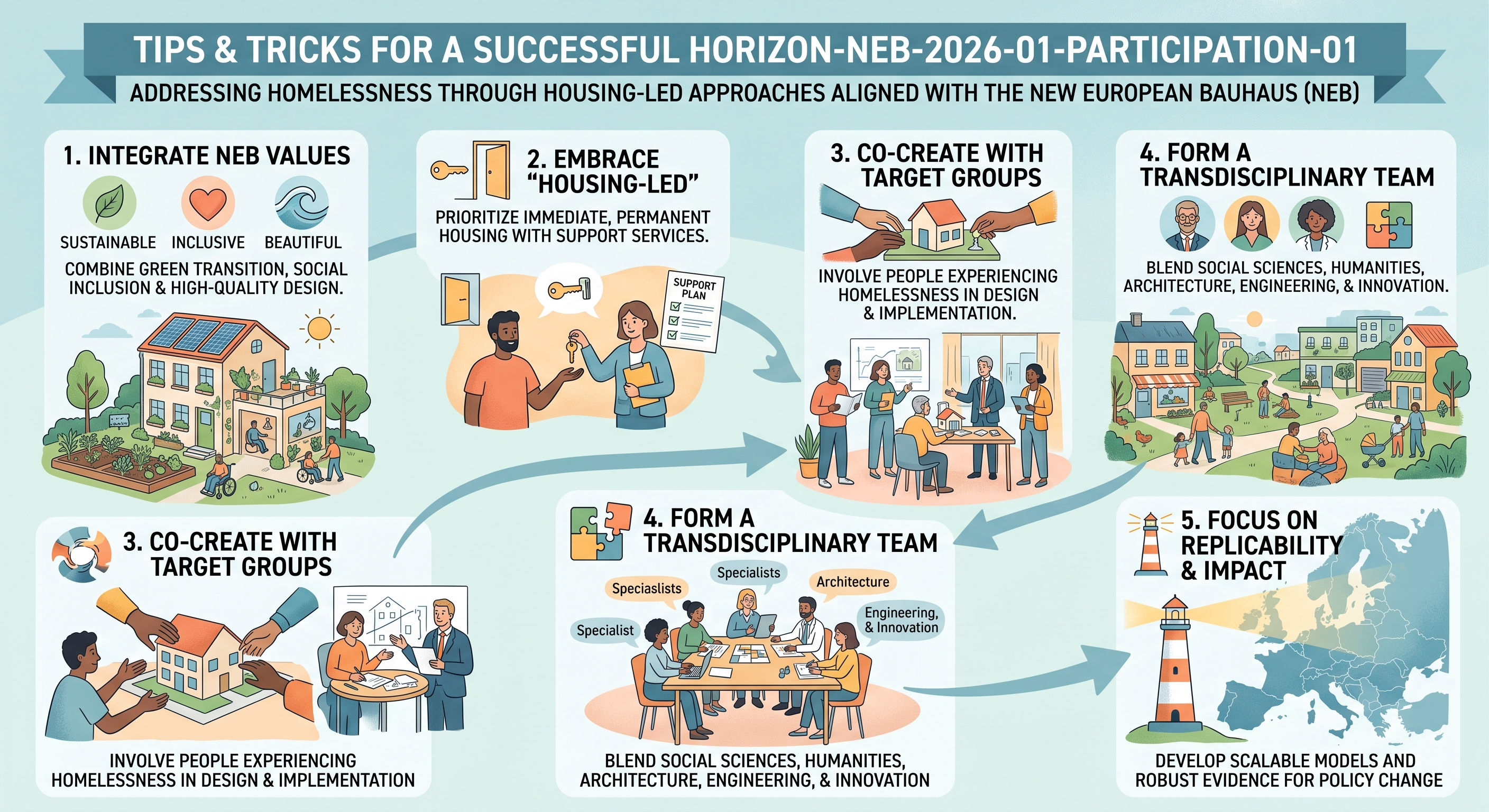
- Pick your three neighbourhoods early. Urban, peri-urban, rural, different countries, with signed commitments from the housing providers.
- Make the monitoring methodology its own work package. It carries half the expected outcome.
- ETHOS is the reference. Use it.
- Prove the housing is green with numbers. Energy figures, not intentions.
- Co-creation needs a method and a budget line. We see plenty of proposals where participation is asserted and never described.
- The call says demonstrate. What evaluators respond to is transferability, so name who picks this up in 2032.
- Lump sum means your work package structure is your budget. Fix it before submission.
Consortium & proposal-writing plan: what works best with this type of call?
- Somewhere between ten and fourteen partners, maybe a couple more if three countries need real local coverage.
- Municipalities and social housing providers as beneficiaries. Letters of support won’t carry this one.
- NGOs working directly with homeless people, plus a network with European data reach.
- SSH is mandatory: sociologists, urban planners, public health researchers.
- If you bring one innovative SME, it can handle the technical side of the retrofit and the measurement tools. Good for the exploitation section too.
- Build the impact section around policy uptake. Who changes what, and when.
- Keep Excellence short. Innovation Actions are won in Implementation.
How would microfluidics contribute to this topic?
Housing quality is normally checked by sending samples to a lab, and the answer comes back weeks later, often after the family moved in. Microfluidic devices run the same assay on a card, on site, in minutes. For a project documenting effect across three countries, that changes what you can measure.
- Water at the tap. Converted or retrofitted buildings can carry lead or legionella. A portable test tells your team before people move in.
- Indoor air and mould screening during refurbishment, then again a year later. Same method twice, so the two numbers mean something together.
- Say one of your sites wants hepatitis C figures before and after rehousing. Homeless people rarely show up for appointments. A cartridge, a drop of blood, an answer in twenty minutes inside the shelter. A real before-and-after instead of a self-reported one.
This is not a technology call, and no chip does the social work. What microfluidics gives your consortium is hard numbers inside a monitoring methodology that would otherwise rest on surveys. Evaluators like evidence someone can check.
The MIC already brings its expertise in microfluidics to Horizon Europe:
H2020-NMBP-TR-IND-2020

Microfluidic platform to study the interaction of cancer cells with lymphatic tissue
H2020-LC-GD-2020-3

Toxicology assessment of pharmaceutical products on a placenta-on-chip model

FAQ - HORIZON-NEB-2026-01-PARTICIPATION-01
What is HORIZON-NEB-2026-01-PARTICIPATION-01 about?
It funds housing-led approaches to homelessness that follow New European Bauhaus values. Projects must refine and demonstrate those approaches in real neighbourhoods, then document what worked. The topic sits under the Destination on green transformation, social inclusion and local democracy.
When does the call open and when is the deadline?
Opening is 05 May 2026 and the deadline is 01 December 2026 at 17.00.00 Brussels time. The Director-General may shift the opening by a month either way and delay the deadline by up to two months. Check the Funding and Tenders Portal before you plan your writing schedule.
How much funding is available and how many projects will be funded?
The topic budget is EUR 12.60 million. Two projects are expected, at around EUR 6.30 million each. Requesting a different amount is allowed, but you would need a good reason for it.
Check the Funding and Tenders Portal for more information.
What exactly counts as a housing-led approach?
The work programme glossary defines it as any policy approach that treats stable housing with security of tenure as the first step, not the reward at the end. Conditionality, temporariness and disciplinary mechanisms are excluded. Staircase and continuum-of-care models do not qualify.
How many neighbourhoods must the project cover?
At least three, located in different Member States or Associated Countries. They must cover urban, peri-urban and rural settings. Each approach has to be adapted to local regulation, population and existing infrastructure.
Is social sciences and humanities involvement really mandatory?
Yes. The topic requires effective contribution from SSH disciplines and the involvement of SSH experts and institutions. Treating this as a token work package is a visible weakness at evaluation.
What does lump sum funding change for the proposal?
Your budget is fixed at the level of work packages, and payment follows their completion rather than actual costs. So the work package breakdown you submit is the one you live with. Build it carefully, with realistic effort per partner.
Are legal entities established in China eligible for this topic?
The restriction on Chinese entities in this call applies to the Destination on circular and regenerative approaches for the built environment. This topic sits in a different Destination, so the restriction is not stated for it. Confirm against the General Annexes and the call conditions before committing to a partner.
What can a microfluidics partner bring to a homelessness project?
Measurement, mostly. Portable tests for water quality, indoor contaminants and health markers give your monitoring work package numbers that do not depend on self-reporting. It is a supporting technical role, not the core of the project.
What are the common mistakes to avoid in this topic?
Vague co-creation, unnamed demonstration sites, and a monitoring methodology bolted on at the end. Another one: promising green housing without energy figures. And forgetting the 0.8% budget share for the New European Bauhaus hub for results and impact.