
Validating soil biotechnologies for restoration and resilient agriculture
Opening
4 February 2027
Deadline
Keywords
Soil biotechnology
Microbial inoculants
soil health
Bioremediation
Soil microbiome
Microfluidic screening
Agricultural resilience
Multi-actor validation
Your microfluidic SME partner for Horizon Europe
We take care of microfluidic engineering, work on valorization and optimize the proposal with you
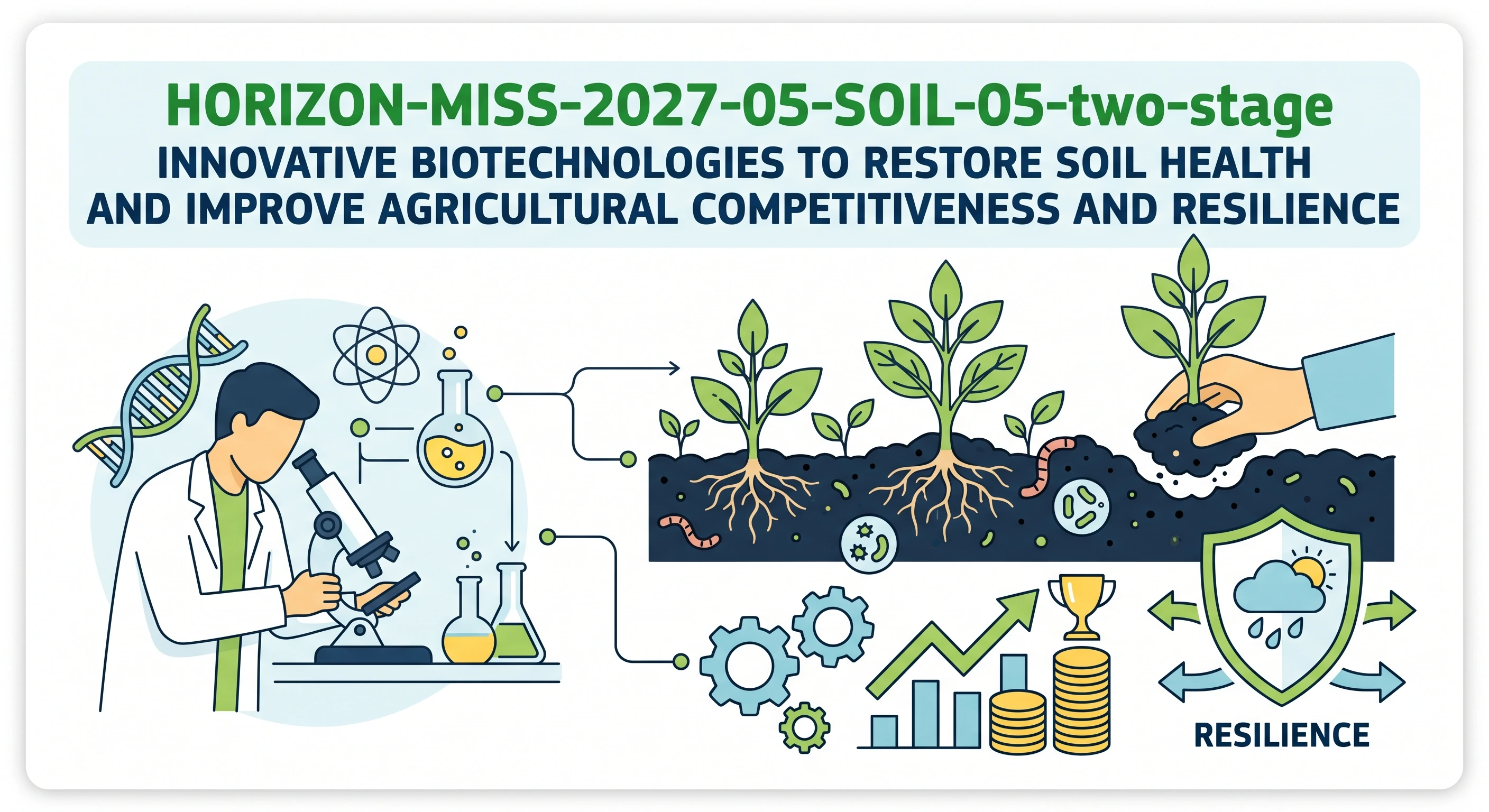
HORIZON-MISS-2027-05-SOIL-05-two-stage: Innovative biotechnologies to restore soil health and improve agricultural competitiveness and resilience
How can a soil inoculant help neighbouring microbes while limiting its own establishment?
A microbial inoculant can release metabolites that neighbouring soil bacteria use for growth, reducing its own competitive advantage. Čaušević and colleagues observed this imbalance in paired agarose-bead cultures and soil microcosms. Their experiments support metabolite sharing as one mechanism; they do not exclude growth-inhibiting interactions or establish a universal field response. [1]
This makes the receiving microbial community part of biotechnology design. The topic connects development and validation of soil-restoring biotechnologies with agricultural performance, environmental stability and practical uptake.
Microfluidics Innovation Center (MIC) could contribute controlled screening and exposure systems as a consortium partner. Within the completed Horizon 2020 MAHT-FunSST project, MIC developed a droplet platform for testing antifungal effects on individual Alternaria alternata spores, with comparison against agar and microplate assays. That experience supports assay engineering; soil-restoring applications need their own biological and agronomic validation. [2]
Download the MIC Horizon Europe 2026/2027 Calls Calendar:
Discover more!
HORIZON-MISS-2027-05-SOIL-05-two-stage: Call facts and decisive conditions
Which call is it, and when are the deadlines?
Mission Soil topic HORIZON-MISS-2027-05-SOIL-05-two-stage (official page) is an Innovation Action under the Soil Deal for Europe Mission.
- Opening: 4 February 2027. Stage 1: 8 April 2027. Stage 2: 14 September 2027. Both deadlines are at 17:00 Brussels local time.
- Indicative topic budget: €12.80 million; expected EU contribution: around €6.40 million per project. The call indicates two projects; different requested amounts remain possible.
- Funding: lump sum. The general maximum Innovation Action funding rate is 70%, or up to 100% for non-profit legal entities.
- Technical maturity: activities are expected to achieve technology readiness level (TRL) 5–6 by project completion.
The multi-actor approach is mandatory. The general consortium minimum is three independent legal entities in three different countries: at least one in an EU Member State and two others in different Member States or associated countries.
Legal entities established in China are ineligible for Innovation Actions. This topic also excludes entities established in otherwise eligible countries that are directly or indirectly controlled by China or by a legal entity established in China.
Stage 1 evaluates Excellence and Impact, with a threshold of 4/5 for each and a demand-dependent overall threshold. Full proposals use the general 3/5 thresholds and 10/15 overall threshold; Impact receives a 1.5 weighting for ranking. The Missions work programme and General Annexes define the applicable conditions.
What the biotechnology must deliver
The two expected outcomes for HORIZON-MISS-2027-05-SOIL-05-two-stage connect validated, scalable, sustainable and cost-effective biotechnologies with market readiness and availability to stakeholders. The intended benefits include soil remediation and better soil health, reduced dependence on synthetic chemicals, crop resilience, quality and productivity.
Proposals should develop, identify, upscale, pilot and validate solutions across diverse pedoclimatic and cropping conditions: combinations of soils, climates and agricultural systems. Soil microbiome approaches, including novel bio-based fertilisers and microbial inoculants, receive particular attention; the scope also permits other biotechnologies.
The work programme connects several dimensions:
- Bioremediation of contaminated soils, naming heavy metals, pharmaceuticals and per- and polyfluoroalkyl substances (PFAS).
- Increasing soil organic carbon stocks and improving soil structure, biodiversity, water retention and nutrient availability.
- Enhancing crop quality, productivity and sustainable biomass production.
Explain which contaminants, soil functions and agricultural uses the solution addresses, and how these choices contribute to the expected outcomes. Include circular resource use, environmental stability and adaptability in the development plan.
The expected outcomes use market-readiness language alongside the specified TRL 5–6 endpoint. Address both explicitly: define the technical validation achieved during the project and the integrated pathway for safe deployment, regulatory compliance and market acceptance.
Build validation around functions and receiving soils
A useful HORIZON-MISS-2027-05-SOIL-05-two-stage design approach is to follow each biotechnology from a defined function through controlled tests to pilots. Specify the intended user, application method, comparison treatment and decision criteria before selecting the screening format.
For microbial candidates, cultivation itself shapes which organisms can be tested. Dai and colleagues cultured microorganisms extracted from Oklahoma loam in droplets with amended media for 14 days at approximately 20 °C. They recovered a broader taxonomic diversity than corresponding bulk cultures; this established a cultivation method, not soil-restoration efficacy. [3]
Use the experimental programme to connect distinct endpoints:
- Candidate function: measure the targeted activity and compare it with appropriate untreated and formulation controls.
- Performance in soils: test the formulation in the intended soil matrices, with their resident communities, moisture conditions and cropping practices.
- Restoration and crop response: assess the relevant contaminant endpoint, soil functions, crop quality and productivity, alongside unintended effects.
- Scale-up: compare batches, storage and application conditions, resource demand and the cost of delivering the intended benefit.
Agree in advance which evidence permits progression to the next scale. A chip result can inform candidate selection or explain a mechanism; the project must establish performance under the conditions represented by its pilots.
Organise the value chain and adoption pathway
Multi-actor involvement should shape the work throughout the project. Farmers and practitioners need meaningful roles in defining use conditions, testing applications and interpreting results. The topic calls for adequate involvement of relevant actors across the value chain, including research teams, research and technology organisations, small and medium-sized enterprises (SMEs), start-ups, investors, product developers, intellectual-property and legal advisers, manufacturers and distributors.
Build interfaces around decisions. Microbiologists define biological candidates and functional assays; soil scientists and agronomists connect them to soil and crop endpoints; manufacturers assess production consistency; farmers and distributors identify application, handling and supply constraints. Environmental and social researchers should help assess impacts and adoption barriers.
The market-readiness pathway should cover cost–benefit, market potential, regulatory compliance, risk assessment, stakeholder engagement, market acceptance and policy foresight. Specify who will use the results and what evidence each decision-maker needs. Match work packages and lump-sum estimates to concrete outputs.
Include a dedicated task, resources, collaboration plan and budget for joint activities with projects funded under this and other relevant topics. Mission-level expectations also include collaboration with SoilWise and the Mission Soil Platform. Agriculture-related results must be summarised in appropriate EIP-AGRI practice abstracts for the Common Agricultural Policy knowledge-sharing channels.
MIC contribution: screening and controlled exposure
MIC could contribute the fluidic engineering of comparative experiments that support candidate optimisation and environmental assessment. Its consortium-partner work includes custom system design, integration and transfer to partners’ laboratories.
The MAHT-FunSST work established single-spore handling and imaging in a defined antifungal assay. MIC integrated flow control and microscopy with a polycarbonate chip supplied by Microfluidic ChipShop for the final assay. [2]
In the ongoing Horizon Europe EDAPHOS project, MIC constructed a microfluidic setup and protocol for continuous soil-leachate exposure to assess growth inhibition in Caenorhabditis elegans, a nematode used in ecotoxicology. This provides a second relevant basis for controlled biological exposure.
For this topic, proposed outputs could include:
- A droplet or perfusion module configured for the consortium’s selected organisms, formulations and measurement endpoints.
- Characterisation of liquid delivery, sample compatibility, droplet occupancy or exposure duration, as appropriate to the assay.
- An operating protocol and comparison dataset linking the miniaturised method to the partners’ reference tests.
Biological partners would define the strains and assays; analytical teams would verify the chemical endpoint; agronomic partners would establish performance in soils and crops. Material interactions, suspended particles and assay-medium compatibility need testing. The proposed module’s maturity must be assessed separately from the biotechnology’s project-level TRL.
The MIC already brings its expertise in microfluidics to Horizon Europe:
H2020-NMBP-TR-IND-2020

Microfluidic platform to study the interaction of cancer cells with lymphatic tissue
H2020-LC-GD-2020-3

Toxicology assessment of pharmaceutical products on a placenta-on-chip model

About the author

Céleste Chidiac, PhD
Scientific writer and digital marketing specialist
Céleste Chidiac holds a doctorate in neuroscience and molecular biology from the University of Strasbourg. Since joining the Microfluidics Innovation Center in 2023, she has combined scientific writing with website management. For MIC’s Horizon Europe topic pages, she draws on her research background to explain scientific challenges and clarify funding priorities. Her writing helps prospective applicants understand each topic’s scope, expected outcomes and research directions.
FAQ - HORIZON-MISS-2027-05-SOIL-05-two-stage: Designing informative soil-biotechnology experiments
These questions examine choices that affect candidate selection, experimental interpretation and transfer between partners.
Does the fastest-growing culture preserve the most microbial diversity?
No. Cell abundance and diversity are different endpoints. Dai and colleagues’ droplet cultures with amended media preserved diversity without consistently increasing growth relative to bulk culture. Choose the endpoint according to whether the aim is biomass production or a broader candidate library. [3]
Does a droplet automatically contain one microorganism?
No. Random loading creates empty, single-cell and multiple-cell droplets. Dai and colleagues used a Poisson loading model. Measure actual occupancy and check aggregation before interpreting a result as the response of one organism. [3]
Are neighbouring droplets chemically isolated?
Not necessarily. Dai and colleagues discuss transport of oil-soluble metabolites between droplets in their culture system. Check cross-talk under the actual oil, surfactant and incubation conditions before attributing a signal exclusively to one candidate. [3]
When should a candidate be tested with resident soil microbes?
Include community interactions when establishment or activity depends on the receiving soil. Paired cultures can reveal effects hidden in isolated growth: Čaušević and colleagues found that inoculants could support neighbouring soil bacteria while losing productivity themselves. Such simplified pairings identify interactions for follow-up; they do not reproduce a whole soil community. [1]
Do repeated inoculations necessarily improve establishment?
No. Papin and colleagues compared inoculation schedules for Pseudomonas fluorescens B177 in soil microcosms. Four high-density applications produced a transient abundance advantage, alongside persistent nitrate accumulation. The study supports testing persistence and soil-function effects separately; it did not establish a universal application schedule or a crop-yield benefit. [4]
How can an assay distinguish a formulation effect from the live organism’s effect?
Compare the complete formulation with a matched carrier control and an untreated control. Where scientifically appropriate, add a control for non-living biomass. Keep exposure and sampling conditions comparable, and specify which contrast answers the biological question. Control design should be agreed with the assay specialists.
How should imaging failures be handled in a screen?
Record them separately from biological inhibition. Predefine image-quality criteria and include untreated organisms under the same imaging conditions. An obscured, out-of-focus or missing observation should trigger review or a repeat measurement, rather than become a positive screening result.
Can a nematode response establish contaminant removal?
No. Growth inhibition is a biological-effect endpoint. The continuous-exposure setup developed within EDAPHOS assesses a nematode response to soil leachates. A remediation claim additionally needs chemical measurements and an appropriate comparison showing what happened to the target contaminant.
What makes a screening hit worth advancing to soil tests?
A repeatable, relevant functional response with adequate controls and a recoverable, identifiable candidate. Agree progression criteria before screening, including repeat testing, formulation compatibility and the next soil-level endpoint. A strong signal alone does not define the minimum useful agricultural effect.
What should accompany an isolate or formulation transferred between partners?
Provide a unique identifier, provenance, composition, preparation history, storage conditions, assay results and handling instructions. Agree access, permitted uses and intellectual-property arrangements before transfer. Keep the identifier consistent across screening, production batches and pilot records so results remain traceable.
References
[1] Čaušević S, Dubey M, Morales M, Salazar G, Sentchilo V, Carraro N, Ruscheweyh H-J, Sunagawa S, van der Meer JR. Niche availability and competitive loss by facilitation control proliferation of bacterial strains intended for soil microbiome interventions. Nature Communications. 2024;15:2557. doi:10.1038/s41467-024-46933-1
[2] Iftikhar S, Vigne A, Sepulveda-Diaz JE. Droplet-based microfluidics platform for antifungal analysis against filamentous fungi. Scientific Reports. 2021;11:22998. doi:10.1038/s41598-021-02350-8
[3] Dai J, Ouyang Y, Gupte R, Liu XJA, Li Y, Yang F, Chen S, Provin T, Van Schaik E, Samuel JE, Jayaraman A, Zhou A, de Figueiredo P, Zhou J, Han A. Microfluidic droplets with amended culture media cultivate a greater diversity of soil microorganisms. Applied and Environmental Microbiology. 2025;91(3):e01794-24. doi:10.1128/aem.01794-24
[4] Papin M, Philippot L, Breuil MC, Bru D, Dreux-Zigha A, Mounier A, Le Roux X, Rouard N, Spor A. Survival of a microbial inoculant in soil after recurrent inoculations. Scientific Reports. 2024;14:4177. doi:10.1038/s41598-024-54069-x