Tips & Tricks for a successful HORIZON-MISS-2027-05-SOIL-02-TWO-STAGE proposal
Opening
04 February 2027
Deadline
Keywords
Mission Soil
living labs
eutrophication
RIA
nitrate vulnerable zones
soil health
Two-stage
multi-actor approach
Soil Monitoring
co-creating
Your microfluidic SME partner for Horizon Europe
We take care of microfluidic engineering, work on valorization and optimize the proposal with you
HORIZON-MISS-2027-05-SOIL-02-two-stage: Living Labs for co-creating solutions to reduce eutrophication from agriculture
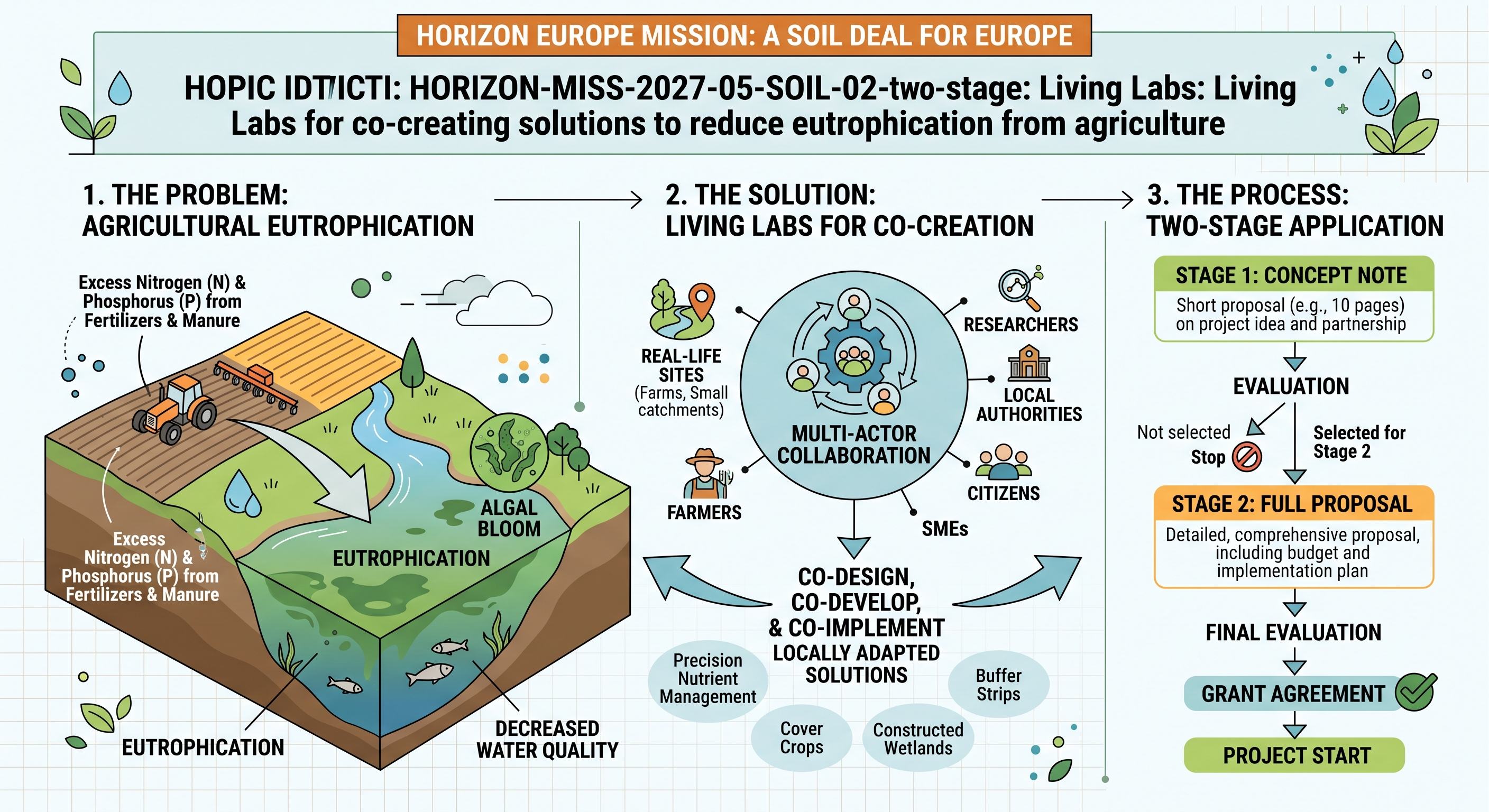
Nitrogen and phosphorus leak out of farmed soils into rivers. The Commission wants that stopped upstream, in real catchments, with the people who manage the land. So this topic funds living labs, not desk studies. Two projects get selected, and both are judged on whether the co-creation is real. This is a two-stage Research and Innovation Action under Mission Soil.
Download the MIC Horizon Europe 2026/2027 Calls Calendar:
Discover more!
Administrative facts: what do we know about the HORIZON-MISS-2027-05-SOIL-02-TWO-STAGE call?
Which call is it, and when is the opening and the deadline?
- Call name: Supporting the implementation of the Soil Deal for Europe Mission
- Call identifier: HORIZON-MISS-2027-05-two-stage
- Destination: A Soil Deal for Europe, supporting the implementation of the Mission Soil
- Topic: HORIZON-MISS-2027-05-SOIL-02-two-stage
- Opening: 04 February 2027
- First stage deadline: 08 April 2027, 17:00 Brussels time
- Second stage deadline: 14 September 2027, 17:00 Brussels time
- Type of action: Research and Innovation Action (RIA)
What about the budget and estimated size of the project?
- Overall topic budget: EUR 24.00 million
- Number of projects expected: 2
- EU contribution per project: around EUR 12.00 million
What are the key eligibility and evaluation conditions?
- Second stage evaluation: overall threshold of 12, with a minimum of 4 on Excellence
- The multi-actor approach is mandatory
- Financial support to third parties allowed, capped at EUR 60 000 per third party
- Four to five living labs, located in at least three Member States or Associated Countries
- Sites should sit in nitrate vulnerable zones (reporting period 7 or more recent), otherwise justify with national, regional or local data
- Collaboration with SOILL, the European Union Soil Observatory and SoilWise, plus Mission Soil clustering activities
Scientific range: what does the Commission expect from the HORIZON-MISS-2027-05-SOIL-02-TWO-STAGE grant?
What outcomes are expected?
By the end, four or five living labs should be running, monitored, and still standing without EU money. Publication series are not what the Commission is after. It wants viable practices that land managers adopt, standardised local soil health data, and policymakers who understand what drives nutrient loss in their own catchment.
What is within scope?
- Soil management practices that cut nitrogen and phosphorus runoff and leaching from agricultural land
- Living labs of 10 to 20 sites each, farms mostly, forest and semi-natural land too
- Baseline setting and monitoring of both soil and the nearby water body
- Indicators from the proposed Soil Monitoring and Resilience Directive, complemented with eutrophication-specific ones
- Business models and organisational strategies for life after Horizon Europe
One boundary: each living lab must focus on one small river catchment, with up- and downstream challenges identified. Labs spread across unrelated territories will struggle.
What are the specifically proposed research directions?
- Nutrient interception through restored soil function, not just reduced input
- Effect of floods and droughts on nutrient export, now and under future climate
- Co-assessment of change over time, farmers doing part of the measuring
- Viability of each solution, technical through cultural, with a real SSHA contribution
- High-performing sites that could become lighthouses, at proposal stage or later
The wording on lighthouses is loose. Room to frame it your way.
Scientific strategy: how can you enhance your chances of being funded through HORIZON-MISS-2027-05-SOIL-02-TWO-STAGE?
What scientific choices matter most?
- Pick your catchments first, then build the science around them. Evaluators read the site list before anything else.
- Show the nutrient pathway. Where does the P go, and how fast.
- Use the Soil Monitoring and Resilience Directive indicator set as the backbone. Add your own on top, but do not replace it.
- Budget the monitoring properly. We see underfunded measurement plans in almost every draft.
- Say who holds the data and when it reaches the EUSO.
- Don’t promise soil recovery in four years.
Consortium & proposal-writing plan: what works best with this type of call?
- Somewhere between twelve and eighteen partners, maybe more if you cover five catchments
- Farmer organisations, water authorities, agronomists, soil scientists, an economist, at least one SSHA team. Skip the social science and the multi-actor approach claim collapses.
- Include an innovative SME or two. They usually carry the sensing and data side, and they make the sustainability plan credible.
- Plan the FSTP scheme in stage 2. Sixty thousand euros per farmer group goes further than you’d think.
- Stage 1 is ten pages. Concept and consortium logic only, no work package detail.
How would microfluidics contribute to this topic?
Standard nutrient monitoring means sending samples to a lab and waiting. Across twenty farm sites, that delay kills the feedback loop. Microfluidic analysers put the measurement in the field, running nitrate and phosphate chemistry on a chip with tiny reagent volumes. Our soil-on-chip review covers the underlying platforms in detail.
- Continuous in-stream nitrate and phosphate sensors at catchment outlets. Hourly data, not monthly grab samples.
- Say a farmer changes cover crop timing and wants to know if it worked. Chip-based analysis of soil pore water answers in weeks, not at the next annual report. A sequential injection device automates that sampling loop.
- Droplet systems for soil microbiome work, useful when tracking nutrient cycling microbes
- Portable devices farmers can operate themselves, which is exactly the participatory monitoring the call describes. A field-usable benchtop pump is often the missing piece.
For your consortium, microfluidics turns a monitoring promise into evidence you can show at review. And it gives the same answer twice, across five catchments, same method. That comparability is what evaluators reward. The same logic runs through the Cluster 6 soil and water topics of this work programme.
The MIC already brings its expertise in microfluidics to Horizon Europe:
H2020-NMBP-TR-IND-2020

Microfluidic platform to study the interaction of cancer cells with lymphatic tissue
H2020-LC-GD-2020-3

Toxicology assessment of pharmaceutical products on a placenta-on-chip model

FAQ - HORIZON-MISS-2027-05-SOIL-02-TWO-STAGE
What is HORIZON-MISS-2027-05-SOIL-02-two-stage about?
It funds living labs that co-create soil management solutions to cut eutrophication coming from agriculture. Nitrogen and phosphorus leaving farm soils reach rivers and lakes. The topic asks for the problem to be tackled in the catchment itself, with land managers in the room.
How much money is available and how many projects will be funded?
The total indicative budget is EUR 24.00 million. Two projects are expected, each around EUR 12.00 million. Proposals asking for a different amount are not excluded, but the Commission has set its expectation clearly.
What are the opening and deadline dates?
Opening on 04 February 2027. First stage closes 08 April 2027, second stage 14 September 2027. Both at 17:00 Brussels time. The Director-General may shift the opening by a month and delay deadlines by up to two months. Check the Funding and Tenders Portal for more information.
How many living labs do I need and where?
Four to five living labs, in at least three Member States or Associated Countries. Each one focuses on a specific small river catchment. Ten to twenty sites per lab, fewer only with a solid justification.
Do my sites have to be in nitrate vulnerable zones?
In principle yes. Sites should sit in nitrate vulnerable zones designated in reporting period 7 or more recent. If not, you need a clear rationale based on national, regional or local data showing the eutrophication challenge.
What does the multi-actor approach mean in practice here?
Researchers alone will not pass. Expect landowners, farmers, water authorities, SMEs, public administrators and civil society in the labs. Roles and resources of each actor must be described. An effective SSHA contribution is expected too.
Can I pay farmers and small actors through the project?
Yes. Financial support to third parties is allowed, up to EUR 60 000 per third party, through grants. It can cover site management, sampling, data collection, events, equipment, and even compensation for production loss.
What are the evaluation thresholds?
At second stage, the overall threshold is 12, with a minimum of 4 on Excellence. Other conditions follow the General Annexes. Stage 1 keeps the standard short-proposal format.
Which initiatives must I collaborate with?
SOILL for living lab support and the lighthouse labelling process. The European Union Soil Observatory and SoilWise for data. Also the Agroecology and Sustainable Food Systems partnerships, EIP-AGRI operational groups, and Mission Soil clustering.
How can microfluidics strengthen my proposal?
It makes the monitoring plan credible. On-chip nitrate and phosphate analysers give high-frequency catchment data without shipping samples to a lab. Farmers can run them themselves. See our soil-on-chip review for what the platforms actually do.