
Tips & Tricks for a successful HORIZON-MISS-2027-03-OCEAN-03 proposal
Opening
09 February 2027
Deadline
Keywords
Mission Ocean
Green harbours
Innovation Action
Port pollution
Invasive species
Circular economy
TRL 6-8
resilient harbour
material reuse
Your microfluidic SME partner for Horizon Europe
We take care of microfluidic engineering, work on valorization and optimize the proposal with you
HORIZON-MISS-2027-03-OCEAN-03: Green, circular and resilient harbours
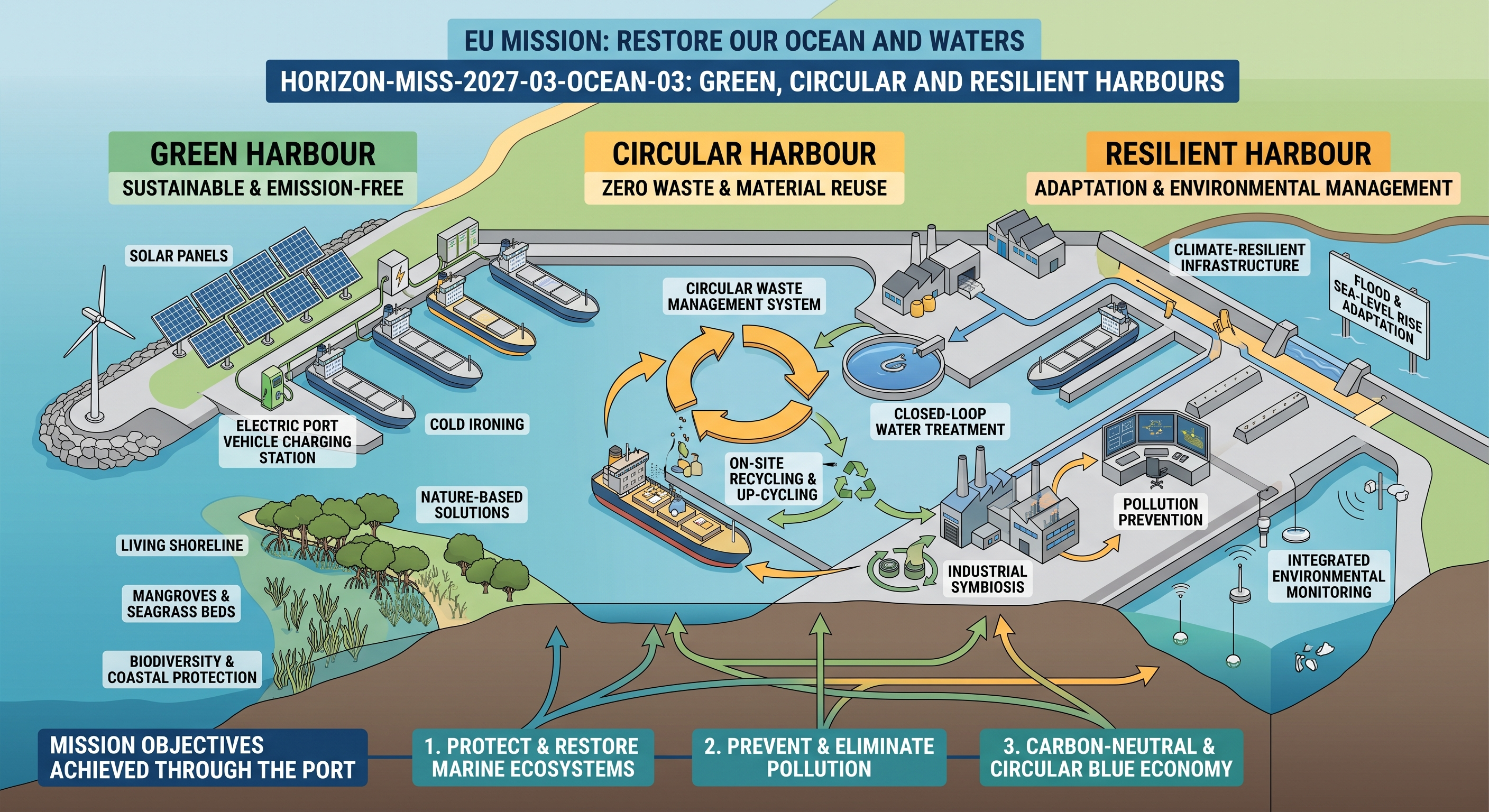
Ports are where the Mission targets get tested for real. This topic funds two Innovation Actions that take solutions already working somewhere and prove they hold up in working harbours. Demonstrations must run in at least four ports, one per Mission basin. Port authorities belong inside the consortium, not outside.
Download the MIC Horizon Europe 2026/2027 Calls Calendar:
Discover more!
Administrative facts: what do we know about the HORIZON-MISS-2027-03-OCEAN-03 call?
Which call is it, and when is the opening and the deadline?
- Call name: Supporting the implementation of the Restore our Ocean and Waters Mission
- Call identifier: HORIZON-MISS-2027-03
- Destination: Restore our Ocean and Waters by 2030
- Topic: HORIZON-MISS-2027-03-OCEAN-03, Green, circular and resilient harbours
- Opening: 09 February 2027
- Deadline: 21 September 2027, 17:00:00 Brussels time
- Type of action: Innovation Action, single stage
- TRL: 6 to 8 by the end of the project
What about the budget and estimated size of the project?
- Overall indicative budget of the call: EUR 100.40 million
- Topic budget: EUR 11.90 million
- Number of projects expected: 2
- Budget per project: EUR 5.95 million (11.90 divided by 2). Commission range: EUR 5.50 to 5.95 million
What are the key eligibility and evaluation conditions?
- General Annexes A to G apply, no derogation on eligibility or award criteria
- Standard Innovation Action thresholds under General Annex D
- Financial support to third parties allowed, grants only, EUR 100 000 maximum per recipient, once per project
- Third parties must be local or regional authorities governed by public law, not already beneficiaries of the project
- Demonstration in at least 4 ports, one per Mission basin
- At least 4 associated regions to be engaged
- No JRC participation, no clustering obligation for this topic
Scientific range: what does the Commission expect from the HORIZON-MISS-2027-03-OCEAN-03 grant?
What outcomes are expected?
Measurable progress against Mission targets, in real ports, with numbers a reviewer can check. The Commission also wants port cities and authorities readier than they were, able to scale what was tested. Feasibility studies are not what this topic is after.
What is within scope?
- Testing, deployment and upscaling of innovative solutions in port areas
- Pollution reduction and better environmental management
- Ecosystem restoration and nature based solutions such as vegetated buffers
- Monitoring of invasive species arriving through maritime traffic
- Renewable energy, alternative fuels, circularity in port operations
- Adaptation to sea level rise, floods, droughts, extreme weather
- Coastal and inland ports, any size
Solutions that stay in the lab, or in one port, fall outside.
What are the specifically proposed research directions?
- Local Implementation Strategies co built with harbours, authorities and industry
- Monitoring effectiveness of deployed solutions, which implies a measurement plan from day one
- Waste management systems that recycle and cut port generated waste
- Capacity building for smaller ports, which usually lack staff more than they lack ideas
- Twinning, summer schools, living labs between ports
- Synergies with ERDF, LIFE, EMFAF, EIB and national programmes
The wording on solution types stays deliberately open. Room to frame your own technical angle, provided it maps onto a named Mission objective.
Scientific strategy: how can you enhance your chances of being funded through HORIZON-MISS-2027-03-OCEAN-03?
- Pick your four basins early. Get the ports committed before you draft the impact section.
- Quantify everything. The outcomes say measurable, quantifiable, verifiable. Reviewers read that literally.
- Anchor each activity to one Mission objective and its 2030 target.
- Show the baseline. Without a before, your after proves nothing.
- Do not oversell TRL. You need 6 to 8, so bring technology that already left the bench.
- Budget the associated regions properly. Cascading funding gets treated as an afterthought, it costs points.
- Name the legal frame: Water Framework Directive, Marine Strategy Framework Directive, Nature Restoration Regulation, EU Port Strategy.
Consortium & proposal-writing plan: what works best with this type of call?
- Somewhere between twelve and eighteen partners, maybe more if the four basins pull in extra ports.
- Port managing authorities as beneficiaries. The topic says strongly encouraged. In practice it reads as required.
- Mix: municipalities, environmental agencies, universities, technology providers.
- An innovative SME or two brings the deployable hardware, and usually the exploitation route public partners cannot offer.
- Write the demonstration sites as a table. Site, basin, problem, solution, indicator, target.
- Keep the replication plan concrete. Name the four associated regions if you can.
How would microfluidics contribute to this topic?
Water quality in a port is still mostly checked with a bottle, a van, and a lab three days away. By then the discharge event is over and nobody can say what caused it. Microfluidics shrinks that analysis onto a chip sitting at the quay, answering the same day.
- Ballast water carries passengers nobody booked. Reading environmental DNA on chip lets your port screen arrivals for invasive species in hours instead of weeks. Same protocol in four basins, so the datasets compare.
- Nutrients, hydrocarbons and metals: analysers on a buoy give continuous numbers, not monthly snapshots.
- Microplastic counting and sizing in flow, one of the harder Mission targets to evidence.
- Bacterial contamination after storm overflows, screened on droplet assays.
- Antifouling coatings tested in microchannels before you paint anything.
- And the kit is small. A container on the quay, not a new building.
Point is, this topic asks you to prove effects, at four sites, with numbers that hold up. Microfluidics is one of the few ways to get the same answer twice in four harbours, on a budget that also pays for the interventions.
The MIC already brings its expertise in microfluidics to Horizon Europe:
H2020-NMBP-TR-IND-2020

Microfluidic platform to study the interaction of cancer cells with lymphatic tissue
H2020-LC-GD-2020-3

Toxicology assessment of pharmaceutical products on a placenta-on-chip model

FAQ - HORIZON-MISS-2027-03-OCEAN-03
What is HORIZON-MISS-2027-03-OCEAN-03 about?
The topic is called Green, circular and resilient harbours. It sits under the call HORIZON-MISS-2027-03, Supporting the implementation of the Restore our Ocean and Waters Mission. It funds the testing, deployment and upscaling of innovative solutions inside working ports, to cut pollution, restore ecosystems and make port operations circular and climate resilient.
When does the call open and what is the deadline?
Opening is 09 February 2027. The single deadline is 21 September 2027 at 17:00:00 Brussels time. It is a single stage call, so the full proposal goes in at that date. The Commission may shift the opening by up to one month and delay the deadline by up to two months, as stated in the work programme.
How much money is available per project?
The topic budget is EUR 11.90 million and 2 projects are expected. That gives EUR 5.95 million per project on average. The Commission itself indicates an EU contribution of between EUR 5.50 and 5.95 million per project. Different amounts can still be requested, but you would need a good reason.
What type of action is it, and which TRL is expected?
This is an Innovation Action. Activities are expected to reach TRL 6 to 8 by the end of the project. In plain terms, the technology must already have left the bench. Reviewers will look for demonstration in real operating conditions, not for early proof of concept work.
For more information, check the Funding and Tenders Portal of the European Commission.
How many ports must be involved, and where?
Demonstration activities are expected in at least 4 ports, one in each of the four Mission basins: Atlantic and Arctic, Mediterranean, Baltic and North Sea, and the Danube River basin including the Black Sea. Public administrations and port managing authorities must be meaningfully involved, not just named in a letter of support.
How does financial support to third parties work here?
Beneficiaries may pass on grants to third parties. Only local or regional authorities established and governed by public law qualify, and only if they are not already beneficiaries in a demonstration site of the same project. The cap is EUR 100 000 per recipient, once for the whole project duration. The aim is capacity building in associated regions.
Who should be in the consortium?
Port authorities, municipalities and environmental agencies form the backbone. Around them you want universities, technology providers and at least one innovative SME able to deliver deployable hardware and carry the exploitation route. For a four basin project, twelve to eighteen partners is a realistic range.
What outcomes will evaluators be looking for?
Measurable, quantifiable and verifiable progress towards Mission objectives, achieved in real ports. Also increased readiness of port cities and authorities to deploy and scale the solutions, plus knowledge sharing between ports. A baseline and a monitoring plan are what turn a claim into evidence.
What falls outside the scope?
Work that stays in the laboratory, or that demonstrates in a single port, does not fit. The topic is about deployment across four basins and replication in associated regions. Studies without physical implementation, or technology below TRL 6, will struggle on both excellence and impact.
How can microfluidics strengthen an OCEAN-03 proposal?
Port monitoring still relies on bottles sent to a distant laboratory. Microfluidic analysers put the measurement at the quay: nutrients, hydrocarbons and metals in continuous mode, environmental DNA screening for invasive species in ballast water, microplastic counting in flow. Same protocol in four basins means four comparable datasets.