Tips & Tricks for a successful HORIZON-MISS-2027-02-CANCER-03 proposal
Opening
10 February 2027
Deadline
Keywords
Rare cancers
First-in-human trials
clinical trials
Biomarker-guided medicines
Precision oncology
Drug repurposing
Patient-reported outcomes
Your microfluidic SME partner for Horizon Europe
We take care of microfluidic engineering, work on valorization and optimize the proposal with you
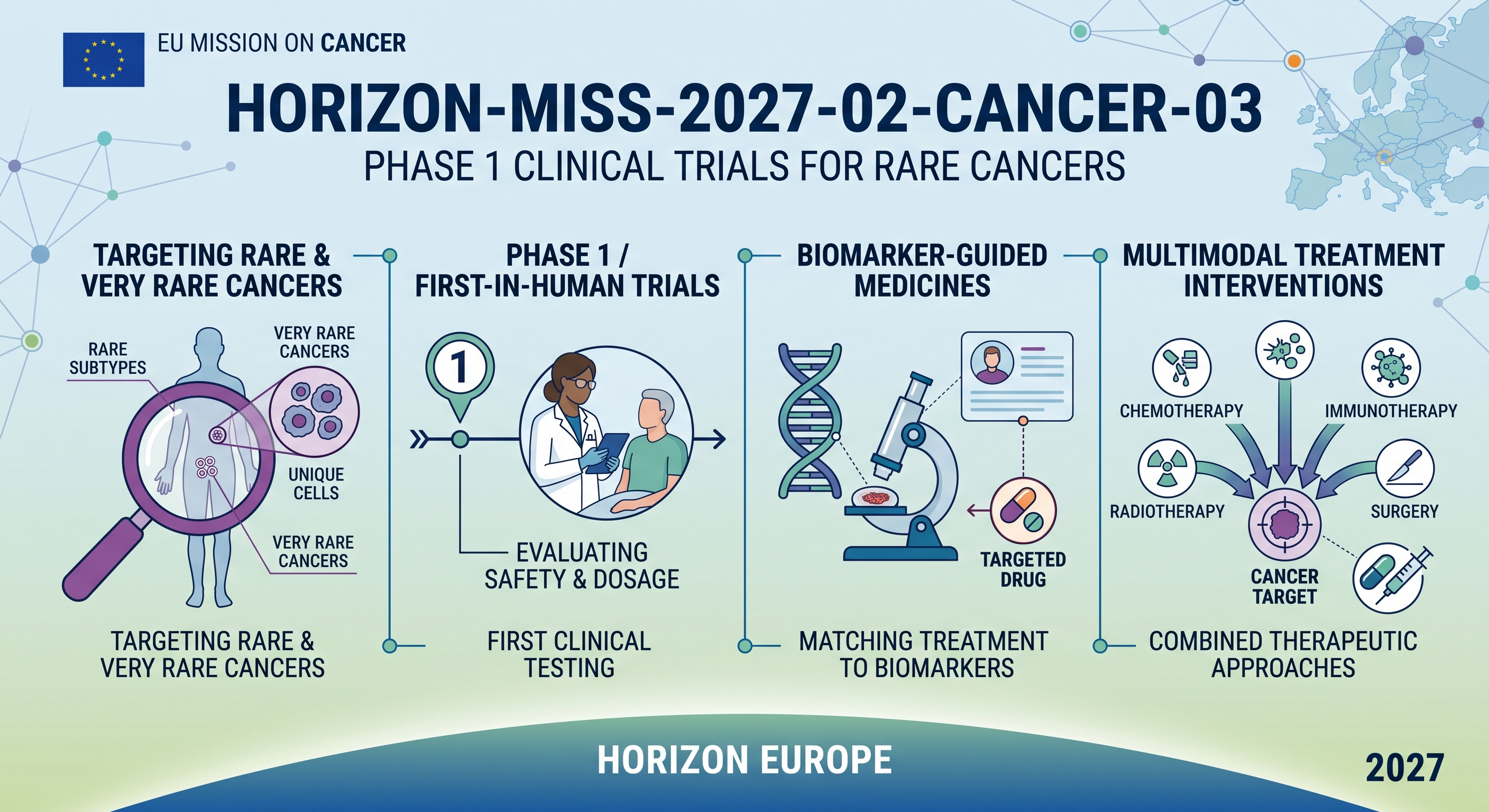
HORIZON-MISS-2027-02-CANCER-03: Phase 1 including first-in-human clinical trials to test biomarker-guided medicines or multi-modal treatment interventions for patients with rare or very rare cancers or cancer subtypes
Rare cancers make up close to a quarter of all cancer cases, yet patients often face late diagnosis and very few options. The Commission wants early clinical evidence that new precision treatments actually help these people. This topic funds phase 1 work, including first-in-human trials, for biomarker-guided medicines or combined treatment approaches. The aim is safety and efficacy signals strong enough to carry a therapy forward.
Download the MIC Horizon Europe 2026/2027 Calls Calendar:
Discover more!
Administrative facts: what do we know about the HORIZON-MISS-2027-02-CANCER-03 call?
Which call is it, and when is the opening and the deadline?
- Call name: Supporting the implementation of the Cancer Mission
- Call identifier: HORIZON-MISS-2027-02
- Destination: Cancer Mission
- Topic: HORIZON-MISS-2027-02-CANCER-03
- Opening date: 10 February 2027
- Deadline: 21 September 2027 at 17:00 Brussels time
- Type of action: Research and Innovation Action (RIA)
What about the budget and estimated size of the project?
- Overall topic budget: EUR 24.00 million
- Number of projects expected: 3
- Budget per project: EUR 8.00 million on average, with a stated range of EUR 7.00 to 9.00 million
What are the key eligibility and evaluation conditions?
- Evaluation thresholds: 4 for Excellence, 4 for Impact, 4 for Implementation, cumulative 12
- Funding form: lump sum
- Clustering: successful projects join the Diagnosis and treatment cluster of the Cancer Mission
- Coordination: projects build on the Knowledge Centre on Cancer
- Results: the granting authority may object to ownership transfer or exclusive licensing for up to 4 years after the action ends
Scientific range: what does the Commission expect from the HORIZON-MISS-2027-02-CANCER-03 grant?
What outcomes are expected?
Patients should gain real access to promising treatments, through follow-on trials or compassionate use programmes. The Commission also wants innovators, SMEs and clinicians to reach validated technology or medicines they can push further. And health authorities need early safety and efficacy data to justify wider testing. Publication lists are not what’s being asked for here.
What is within scope?
- Preclinical validation of biomarker-guided drugs, when still needed, using in vivo, ex vivo or in silico models
- Drug repurposing as a route worth considering
- Phase 1 and first-in-human multi-centre trials, with newer trial designs where they fit
- Data disaggregated by tumour biology, sex, gender, age, and factors like socio-economic status or ethnicity
The Commission draws a line here. This is early clinical validation for rare cancers, not late-stage confirmatory trials.
What are the specifically proposed research directions?
- Basket, umbrella, adaptive, decentralised or roll-over trial designs suited to tiny patient numbers
- Endpoints covering safety, efficacy and patient-reported outcomes, defined together with patients and caregivers
- Participative research that brings end users into the trial design
- Datasets described in the European Health Data Space catalogue, tools shared via the future UNCAN.eu platform
- Regulatory advice on trial design, secured before submission (they ask for proof of it)
Scientific strategy: how can you enhance your chances of being funded through HORIZON-MISS-2027-02-CANCER-03?
What scientific choices matter most?
- Get regulators in early. The call asks for documented regulatory advice, so this is not optional.
- Pick a trial design that fits rare cancers. Basket and umbrella approaches let you pool small subgroups.
- Show a credible biomarker rationale. Reviewers want to see why this drug, for this target, in this patient group.
- Build patient engagement into the science, not as a box to tick.
- Plan your data flow toward EHDS and UNCAN.eu from day one.
- Where preclinical gaps remain, close them convincingly. A shaky preclinical base sinks a phase 1 story.
Consortium & proposal-writing plan: what works best with this type of call?
- Aim for somewhere between eight and twelve partners, maybe more if clinical coverage demands it.
- You’ll want trial sites across several Member States, plus a strong regulatory and patient-advocacy presence.
- Mix academia, hospitals, patient organisations, and at least one innovative SME bringing enabling technology or a drug candidate.
- If you have a startup or spin-off with a promising asset, that fits the outcome the Commission spelled out.
- Interdisciplinary matters. Oncologists, trialists, data people, regulatory experts.
- On writing: map each expected outcome to a concrete deliverable. Evaluators check that link fast.
How would microfluidics contribute to this topic?
Rare cancers come with a hard problem. Barely any patient samples, and animal models that often miss the human biology. Conventional preclinical testing struggles when material is this scarce. Microfluidic organ-on-chip and tumour-on-chip systems change what you can do with a small sample.
- Patient-derived organoids grown on chip let you test a candidate drug on the actual tumour, using tissue amounts too small for a normal assay plate.
- Say you want to know whether a biomarker really predicts response. You can run that comparison on chip, side by side, and get the same answer twice.
- Liquid biopsy work on microfluidic devices helps you track rare tumour cells or circulating DNA during the trial, which feeds your safety and efficacy endpoints.
- One team used a chip to screen a repurposed compound across several rare subtypes at once. Same compound, different tissue, different outcome. That told them where to focus.
For a phase 1 proposal, this is where microfluidics earns its place. It strengthens your preclinical package, it stretches scarce samples, and it gives your consortium concrete evidence to put in front of regulators. A partner with this capability quietly makes your validation story harder to argue with.
The MIC already brings its expertise in microfluidics to Horizon Europe:
H2020-NMBP-TR-IND-2020

Microfluidic platform to study the interaction of cancer cells with lymphatic tissue
H2020-LC-GD-2020-3

Toxicology assessment of pharmaceutical products on a placenta-on-chip model

FAQ - HORIZON-MISS-2027-02-CANCER-03
What is the HORIZON-MISS-2027-02-CANCER-03 call about?
It funds early clinical work for rare and very rare cancers. Specifically phase 1, including first-in-human trials, to test biomarker-guided medicines or multi-modal treatment interventions. The goal is early safety and efficacy evidence for patients who currently have few options.
When does the call open and close?
The call opens on 10 February 2027. The deadline is 21 September 2027 at 17:00 Brussels time. It is a single deadline. The Director-General may shift the opening by up to one month and the deadline by up to two months.
How much funding is available per project?
The total topic budget is EUR 24.00 million. The Commission expects to fund 3 projects. That works out to roughly EUR 8.00 million each, within a stated range of EUR 7.00 to 9.00 million. Different amounts can still be requested.
What type of action is this, RIA or IA?
It is a Research and Innovation Action (RIA). Funding takes the form of a lump sum. Evaluation thresholds are 4 for each criterion, with a cumulative threshold of 12.
Which cancers are in scope?
Rare and very rare cancers, and rare cancer subtypes. Roughly a quarter of all cancers are rare. The focus is patients with advanced disease and few treatment options, where phase 1 validation is hard to access. Check the Funding and Tenders Portal for more information.
What clinical trial designs does the Commission encourage?
Designs suited to small patient numbers. Basket, umbrella, adaptive, decentralised and roll-over or extension trials are named in the work programme. New trial designs are welcome where they fit the rare-cancer setting.
Is regulatory advice required before submission?
Yes. Applicants must include proof of advice from regulators on the clinical trial design. This is not a soft recommendation. Skipping it weakens the proposal on both Impact and Implementation.
What are the data and open science requirements?
Datasets should be described with metadata in the European Health Data Space catalogue. Tools and models should follow open science principles and be made available through the future UNCAN.eu platform. Successful projects also build on the Knowledge Centre on Cancer.
Do funded projects have to work together?
Yes. Successful proposals join the Diagnosis and treatment cluster of the Cancer Mission. You should budget for networking, meetings and joint activities. The Commission coordinates this.
How can microfluidics strengthen a proposal for this topic?
Microfluidics helps where samples are scarce, which is the norm for rare cancers. Organ-on-chip and tumour-on-chip models, patient-derived organoids on chip, and liquid biopsy devices support preclinical validation and biomarker work. Including a partner with this capability strengthens the preclinical package that a phase 1 trial rests on.