
Functional genomics: connecting cancer targets to the patients who need them
Opening
10 February 2027
Deadline
Keywords
Cancer Mission
functional genomics
novel cancer targets
tumour heterogeneity
paediatric cancers
UNCAN.eu
RIA
Your microfluidic SME partner for Horizon Europe
We take care of microfluidic engineering, work on valorization and optimize the proposal with you
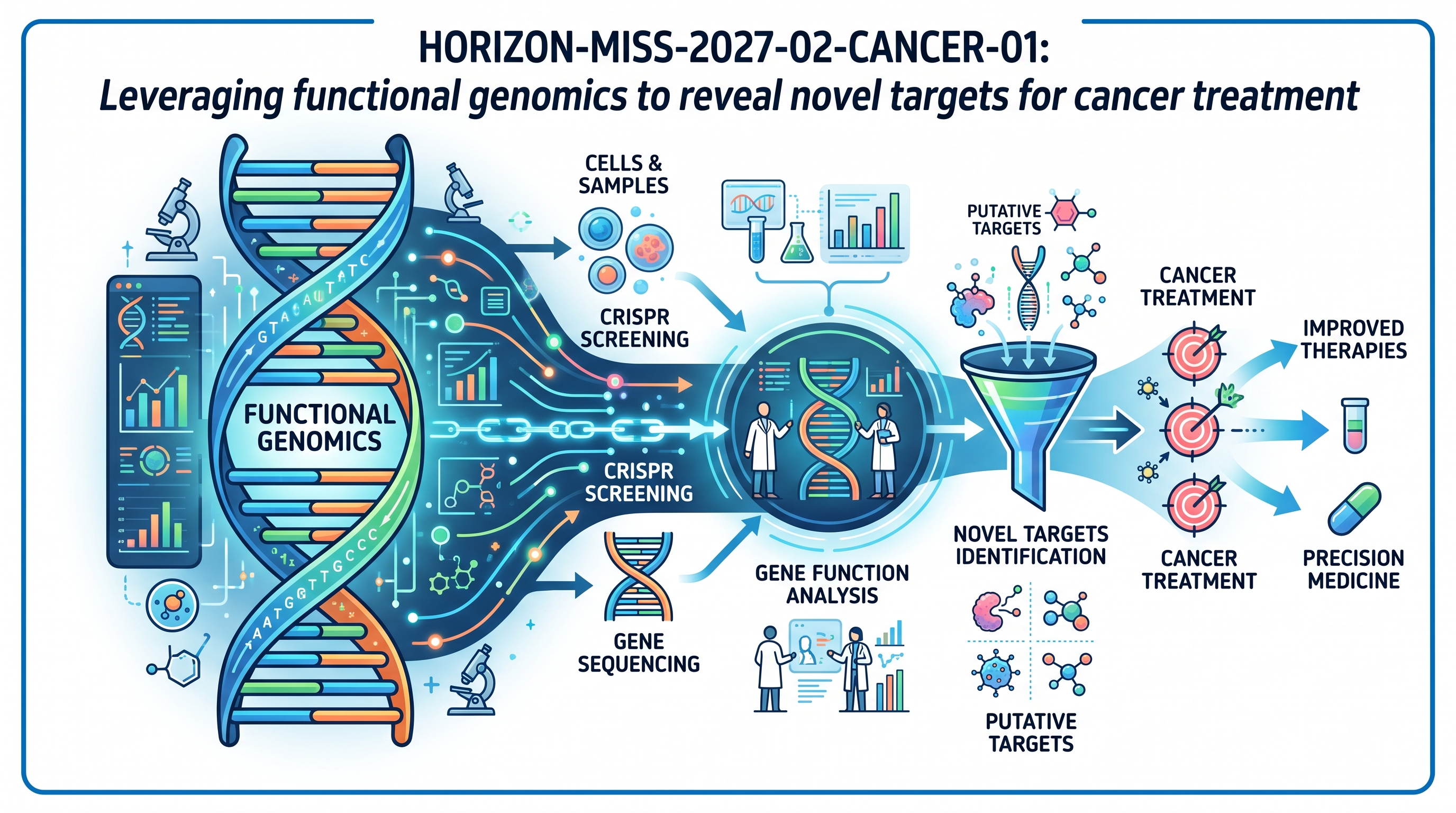
HORIZON-MISS-2027-02-CANCER-01: Leveraging functional genomics to reveal novel targets for cancer treatment
Why should target discovery identify the patients as well as the gene?
A cancer target becomes more useful when researchers can identify the tumours that depend on it. A dependency is a gene function required for cancer-cell survival or growth; a molecular marker can help identify the context in which that dependency occurs. Pacini and colleagues combined genetic-screen and multi-omics data from 930 cancer cell lines to connect dependencies with molecular markers and prioritise candidate targets. This was target-discovery research, not evidence of benefit from treating patients. [1]
For HORIZON-MISS-2027-02-CANCER-01, the next question is whether those vulnerabilities persist as tumours evolve. The topic connects functional genomics with tumour heterogeneity, the surrounding microenvironment and longitudinal patient data to reveal and validate new therapeutic targets.
Microfluidics Innovation Center (MIC) could contribute as a partner to the engineering of controlled tumour-model experiments. Within the completed Horizon 2020 Tumor-LN-oC project, MIC developed a perfusion pump for maintaining flow through cell-culture chips. This provides a concrete engineering basis for testing candidate targets under defined culture and exposure conditions.
Download the MIC Horizon Europe 2026/2027 Calls Calendar:
Discover more!
HORIZON-MISS-2027-02-CANCER-01: Funding, timetable and decisive conditions
Which call is it, and when are the opening and deadline?
- Topic: HORIZON-MISS-2027-02-CANCER-01 — Leveraging functional genomics to reveal novel targets for cancer treatment. (Official page)
- Call: Supporting the implementation of the Cancer Mission, HORIZON-MISS-2027-02.
- Scheduled opening: 10 February 2027. Single-stage deadline: 16 September 2027, 17:00 Brussels local time.
- Action: Research and Innovation Action (RIA). No target technology readiness level is specified.
Funding: the indicative topic budget is EUR 32.32 million, with an expected EU contribution of EUR 7–8 million per project and an indicative four projects. Different requested amounts remain admissible.
Participation: the standard minimum is three independent legal entities in three different countries: at least one in an EU Member State and two others in different Member States or Associated Countries. The General Annexes also govern participation and funding eligibility. Their restriction on entities established in China applies to this RIA, subject to justified case-by-case exceptions. The topic additionally applies restrictions protecting European communication networks.
Evaluation: thresholds are 4 for Excellence, 4 for Impact and 4 for Implementation, with a cumulative threshold of 12. The portfolio rule provides for at least one highest-ranked qualifying application targeting children and adolescents aged 0–19 at first diagnosis, provided all thresholds are met. This does not guarantee funding for every paediatric proposal.
The granting authority may object to transfers of ownership or exclusive licensing of results up to four years after the action ends. Consult the final Missions work programme for the specific conditions; the Portal remains the reference for the submission timetable.
Scientific scope: connect target validation, tumour evolution and patient data
The HORIZON-MISS-2027-02-CANCER-01 topic seeks three outcomes: deeper understanding of the functional effects of tumour heterogeneity; knowledge and tools for next-generation genomically informed treatments; and contributions to UNCAN.eu, including interoperable data and sustainable access to digital tools and models.
Proposals should address all three activity strands:
- Identify and validate new targets: develop relevant experimental models and technologies to investigate temporal tumour heterogeneity during initiation, progression and relapse.
- Explain changing vulnerabilities: investigate dynamic multi-omics, the tumour microenvironment and patient factors, including adaptive resistance to treatment. Relevant factors include genetic background, immune status, age, sex and comorbidities.
- Integrate longitudinal evidence: analyse multimodal patient data following FAIR principles, Findable, Accessible, Interoperable and Reusable, and make the resulting digital assets available through UNCAN.eu.
Paediatric and adolescent cancers, refractory or rare cancers, limited treatment options and low five-year survival are of particular interest. These priorities do not create an exclusive list of eligible cancer types.
Functional genomics includes transcriptomics, proteomics, epigenomics and metabolomics used to understand gene function. Single-cell and spatial methods, structural biology, liquid biopsies and functional precision oncology are encouraged approaches. Computational modelling, causal inference and artificial intelligence are encouraged, rather than each being compulsory. Relevant models may be computational, in vitro, in vivo, ex vivo, preclinical or clinical.
Research strategy: follow a target through changing disease states
A useful HORIZON-MISS-2027-02-CANCER-01 proposal can define a target-marker-disease-state relationship: which intervention is being tested, which molecular context predicts a response, and at which stage of disease. This is a design recommendation, not an additional call condition.
Connect discovery screens to focused validation. Plan independent perturbations, suitable controls and an orthogonal readout for prioritised targets. Compare results across the relevant tumour states and microenvironments. Define in advance what evidence would advance a candidate, restrict it to a subgroup or rule it out.
Link sample collection to treatment history and clinically meaningful time points. Distinguish repeated measurements from the same patient from comparisons between different patients. Explain how missing samples, changing cell composition and technical batches will be handled.
Proposed outputs could include a prioritised target set with associated markers, experimentally tested resistance mechanisms, qualified model protocols and reusable analysis tools. State how oncology partners will assess their biological relevance and how independent samples or models will test whether findings extend beyond the discovery material.
Consortium and data plan: build the interfaces required for reuse
For HORIZON-MISS-2027-02-CANCER-01, combine clinical oncology and sample access with functional genomics, experimental modelling, bioinformatics and data stewardship. Include the appropriate mix of healthcare professionals, researchers, infrastructure specialists, solution providers and companies for the planned work. The topic specifies no ideal consortium size or SME quota.
Data delivery is part of the research plan. All datasets produced should have metadata records in the EU dataset catalogue of the European Health Data Space. Describe interoperability, access permissions and the sustainable availability of tools and models. Reflect relevant European Strategy Forum on Research Infrastructures (ESFRI) life-science resources and biobanking options in the work plan.
Build on European 1M+ Genomes and European Cancer Imaging data and experience where possible. Successful proposals are expected to establish appropriate collaboration with UNCAN-CONNECT, which is implementing the UNCAN.eu platform.
Include a budget for networking, meetings and joint activities in the Cancer Mission’s Understanding project cluster. Detailed joint activities can be defined during grant preparation and the project. Clinical studies are optional; applicants planning them should complete the dedicated submission annex.
Microfluidics and MIC: connect perturbations to controlled tumour models
Microfluidics can support two relevant experimental functions. Droplet assays miniaturise perturbation screens: Mathur and colleagues used Combi-seq to profile 420 drug combinations in K562 leukaemia cells, with about 250 single-cell droplets per condition. Treatment barcodes linked drug exposure to transcriptomic readouts. This demonstrated a cell-line workflow, not a validated patient-selection test. [2]
Compartmentalised tumour models help test microenvironment effects. Plesselova and colleagues separated ovarian cancer cells, stromal cells and circulation channels in a tumour-on-chip. Cancer-associated fibroblasts increased resistance to carboplatin/paclitaxel compared with normal fibroblasts in the studied cell-line models. The result supports investigating tumour–stroma interactions; it does not establish performance across cancers or patients. [3]
For this topic, a consortium could use such models to test whether a candidate vulnerability changes with stromal context or treatment sequence. Genetic perturbation, molecular profiling and the biological choice of model would need to be designed together. Microfluidics is one experimental option, not a call requirement.
MIC could develop and integrate the fluid-delivery setup for these validation experiments, tailoring perfusion and exposure conditions to the oncology partners’ assays. Its perfusion pump combines pressure-driven flow with a flow sensor and can operate inside a cell-culture incubator.
A proposed deliverable is an integrated setup with operating procedures and recorded flow and exposure checks. Engineering qualification should assess flow stability, bubbles, compound delivery and material compatibility under the selected conditions. Oncology partners would supply the biological models and perturbations, then validate the readouts against appropriate controls and reference methods. This connects MIC’s instrumentation task to the target-validation experiments.
The MIC already brings its expertise in microfluidics to Horizon Europe:
H2020-NMBP-TR-IND-2020

Microfluidic platform to study the interaction of cancer cells with lymphatic tissue
H2020-LC-GD-2020-3

Toxicology assessment of pharmaceutical products on a placenta-on-chip model

About the author

Julia Sepulveda Diaz, PhD
Chief Executive Officer, Microfluidics Innovation Center
Julia holds a PhD in glycobiology and neurobiology from Université Paris-Est Créteil. Before moving into microfluidics, she spent several years as a postdoctoral researcher at the Paris Brain Institute, on Parkinson’s disease, neuroinflammation, and the role of heparan sulfate in protein aggregation. Today she leads the Microfluidics Innovation Center as CEO, steering its researchers and engineers and its collaborative research and innovation projects.
FAQ - HORIZON-MISS-2027-02-CANCER-01: Interpreting functional-genomics and tumour-model experiments
These questions address experimental interpretation, model selection and the division of work between oncology and microfluidic engineering partners.
What does a genetic dependency add to a tumour sequence?
A dependency identifies a gene function on which cancer cells rely. Sequencing identifies molecular features; perturbation screens test functional consequences. Linking the two helps prioritise targets for particular molecular contexts, as illustrated by Pacini and colleagues’ dependency map. [1]
How should a project examine selectivity for cancer cells?
Include relevant non-malignant comparators in the validation plan and define the effect that would constitute useful selectivity. Specify the cell type, exposure and endpoint. Activity against a tumour model alone is insufficient to establish a therapeutic window or acceptable toxicity in patients.
How can a screen distinguish cell killing from slower growth?
Plan separate readouts for cell number, proliferation and death, with appropriate time points and controls. A lower final cell count can have several explanations.
Does every dependency–marker association demonstrate synthetic lethality?
No. Synthetic lethality involves loss of viability from a combination of perturbations that are individually tolerated. Pacini and colleagues found many associations reflecting gain-of-function gene addiction instead. A marker association needs mechanistic testing before it is labelled synthetic lethal. [1]
Does encapsulating single cells guarantee cell-resolved sequencing?
No. Combi-seq barcodes identified treatment conditions, so transcriptomes from cells receiving the same treatment were combined. Resolving a rare resistant population would require an appropriately designed cell-level readout or additional separation; single-cell encapsulation alone does not provide that resolution. [2]
Can every drug be screened in the same droplet formulation?
No. Compound exchange between droplets must be checked. The Combi-seq study selected drugs with low partition coefficients to limit exchange and tested whether drug-containing droplets affected untreated controls. Qualify the selected compounds, emulsion and incubation conditions before interpreting a screen. [2]
Should a tumour-on-chip reproduce every component of a tumour?
No. Select components needed to test the mechanism. In Plesselova and colleagues’ ovarian models, spatial separation of tumour and stromal compartments affected the observed resistance phenotype. Adding components should answer a defined question and preserve interpretable controls. [3]
Which records should accompany a perfused tumour experiment?
Record the cell and matrix sources, device materials, flow conditions, medium, compound concentration, exposure timing and sampling points. Link these to the molecular and phenotypic readouts. The validation plan should check the exposure actually delivered to the culture, including relevant losses or delays in the fluidic circuit.
How can longitudinal analyses avoid confusing technical change with tumour evolution?
Distribute collection time points across processing batches where feasible, retain common controls and record handling differences. Keep patient identity and treatment chronology linked to each sample. Analyse technical and biological variation explicitly before attributing a change to progression or resistance.
How would MIC and cancer-biological partners divide the experimental work?
MIC could design and qualify the fluidic hardware and exposure controls, drawing on its Tumor-LN-oC engineering work. Cancer-biological partners would define the models, gene perturbations and biological endpoints. Joint tests would establish whether the integrated setup meets the assay’s requirements; hardware qualification would remain distinct from target validation.
References
[1] Pacini, C., Duncan, E., Gonçalves, E., et al. A comprehensive clinically informed map of dependencies in cancer cells and framework for target prioritization. Cancer Cell. 2024;42(2):301–316.e9. doi:10.1016/j.ccell.2023.12.016
[2] Mathur, L., Szalai, B., Du, N. H., et al. Combi-seq for multiplexed transcriptome-based profiling of drug combinations using deterministic barcoding in single-cell droplets. Nature Communications. 2022;13:4450. doi:10.1038/s41467-022-32197-0
[3] Plesselova, S., Calar, K., Axemaker, H., et al. Multicompartmentalized Microvascularized Tumor-on-a-Chip to Study Tumor-Stroma Interactions and Drug Resistance in Ovarian Cancer. Cellular and Molecular Bioengineering. 2024;17:345–367. doi:10.1007/s12195-024-00817-y