
Tips & Tricks for a successful HORIZON-CL6-2027-01-ZEROPOLLUTION-01 proposal
Opening
20 April 2027
Deadline
Keywords
human health
Aspergillus fumigatus
biocidal products
wood preservatives
bio-based substitutes
larvicides
mosquito insecticides
SSbD
hazardous substances
Your microfluidic SME partner for Horizon Europe
We take care of microfluidic engineering, work on valorization and optimize the proposal with you
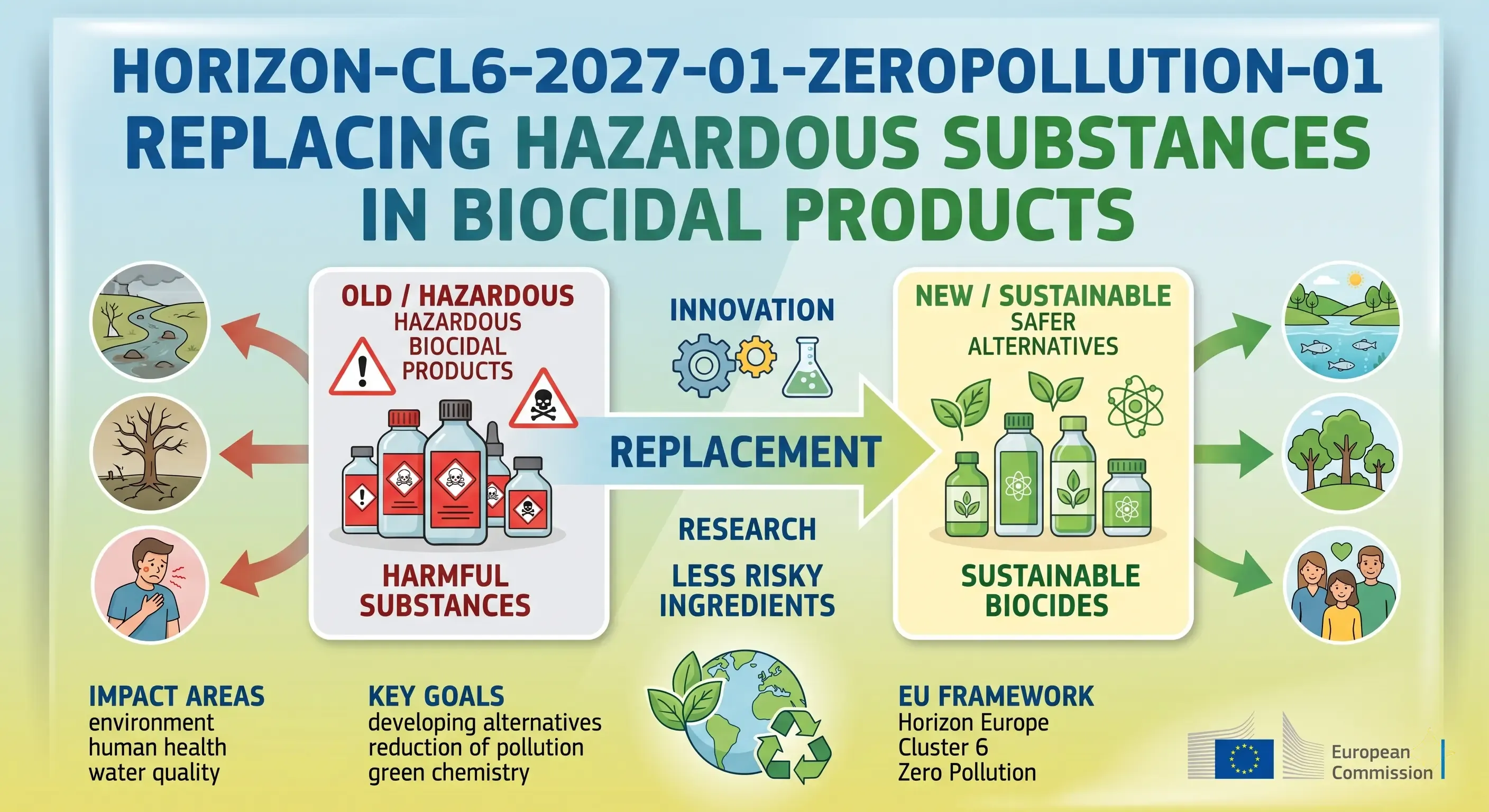
HORIZON-CL6-2027-01-ZEROPOLLUTION-01: Replacing hazardous substances in biocidal products
There are also biocidal active substances known to pose health and biodiversity risks, yet still available on the market, since safer alternatives are not yet available at the appropriate performance level. The Commission would like to make a difference. It is a topic that supports the research on bio-based substitutes that are really effective, in particular, wood preservatives, and insecticides against mosquitoes. The angle is not designed in response to this, but rather as part of safe and sustainable design.
Download the MIC Horizon Europe 2026/2027 Calls Calendar:
Discover more!
Administrative facts: what do we know about the HORIZON-CL6-2027-01-ZEROPOLLUTION-01 call?
Which call is it, and when is the opening and the deadline?
- Call name: Call 01 – single stage (2027)
- Call identifier: HORIZON-CL6-2027-01
- Destination: Clean environment and zero pollution
- Topic: HORIZON-CL6-2027-01-ZEROPOLLUTION-01
- Opening date: 20 April 2027
- Deadline: 22 September 2027, 17:00 Brussels local time
- Type of action: Research and Innovation Action (RIA)
What about the budget and estimated size of the project?
- Overall topic budget: EUR 12.00 million
- Expected number of funded projects: 3
- Budget per project: around EUR 4.00 million
- Lump sum funding applies
- Financial support to third parties is allowed, up to EUR 60,000 per third party
What are the key eligibility and evaluation conditions?
- Standard Horizon Europe eligibility (General Annex B)
- TRL expectation: activities should reach TRL 4 to 5 by the end of the project. Starting TRL is open.
- Standard award criteria (General Annex D)
- SME participation in the consortium is encouraged
- International cooperation is encouraged, particularly for the review of hazardous substances in scope
- Projects must include social sciences and humanities (SSH), especially for safety testing on humans, with attention to sex, age, disability, ethnicity, gender diversity, and vulnerable groups
Scientific range: what does the Commission expect from the HORIZON-CL6-2027-01-ZEROPOLLUTION-01 grant?
What outcomes are expected?
The Commission hopes to have bio-based or natural substances by the end of the project that can plausibly substitute for hazardous active substances in biocidal products under the Biocidal Products Regulation (EC No 528/2012). It is not only an attempt to prove something in the lab. You must prove that these substances are safe to people, safe to biodiversity (including pollinators), and efficient such that regulators and the industry can in fact contemplate implementing them. This is a direct input to the EU Life Sciences Strategy, the Biotech Act and the Startup and Scaleup Strategy.
What is within scope?
- Development of Safe and Sustainable by Design (SSbD) bio-based to substitute hazardous active substances in biocidal products, at least in one of the two areas of use:
- Wood preservatives: the new material needs to be less permeable to resistance or cross-resistance in undesirable organisms, especially the Aspergillus species, especially Aspergillus fumigatus.
- Insecticides for mosquito control: the compound should be able to manage larvae or adult mosquitoes that cause diseases to humans or other animals.
- Active substances derived from plants, microbes, and other natural sources, as well as bio-based substances.
- A global assessment of the target hazardous active ingredients (wood preservatives and mosquito-control insecticides).
- Safety testing for human health, terrestrial and aquatic biodiversity, and pollinators.
- Checking biodiversity enhancement where necessary.
- Evidence of success in substituting the hazardous substances, including incorporation into final products, and cost-effectiveness evaluation based on scientifically validated indicators.
The SSbD model is not a choice in this case. The Commission will expect it to be evident throughout your innovation process, not only recognized in a paragraph.
What are the specifically proposed research directions?
- Bio-based anti-fungal compounds to preserve wood, designed or selected so as not to evoke resistance to Aspergillus fumigatus (not a materials science issue, but a public health one).
- Bio-based larvicides or adulticides for Mosquito vector control are sufficiently effective to qualify as real substitutes in the field of operation.
- International benchmarking of currently approved hazardous active substances in both application areas
- SSH-based safety evaluation and direct analysis of the effects on the vulnerable population (age, sex, disability, ethnicity).
- Cost effectiveness analysis which is beyond lab performance, but considers product integration and market viability.
This is a relatively specific work programme. There is not much space to roam out into other biocide categories. The two named lanes are wood preservatives and mosquito insecticides and the Commission obviously anticipates at least one of them in a project.
Scientific strategy: how can you enhance your chances of being funded through HORIZON-CL6-2027-01-ZEROPOLLUTION-01?
What scientific choices matter most?
- Select your application lane in time. The expertise requirements and regulatory avenues and landscape of the end-user of wood preservatives and mosquito insecticides are vastly different. Attempting to encompass both within a single proposal is likely to be a stretch at EUR 4 million, except with a very tight consortium. We would say it is wiser to be deep on one.
- Construct the SSbD framework as part of your work plan structure, and not as a deliverable. Evaluators will seek to determine whether safety and sustainability have inspired your design decisions since the first month.
- The Aspergillus fumigatus angle is not ornamentation. The increasing clinical issue is antifungal resistance and the Commission is specifically referring to it. When you are on the wood-preservative track, demonstrate that your solution does not contribute to the greater-resistance crisis.
- In the case of the mosquito lane, the data on its effectiveness must be operational, not only in the laboratory. Consider field-trial design, dose-response scaling, and species coverage.
- Do not make the international review a literature review. You have the opportunity to compare the EU portfolio of substances to what other markets permit or limit, which is the direct reason behind your rationale of the options you suggest.
- SSH integration: The reviewers will ensure that this is not a token work package. The safety testing on human subjects should be structured with diversity in mind not added in the ethics review.
- Add a distinct pathway of exploitation. The Startup and Scaleup Strategy is not in vain mentioned by the Commission. Your findings must be commercially, as well as scientifically, interesting.
Consortium and proposal-writing plan: what works best with this type of call?
- The consortium should be kept focused on a lump-sum model of about EUR 4 million per project. 6 or 10 partners is good, perhaps 2 or 3 more partners are necessary depending upon the field-testing locations you require, climate zones and so on.
- At the center will be bio-based chemistry or biotechnology skills and a combination of entomologists (mosquito track) or mycologists and wood scientists (preservative track). One of the partners must have experience in regulation with the Biocidal Products Regulation.
- A formulation or product integration capability of an innovative SME lends seriousness. Evaluators seek an indication of the pathway from laboratory material to a commercial biocidal product, and SMEs can offer that translational trustworthiness.
- When you are on the mosquito track, have a companion from an area with active transmission of vector-borne diseases. International collaboration is promoted by the Commission and field-testing under appropriate climatic conditions helps to reinforce your case.
- SSH partners are not something that should be a byword. Invite an experienced group of risk perception, health equity analysts, or regulatory sociologists early in the writing process to make their contribution to the project, rather than simply occupying a box.
- Lump sum budgeting implies that your cost plan has to be sound from the beginning. It is not possible to re-shuffle work packages once the grant has been signed.
- Write the impact area around the EU zero pollution ambition and the Life Sciences Strategy. Present your proposal as bridging a certain gap: the market requires alternatives, the regulation requires it, and your project provides a worthy candidate.
How would microfluidics contribute to this topic?
The conventional setups are slow in screening bio-based candidate substances to biocidal activity, one compound at a time. Running plate assay, waiting, results reading, formulating, re-forming, re-reading. That loop is squeezed by microfluidic platforms. Hundreds of concentrations, combinations and formulations can be tested in parallel on one chip, using very small amounts of material which could be costly or difficult to obtain.
- Suppose you are developing a plant-based larvicide to kill mosquitoes. A microfluidic droplet system enables you to screen compound libraries onto individual larvae or mosquito cell lines in nanoliter compartments. The dose-response curves are obtained more quickly, using less material and having higher statistical power than one could possibly obtain in well plates.
- In the case of the wood preservative track, the organ-on-chip-like devices can simulate exposure of human lung tissue to candidate antifungal drugs and their breakdown products. This provides you with safety information early in the design process, when you are not yet bound by costly animal testing or extensive toxicology testing.
- Aspergillus fumigatus resistance profiling on chip: you have the capability to culture fungal strains on antifungal gradients under controlled conditions and you can watch the development of resistance in real time. The same compound, varied concentrations, varied strains, and they are all running at the same time. That is what the Commission wants to receive when they raise the red flag of cross-resistance.
- It has the advantages of a biodiversity impact assessment. Microfluidic ecotoxicology measurements expose aquatic indicator organisms (Daphnia, algae, fish embryos) to your candidate substances under standardized flow conditions, yielding repeatable results without the need for large volumes of test organisms or waste.
Microfluidics will not substitute your field test, or your regulatory submission, but it will speed up the design-test-iterate cycle to get to a plausible candidate substance at a reduced cost. In the case of a EUR 4 million RIA and TRL 4-5, such efficiency is important. When you can demonstrate to evaluators that your screening and safety assessment pipeline is throughput-oriented, you make your proposal even more effective, and a microfluidic platform is precisely what it is.
The MIC already brings its expertise in microfluidics to Horizon Europe:
H2020-NMBP-TR-IND-2020

Microfluidic platform to study the interaction of cancer cells with lymphatic tissue
H2020-LC-GD-2020-3

Toxicology assessment of pharmaceutical products on a placenta-on-chip model

FAQ – HORIZON-CL6-2027-01-ZEROPOLLUTION-01
What is HORIZON-CL6-2027-01-ZEROPOLLUTION-01 about?
The topic HORIZON-CL6-2027-01-ZEROPOLLUTION-01 finances Research and Innovation Actions to develop bio-based and/or natural alternatives for active substances of concern in biocidal products under the Biocidal Products Regulation (EC No 528/2012). The focus is on wood preservatives and mosquito control insecticides. The Commission seeks Safe and Sustainable by Design approaches.
What is the budget and how many projects will be funded?
The total budget of the topic is EUR 12.00 million for 3 projects. The projects are funded via lump sum with approximately EUR 4.00 million per project. Third party funding is permitted, as long as it doesn’t exceed EUR 60,000 per third party.
When does the call open and close, and what is the type of action?
Which application lanes does the Commission want addressed?
The Commission mentions two lanes: wood preservatives, where the bio-based active ingredient has to be safe with respect to resistance and cross-resistance (particularly to Aspergillus fumigatus), and insecticides for mosquito control, active against larvae or adults of disease vector species. The Commission wants at least one of these to be addressed. It is usually not advisable to tackle both within a 4 million EUR project.
Why is Aspergillus fumigatus singled out in the wood-preservative track?
Resistance to antifungal drugs in Aspergillus fumigatus is increasing, and azole wood preservatives are thought to contribute to the selection of resistance in the environment. The Commission is seeking solutions that don’t contribute to this health problem. So, proposals on the wood-preservative track should include specific resistance profiling against Aspergillus species.
What does Safe and Sustainable by Design (SSbD) mean for this proposal?
SSbD means that safety and sustainability considerations should be part of the design process, starting with the selection of compounds – not an afterthought to be tackled just before submission. The assessors will consider whether your work plan demonstrates SSbD in compound screening, formulation, testing and exploitation, or if SSbD is just mentioned as part of a deliverable. The latter scores poorly.
What TRL is expected at the end of the project?
The project should have activities at TRL 4-5 by the end. Starting TRL is open. That is, proof-of-concept candidates validated in relevant laboratory and small-scale field conditions, with plausible paths to field validation and regulatory dossiers later. Projects stretching to TRL 6+ within the budget envelope tend not to score highly.
How should social sciences and humanities (SSH) be integrated?
SSH must be integral to the project, particularly for human safety testing (“sex, age, disability, ethnicity, gender diversity, vulnerable groups”). Include SSH partners (risk perception, health equity, regulatory sociology) in the writing process. De minimis SSH work packages are obvious to the evaluators and detract from the proposal.
What consortium profile fits a EUR 4 million lump-sum RIA?
A minimum of six to ten is needed, perhaps two or three more for field testing. Key functionalities: bio-based chemistry or biotechnology; entomology (mosquito tracking) or mycology and wood science (preservative track); regulatory knowledge of the Biocidal Products Regulation; formulation/product integration by an innovative SME; SSH partners with experience in research diversity. For mosquitoes, an international partner from a region where vector-borne diseases are endemic is helpful.
How can microfluidics support the screening and safety pipeline?
Microfluidics enables high-throughput screening of hundreds of conditions simultaneously on a chip with very small volumes – ideal when bio-based compounds are in limited supply. Drop-based microfluidics provide nanoliter dose-response testing on mosquito larvae or cell lines; organ-on-chip platforms provide early, human-relevant safety information on antifungal candidates and degradation products. Resistance profiling of Aspergillus fumigatus on chip and microfluidic ecotoxicology on aquatic indicator species (Daphnia, algae, fish embryos) complete the package.