
Tips & Tricks for a successful HORIZON-CL6-2026-01-ZEROPOLLUTION-01 proposal
Opening
17 April 2026
Deadline
Keywords
underwater noise
marine ecosystems
MSFD
zero pollution
organ-on-chip
biosensor
RIA
environmental policy
noise pollution
Your microfluidic SME partner for Horizon Europe
We take care of microfluidic engineering, work on valorization and optimize the proposal with you
HORIZON-CL6-2026-01-ZEROPOLLUTION-01 – Toward a comprehensive assessment of the disturbance of marine ecosystems by anthropogenic underwater noise
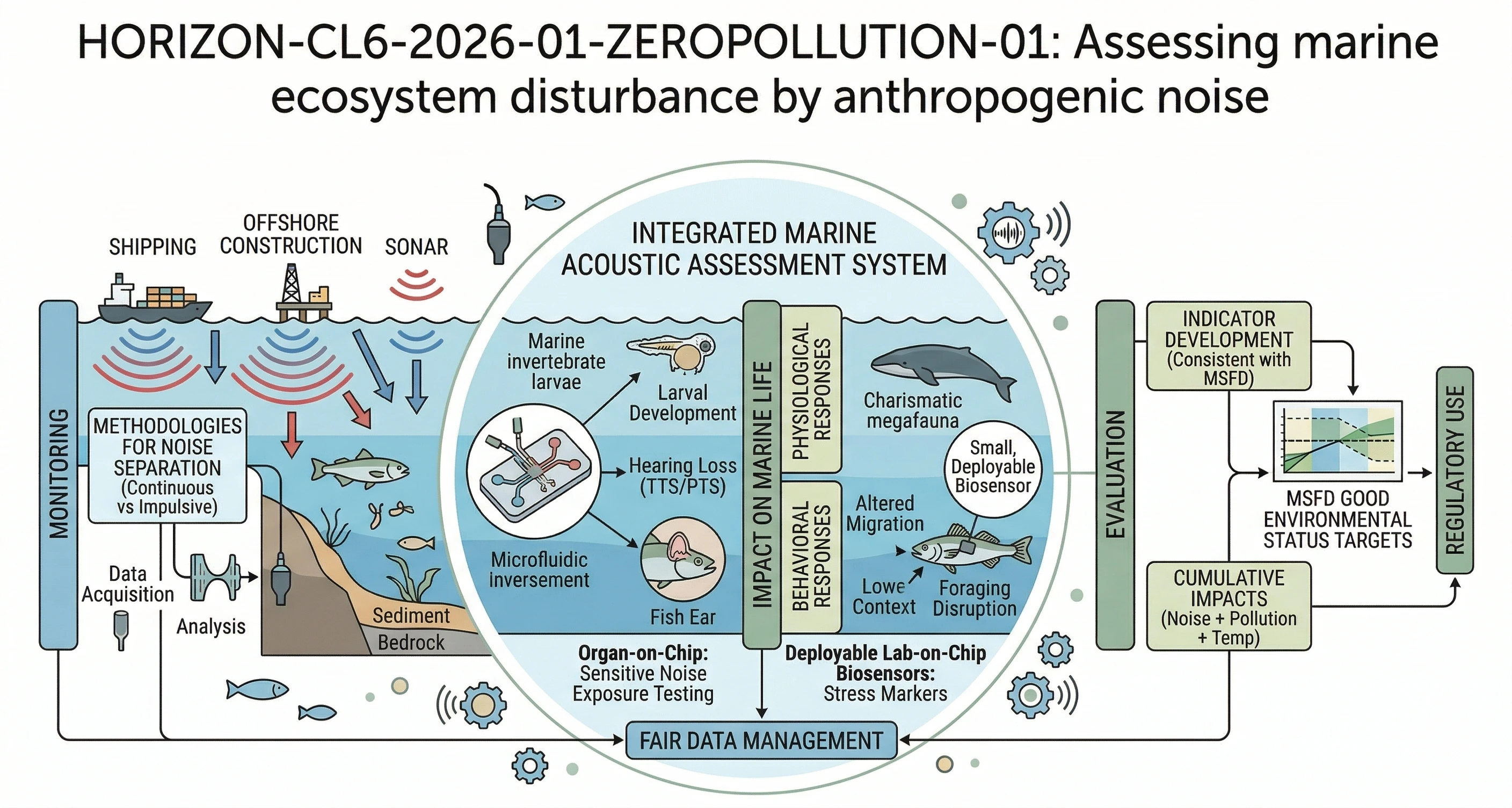
Noise produced by ships, offshore construction, and sonar is transmitted through water much more effectively than air, and the impact it has on marine animals, their food webs, and ecosystem functioning is largely unknown and insufficient for regulatory decision-making. This call seeks to establish scientific approaches and instruments that can enable environmental agencies to manage and monitor underwater noise pollution.
Discover more!
Administrative facts: what do we know about the HORIZON-CL6-2026-01-ZEROPOLLUTION-01 call?
Which call is it, and when is the opening and the deadline?
- Call name: Call 01 – single stage (2026)
- Call identifier: HORIZON-CL6-2026-01
- Destination: Clean environment and zero pollution
- Topic: HORIZON-CL6-2026-01-ZEROPOLLUTION-01
- Opening date: 17 April 2026
- Deadline: 17 September 2026 (17:00 Brussels local time)
- Type of action: RIA
What about the budget and estimated size of the project?
- Total indicative budget: EUR 10 million
- Number of projects expected: 1
- Budget per project: EUR 10 million (full topic budget goes to a single consortium)
What are the key eligibility and evaluation conditions?
- Standard Horizon Europe admissibility, eligibility, and award criteria apply (General Annexes A, B, C, D)
- No specific eligibility restrictions listed for this topic
- No explicit TRL requirement
- Single-stage procedure; no clustering requirement mentioned
Deadlines of European Programmes 2026/2027
Get the MIC Horizon Europe 2026/2027 Calls Calendar:
-All Horizon Europe deadlines (by cluster and call).

Scientific range: what does the Commission expect from the HORIZON-CL6-2026-01-ZEROPOLLUTION-01 grant?
What outcomes are expected?
Environmental agencies must be able to use efficient instruments and methodologies for evaluating good environmental status and monitoring the effects of noise at the end of the project. It’s not about producing numerous publications. The project must prove useful to Member States in achieving the targets set by the Marine Strategy Framework Directive (MSFD).
What is within scope?
- New or enhanced methodologies for measuring anthropogenic noise pollution at multiple trophic levels
- New or improved indicators for determining the overall impact of noise stress on marine organisms and services provided by the ecosystem
- Consistency with MSFD indicators and thresholds
- Development and assessment of impact mitigation techniques
- Carbon sequestration defined as an ecosystem service
What are the specifically proposed research directions?
- Research into methodologies for separating continuous and impulsive noise
- Comparison of these stressors against other environmental pressures to assess cumulative impacts
- Development of indicator systems for MSFD use
- Differentiation in data acquisition and analysis between EU marine regions
Scientific strategy: how can you enhance your chances of being funded through HORIZON-CL6-2026-01-ZEROPOLLUTION-01?
What scientific choices matter most?
- MSFD compliance at the core: all proposals should be structured around the data Member States must submit; generic claims will score less.
- Multiple trophic levels: avoid focusing exclusively on charismatic megafauna such as whales and dolphins; the inclusion of invertebrates and fish is crucial to the proposal’s scientific scope.
- Distinguishing continuous from impulsive noise: differentiate these sources and their impacts, as this separation is relevant for both biological responses and regulatory treatment.
- Cumulative impact with other stressors: ensure the proposal addresses how noise interacts with other stressors; failure to do so has disqualified many proposals during evaluation.
- Mitigation as an integrated part of the project: integrate assessment of mitigation efficiency in the project design from the beginning, rather than considering it a late add-on.
- FAIR data handling: adhere to FAIR principles, even though not explicitly stated in the call for proposals.
Consortium & proposal-writing plan: what works best with this type of call?
- A consortium of ten to fifteen partners is recommended for the EUR 10 million single-project RIA call
- Representation from marine acoustics, marine ecology, physical oceanography, and environmental policy is needed
- Inclusion of national environmental or maritime authorities is highly advisable given the project’s applied nature, with two or three Member States’ agencies ideal
- Participation by an innovative SME specialising in underwater acoustic instrumentation or oceanographic technology would significantly boost the practical applicability of the project
- Proposals should not over-promise, and should clearly define the scope and methodology
How would microfluidics contribute to this topic?
Current methods for assessing the effects of underwater noise on marine life, such as mesocosm studies and ship-borne campaigns, are costly and slow. Microfluidic technologies are applicable in the following areas to address these challenges:
- Organ-on-chip devices: microfluidic systems allow detailed assessment of individual tissues or organisms to noise exposure under tightly controlled experimental conditions. These systems offer the capacity for more sensitive data collection that cannot be obtained from the environment. For example, researchers can examine how chronic low frequency noise influences larval development without mesocosm constraints.
- Biosensors based on lab-on-chip technologies: these biosensors can analyze minute field-collected samples to determine biological stress markers, establishing a direct link between measured noise exposure and biological response which is currently absent from most assessments.
- Small, deployable biosensor systems for marine organisms: this aspect requires expertise in microfluidics from SME partners, and can contribute a significant, innovative approach to marine noise monitoring.
Microfluidics can help your consortium identify promising avenues for its integration with mechanism and biomarker research in the proposed study.
The MIC already brings its expertise in microfluidics to Horizon Europe:
H2020-NMBP-TR-IND-2020

Microfluidic platform to study the interaction of cancer cells with lymphatic tissue
H2020-LC-GD-2020-3

Toxicology assessment of pharmaceutical products on a placenta-on-chip model

FAQ – HORIZON-CL6-2026-01-ZEROPOLLUTION-01
What is HORIZON-CL6-2026-01-ZEROPOLLUTION-01 about?
There is one large Research and Innovation Action (RIA) funded by HORIZON-CL6-2026-01-ZEROPollution-01 and amounting to EUR 10 million. It will strive to produce scientifically proven methods, apparatus and pointers that would enable the national environmental authorities to comprehensively observe and assess the influence of anthropogenic underwater noise on marine life to satisfy the demands of the Marine Strategy Framework Directive.
Budget and amount of projects to be financed.
The indicative budget will amount to EUR 10 million that will be vested in one consortium. None: the Commission envisages a single large and well-structured project that will take care of the whole sphere of the subject. The amount that EU is expected to contribute on a project basis would be approximately EUR 10 million.
What is the submission deadline and how do you apply?
The call opens on 17 April 2026 under HORIZON-CL6-2026-01 (Call 01 – single stage 2026). This is due on or before 17 September 2026, 17.00 local time Brussels. The applications are done on the EU funding and tenders portal. Horizon Europe RIA Standard Horizon Europe admissibility and eligibility standards.
What will the marine species and levels of trophic levels need to be considered in the proposal?
It is clearly stated in the work programme that the proposals should include a number of troic levels such as phytoplankton and zooplankton to invertebrates and fish up to the marine mammals. Suggestions concerned with cetaceans or charismatic megafauna alone will be viewed as scientifically incomplete. The monitoring methods and indicators also have to capture regional differences between EU sea basins (Baltic, Mediterranean, Atlantic, Black Sea).
How should the proposal address cumulative noise impacts?
Noise is not something that can be assessed alone. The propositions should come up with methodologies in which underwater noise is considered as a part of multiple stressors in the same environment e.g. temperature, fishing pressure, chemical pollution and hypoxia. Similar calls have been disqualified by the inability to give a plausible cumulative impact model. The language of Commission is clear on this.
How does the Marine Strategy Framework Directive contribute towards this call?
The MSFD requires the Member States to analyse and achieve good environmental conditions in the European seas. Underwater noise is another term used by the Directive, i.e. the Member States have to monitor, establish limits, and prove progress. This appeal brings within immediate distribution that scientific foundation which those engagements demand. The national authorities should not only be able to report on the MSFD compliance using peer-reviewed publications.
What are some of the mitigation measures?
The call particularly solicits research of mitigation that aims at safeguarding ecosystem services, including the sequestration of carbon. The proposals should also create or enhance the tools to quantify the effect of mitigation actions and their effectiveness. It is not an option: the mitigation assessment should be included in the work plan, as opposed to a late-deliverable.
What is the best consortium profile to use here, EUR 10 million single-project RIA?
This is suitable among a consortium of ten to fifteen partners. You will need marine acoustics experts, marine ecologists, physical oceanographers and environment policy experts. The key – -the call is in short, one of constructing instruments which will be utilised by the regulators. A creative SME that has experience in acoustic instrumentation or ocean monitoring provides useful deployment credibility which is highly appreciated by reviewers.
What role can play organ-on-chip and microfluidic biosensor technology?
Organ-on-chip systems are able to subject isolated tissues or small organisms to controlled acoustic conditions, to generate cause-and-effect biological data which is not easily generated in field studies. Lab-on-chip biosensors can detect stress-indicators such as cortisol or oxidative stress-indicators of minute field-collected samples, and this is the limit between exposure monitoring and physiological response. A novel technique of in-situ marine noise monitoring that can be achieved through microfluidics capability is the miniaturised deployable biosensor platforms.
What are the most pitfalls concerning the proposal on this topic?
The most common weaknesses that we see when it comes to proposals on such topics: tackling noise in a vacuum, without cumulative analyses of effects; tackling one taxonomic group only (most frequently marine mammals); developing monitoring instruments without linking them to MSFD compliance procedures; addressing mitigation as a peripheral activity, and not a work package. Also: excessive promise of geographic coverage without a realistic implementation plan of several sea basins in the EU.