
Tips & tricks for a successful HORIZON-CL5-2027-05-D3-31 proposal
Opening
05 May 2027
Deadline
Keywords
CO2 transport
CO2 storage
CCUS
CSA
EU policy
infrastructure repurposing
renewable gases
CO2 quality
climate neutrality
cross-border transport
Your microfluidic SME partner for Horizon Europe
We take care of microfluidic engineering, work on valorization and optimize the proposal with you
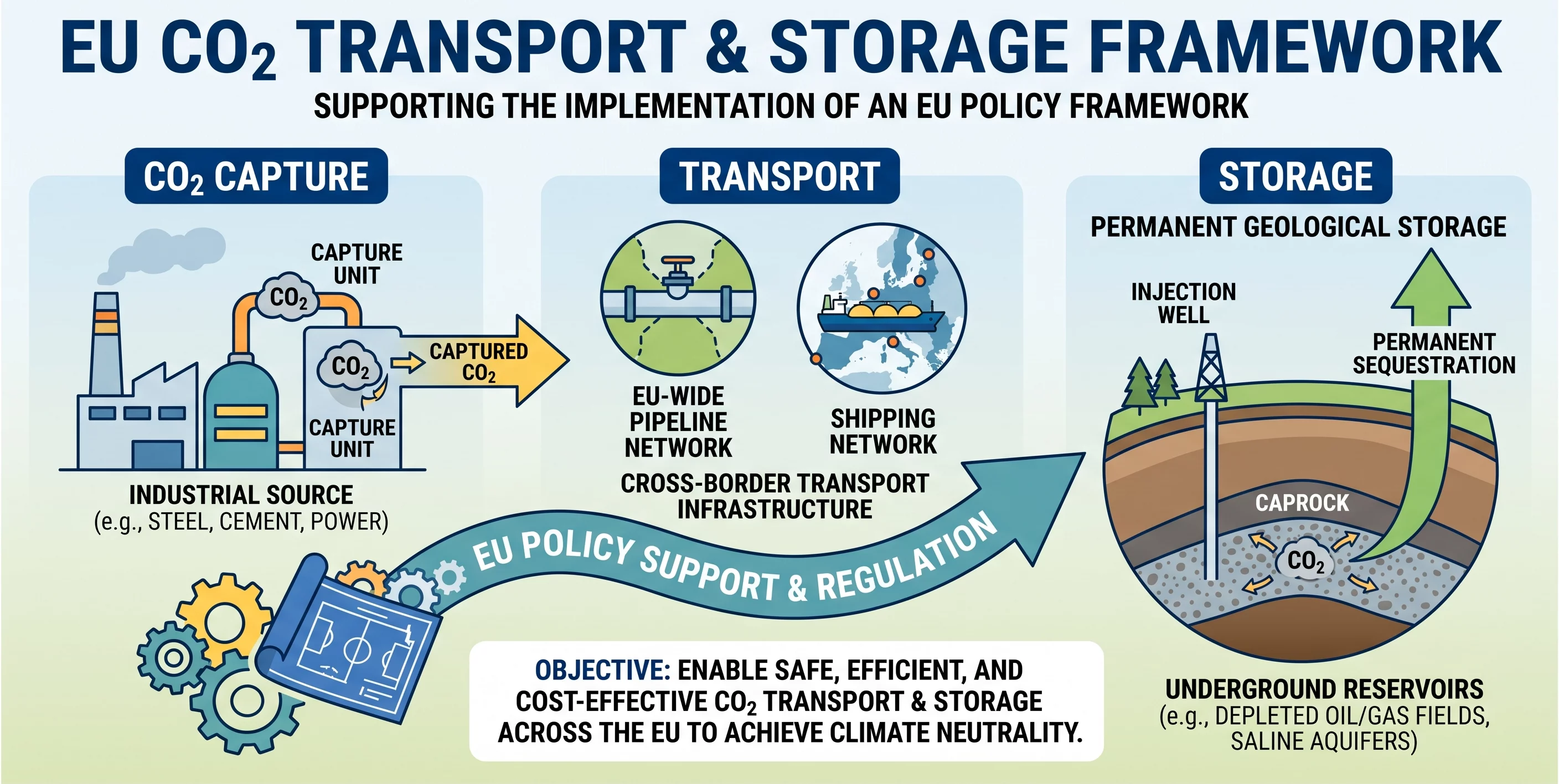
HORIZON-CL5-2027-05-D3-31: Support to the implementation of an EU policy framework for CO2 transport and storage infrastructure
Why can a shared CO₂ specification impose different costs on emitters?
Impurities differ in how readily they separate from CO₂, so a common specification can require different conditioning effort. Jensen and colleagues modelled four feeds and found that composition strongly affected purification and liquefaction costs. Their common design was optimised for the highest-purity feed, limiting comparisons across cases. [1]
For HORIZON-CL5-2027-05-D3-31, this raises an implementation question: how should technical harmonisation account for differences between connected emitters? The topic links CO₂ quality with market access, cost structures and infrastructure planning.
Download the MIC Horizon Europe 2026/2027 Calls Calendar:
Discover more!
Call facts and participation conditions
Which call is it, and when does it open?
- Topic: HORIZON-CL5-2027-05-D3-31, in the BATTERIES and ENERGY call (HORIZON-CL5-2027-05), under Sustainable, secure and competitive energy supply. Official topic page
- Action: Coordination and Support Action (CSA), with a single-stage submission.
- Schedule: opening on 5 May 2027; deadline on 15 September 2027 at 17:00 Brussels time.
What funding is indicated?
The indicative topic budget is EUR 5 million. The expected EU contribution is around EUR 5 million per project, with one project indicatively expected. Proposals requesting different amounts may also be submitted and selected. Funding takes the form of a lump sum.
Which participation and proposal conditions apply?
- Eligibility: under the General Annexes, a CSA application may be submitted by one or more legal entities. Beneficiaries normally need to be established in an EU Member State or Associated Country. The applicable country and entity restrictions still apply.
- Proposal length: the general limit for the narrative proposal in a lump-sum CSA is 28 pages; use the submission template for the sections covered by that limit.
- Activity boundary: this CSA supports coordination and implementation. New research and innovation activities are outside its action type. No target technology readiness level is specified.
- Satellite services: if satellite-based Earth observation, positioning, navigation or related timing data and services are used, beneficiaries must use Copernicus and/or Galileo/EGNOS. Other sources may additionally be used.
The Climate, Energy and Mobility work programme gives the topic-specific conditions. It specifies neither a fixed project duration nor a numerical consortium size.
Scope and expected implementation outcome
For the HORIZON-CL5-2027-05-D3-31 topic, the expected outcome is stakeholder readiness: organisations involved in CO₂ infrastructure networks should be able to implement the upcoming legislative framework. The work should connect legal arrangements, market organisation and practical infrastructure constraints.
The scope covers the following connected issues:
- Markets and investment: market and cost structures, investment incentives for new infrastructure, tariff regulation, ownership and contractual models.
- Access and responsibility: third-party access, liability along the transport and storage chain, and the roles of competent regulatory authorities.
- Network integration: cross-border integration, interoperability, planning and technical harmonisation, supported by a baseline assessment of current legislation across the value chain.
A review and report on repurposing existing infrastructure for CO₂ are expected deliverables. The assessment should also consider infrastructure needs for renewable gases. Reuse should be examined as an option with technical, economic and regulatory constraints.
The analysis should cover technical feasibility, costs, synergies between new multimodal CO₂ infrastructure and existing systems, and regulatory barriers to connecting industrial clusters. CO₂ quality, flexibility, robustness and links between CO₂ and energy infrastructure are also part of the scope. Multimodal planning means considering how different transport modes work together across the chain.
Build an evidence-based implementation strategy
Start with a dated legal and operational baseline. For each issue, identify the applicable jurisdiction, the responsible actor, the existing rule and the implementation question. Keep adopted legislation, proposals and policy options separate when following the Commission’s CO₂ transport and market initiative.
The following approach is proposal advice, rather than an additional set of call conditions:
- Select cases for their differences. Explain how the chosen routes, industrial clusters or jurisdictions reveal cross-border, contractual and technical problems. Justify the coverage; the topic does not prescribe a minimum number of corridors.
- Use a common comparison basis. State the assumed transport service, volumes, operating conditions, cost boundaries and assessment period before comparing infrastructure options. Separate existing evidence from assumptions requiring stakeholder confirmation.
- Make policy choices traceable. Connect each recommendation to the problem it addresses, its supporting evidence, the actors affected and the decision needed for implementation.
- Plan for changes during the action. Assign responsibility for tracking legislative developments and updating guidance. Record which conclusions remain applicable when a proposal or implementation timetable changes.
Use existing technical studies, operational information and stakeholder consultation to support the assessment. Organise these inputs into practical implementation resources, with a clear distinction between agreed findings and unresolved choices.
Connect consortium expertise with stakeholder needs
Build the HORIZON-CL5-2027-05-D3-31 partnership around the expertise and information needed to answer the implementation questions. The following roles are recommended capabilities; the topic does not impose a regulator, ministry, operator or small-business quota.
- Regulatory and legal expertise: compare access arrangements, tariffs, liability and contractual interfaces across the selected jurisdictions.
- Network and industrial experience: obtain relevant input from transport providers, storage operators, emitters and infrastructure planners on operating constraints and investment decisions.
- Economic and technical assessment: connect cost analysis with infrastructure compatibility, CO₂ quality, multimodal operation and competing infrastructure needs.
- Stakeholder engagement: reach the authorities and organisations expected to use the results, including participants whose interests or operating situations differ.
Explain which expertise sits within the consortium and which will be accessed through consultation. Specify how operational and commercial information can inform the analysis while respecting confidentiality.
For the lump-sum work plan, define coherent work packages, responsible partners and identifiable outputs. The repurposing report, legal baseline and implementation guidance should each have a clear review process and a realistic allocation of effort.
Check guidance with its intended users
Use structured stakeholder walkthroughs to check whether the guidance is usable. As a proposed method, ask intended users to work through a defined situation, identify the information they need and explain which organisation must act next.
For example, a walkthrough could follow a new emitter seeking network access, a transfer between transport modes or a disruption at an interface. Choose examples that expose the issues covered by the proposed guidance. Record conflicting interpretations, missing information and responsibilities that remain unclear.
Combine these exercises with legal and technical review. A useful assessment record would connect each comment to a revision, an explanation for retaining the original recommendation or a policy question that remains open.
The resulting resources could include a comparison of implementation options, practical guidance for different stakeholder groups and a record of unresolved decisions. Distinguish project recommendations from binding rules and identify who would need to act for each recommendation to be taken forward.
The MIC already brings its expertise in microfluidics to Horizon Europe:
H2020-NMBP-TR-IND-2020

Microfluidic platform to study the interaction of cancer cells with lymphatic tissue
H2020-LC-GD-2020-3

Toxicology assessment of pharmaceutical products on a placenta-on-chip model

About the author

Céleste Chidiac, PhD
Scientific writer and digital marketing specialist
Céleste Chidiac holds a doctorate in neuroscience and molecular biology from the University of Strasbourg. Since joining the Microfluidics Innovation Center in 2023, she has combined scientific writing with website management. For MIC’s Horizon Europe topic pages, she draws on her research background to explain scientific challenges and clarify funding priorities. Her writing helps prospective applicants understand each topic’s scope, expected outcomes and research directions.
CO₂ transport and storage: practical questions
These questions explore the physical, logistical and investment choices behind CO₂ network implementation.
What does a CO₂ purity percentage leave out?
No single percentage identifies every impurity. Jensen and colleagues found that impurity concentrations and volatility affected distillation, cooling demand and CO₂ losses in their model. Composition information therefore matters alongside overall purity. [1]
Is CO₂ purity the same as CO₂ recovery?
No. Purity describes product composition; recovery measures how much incoming CO₂ reaches the product. In Jensen and colleagues’ model, venting impurities also removed CO₂, so meeting a purity specification did not ensure complete recovery. [1]
Why does the preferred transport mode change with scale?
Different transport modes spread their costs differently over distance and annual throughput. Oeuvray and colleagues’ assessment found volume-dependent economies for dedicated ships, barges and pipelines. Their comparative trends depend on the route and cost assumptions; they are not universal price rankings. [2]
Why does a CO₂ chain need intermediate buffer storage?
Buffers bridge the interval between CO₂ production and scheduled collection. Oeuvray and colleagues included intermediate storage in transport-chain costs and showed how connection frequency affects the required container inventory. Sizing must reflect the selected service and operating pattern. [2]
Is the lowest cost per tonne enough to choose a transport route?
No. A route also needs workable connections, deployment timing and resilience to disruption. Oeuvray and colleagues combined economic comparison with operational criteria, including seasonal capacity changes. Their analysis illustrates why a cheap connection can still impose difficult logistics. [2]
Why should transport planning consider the closure of capture facilities?
Transport assets can outlast the flows they were built to serve. Zhang and colleagues included capture growth and closure scenarios in an illustrative Humber infrastructure model. The preferred investment changed with those assumptions, showing why expansion-only planning can miss exposure to lower demand. [3]
When can shipping flexibility change an investment comparison?
When vessels retain value outside the original transport chain. In Zhang and colleagues’ model, assigning residual value to ships made them more attractive under pessimistic capture-development assumptions. This was a scenario-dependent result, not a general finding that shipping is cheaper than pipelines. [3]
Does a scenario model predict which CO₂ network will be built?
No. It calculates decisions under specified inputs and assumptions. Zhang and colleagues tested alternative capture-development cases, financing constraints and discount rates. Such results can reveal sensitive choices; they do not establish the probability that a real infrastructure project will proceed. [3]
What makes a comparison of repurposed and new infrastructure fair?
Compare options that deliver the same defined service. A useful assessment should include conversion work, remaining asset life, operating costs and competing uses of the infrastructure. The topic’s repurposing assessment explicitly includes technical feasibility and renewable-gas needs; it does not establish that reuse is always cheaper.
Does technical compatibility settle third-party access?
No. Compatibility addresses whether a CO₂ stream can be handled by an infrastructure system. Access arrangements address who may use it and under what conditions. The topic scope treats technical harmonisation, third-party access, tariffs and liability as connected issues requiring attention.
References
[1] Jensen EH, Pedersen RC, Løge IA, Dlamini GM, Neerup R, Riber C, Elmegaard B, Jensen JK, Fosbøl PL. The cost of impurities: A techno-economic assessment on conditioning of captured CO₂ to commercial specifications. International Journal of Greenhouse Gas Control. 2025;141:104309. doi:10.1016/j.ijggc.2025.104309
[2] Oeuvray P, Burger J, Roussanaly S, Mazzotti M, Becattini V. Multi-criteria assessment of inland and offshore carbon dioxide transport options. Journal of Cleaner Production. 2024;443:140781. doi:10.1016/j.jclepro.2024.140781
[3] Zhang L, Anjos MF, Chalmers H. A stochastic programming model for planning CO₂ transport infrastructure with uncertainty. Computational Management Science. 2026;23:11. doi:10.1007/s10287-026-00555-8