
Tips & Tricks for a successful HORIZON-CL5-2027-04-Two-Stage-D2-07 proposal
Opening
15 December 2026
Deadline
Keywords
Cluster 5
next-generation batteries
BATT4EU
IAM4EU
advanced materials
RIA
two-stage
Your microfluidic SME partner for Horizon Europe
We take care of microfluidic engineering, work on valorization and optimize the proposal with you
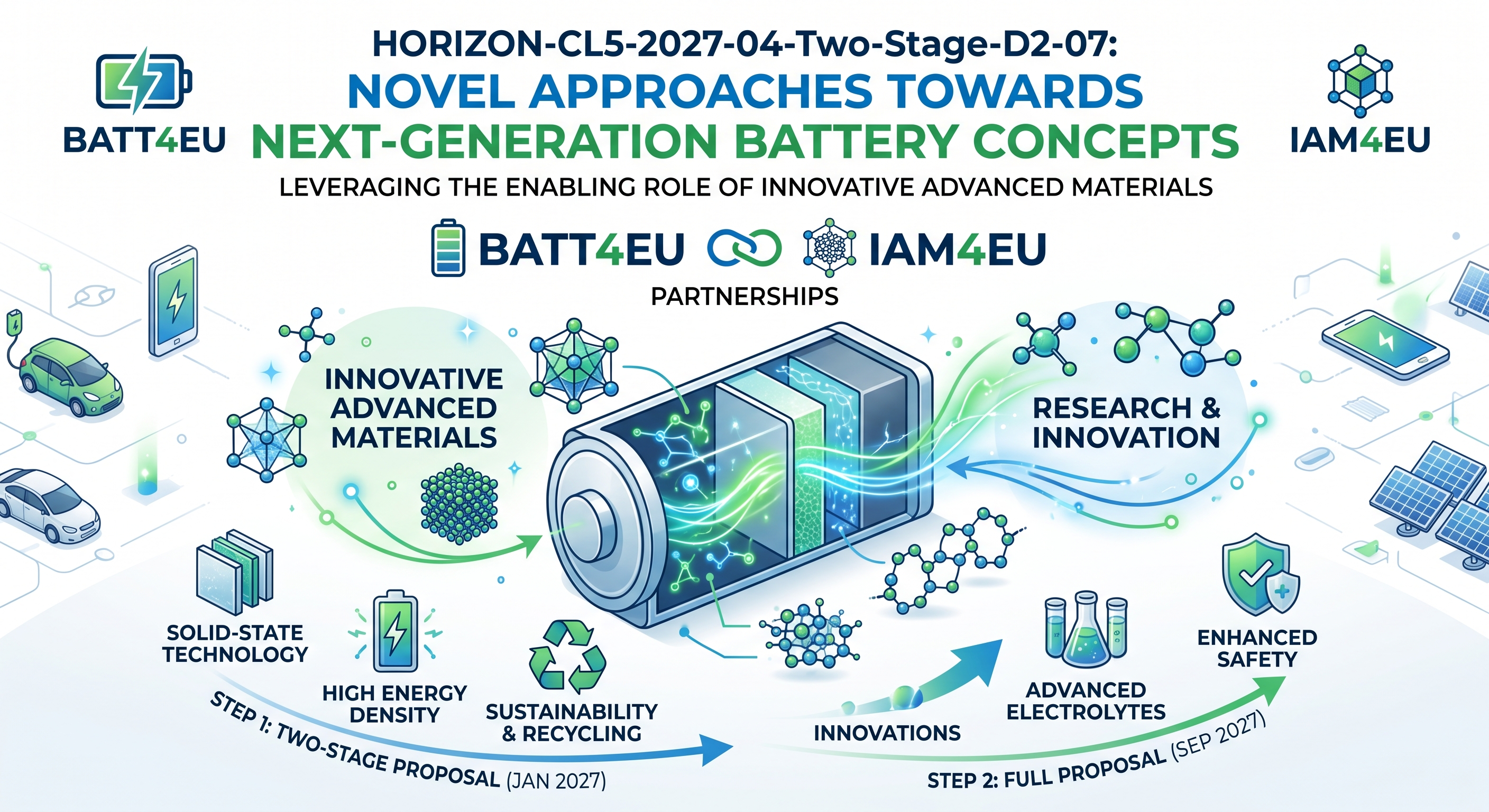
HORIZON-CL5-2027-04-Two-Stage-D2-07: Novel approaches towards next-generation battery concepts, leveraging the enabling role of innovative advanced materials (BATT4EU and IAM4EU Partnerships)
Europe wants battery concepts that do not exist yet, built on new materials. The topic sits across two partnerships, Batt4EU and IAM4EU. An incremental gain on today’s lithium-ion cell is not what the Commission is after. It wants a chemistry or a material family that shifts the cost or performance picture.
Download the MIC Horizon Europe 2026/2027 Calls Calendar:
Discover more!
Administrative facts: what do we know about the HORIZON-CL5-2027-04-Two-Stage-D2-07 call?
Which call is it, and when is the opening and the deadline?
- Call name: BATTERIES and MOBILITY
- Call identifier: HORIZON-CL5-2027-04-Two-Stage
- Destination: Cross-sectoral solutions for the climate transition
- Topic: HORIZON-CL5-2027-04-Two-Stage-D2-07
- Opening: 15 December 2026
- Deadline first stage: 14 April 2027
- Deadline second stage: 7 October 2027
- Type of action: Research and Innovation Action (RIA)
What about the budget and estimated size of the project?
- Topic budget: EUR 48.00 million, of which EUR 10.00 million from the Digital, Industry and Space budget
- Indicative number of projects: 10
- Budget per project: EUR 4.80 million
What are the key eligibility and evaluation conditions?
- TRL 4 to 5 by project end. Activities may start at any TRL
- First stage evaluated blind: no organisation names, acronyms, logos or personnel names in the abstract or Part B
- Lump sum funding
- JRC may join as beneficiary with zero funding or associated partner, taking no part in preparing the proposal
- Portfolio clustering: at least one highest ranked proposal per area funded, if thresholds are met
Scientific range: what does the Commission expect from the HORIZON-CL5-2027-04-Two-Stage-D2-07 grant?
What outcomes are expected?
By the end you need a working cell concept, benchmarked against the state of the art, with numbers that survive scrutiny. The stated aim is safeguarding European competitiveness through innovative battery materials. Publication series are not what the Commission is after.
What is within scope?
You pick one area. Not two.
- Area A: low-cost chemistries for passenger electric vehicles and/or stationary storage. Minimised Critical Raw Materials, main component cost below EUR 35 per kWh. Lightweight or simplified casing and cooling concepts encouraged.
- Area B: high-performance chemistries for aviation and maritime. Energy density above 500 Wh/kg and/or power density beyond the benchmark. Structural integration, multifunctional materials.
- Area C: durable materials and cell-level concepts for grid or energy-intensive industry. Grid case, system cost below EUR 50/kWh, multi-hour duration. Industry case, continuous high load, harsh cycling.
What are the specifically proposed research directions?
- Benchmark first. Area A explicitly wants a Design-to-Performance lithium-ion and sodium-ion baseline, then your gains against it.
- Scalability, manufacturability, market relevance. Assessed in every project, whatever the area.
- Extended cycle life, cost-efficient recyclability, sustainability under the Safe and Sustainable by Design framework.
- Safety, thermal management, performance monitoring, predictive diagnostics.
The advanced materials wording stays loose. Room to frame your material story your way.
Scientific strategy: how can you enhance your chances of being funded through HORIZON-CL5-2027-04-Two-Stage-D2-07?
What scientific choices matter most?
- Choose your area on day one. A proposal hedging between A and B reads unfocused.
- Own the benchmark. An optimistic baseline is the fastest way to lose Excellence points.
- Write the first stage blind. Really blind.
- Build techno-economic and life-cycle work in from the start, not as a work package bolted on later.
- Show the material actually enables something. IAM4EU is in the title for a reason.
- Say what happens if the chemistry underperforms. Risk sections admitting nothing read as naive.
Consortium & proposal-writing plan: what works best with this type of call?
- Somewhere between eight and twelve partners, a couple more if you need a second cell line.
- Materials chemists, a cell manufacturer, modelling people, an end user from the application you picked. Without the end user, market relevance stays a claim.
- At least one innovative SME. They usually carry the process innovation, and evaluators like a route to market that is not a spin-out promise.
- JRC can join with zero funding for performance or safety testing. Worth an early call.
- Lump sum. So the work package split has to be defensible before submission.
- First stage is short. Say what is new and why it matters, nothing else.
How would microfluidics contribute to this topic?
Screening battery materials the usual way eats grams of material and weeks per formulation. Coin cells are slow, and they hide the interface until you tear them down. Microfluidics runs the same chemistry at microlitre scale, with optical access. You watch it happen.
- Electrolyte and additive screening in droplets. Hundreds of formulations in the time a coin cell campaign gets through twenty.
- Say you suspect a coating fails at the particle surface after fast cycling. A microfluidic electrochemical cell with optical access lets you look during cycling, not after teardown. Cause and effect, not a post-mortem.
- Continuous flow synthesis of active materials and solid electrolytes, with tight control on particle size. Same recipe, same answer twice.
- Microchannel cooling, straight to the casing and cooling concepts Area A encourages.
- Recovery of critical raw materials, tested small before anyone commits to a pilot line.
None of this replaces cell testing. It shortens the loop between a material idea and the evidence it works, and gives your Excellence section data a coin-cell-only consortium will not have. On a topic asking you to beat a benchmark and prove scalability, that matters.
The MIC already brings its expertise in microfluidics to Horizon Europe:
H2020-NMBP-TR-IND-2020

Microfluidic platform to study the interaction of cancer cells with lymphatic tissue
H2020-LC-GD-2020-3

Toxicology assessment of pharmaceutical products on a placenta-on-chip model

FAQ - HORIZON-CL5-2027-04-Two-Stage-D2-07
What is HORIZON-CL5-2027-04-Two-Stage-D2-07 about?
It funds next-generation battery concepts built on innovative advanced materials. The topic implements two co-programmed partnerships, Batt4EU and IAM4EU. Projects are expected to generate innovative battery concepts that safeguard future European competitiveness, with better energy storage and management capabilities.
When does the call open and when are the two deadlines?
The BATTERIES and MOBILITY call opens on 15 December 2026. First-stage proposals are due 14 April 2027, second-stage proposals on 7 October 2027. All Horizon Europe deadlines close at 17:00:00 Brussels time.
How much money is on the table, and for how many projects?
The topic budget is EUR 48.00 million, of which EUR 10.00 million comes from the Digital, Industry and Space budget. Around 10 projects are expected, so roughly EUR 4.80 million each. Asking for a different amount is allowed, but you will need to justify it.
What type of action is it, and what TRL should we reach?
It is a Research and Innovation Action (RIA), funded as a lump sum. Activities are expected to reach TRL 4 to 5 by the end of the project. You may start at any TRL.
Why is the first stage evaluated blind, and what does that change for us?
First-stage proposals under this topic go through blind evaluation. You must not disclose organisation names, acronyms, logos or names of personnel in the abstract or in Part B of the first-stage application. Practically, that means the science has to carry the proposal on its own. Reputation will not help you at stage one.
Do we have to choose between Area A, Area B and Area C?
Yes. The scope is written as three alternative areas, and proposals are expected to cover all the bullet points of the area they pick. Area A is low-cost chemistries, Area B is high-performance chemistries, Area C covers stationary storage for grid and energy-intensive industry. Hedging between two areas weakens the proposal.
Check the Funding and Tenders Portal for more information.
What cost and performance targets does the topic actually set?
Area A asks for a main component cost below EUR 35 per kWh and a minimised amount of Critical Raw Materials. Area B asks for energy density above 500 Wh/kg and/or power density beyond the state-of-the-art benchmark. For grid storage under Area C, the target is a system-level cost below EUR 50/kWh with multi-hour storage duration.
Can the Joint Research Centre take part in our consortium?
Yes. The JRC may participate as a beneficiary with zero funding or as an associated partner, and its contribution could cover experimental or desk-top research on battery performance or safety. The JRC takes no part in preparing or submitting the proposal, and the same information is made available to all applicants.
How does the portfolio rule affect our chances?
Grants are not awarded on ranking alone. To keep a balanced portfolio across sectors, at least the highest ranked proposal within each of the three areas will be funded, provided it passes all thresholds. So a strong proposal in a less crowded area has a real structural advantage.
Where does microfluidics fit into a battery materials proposal?
Mostly in the screening and synthesis loop. Droplet platforms let you test hundreds of electrolyte and additive formulations on microlitre volumes. Continuous flow synthesis gives tight control over particle size for active materials and solid electrolytes. And micro-scale electrochemical cells with optical access let you watch the interface during cycling instead of after teardown.