
Tips & Tricks for a successful HORIZON-CID-2027-01-01 proposal
Opening
12 January 2027
Deadline
Keywords
Clean Industrial Deal
energy intensive industries
IA
CCU and CCUS
industrial electrification
Clean Steel
circularity & resource efficiency
Processes4Planet
Your microfluidic SME partner for Horizon Europe
We take care of microfluidic engineering, work on valorization and optimize the proposal with you
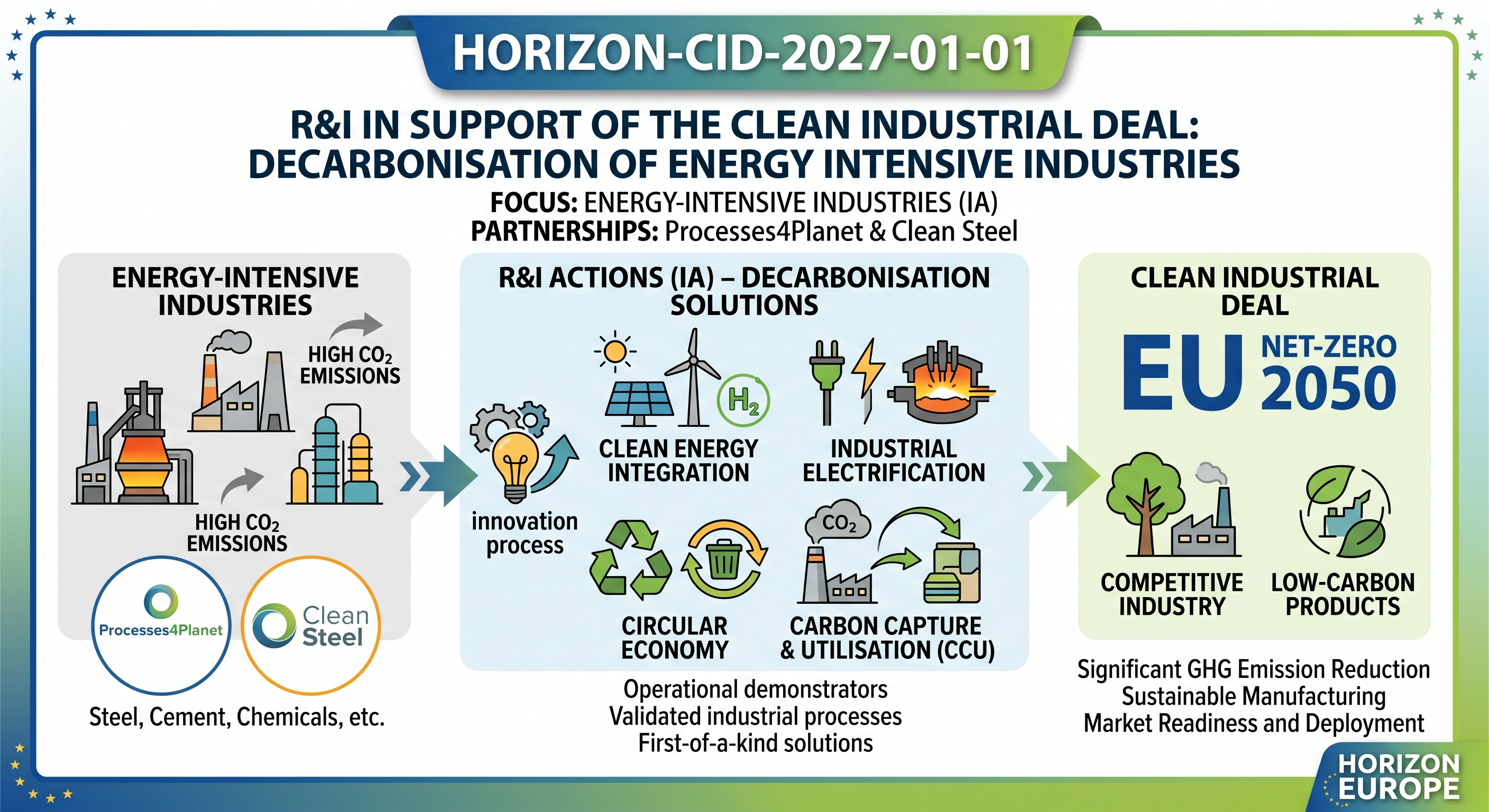
HORIZON-CID-2027-01-01: R&I in Support of the Clean Industrial Deal: Decarbonisation of energy intensive industries (IA) (Processes4Planet and Clean Steel partnerships)
The Commission wants first-of-a-kind demonstrators that cut emissions in steel, cement, chemicals and other energy-hungry industries. A horizontal Clean Industrial Deal call, not a classic cluster topic. Technology is half the file. The other half is a business plan proving the plant will actually get built.
Download the MIC Horizon Europe 2026/2027 Calls Calendar:
Discover more!
Administrative facts: what do we know about the HORIZON-CID-2027-01-01 call?
Which call is it, and when is the opening and the deadline?
- Call name: R&I in Support of the Clean Industrial Deal
- Call identifier: HORIZON-CID-2027-01
- Horizontal call, Work Programme Part 14
- Topic: HORIZON-CID-2027-01-01, Decarbonisation of energy intensive industries
- Opening date: 12 January 2027
- Deadline: 15 September 2027, 17.00 Brussels time
- Type of action: Innovation Action (IA)
What about the budget and estimated size of the project?
- Overall topic budget: EUR 125.00 million
- Indicative number of projects: 8
- EU contribution per project: EUR 15.00 to 25.00 million (average EUR 15.6 million)
What are the key eligibility and evaluation conditions?
- Thresholds: standard General Annex D, no topic-specific exception
- TRL: start at 6, reach 7 to 8
- Page limit extended to 60 pages (business plan and market-readiness strategy included)
- Portfolio rule: the top-ranked proposal in each technology area is funded, if thresholds are met
- Satellite data, if any, via Copernicus and/or Galileo/EGNOS
- The granting authority may object to ownership transfer or exclusive licensing of results for 4 years post-project
- No JRC or clustering requirement stated
Scientific range: what does the Commission expect from the HORIZON-CID-2027-01-01 grant?
What outcomes are expected?
A real industrial demonstrator running at TRL 7 to 8, or a newly installed decarbonisation solution optimised. Alongside it, a tested business case: market-ready clean products and industrial partners committed to deployment. A pilot with no buyer is not what they are after.
What is within scope?
Three technology areas. Pick one main area (combining them within one sector is allowed if innovative):
- Managing the carbon cycle (CCU and/or CCUS): capture, use or storage of CO2 or CO, with roughly 30% less energy per tonne than today
- Clean energy usage in production: electrification, hydrogen, on-site renewable storage, waste heat upgrade, horizon 2035
- Circularity and resource efficiency: material, energy and water use improved by 30% by 2035, side-streams turned into feedstock
- Advanced, safe and sustainable materials also welcome
No positive LCA, no viable business case at project end: out.
What are the specifically proposed research directions?
Deliberately bottom-up. You choose the technology, you justify it. Still, between the lines:
- Capture rate and purity at much lower energy cost is the CCU benchmark you will be held against
- Direct integration (lower GHG from a process) or indirect (a new clean product), both count. Pollutants and biodiversity too
- Reuse of earlier EU or national project results is encouraged (cheap points, often forgotten)
Scientific strategy: how can you enhance your chances of being funded through HORIZON-CID-2027-01-01?
What scientific choices matter most?
- Build the go/no-go moment into the work plan from day one. Before it: engineering plans, techno-economic assessment, permits, and a business plan naming who leads deployment. Fuzzy gate, fuzzy proposal.
- Quantify against the 30% targets. Baseline first, then how you measure the gap.
- Treat the LCA as a design tool, not a deliverable. We’ve seen consortia bolt it on at month 30. Too late.
- Pick your main area honestly. With the portfolio rule, second in a crowded area loses to first in a thin one.
- Permits are science too, in this call.
Consortium & proposal-writing plan: what works best with this type of call?
- Industry driven, the work programme says so twice. An energy-intensive producer should coordinate or own the demonstration site.
- Small and manageable. No number given, but the sister topic says indicatively ten participants at most. Fair guide. Justify yours.
- One or two research organisations for measurement and LCA work, not driving the narrative.
- SMEs are explicitly encouraged. An innovative SME bringing a monitoring or analytics brick fits well here.
- Use the extra pages. Addressable market, financial projections, risk assessment. All weigh under the impact criterion.
- Write exploitation as if an Innovation Fund application follows in 2030. The work programme names it.
How would microfluidics contribute to this topic?
Honestly, microfluidics won’t be your headline argument in a plant-scale demonstration call. Process analytics in a steel or cement plant still rely on periodic sampling and offline labs. Slow, when you are chasing a 30% target on a live process. Microfluidic sensing and micro-scale reactors bring continuous, small-volume measurement at the line, plus fast screening before full-scale commitment.
- Say your CCU loop uses an amine or a new sorbent. A microfluidic cell lets you watch capture chemistry and solvent degradation on millilitres per hour, so you know when to swap before performance drifts.
- Water is one of the three resource-efficiency variables. Inline lab-on-chip analysers in a closed loop give you the freshwater numbers your LCA needs, no sampling campaign.
- Microreactors for screening CO2 utilisation catalysts. Dozens of conditions per week instead of a few per month.
- And for electrification: small flow cells to test an electrochemical step before scaling up electrodes.
None of this replaces the demonstrator. It feeds it with data. A partner like the Microfluidics Innovation Center covers the monitoring and screening layer, ticks the SME box, and puts measured values under your LCA. Modest, but real.
The MIC already brings its expertise in microfluidics to Horizon Europe:
H2020-NMBP-TR-IND-2020

Microfluidic platform to study the interaction of cancer cells with lymphatic tissue
H2020-LC-GD-2020-3

Toxicology assessment of pharmaceutical products on a placenta-on-chip model

FAQ – HORIZON-CID-2027-01-01
What is HORIZON-CID-2027-01-01 actually funding?
First-of-a-kind industrial demonstrators, or the optimisation of newly installed decarbonisation solutions, in energy intensive sectors such as steel, cement and chemicals. The topic sits under the Clean Industrial Deal horizontal call and implements the Processes4Planet and Clean Steel partnerships.
Who should apply, and how much money is on the table?
Industry-driven consortia with an energy intensive producer at the core. The topic budget is EUR 125 million for around 8 projects, with an expected EU contribution of EUR 15 to 25 million per project. Opening 12 January 2027, deadline 15 September 2027.
What are the three technology areas?
Managing the carbon cycle (CCU and/or CCUS), clean energy usage in production (electrification, hydrogen, storage, waste heat), and circularity and resource efficiency of production processes. Each comes with a quantified ambition, typically a 30% improvement against current practice.
Check the Funding and Tenders Portal for more information.
Do we have to pick one area only?
You must select one main area in the application. Combining two or three areas within a single industrial sector is allowed, provided the combination is innovative and leads to low carbon solutions. The main area you select is also what the portfolio rule uses.
What does the portfolio rule mean for our chances?
Grants are awarded by ranking, but at least one proposal, the highest ranked in each of the three areas, is funded as long as it passes all thresholds. In practice, a strong proposal in a less crowded area has a better route to funding than a good proposal in a crowded one.
Which TRL is expected at start and end?
Activities start at TRL 6 and should reach TRL 7 to 8 by the end of the project. This is an Innovation Action, so the demonstrator has to run in a real or near-real industrial environment.
What is the go/no-go moment and why does it matter?
Proposals must include a clear go/no-go gate before contracting and demonstration. Before that gate, the project delivers detailed engineering plans, a techno-economic assessment, all permits for the demonstrator, and a complete business plan naming the industrial partner leading deployment. Evaluators read this gate as a test of how realistic the plan is.
Why is the page limit 60 pages instead of the usual limit?
The extension exists to fit the mandatory business plan and market-readiness strategy into part B. Both are decisive under the impact criterion and are updated yearly during the project. Do not use the extra space for more technical description.
How does this topic relate to HORIZON-CID-2027-01-02 and the partnerships?
The sister topic HORIZON-CID-2027-01-02 covers clean technologies for climate action. Funded projects under both topics are encouraged to coordinate with each other and with projects from Processes4Planet, Clean Steel and other European Partnerships. Mentioning this coordination in your proposal is a small but useful signal.
Where would a microfluidic SME like the MIC fit in the consortium?
As a technical partner covering inline monitoring, small-volume process analytics and rapid screening of sorbents, catalysts or electrochemical steps. This feeds measured data into the demonstrator and the LCA, and ticks the SME participation box the work programme encourages. It is a support role, not the headline of the proposal.