
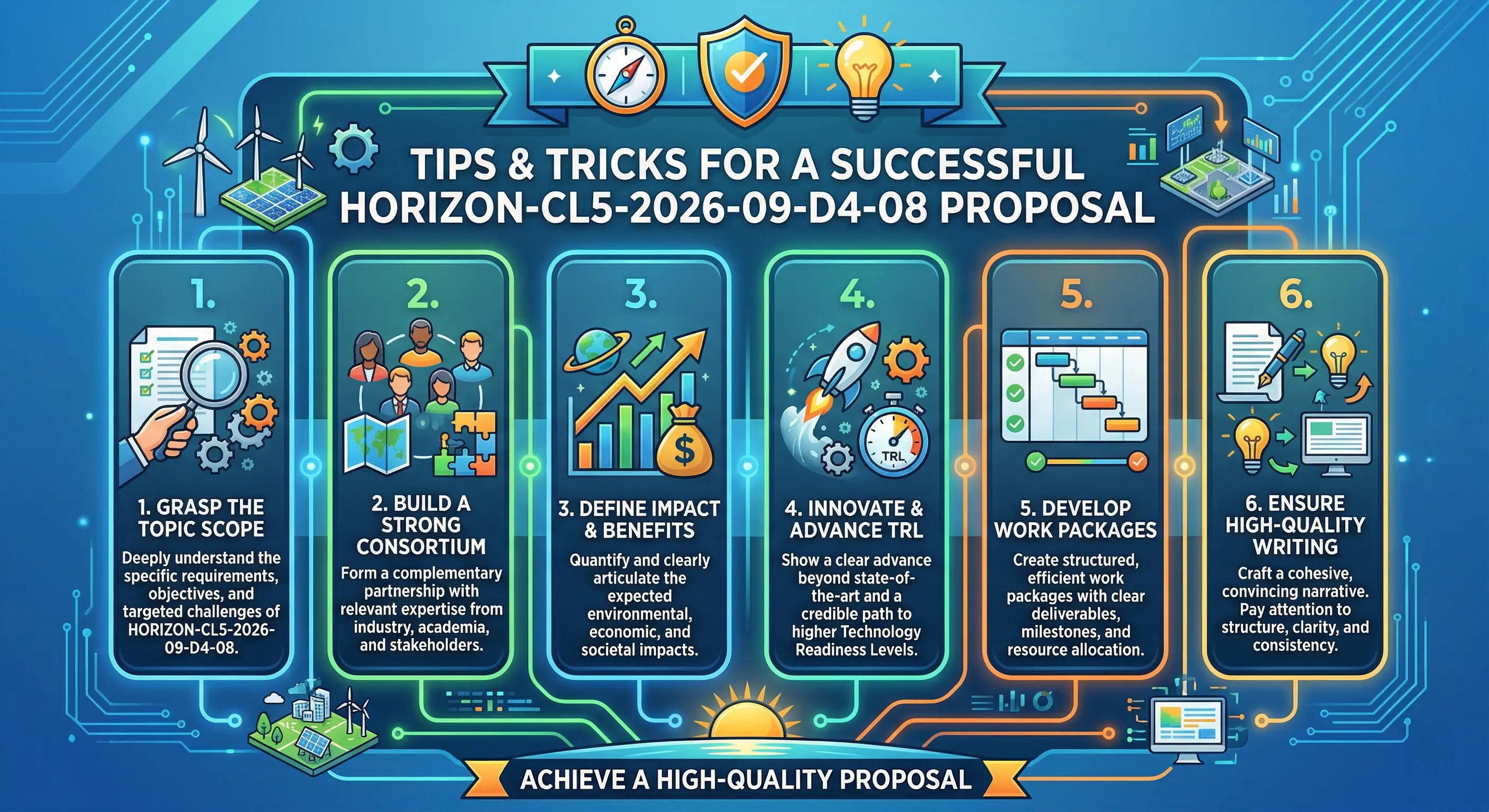
Tips & Tricks for a successful HORIZON-CL5-2026-09-D4-08 proposal
Opening
05 May 2026
Deadline
Keywords
Industrial Heat Upgrading
Waste Heat Recovery
BATTERIES and ENERGY
Thermal Energy Storage (TES)
High-Temperature Heat Pumps
industrial processes
Your microfluidic SME partner for Horizon Europe
We take care of microfluidic engineering, work on valorization and optimize the proposal with you
HORIZON-CL5-2026-09-D4-08: Full-scale demonstration of heat upgrade solutions in industrial processes
It is something very concrete that the Commission targets here: a real, working example of heat recoveries and upgrade in an actual industrial facility. Not a feasibility study. Not a pilot at bench scale. This is aimed at demonstrating that surplus or waste heat of a production process can be captured, upgraded (think heat pumps), and fed back into the same process, reducing the consumption of fossil fuel in a quantifiable manner. The budget to be shared will be in two projects, therefore, there is competition but not excessive. The actual problem is replicability: the evaluators will want to know that what you prove in one plant can be transferred to dozens others throughout the EU.
Discover more!
Administrative facts: what do we know about the HORIZON-CL5-2026-09-D4-08 call?
Which call is it, and when is the opening and the deadline?
● Call name: BATTERIES and ENERGY
● Call identifier: HORIZON-CL5-2026-09
● Destination: D4: Efficient, sustainable and inclusive energy use
● Topic: HORIZON-CL5-2026-09-D4-08
● Opening date: 05 May 2026
● Deadline: 15 September 2026 (17:00 Brussels time)
● Type of action: Innovation Action (IA)
What about the budget and estimated size of the project?
● Total topic budget: EUR 18.00 million
● Number of projects expected: 2
● Expected EU contribution per project: around EUR 9.00 million
● Costs take the form of lump sum contributions
What are the key eligibility and evaluation conditions?
● Eligibility: General Annex B applies. No consortium-composition restriction beyond standard Horizon Europe rules.
● Satellite data: if the project uses earth observation or GNSS data, Copernicus and/or Galileo/EGNOS must be used.
● TRL target: 7–8 by end of project; activities may start at any TRL.
● Ownership transfer: the granting authority may object to transfers of project results for up to 4 years after project end.
● Prior work: if the targeted sector was covered by LIFE-2024-CET-HEATPUMPS actions, the proposal must build on those results.
● Dissemination to JRC Sevilla and INCITE expected, for use in BREFs under the IED 2.0 framework.
Scientific range: what does the Commission expect from the HORIZON-CL5-2026-09-D4-08 grant?
The scope is tightly defined. The Commission seeks heat upgrade at commercial level, not the second round of technology development. It is natural that the focus is heat pumps, which however do not state the range of temperature. The transparency is not by chance: the assessors will rank your proposal by the fact that the solution can be deployed in industries where these methods are not state of the art yet, not whether you achieved a certain temperature.
All of the following need to be covered in the project:
● At one or more actual industrial locations, physically show how one process can be transformed by recovering excess or waste heat and then upgraded to be reused by the same process.
● Get the needs of the EU and Associated Countries factories within the same industrial sector surveyed before joining design; the solution should be flexible to the majority of them and not to the host site only.
● Extract general parts and establish a standard format of the solution.
● Create open technical and economic system design and business case development guidelines and tools (not proprietary and open access).
● Storage of thermal and/or electrical energy can also be included in case it enhances an adaptation of heat sources to the requirements of the process or helps to maintain the flexibility of the grid.
The expected results are in two directions: one industrial sector acquires valid deployment paths and business models, and the solution shows real benefits in energy and flexibility, environmental and profitability.
Scientific strategy: how can you enhance your chances of being funded through HORIZON-CL5-2026-09-D4-08?
What are the most important scientific choices?
● Select a high-heating sector of the industry where there is still low usage of heat upgrade solutions. Food processing, paper, chemicals or textile are some worth considering. The Commission favors new application context as opposed to new technology.
● Do not make the case of replicability during the demo. The work programme is clear: scan the EU sector situation during the beginning of the design phase. Make that survey a part of your work plan as a formal product named methodology.
● The process of standardisation is not a choice. Determine the components that are common to plant types. The projects which consider the demo site a one-off will be concerned with evaluators.
● Measure the phase-out of fossil fuel. Reduction of significant proportions is not sufficient. Assign an evaluation percentage, schedule, scale.
● The choice of heat pumps is important, though do not hide the proposal in thermodynamic riddles. The reviewers desire to view integration logic and business case, rather than compressor specs.
● Flexibility of the grid. In case your system is capable of moving electrical load, say so and measure the flexibility service.
● Build in a go/no-go before deployment. This is not required in the call (as some of the apposite ones are), but there are proposals that have fared better with it.
Consortium & proposal-writing plan: what works best with this type of Innovation Action?
● It would have between eight and twelve partners likely to serve the ground you need, perhaps a few more should the industrial coverage be necessary.
● You must have an industrial end-user or two (that is, the company that will be operating the demonstration site). The proposal will not hold without them.
● A technology integrator or an engineering company is obligatory. The system has to be designed and installed by someone.
● Add a progressive SME that has certain expertise in heat pump integration or thermal storage. The presence of SMEs is often felt when they introduce the flexibility to alter the standardised solutions to the constraints of the plants, and evaluators are keen on this.
● The monitoring and performance assessment and open guidelines deliverables are covered in universities or research institutes.
● Bring in a second industrial site, as a replication observer, without running a second demo; this provides reinforcement of the claim of replicability.
● On writing: the proposal dies or lives on the replicability section. Place the most seasoned writer on it. Don’t make it a series of bullet points of what you plan to do. Illustrate the path in which the solution will go out of plant A to plant B to plant Z.
● Lump sum grant. This is different with budget justification. Follow the advice to the letter when constructing your financial plan (this is a trap with which people lose sight).
How would microfluidics contribute to this topic?
Heat upgrade in industrial processes is a far cry from microfluidics. However, where are the real bottlenecks. The behavior of fluids under controlled conditions is vital in the industrial heat pumps, heat exchangers, and thermal storage systems. Microfluidic tools bring about something there.
● Suppose that you would like to test the performance of a new working fluid at thirty different operating conditions of an industrial heat pump. It is slow and costly to run those tests in full scale. Microfluidic test platforms enable you to test fluid behaviour inexpensively and in a short time before making a decision on the component selection.
● The performance of the heat exchanger is based on a careful control of thin fluid films and surface interactions. Microfluidic characterisation platforms provide you with quantitative measures of the interface level of fouling, wetting, and thermal transfer. Your consortium obtains design information that cannot possibly be obtained by field measurements.
● Phase-change material thermal storage systems require repeat and constant characterisation of melting and solidification processes. High throughput is done in a microfluidic calorimetry setup. Same stuff, same response, all the time.
● And on the monitoring side: distributed micro-sensors built into heat transfer circuits can provide real-time information depth on flow rates and temperature gradients where traditional instrumentation would not be accurate. That information is directly inputted into the open system design tools that the call needs.
The MIC microfluidic platforms lie at the borderline of lab-level material characterisation and full-scale system design. This is precisely what this call is asking you to fill. In the event that your consortium is constructing a heat upgrade demonstrator and requires defensible component-selection information or high-throughput fluid screening, we are your source.
The MIC already brings its expertise in microfluidics to Horizon Europe:
H2020-NMBP-TR-IND-2020

Microfluidic platform to study the interaction of cancer cells with lymphatic tissue
H2020-LC-GD-2020-3

Toxicology assessment of pharmaceutical products on a placenta-on-chip model