
Inside flowers, microfluidics!
Author
Lisa Muiznieks, PhD
Publication Date
October 30, 2019
Keywords
art & science
fluid movement
Flow at Microscale
microchannels
microfluidic movement
fluid flow
paper Microfluidics
water movement
Your microfluidic SME partner for Horizon Europe
We take care of microfluidic engineering, work on valorization and optimize the proposal with you
Art & science: Explore the movement of water – on the micro-scale!
Yes, art & science exist together.
Water moving through a garden hose or up a straw are common and easy-to-see examples of fluid flowing in a channel (macroscopic). On the other hand, microfluidics is the flow of tiny volumes of liquid (that can be less than a droplet!) through channels that are only a fraction of a millimeter wide.
Such thin channels are abundant in biology and play essential roles in transporting fluid in living organisms, e.g., around the body (capillaries are the smallest blood vessels) and in plants (water travels in tiny channels from the roots, up the stem and to the tips of the leaves).
Flow on the micro-scale can be hard to see! A classic tool to help visualize tiny channels and the fluid inside is food dye. For example, the small channels in plants are visible in the cut end of a celery stalk after soaking in water mixed with food dye. A similar experiment can be done using flowers with some art & science results.
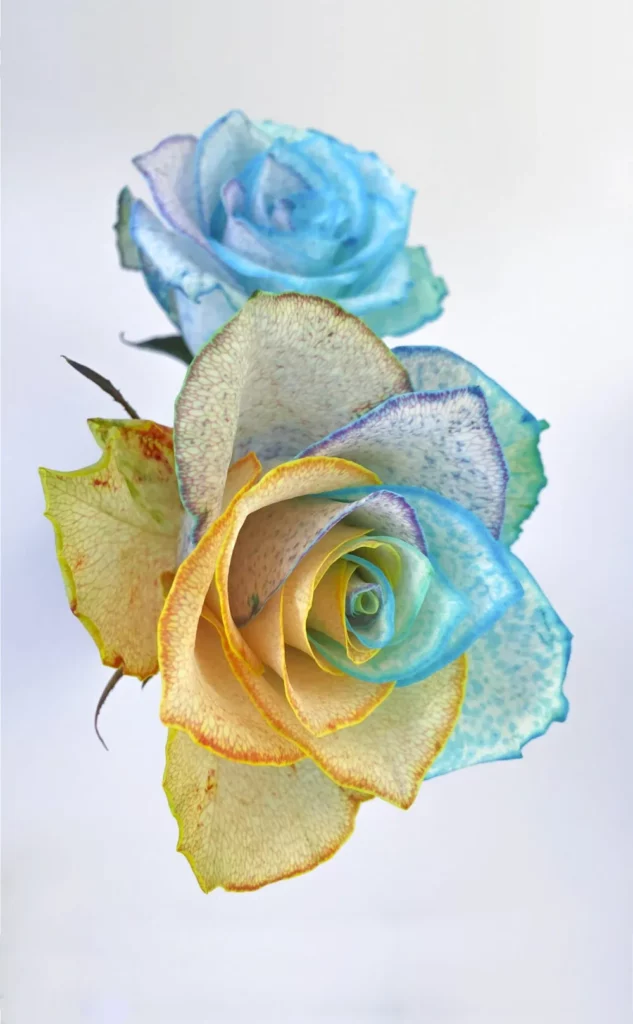
Art & science activity: Microfluidics and multi-coloured roses
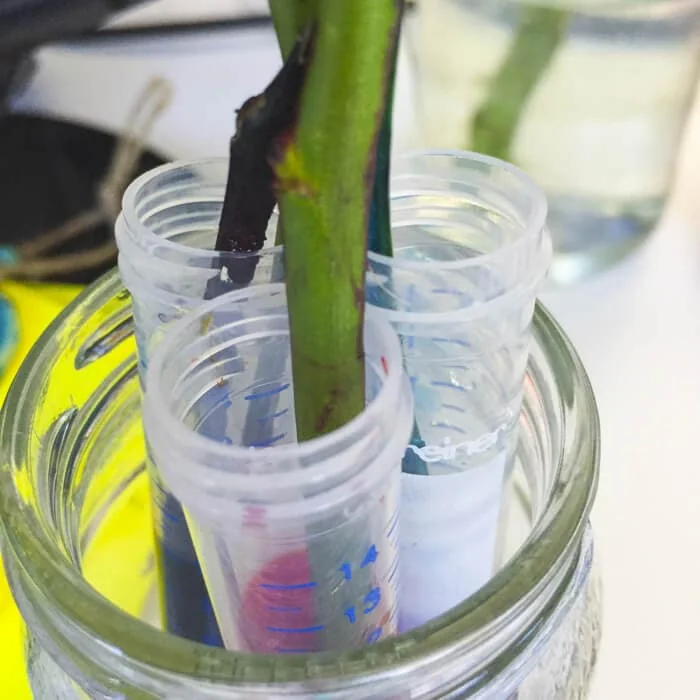
Material
- White flowers
- Sharp blade
- Food colour
- Small jars (2-3 per flower)
- Water
Method
- Add ten drops of food color to 2 small jars of water
- Cut the stem of a white flower lengthways (make the incision straight and about 10 cm long)
- Put each end of the stem into a jar of different colored water
- Observe the petals after 1-2 hours and again after 12-24 hours. What changes do you see?
To think about
- What happens if you make two parallel incisions and insert the ends into three jars of different colored water?
- What will happen to the colored flowers if you transfer them to a jar of clear water (will the color disappear)?
- What will happen to the colored flowers if you transfer them to an empty jar (where does the water go)?
Art & science: Movement of fluid in microchannels
In this experiment, the molecules of food dye will bind to the petals and stain the channels even after the colored water is replaced by clear water. If no water is left in the glass, the flower will dry out as the water evaporates from both the channels’ top and bottom open ends. Dried flowers will remain colored!
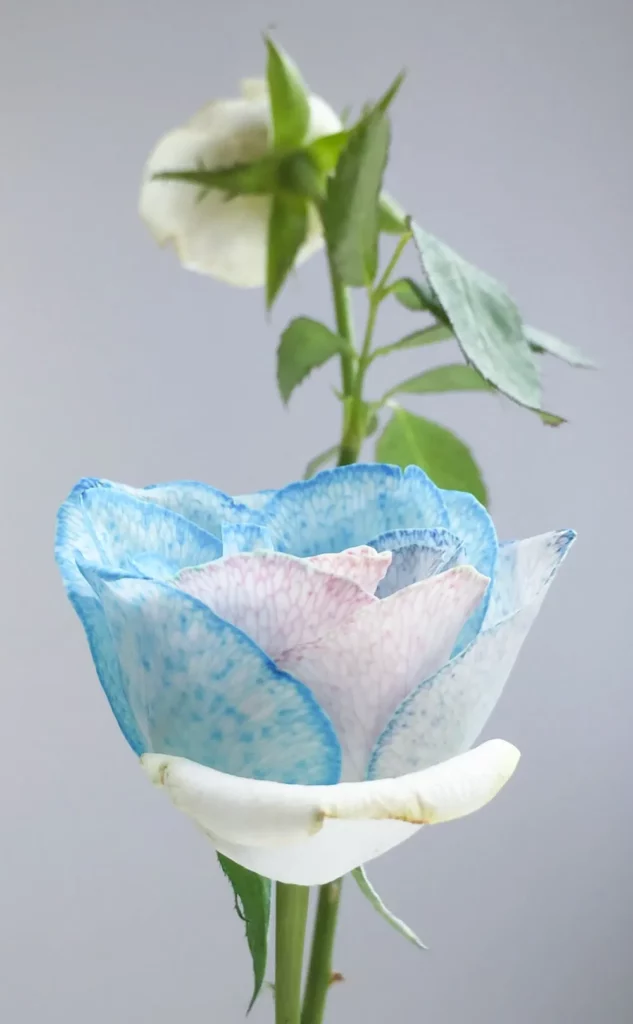
Observation: The petals become colored. The color becomes more robust over time.
Explanation: capillary action in the “veins” of the plant (called xylem for water transport), a network of thin, straight channels that carry water from the roots to the leaf tips.
How does liquid move in channels? Forces drive fluid flow. Common examples include gravity (water in a stream flows downhill, and the moon’s gravitational pull causes tides on Earth) or external pressure (as in the case of a garden hose or a straw). In plants, water movement occurs by capillary action.
Capillary-driven flow is water movement up thin tubes due to a combination of molecule adhesion and cohesion. Adhesion describes the property of the liquid molecules sticking to the walls of the channel.
Cohesion is the ability of molecules of the same type, e.g., water, to stick to each other. In plants, this directional flow is called transpiration and is aided by evaporation at the open ends of the channels in parts of the plant that are above ground.
What if the channel is not a tube?
The microfluidic movement must not be guided through a classical tube or trough. Materials with wicking properties, like paper towels or the hem of your jeans in the rain, will do the job! This experiment explores the movement of water through micropores made by networks of closely woven fibers.
Art & science activity: Walking rainbows
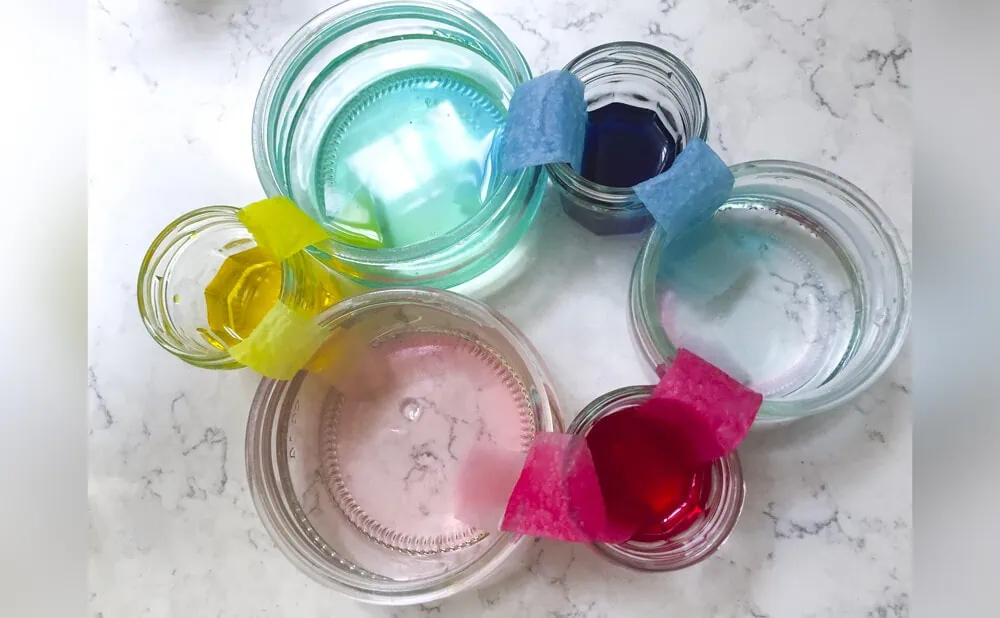
Material
- Small jars (3)
- Food colour
- Paper towel strips
- Water
Method
Art & science: Movement of fluid through micropores
Observation: movement of colored water up the paper and into the jars of clear water. After a time, the clear water will turn into a mix of the two primary colors.
Explanation: (paper microfluidics) The porous network of fibers that makes up the paper acts like a wick to absorb water from a wet area to a neighboring dry area. The dye molecules (color) are dissolved in the water and are mobile and free to diffuse through the liquid to an area of higher to lower dye concentration. The two primary colors are mixed by diffusion in the jar to create a secondary color (e.g., mixing yellow and blue makes green).
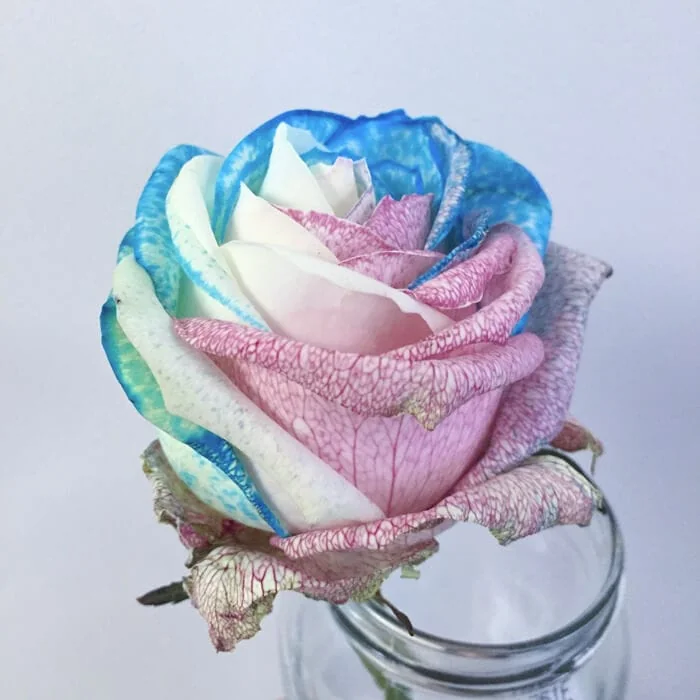
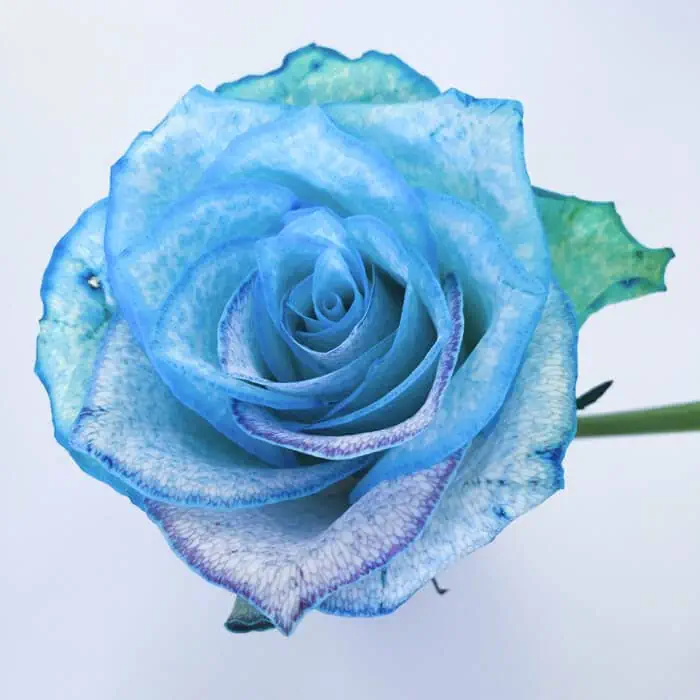
This art and science project was presented during the European Research and Innovation Days. The European Commission’s first annual policy event brought together stakeholders to debate and shape the future research and innovation landscape.
Date: 24/09/2019 – 26/09/2019
Marie Curie H2020 Individual Fellow. Microfluidics Innovation Center.

FAQ - Inside flowers, microfluidics!
What is it that is meant by microfluidics within flowers?
It is not a metaphor: the stem of a flower is filled with small canals carrying water (and whatever is dissolved in it) to the top. Microfluidics, in general, is concerned with controlling small volumes of liquid, such as a drop of water, through channels only a fraction of a millimeter in diameter. Those channels are already present in a plant, and rather astonishingly, they are engineered.
What is the reason behind the change of color of white flowers when they are dipped in coloured water?
Because the dye flows with the water through the stem’s internal microchannels, it finally reaches the petals. The staining increases with time, in part because more dyed water passes through, and in part because dye molecules adsorb to plant tissues. The outcome is an apparent map of fluid transport; however, it occurs at the microscale.
What is the transport structure of the plant in this experiment?
Mostly the xylem. Xylem is a system of long, narrow, and relatively straight channels dedicated to the water movement in the lower sections of the plant to the leaves and petals. When you think of a microfluidic engineer, you are dealing with an inherent microchannel network with geometry, surface chemistry, and flow mechanisms.
What is the pressure, pumping, or something that causes the flow to go upward in the stem?
No pump in the usual sense. The movement is largely driven by capillary action (and the larger transpiration process). Water can be drawn upwards in narrow channels by adhesion (water preferring the channel walls) and cohesion (water molecules to one another). Exposed ends Evaporation above ground. It also contributes to evaporation by continually drawing water through the system. The plants use this evaporation, often called transpiration.
What should I do to make it multicolored?
It can be done very straightforwardly: divide the stem along its length, and place each portion in a separate colored water set. The procedure typically involves a straight incision of approximately 10 cm and ten drops of food coloring in each small jar of water. Change after 1-2 hours and more striking after 12-24 hours.
The interesting bit (which is also a little unpredictable) is that the initial color limits may be quite strong, almost as individual lanes of circulation, and then shift slightly depending on the reconnection of channels within the stem.
Will the color disappear if I take the coloured flower and put it again into clear water?
Not completely. The dye molecules can bind to petals and stain internal pathways, so they may remain visible even when the dyed water is replaced with clear water. It is an effective lesson to keep in mind when microfluidics experiments are involved as well: adsorption and binding can produce memory effects even when you assume that you have flushed a system.
But what happens to the flower that has not received any water, but has already absorbed dye?
It dries out. Water can evaporate through the open ends of channels (both at the cut stem and in the upper tissues). The flower can not dry out; it still has color, basically a snapshot of the dye location. It is aesthetically pleasing, yet it also quietly demonstrates a real transport principle and shows how evaporation can be a formidable force at small scales.
Does that mean that microfluidic flow is confined to tubes and rigid channels?
Not at all. Microfluidic transport may occur through porous materials via wicking. Imagine paper towels, fabrics or any structure of fine pores created by fibers. Water moves in these materials not through man-made microchannels but by capillary action, wetting areas, and moving toward drier areas.
Scientifically speaking, what is the experiment of the walking rainbows demonstrating?
It is a standard example of microfluidics made of paper and diffusion-based mixing. You have jars with paper towel bridges, colored jars of water, and wicks that allow water to wick through the paper into a glass of water. Over time, the transparent dish turns colored, and two primary colors appear; they can combine to form a secondary color (e.g., yellow + blue = green).
It consists of two processes piled atop each other: capillary transport through the porous paper network and molecular diffusion that drives concentration gradients and mixes the dyes in the receiving jar.
So why should the researchers be interested in these unsophisticated demos- beyond outreach or education?
They simulate actual design issues in lab-on-a-chip systems, including capillary-driven pumping, porous microfluidics, surface interactions (adsorption/binding), and transport coupled to evaporation. Such kitchen-table experiments involve cheap analogs of phenomena you would subsequently struggle with (or pursue to advantage in microfluidic chips) in diagnostics, sample preparation, and passive pumping designs.