
How to maintain a stable pH under flow conditions?
Writer
Celeste Chidiac, PhD
Keywords
Microfluidic Devices, Intelligent Microfluidics, Artificial Intelligence, Machine Learning
Author
Lisa Muiznieks, PhD
Eve-Line Bancel, PhD
& Justine Lereculey
Publication Date
Keywords
stable pH
flow conditions
pump hermeticity
CO₂ control
CO₂ incubator
impermeable materials
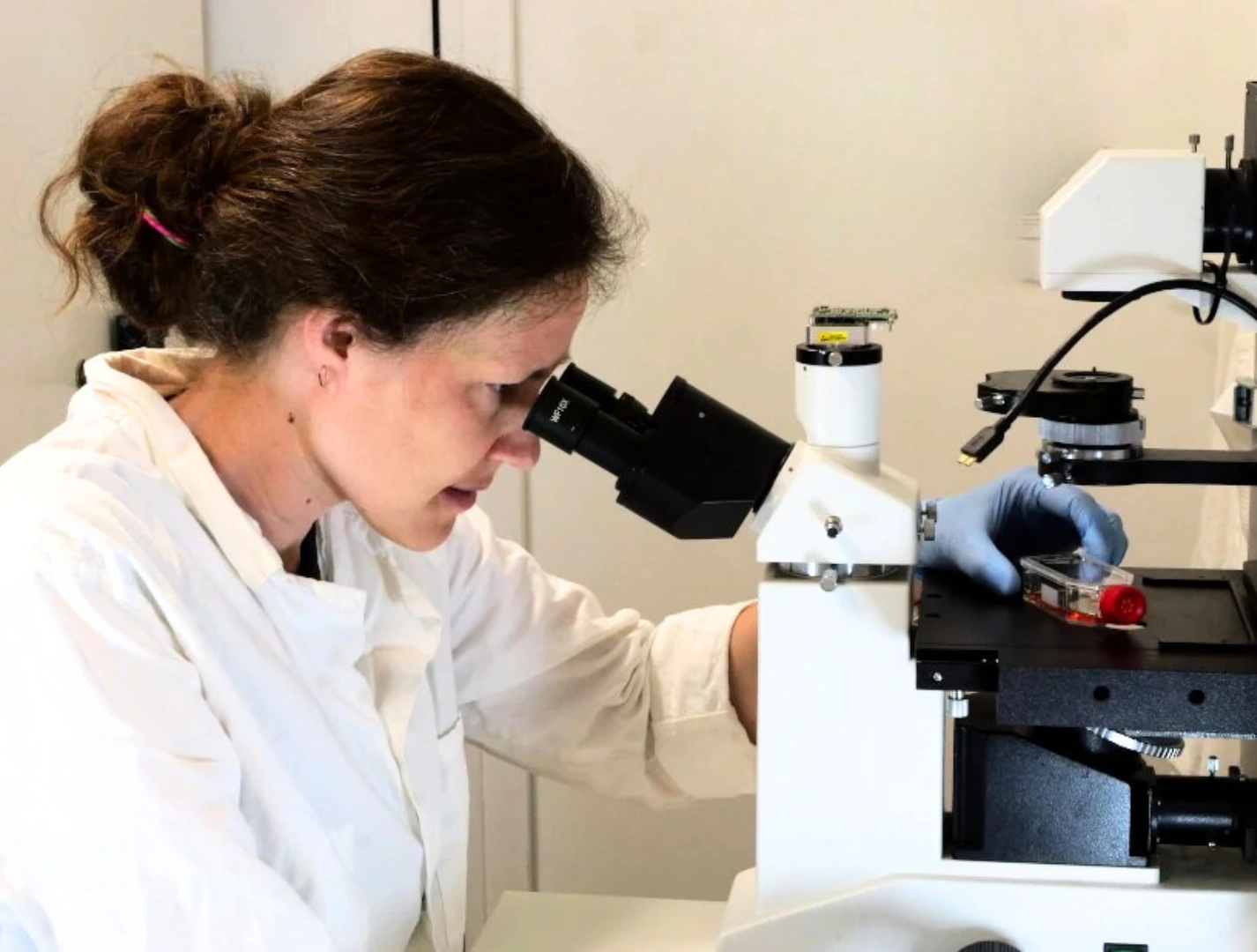
Need advice about having a stable pH under flow conditions?
Your microfluidic SME partner for Horizon Europe
We take care of microfluidic engineering, work on valorization and optimize the proposal with you
Introduction
In standard cell culture, media that uses a bicarbonate buffering system requires a controlled CO₂ atmosphere to maintain a stable pH (around 7.2-7.4) for cell viability. Traditional 2D and most 3D culture models are inherently static and do not model key physiological conditions, such as constant fluid shear. Microfluidics has become a significant technology to recreate the dynamic microenvironment of living tissues.
Yet, achieving stable pH conditions becomes increasingly challenging when microfluidic systems operate under flow conditions or outside the controlled atmosphere of a CO₂ incubator. A slight variation in gas permeability or pump hermeticity would be enough to alter the CO2-bicarbonate balance in microfluidics, leading to undesirable flow conditions. It is especially important for long-term perfusion or live-cell imaging, as well as for benchtop devices with low CO2 control. The choice of materials, pumping strategies, and gas compositions is crucial to provide stable culture conditions.
Quick tips on how to maintain a stable pH under flow conditions
Quick tip 1
If you want to work outside of the CO2 incubator, what you need is a system that is gas-tight, which means impermeable tubing and a pump without gas leaks. Here is a summary of the combinations that work to maintain the pH in the micro-chip:
Table 1: Summary of material compatibility with microfluidic pumps for maintaining a stable pH outside the CO2 incubator
Pump | Tubing material | Combination |
Syringe Pump | PTFE | ✗ |
PEEK | ✔ | |
Peristaltic Pump | Silicon | ✗ |
Pressure-driven flow controller | PTFE | ✗ |
PEEK | ✗ | |
Gas-tight Beetle pump | PTFE | ✗ |
PEEK | ✔ |
✔= Microfluidic system that maintains the chemical composition of the micro-environment
✗ = Microfluidic system that is permeable to the outer environment
PEEK: polyether ether ketone
PTFE: polytetrafluoroethylene (teflon®)
PP: polypropylene
PE: polyethylene
The reservoir material (most often Glass, PP, or PE) is impermeable enough and won’t affect the capacity of the microfluidic system to maintain the chemical compositions of the liquids in the reservoir.
Concerning the chip material CO2 permeability, refer to Table 2.
Quick tip 2
Use these combinations to control dissolved gas:
1) Inside a CO2 incubator
When using a permeable pump system, the chip must go inside the CO₂ incubator, and the chip and the part of the tubings that are in the incubator must be fully permeable to the incubator environment (your pump itself may or may not also be able to go in the CO₂ incubator – see the manufacturer’s instructions).
Any system works if you have long enough permeable tubing (eg, Pressure-driven flow controller) + gas-permeable materials
2) Outside a CO2 incubator (e.g., on the bench or microscope stage)
If you want to work outside the CO2 incubator, you need, on the contrary, a system that is gas-tight to the atmosphere, meaning a gas-tight pump with gas-impermeable tubing.
Syringe pump + gas-impermeable materials
Gas-tight Beetle pump + gas-impermeable materials
Quick tip 3
Impact of the media on pH value without environmental control
Medium composition significantly affects how long cells can safely remain in the open air (meaning outside the CO2 incubator or without gas control) without pH drift.
Using DMEM of lower NaHCO3 concentration supplemented with HEPES (eg, DMEM/F12 (1,2 g/L NaHCO₃) + 15 mM HEPES) has a weaker CO₂-dependent buffering and results in a more stable pH in the open air than DMEM of higher NaHCO3 concentration (eg, DMEM/F12 (2,4 g/L NaHCO₃) and DMEM (3,7 g/L NaHCO₃).
Download the MIC Horizon Europe 2026/2027 Calls Calendar:
A bit more details
About quick tip 1
Table 2: Table of material permeability
| Material | CO₂ Permeability Coefficient* at 25 °C (mol·Pa⁻¹·s⁻¹·m⁻¹) |
|
| Tubings | PTFE (amorphous fluoropolymers, teflon® AF …) | 2×10⁻¹³ |
| PEEK | 3×10⁻¹⁶ | |
| Silicon | 2×10-13 | |
| Chip | Glass (inorganic) | 3×10⁻25 |
| PMMA (Acrylic) | 1×10-14 | |
| PDMS | 1×10-13 | |
| PC (Polycarbonate) | 3×10-15 | |
| PS (Polystyrene) | 4×10-15 | |
| COC (Cyclic Olefin Copolymer)/ COP (Cyclic Olefin Polymer) | 8×10-16 | |
| Reservoirs | PP (Polypropylene) | 2×10⁻¹5 |
| Glass | 3×10⁻25 | |
| ibidi Polymer Coverslip | 2×10-15 |
* Average values that do not take into account the different types and densities of materials
PTFE: polytetrafluoroethylene
PEEK: polyetheretherketone
PMMA: Polymethyl methacrylate
PDMS: Polydimethylsiloxane
PC: Polycarbonate
PS: Polystyrene
COC: Cyclic Olefin Copolymer
COP: Cyclic Olefin Polymer
PP: polypropylene
About quick tip 2
1) Inside a CO2 incubator
Case study with a Pressure-driven flow controller
Pump hermeticity can alter the CO₂-bicarbonate balance in microfluidic systems, causing undesirable pH drift, a problem encountered with pressure-driven flow controller and peristaltic pumps that leak gas during perfusion. In such a case, the experiment should be performed in a CO₂ incubator. In practice, you should keep the chip in a CO2 incubator and use gas-permeable tubing (e.g., PTFE).
Pressure-driven flow controller + CO2 incubator (5% CO₂, 37°C) + PTFE tubings + pressurized with air
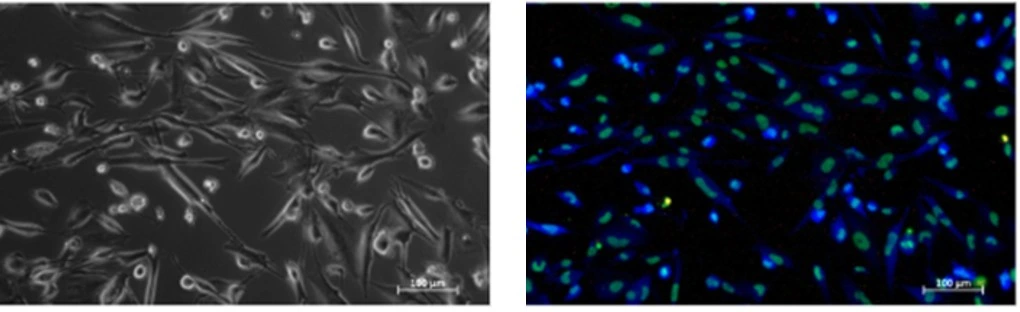
In a first experiment, we evaluated cell viability under continuous perfusion using a pressure-driven flow controller. The system was pressurized with air and the microfluidic chip and waste outlet were placed in a conventional CO₂ incubator (5% CO₂, 37°C). Gas-permeable PTFE tubing was used. Cells were perfused (1 µl/min) for 1 week at a controlled pH (∆pHmax < 0.1, monitored inline), enabling assessment of cell growth and system performance. Images were taken on day 7 (Figure 1) showing a high ratio of live to dead cells. A microfluidic sensor equipped with an optical fiber probe was incorporated in the setup for real-time measurement of both pH and temperature.
2) Outside a CO2 incubator
Case study with a gas-tight Syringe pump
Syringe pump → gas-tight, no exchange with outside, no need to control gas once liquid is pre-equilibrated.
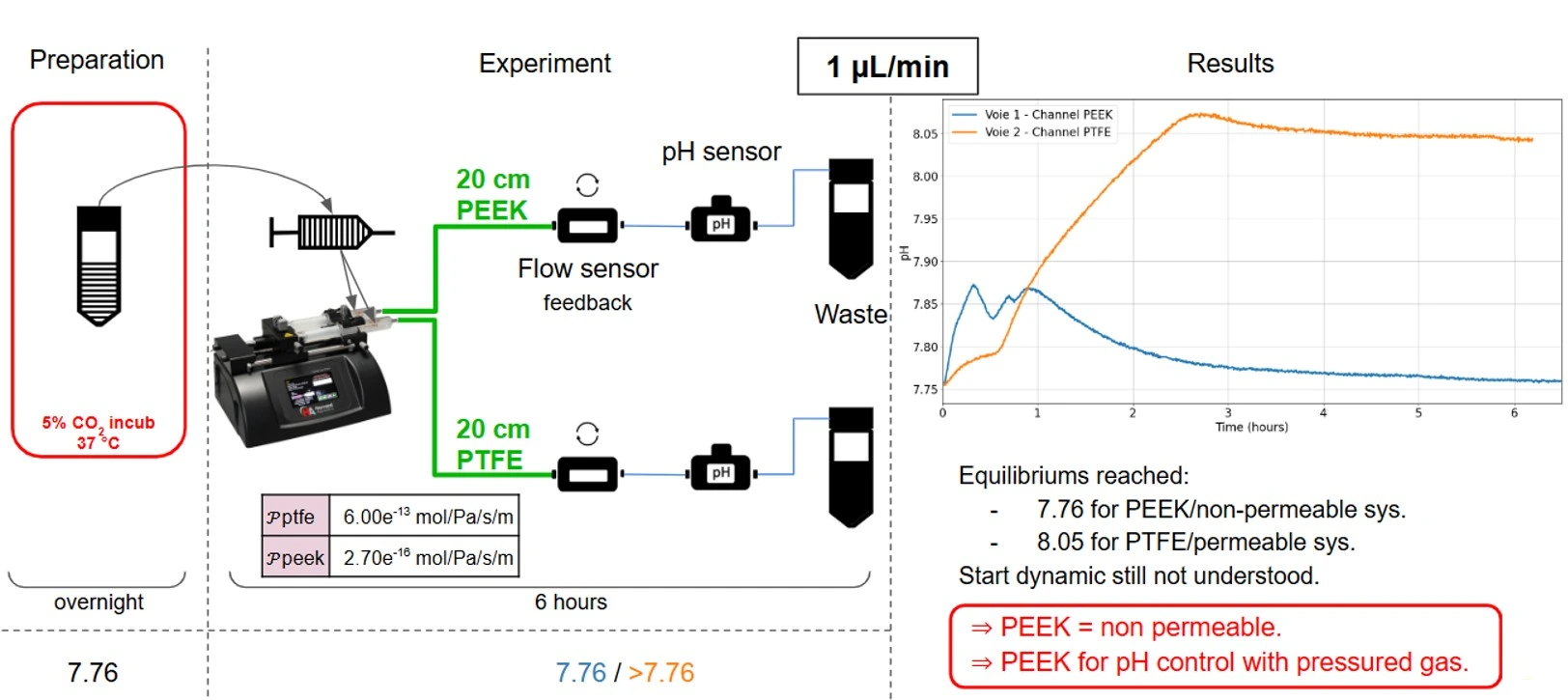
In a second experiment, we evaluated the influence of tubing material permeability on pH evolution in a standard perfusion experiment using a glass syringe pump at 1 µL/min. We equilibrated the medium in a 5% CO2 incubator at 37 °C overnight, then measured pH evolution through PEEK tubing versus PTFE tubing when perfused with pre-equilibrated DMEM for 6 hours.
pH was 7.76 at the start of the measurement in both set-ups. Equilibrium was maintained at pH 7.76 with gas-impermeable PEEK tubing, whereas equilibrium was reached at pH 8.05 with gas-permeable PTFE tubing (Figure 2).
If using a syringe pump, gas-impermeable materials (eg, PEEK) should be used for the tubing, without the need for gas control during perfusion.
Case study with a gas-tight Beetle pump
As seen in Quick Tip 2.1, the problem with many commercially available pressure pumps is the leakage of pressurized gas into the atmosphere during pressure regulation. Gas-tight pumps do not have this problem and thus, can be used to maintain the pH of liquid in the absence of a CO2 incubator, e.g., for a special gas mix, such as 5% CO2, gas-tight pumps can maintain precise levels of dissolved CO2 in the liquid during pressurization and prevent gas leakage into the atmosphere.
The MIC designed a gas-tight, pressure-driven system, the Beetle, to maintain and manipulate cell cultures with a controlled 5% CO₂ supply, outside a conventional CO2 incubator. This system enables continuous perfusion and real-time monitoring under sterile conditions, minimizing disruptions associated with working with traditional CO2 incubators. This gas-tight Beetle pump can be connected to any pre-mixed gas bottle, and it will pressurize your liquid without altering the gas composition of a pre-equilibrated solution.
The setup includes flow rate sensors, allowing flow rate feedback control. A stand-alone temperature-controlled chamber set to 37°C is used to maintain the temperature.
In the following experiment, we measured the pH in two conditions:
- The beetle was connected to a pre-mixed gas bottle (95% air/5% CO2), and
- The beetle was pushed with air.
An alkaline drift was observed when liquid was pushed with air (pH increased by 0.2 over 1.3 days), whereas the pH remained stable when pushed with 5% CO2.
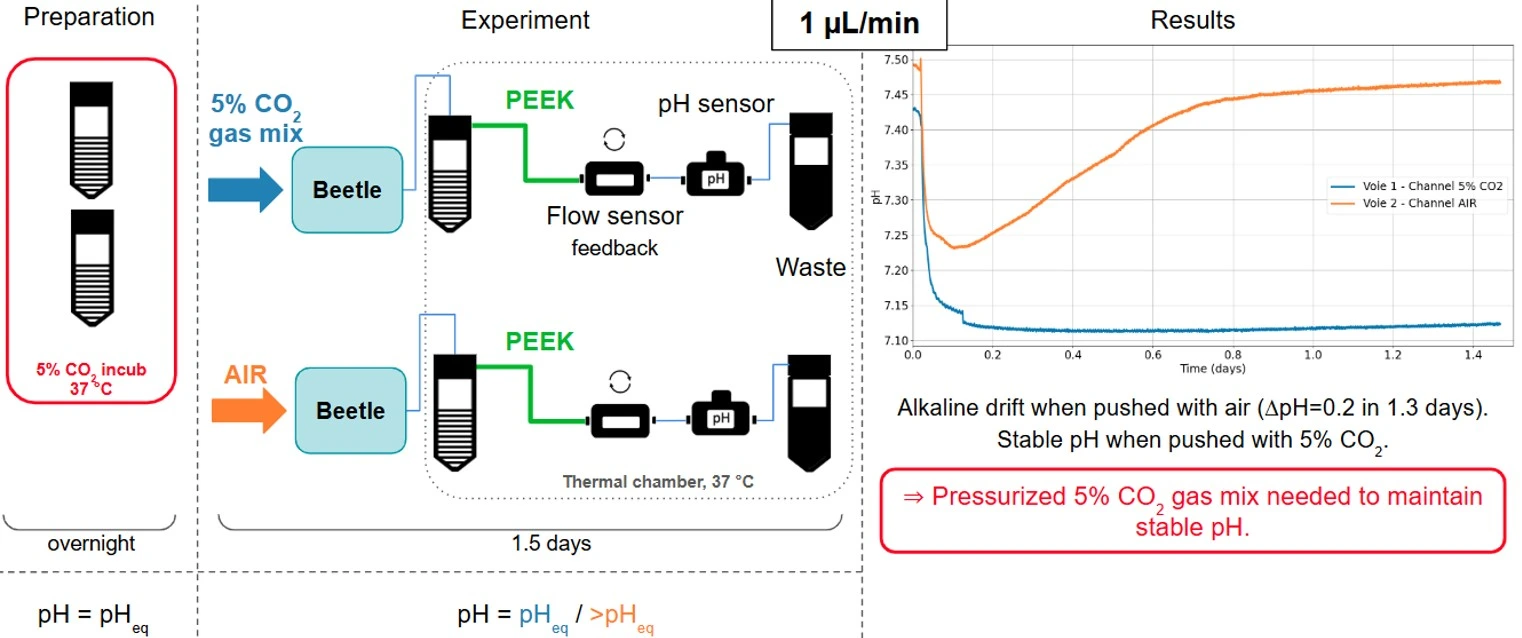
To conclude, using a gas-tight Beetle pump enables you to work outside the CO2 incubator.
Gas-tight Beetle pump + thermal chamber at 37°C + low-permeability tubing + pressurized with 5% CO2
About quick tip 3
Impact of the media on pH value
Case study without a pump
All experiments described above were performed with DMEM (3.7 g/L NaHCO3), without 4-(2-hydroxyethyl)-1-piperazineethanesulfonic acid (HEPES). However, different media with different buffer composition will have different pH dynamics. In order to evaluate these dynamic differences, we measured the pH evolution to the open air in 3 different media (around 30 mL of each in 50 mL tubes) for 7 hours: DMEM (3.7 g/L NaHCO3) alone; DMEM F12 (2.4 g/L NaHCO3) alone; and DMEM F12 (1.2 g/L NaHCO3) + 15 mM HEPES. This experiment aims to show how long you can keep your cells in the air outside the incubator, e.g., under the microscope.
All 3 media were pre-equilibrated for 48h in the CO2 incubator. The pH measurement began after the 48h incubation, in contact with air, without gas control.
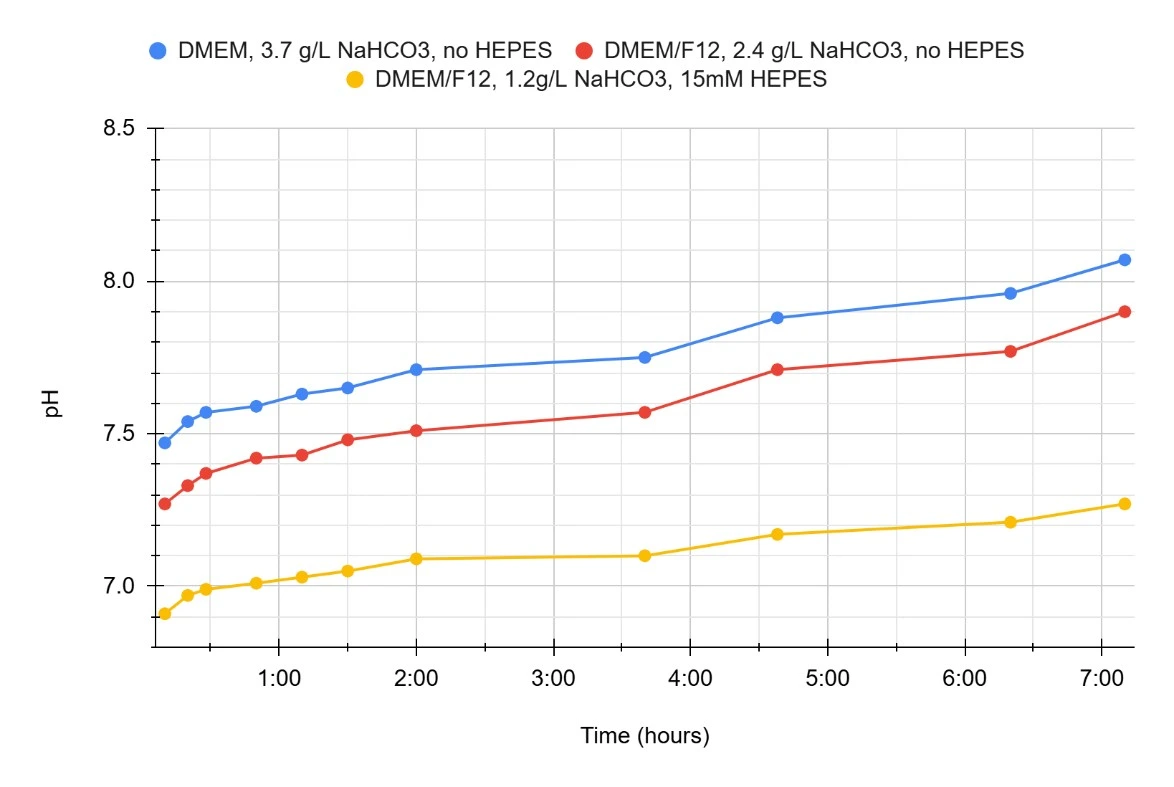
The pH in the different media increased by 0.1 in half an hour. pH in DMEM (3.7 g/L NaHCO3) increased from 7.5 to 7.9 in 5 hours, and to 8.1 in 7 hours (stronger CO₂-dependent buffering). pH in DMEM F12 (2.4 g/L NaHCO3) increased from 7.3 to 7.7 in 5 hours and to 7.9 in 7 hours (weaker CO₂-dependent buffering). pH in DMEM F12 (1.2 g/L NaHCO3) + 15 mM HEPES increased from 6.9 to 7.2 in 5 hours and to 7.3 in 7 hours (much weaker CO₂-dependent buffering).
Depending on your cells, you can assess whether this pH change is dramatic for them.
Conclusion on how to maintain a stable pH under flow conditions
Maintaining stable pH under flow conditions depends on the choice of appropriate pump hermeticity, tubing gas permeability, and gas composition. Syringe pumps, which are examples of gas-tight pumps, do not allow CO2 exchange and can retain the original pH using impermeable tubing. Pressure-driven systems bring about gas exchange and, as such, require a controlled CO2 atmosphere (CO2 incubator) or a gas-tight pump coupled with a 5% CO2 supply. Our Beetle gas-tight pump enables cell culture without an incubator and maintains the original gas composition. Media composition also plays a major role in buffering capacity and should be considered when conducting experiments outside controlled environments. By aligning these parameters, the researchers will be able to maintain physiologically relevant pH conditions during continuous microfluidic perfusion.


Funding and Support
This review was written under European Union’s Horizon research and innovation program under HORIZON-EIC-2023-PATHFINDEROPEN-01, grant agreement no. 101130747 (Bio-HhOST).
This page was written by Lisa Muiznieks, PhD,
Eve-Line Bancel, PhD,
& Justine Lereculey
Published in June 2026.
Contact: Partnership@microfluidic.fr