Tips & Tricks for a successful HORIZON-CL6-2027-01-BIODIV-03 proposal
Opening
20 April 2027
Deadline
Keywords
Biodiversity
Ecosystem restoration
digital Innovations
Nature Restoration Regulation
TRL 6-7
SME relevance
agricultural machinery
biosensors for monitoring
Your microfluidic SME partner for Horizon Europe
We take care of microfluidic engineering, work on valorization and optimize the proposal with you
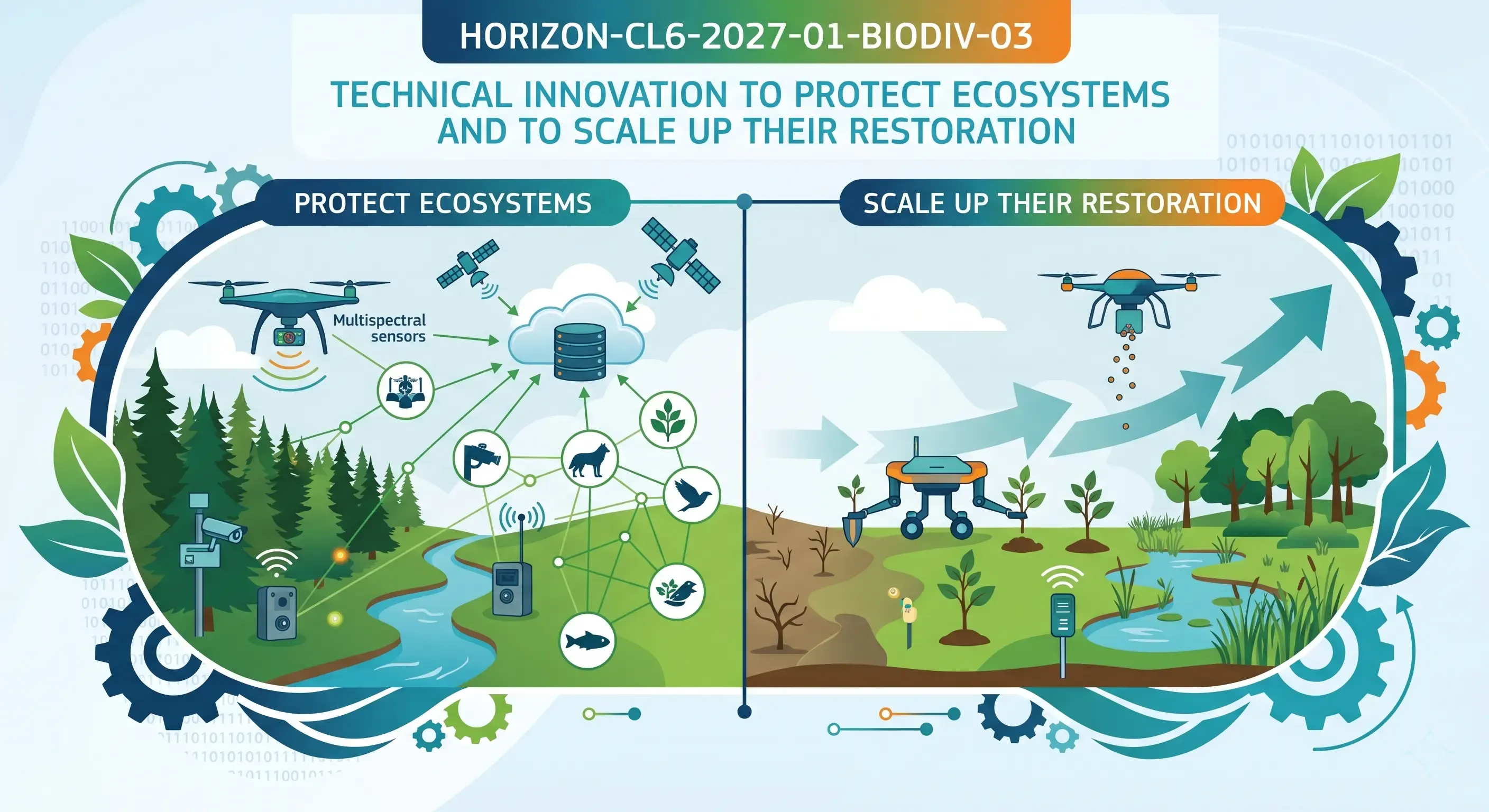
HORIZON-CL6-2027-01-BIODIV-03: Technical innovation to protect ecosystems and to scale up their restoration
What the Commission is seeking here is something practical: machines and technical equipment that will assist people on the ground in protecting and rebuilding ecosystems. The work programme is unabashed regarding the issue. The work of restoration is even now largely based on agricultural machinery which was never intended to do this work. The gap is on what is required by the EU Nature restoration regulation and what can be practically applied by field practitioners. The gap this Innovation Action addresses is the Commission’s seriousness about it, as indicated by the budget.
Download the MIC Horizon Europe 2026/2027 Calls Calendar:
Discover more!
Administrative facts: what do we know about the HORIZON-CL6-2027-01-BIODIV-03 call?
Which call is it, and when is the opening and the deadline?
- Call name: Food, Bioeconomy, Natural Resources, Agriculture and Environment
- Call identifier: HORIZON-CL6-2027-01
- Destination: Biodiversity and ecosystem services
- Topic: HORIZON-CL6-2027-01-BIODIV-03
- Opening date: 20 April 2027
- Deadline: 22 September 2027 (17:00:00 Brussels local time)
- Type of action: Innovation Action (IA)
What about the budget and estimated size of the project?
- Overall topic budget: EUR 14.00 million
- Number of projects expected to be funded: 2
- Budget per project: around EUR 7.00 million
- Eligible costs take the form of a lump sum
- Equipment and infrastructure purchased or developed for the action may be declared as full capitalised costs
- Target TRL at end of project: 6 to 7
What are the key eligibility and evaluation conditions?
- Standard eligibility conditions as described in General Annex B
- Standard evaluation thresholds as described in General Annex D
- No JRC involvement mentioned for this topic specifically
- No multi-actor approach required
- The topic is explicitly flagged as particularly relevant for SMEs
- Proposals should foresee resources for close cooperation with the EC Knowledge Centre for Biodiversity (KCBD) and its Science Service
Scientific range: what does the Commission expect from the HORIZON-CL6-2027-01-BIODIV-03 grant?
What outcomes are expected?
There are two things desired by the Commission. First, it makes stakeholders’ ecosystem protection and restoration activities easier and more effective in practice. Second, the fact that the conditions of scaling up the EU Nature Restoration Regulation are in fact better, such as the ecosystem services that the restored habitats offer to climate mitigation and adaptation. This, in a word, is not about writing about restoration work, but making it work at scale.
What is within scope?
- New or modified machines that are intended to perform ecosystem restoration or protection activities (not used agricultural machines)
- Low-tech solutions, basic tools, field ready solutions which the practitioner can take without needing to train extensively.
- Digital innovations or digital-and-physical hybrids.
- Any type of ecosystem can be covered: terrestrial, freshwater, and marine.
- Specific innovations trying to address operational requirements like temporal protection of plants, the elimination of invasive species (along with their seeds) or the specific lure of a species.
- Consideration of effectiveness, ease of use, durability, and environmental sustainability of the very innovations (the Commission expressly requests proposers to be sensitive to the possible risks, trade-offs and unintended outcomes of the technologies they come up with)
It has a wide scope that is intentional. The commission does not dictate a particular ecosystem or particular technology. What is not covered, however, at least implicitly, is pure research, modelling exercises or monitoring platforms, which have no physical hardware or activity output. It is an Innovation Action TRL 6 to 7. At the end you require something to be tested in real conditions.
What are the specifically proposed research directions?
- Design, development, and field-testing of technical innovations related to identified needs of specific ecosystem protection or restoration activities.
- The issue of managing invasive alien species is specifically mentioned in the work programme, and the relevant problem lacks specific tools dedicated to it (particular lures, seed removal devices).
- Adapted equipment to restore habitats where standard agricultural equipment doesn’t work or causes damage.
- The digital tools combined with physical devices in which the precision restoration work is carried out.
- Simple enough solutions that can be deployed by non-specialist stakeholders on scale.
It is not too restrictive in wording. However, it appears that the Commission is aiming at: naming an actual bottleneck in the practice of restoration, constructing something that addresses it, and proving it to work in actual systems. The focus on the identified needs is to be taken literally. Proposals based on the problem, rather than on the technology, are more likely to be easier for evaluators to read.
Scientific strategy: how can you enhance your chances of being funded through HORIZON-CL6-2027-01-BIODIV-03?
What scientific choices matter most?
- Begin in the field, not in the laboratory. Identify the targeted ecosystem, the targeted restoration activity and the targeted gap in operations that you are addressing. In evaluating you, evaluators desire to know you have engaged in conversations with the individuals who actually perform the restoration work and have realized where they are failing.
- Keep the innovation down to earth. This is TRL 6 – 7, meaning that your prototype will have to be operating in real conditions in month 36 or so. If the project does not allow you to test it in the field, it is too early to make this call.
- Do not overlook the side effects. The work programme specifically requests vigilance to unintended consequences. A weed remover, which destroys the habitat of ground-nesting birds, will not rank highly, regardless of the effectiveness of the remover. The environmental risk assessment should be incorporated in your work plan.
- Think simplicity. The Commission puts right next to effectiveness simplicity of use and durability. It is not about the most advanced tool. It is about the things that a park ranger can actually use, preserve, and can afford.
- Discuss more than one type of ecosystems provided you can. Proposals to terrestrial and freshwater, or to terrestrial and marine, will likely appear more robust, as they will show greater extensiveness. But do not go farther than is plausible.
- Relate your innovation to the Nature Restoration Regulation timeline. By 2030, Member States must possess 20% of land and 20% of sea areas under restoration measures. Demonstrate to evaluators that your tool can meet that deadline.
- Properly budget the KCBD cooperation. It is stated in the work programme and to forget about it would be an obvious gap.
Consortium and proposal-writing plan: what works best with this type of call?
- Strive to have between 6 and 10 partners. It is a EUR 7 million lump sum IA and it requires both the technical developers and end-users in the field. With too few partners, you will not capture ecosystem diversity; with too many, lump-sum coordination becomes a nightmare.
- You require at least a team of one or two technology developers (SMEs or small players in the industry with prototyping and manufacturing capabilities). The call flags SME relevance directly; thus, an innovative SME developing a construction restoration device or digital solution should be an apparent element of the consortium.
- Combine them with ecological research institutes or conservation non-governmental organizations that are familiar with the restoration context on the inside. These collaborators specify the operation requirements and test the field.
- When dealing with marine ecosystems, it is worth having a partner that has access to coastal or marine field sites. And the same is true of fresh water or mountainous terrain: where you do your testing must be realistic, not convenient.
- Credibility would be enhanced by a governmental body or a conservatory agency. Evaluators will want to determine whether a consortium member is capable of implementing the innovation after the project ends.
- When writing a proposal, you should state the problem, and not the solution first. The initial pages of Part B are meant to create an impression of the gap: explain how a restoration professional finds themselves in a difficult situation when performing a specific task, and why the available tools do not work. Introduce your innovation in response then. This structure has been found to be effective in IAs that take environmental applications.
- Lump sum form implies that your budget story must be particularly understandable. Identify work packages that have clear deliverables and milestones and ensure that the budget justification is lean.
How would microfluidics contribute to this topic?
The heavy machinery not only makes ecosystem restoration. One of the key components of the work is understanding what is happening in the soil, water, or sediment before and after your intervention. The standard lab analysis is lengthy and costly and it takes weeks before you may receive the results after the field campaign has been completed. That equation is altered with microfluidic sensors and portable analytical platforms.
- Suppose you want to know whether a restored wetland is actually filtering pollutants as it should. A microfluidic water quality sensor provides on-site measurements of nutrients, pH, dissolved oxygen, trace contaminants, even, without having to ship samples to the lab. You find out in the field, the same day.
- Another concrete fit would be soil health monitoring. Microfluidic systems can measure microbial activity and nutrient and contaminant concentrations in small soil samples, which is important when sampling dozens of restoration sites and need to compare conditions quickly.
- In microfluidic eDNA detection, the target species in water or soil can be detected within hours, enabling timely management of invasive species. It is a true working bonus when you are making decisions about where to focus removal efforts or whether a treatment has been successful.
- A chip-based biosensor can be used to monitor biological indicators of ecosystem recovery (enzyme activity or other markers of microbial diversity) at a fraction of the cost and time of standard techniques. Better feedback loops between monitoring and intervention in your consortium.
- And it depends on the portability. They are gadgets that can be either carried in a backpack or a field kit. The same individuals that the Commission aims to provide with more powerful tools can use them with basic training.
Microfluidics will not be used to substitute the excavators and seed drills, but it will fill a monitoring and decision-support gap that makes the entire restoration process quicker, less expensive and more evidence-based. To make a proposal in this call, the incorporation of a portable analytical platform will be effective in enhancing the innovation aspect and the environmental sustainability evaluation which the Commission requires.
The MIC already brings its expertise in microfluidics to Horizon Europe:
H2020-NMBP-TR-IND-2020

Microfluidic platform to study the interaction of cancer cells with lymphatic tissue
H2020-LC-GD-2020-3

Toxicology assessment of pharmaceutical products on a placenta-on-chip model

FAQ – HORIZON-CL6-2027-01-BIODIV-03
What is HORIZON-CL6-2027-01-BIODIV-03 about?
HORIZON-CL6-2027-01-BIODIV-03 provides funding for the design, development and testing of technical innovations (equipment, tools, low-tech and digital) to facilitate ecosystem protection and restoration. The goal is to ramp up implementation of the EU Nature Restoration Regulation by providing practitioners with equipment, rather than modified farm machinery.
When does HORIZON-CL6-2027-01-BIODIV-03 open and close?
The call HORIZON-CL6-2027-01 opens on 20 April 2027 and closes on 22 September 2027 at 17:00:00 Brussels local time. The call is a one-step call, meaning that the entire proposal is submitted at the deadline.
What is the budget per project for HORIZON-CL6-2027-01-BIODIV-03?
The EU contribution per project will be of the order of EUR 7.00 million. The overall budget for the topic is EUR 14.00 million, with the Commission planning to award 2 projects. The type of costs eligible are a lump sum.
What type of action is HORIZON-CL6-2027-01-BIODIV-03?
HORIZON-CL6-2027-01-BIODIV-03 is an Innovation Action (IA). The project is expected to achieve TRL 6-7 working prototype in a real-life or operational environment.
Which TRL must be reached at the end of the project?
Is HORIZON-CL6-2027-01-BIODIV-03 SME-friendly?
Yes. The work programme clearly identifies HORIZON-CL6-2027-01-BIODIV-03 as being relevant for SMEs. The addition of an innovative SME with prototyping and manufacturing capabilities adds to the credibility of the consortium on the innovation front.
What ecosystems are covered by HORIZON-CL6-2027-01-BIODIV-03?
Any type of ecosystem can be covered: terrestrial, fresh water and marine. One or multiple ecosystems may be addressed. Addressing several ecosystems typically indicates a more general application, but with field sites and expertise.
Is JRC participation expected for this topic?
This topic doesn’t explicitly mention the JRC. But proposals should plan on funds for tight collaboration with the EC Knowledge Centre for Biodiversity (KCBD) and its Science Service. If you omit that line from your work plan, it will be a red flag.
How can microfluidics support a HORIZON-CL6-2027-01-BIODIV-03 proposal?
Microfluidics addresses the gap in monitoring & decision support in restoration. Handheld microfluidic sensors provide on-site water and soil monitoring, eDNA analysis of invasive species in a matter of hours, and chip-based biosensors for monitoring ecosystem recovery indicators, at reduced cost and time compared to lab-based analysis.
What is the ideal consortium size for HORIZON-CL6-2027-01-BIODIV-03?
We recommend 6-10 partners. The combination should include technology providers (SMEs, small industry) and ecological research institutes, conservation NGOs, and one public entity or protected area management body to support post-project implementation.