
Tips & Tricks for a successful HORIZON-CL6-2027-02-FARM2FORK-03 proposal
Opening
20 April 2027
Deadline
Keywords
One Health
Livestock microbiome
reduced antibiotics
RIA
Antimicrobial resistance
Zoonotic disease
Sustainable farming
Animal health
cross-disciplinary
Your microfluidic SME partner for Horizon Europe
We take care of microfluidic engineering, work on valorization and optimize the proposal with you
HORIZON-CL6-2027-02-FARM2FORK-03: Microbiome for terrestrial livestock sustainability and health within a One Health approach
The Commission wants to understand what the gut and body microbiome of farm animals actually does and how it connects to animal disease, soil health, and human health risks. This isn’t a call for incremental microbiology. The Commission is after systemic, cross-disciplinary research that can eventually support real farming decisions: fewer antibiotics, lower zoonotic risk, and better animal welfare. One Health is the frame, but the real pressure behind this topic is antimicrobial resistance (AMR) and the lack of practical, field-validated tools.
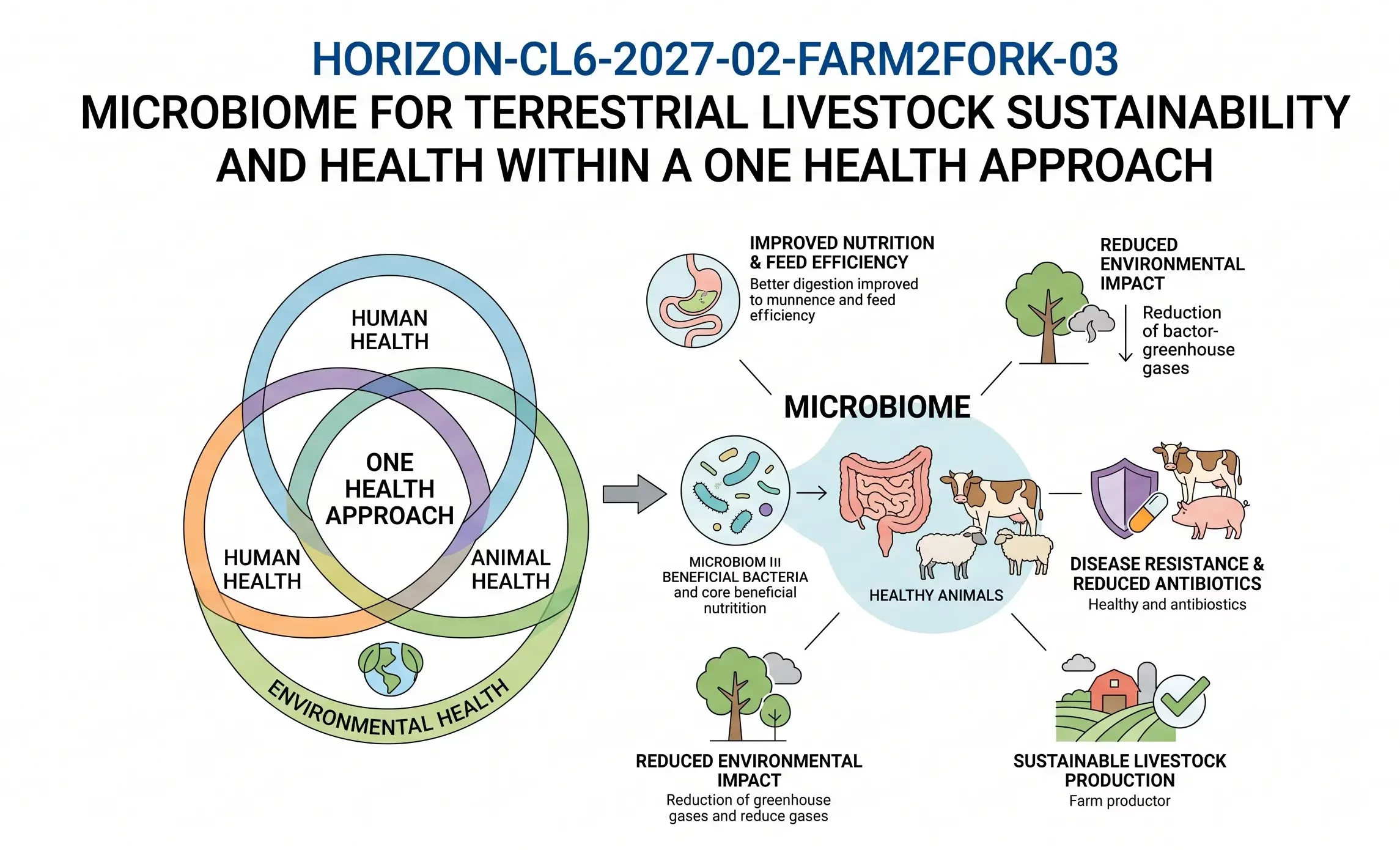
Download the MIC Horizon Europe 2026/2027 Calls Calendar:
Discover more!
Administrative facts: what do we know about the HORIZON-CL6-2027-02-FARM2FORK-03 call?
Which call is it, and when is the opening and the deadline?
- Call name: Call 02, single stage (2027)
- Call identifier: HORIZON-CL6-2027-02
- Destination: Fair, healthy and environmentally friendly food systems from primary production to consumption
- Topic: HORIZON-CL6-2027-02-FARM2FORK-03
- Opening date: 20 April 2027
- Deadline: 23 September 2027 (17:00 Brussels local time)
- Type of Action: Research and Innovation Actions (RIA)
What about the budget and estimated size of the project?
- Overall topic budget: EUR 11.80 million
- Number of projects expected: 2
- EU contribution per project: EUR 5.00 to 6.00 million
- Note: lump sum funding rules apply under this topic
What are the key eligibility and evaluation conditions?
- General admissibility, eligibility and award criteria as described in General Annexes A, B, C, D
- No explicit multi-actor approach requirement stated for this topic (unlike several sibling topics in this call)
- Eligible costs take the form of a lump sum contribution
- TRL range not explicitly stated in the work program for this topic (worth verifying on the Funding and Tenders Portal)
- Projects are expected to interact with ongoing related projects, particularly those from topic HORIZON-CL6-2026-02-FARM2FORK-11
- Coordination with European partnerships on animal health and welfare, One Health AMR, and pandemic preparedness is expected
Scientific range: what does the Commission expect from the HORIZON-CL6-2027-02-FARM2FORK-03 grant?
What outcomes are expected?
By the end of the project, farmers, breeders, and the research community should have a much clearer picture of how the livestock microbiome influences animal health, AMR spread, and zoonotic disease risk. The Commission also wants a functional platform for data sharing and microbiome research standardization. On top of all that, targeted guidelines should be ready for service providers and industry to actually use in the field.
What is within scope?
- Microbiome research in terrestrial livestock, including holobiont and hologenome perspectives
- Interactions between livestock microbiomes, soil health, plant health, water, and air
- Antimicrobial resistance (AMR): emergence, transmission, cross-species dynamics
- Zoonotic disease risk assessment and prevention
- Microbiome-based intervention strategies to reduce antimicrobial use and prevent outbreaks
- Integrated data monitoring systems for microbiome-related health indicators
- Holistic health modelling incorporating soil and plant health dimensions
- Collaborative platform development for microbiome tools, products and services within One Health
- Cross-disciplinary collaboration (veterinarians, microbiologists, geneticists, epidemiologists, ecologists)
Human health only enters through the One Health lens; this is not a clinical or therapeutic research topic in the pharmaceutical sense.
What are the specifically proposed research directions?
- Investigating microbiome variability in host-microbiome interactions and what drives it across species, breeds, and farming systems
- Building integrated monitoring systems that track microbiome-linked health indicators across livestock, plants, and humans simultaneously
- Studying how microbiome-based solutions interact with soil and plant health, and with the use of chemical fertilisers and pesticides
- Designing intervention strategies to prevent cross-species disease transmission and outbreaks
- Creating or contributing to a shared platform for assessing and optimising microbiome tools and services in the livestock sector
- Connecting this work to broader One Health partnerships on AMR and pandemic preparedness, not just staying within the agricultural silo
Scientific strategy: which are the best ways to improve your chances of receiving funding under the HORIZON-CL6-2027-02-FARM2FORK-03?
What scientific choices matter most?
- Frame your proposal around the AMR problem, not microbiome science in general: Evaluators are looking for proposals that treat AMR reduction as the end goal, not as a secondary benefit. The microbiome is the tool, not the story.
- Design for real-world farming settings from the start: The work program explicitly flags a gap in “assessing these interventions in real-world farming settings.” If your methodology stays in the lab, expect questions.
- Include the soil-plant-water dimension: Proposals that treat livestock microbiomes in isolation are probably missing the point. The commission wants to see how what happens in the animal connects to what happens in the field and the food chain.
- Build a proper data monitoring architecture, not just sampling protocols: The expected outcome around “integrated data monitoring systems” suggests the Commission is not looking for another microbiome atlas. They want something that tracks health signals across sectors in real time, or close to it.
- Connect explicitly to HORIZON-CL6-2026-02-FARM2FORK-11 and the relevant European partnerships: This is listed as a requirement, not a suggestion (worth checking twice).
- Address both zoonosis prevention and AMR in the same intervention logic: Treating them separately signals you haven’t fully read the brief.
- Don’t propose to study which microbes are present: The Commission is after functional impact and actionable tools. Descriptive microbial surveys without intervention design are not what they’re after.
Consortium & proposal-writing plan: what works best with this type of call?
- Somewhere between eight and twelve partners is probably the right range for an RIA of this size, maybe a few more if the geographic or species coverage demands it.
- You need veterinary science and microbiology as core disciplines. That’s the obvious part. What trips people up is the soil and plant health side: make sure at least one partner brings genuine expertise in soil microbiology or agroecology, not just a mention in the description.
- A livestock farmer or farm organization should be on board. The Commission’s expected outcomes explicitly name farmers as one of the target groups. If there’s no farmer voice in the consortium, that’s a gap evaluators will flag.
- Include an innovative SME developing microbiome-based tools or diagnostic products. The platform development objective opens a natural door for a biotech or agri-tech SME. And it helps with the commercialization angle that RIAs increasingly need to show.
- If you can align with a relevant European Partnership (One Health AMR, pandemic preparedness, or animal health and welfare), include a partner who is already active in one of them. The interaction requirement is explicit; showing an existing connection is better than promising to build one.
- On proposal writing: the Commission uses “One Health” extensively, but in practice what evaluators respond to is concrete risk scenarios. Describe a specific AMR or zoonosis transmission scenario your project will address, then build your methodology backward from there. Generic One Health framing without a named problem reads as vague.
- Social sciences and humanities are not explicitly required here (unlike some sibling topics). But given the farmer adoption dimension, a social scientist or an expert in behavioral change in agriculture would strengthen the proposal’s credibility on impact.
How would microfluidics contribute to this topic?
Standard methods for studying gut microbiome communities in livestock are slow, expensive, and poor at capturing what actually happens inside a living animal. You can sequence samples from a farm, but you lose the spatial dynamics, the host-microbe interface, and the real-time response to a stressor. That’s where microfluidic approaches come in: they let you reproduce part of that interface in a controlled, miniaturised setting and observe interactions directly.
- Gut-on-a-chip models can simulate parts of the intestinal environment of different livestock species and test how specific microbial communities behave under controlled conditions: nutrient stress, antibiotic exposure, and pathogen challenge. Say you want to know whether a particular probiotic strain actually inhibits a pathogen at the intestinal wall level, or just shows up in a sequencing result. A microfluidic gut model lets you run that experiment directly, with consistent results across trials.
- Microfluidic biosensors and lab-on-chip systems can be integrated into monitoring platforms, enabling real-time or near-real-time tracking of microbiome-linked biomarkers (metabolites, immune signals) in biological samples from livestock. For a proposal trying to build integrated data monitoring systems, this is a concrete technical layer that adds value.
- High-throughput microfluidic droplet systems can isolate and culture individual microbial strains from complex livestock gut communities. This matters for functional characterization: you need to know what a specific strain does, not just that it’s present. Same compound, different host species, different outcome.
- For AMR research specifically, microfluidic platforms can accelerate resistance screening across large panels of microbial isolates from livestock environments, identifying resistance patterns much faster than conventional culture methods.
For a proposal under HORIZON-CL6-2027-02-FARM2FORK-03, your consortium would benefit from MIC’s expertise in organ-on-chip and biosensor development as a direct technical contribution to the platform and monitoring objectives of the call. We’ve seen this type of integration work well in cross-disciplinary One Health proposals, and it’s an angle that tends to stand out.
The MIC already brings its expertise in microfluidics to Horizon Europe:
H2020-NMBP-TR-IND-2020

Microfluidic platform to study the interaction of cancer cells with lymphatic tissue
H2020-LC-GD-2020-3
Toxicology assessment of pharmaceutical products on a placenta-on-chip model

About the author

Julia Sepulveda Diaz, PhD
Chief Executive Officer, Microfluidics Innovation Center
Julia holds a PhD in glycobiology and neurobiology from Université Paris-Est Créteil. Before moving into microfluidics, she spent several years as a postdoctoral researcher at the Paris Brain Institute, on Parkinson’s disease, neuroinflammation, and the role of heparan sulfate in protein aggregation. Today she leads the Microfluidics Innovation Center as CEO, steering its researchers and engineers and its collaborative research and innovation projects.
FAQ – HORIZON-CL6-2027-02-FARM2FORK-03
What is the HORIZON-CL6-2027-02-FARM2FORK-03 call really about?
This Horizon Europe RIA is seeking One Health systems research on the microbiomes of terrestrial animals. The Commission is not calling for basic microbiology. They want to see multi-disciplinary projects that connect animal gut health to AMR, zoonoses, soil, and farm management.
Who should apply and how much funding is available?
Consortia of livestock scientists, microbial scientists, veterinarians, soil scientists, epidemiologists, and farmers’ organizations. Total budget for two projects: EUR 11.80 million; EUR 5.00-6.00 million per project. Lump sum funding rules apply. Deadline: 23 September 2027.
Which livestock species and farming systems are in scope?
We are interested in all farm animals: cattle, pigs, poultry, sheep, goats, and other livestock. We are interested in both organic and conventional livestock production. It is critical that the application is relevant on the farm, not just in the lab.
What are the four main outcomes evaluators will look for?
They want to see: (1) better knowledge of the interaction between the livestock microbiome and animal health, soil, and human health (One Health approach); (2) a data sharing platform and standardization of microbiome research; (3) intervention strategies to reduce the use of antibiotics; and (4) improved risk assessment for zoonosis and AMR.
How should we address AMR and zoonosis in a single intervention logic?
AMR and zoonosis are not separate work packages, but are on a continuum. Create an intervention logic that uses microbiome approaches to address both risks. Your surveillance system needs to detect signals from livestock, plants, and humans. This means epidemiologists and microbiologists.
What is the microfluidics value-added for this call?
Gut-on-chips test microbiome interventions at the microbiome-host interface. Lab-on-chip and microfluidic biosensors track microbiome biomarkers in real time from animal hosts. Droplet microfluidic devices isolate and identify single strains from the poly-microbial gut, which are necessary for developing interventions.
What makes a strong consortium for FARM2FORK-03?
8 to 12 members. Veterinary medicine, microbiology, soil microbiology/agroecology, epidemiology, and farm organization are essential. Have a biotech or agri-tech SME help to develop the platform. Partner is already part of the One Health AMR European Partnership or the Animal Health and Welfare Partnership.
What is strictly in and out of scope for this topic?
In scope: all terrestrial livestock species and systems; AMR emergence and risk; zoonotic risk; microbiome interventions; interactions with plant and soil health; and partnership platform development. Not in scope: human health (clinical/therapeutic) studies, microbiome surveys without intervention studies. Check the Funding and Tenders Portal for more information.
What are the typical pitfalls that sink livestock microbiome RIA proposals?
The biggest mistakes are: suggesting microbiome studies instead of intervention studies; treating AMR and zoonosis independently; ignoring the soil/plant health component; failing to meet the requirements of HORIZON-CL6-2026-02-FARM2FORK-11 and other European Partnerships; and treating farmers as “end users” only, not as consortium partners.
What does the interaction requirement with FARM2FORK-11 mean in practice?
According to the work program, projects have to interact with HORIZON-CL6-2026-02-FARM2FORK-11. That means listing the funded projects for that topic and assigning one task for coordination and knowledge management. Allocate some person-months for this. The reviewers want to see a plan, not an interaction statement.