Tips & Tricks for a successful HORIZON-HLTH-2027-02-DISEASE-14-two-stage proposal
Opening
10 February 2027
Deadline
Keywords
FAIR data
Neurodegenerative disease
Parkinson’s
active substance
Brain-on-chip
Combination therapy
therapeutic interventions
Clinical trials
Alzheimer’s
Your microfluidic SME partner for Horizon Europe
We take care of microfluidic engineering, work on valorization and optimize the proposal with you
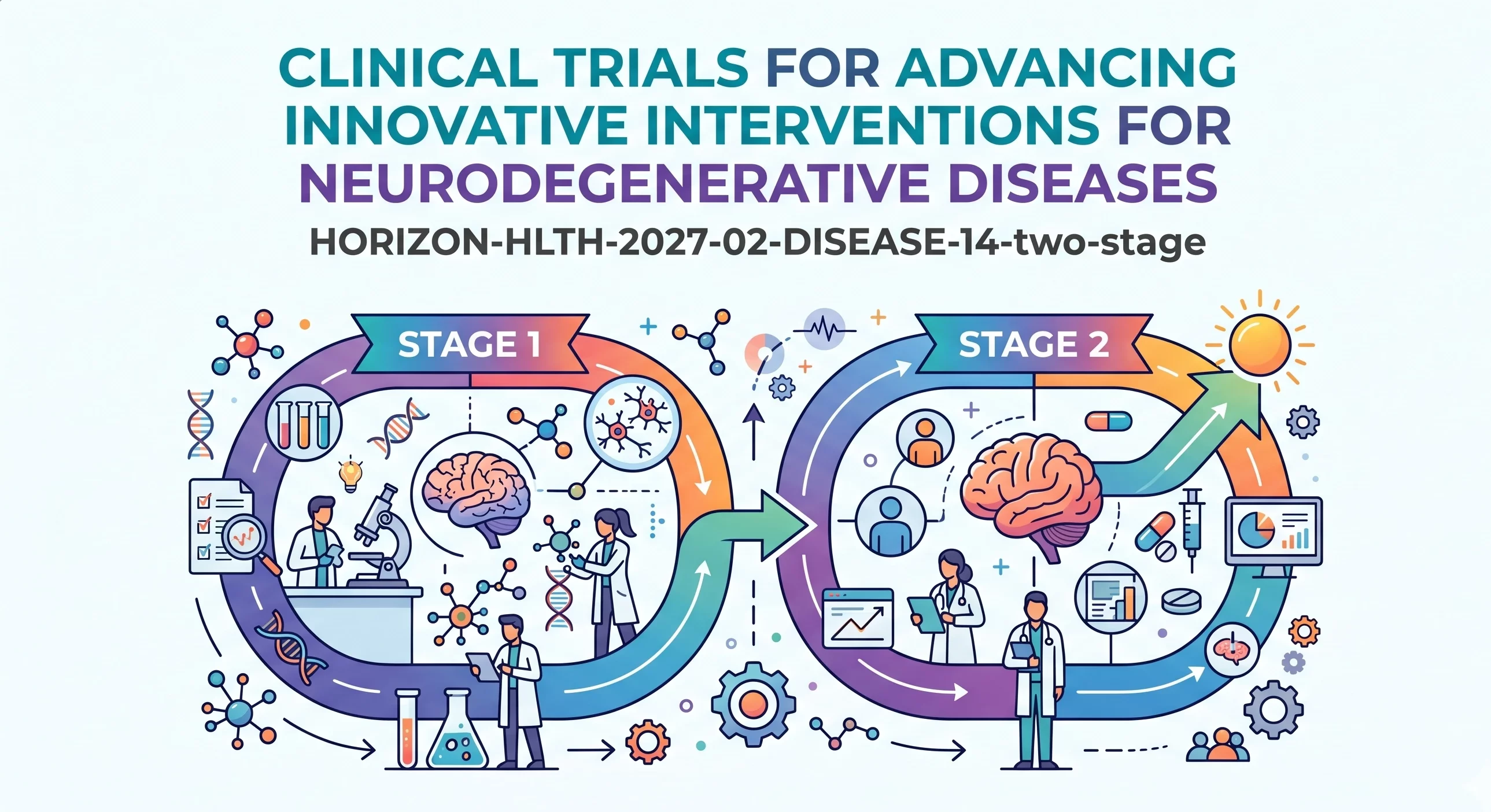
HORIZON-HLTH-2027-02-DISEASE-14-two-stage: Clinical trials for advancing innovative interventions for neurodegenerative diseases
The Commission would like to see clinical evidence that novel treatments of neurodegenerative diseases can not simply control symptoms. We are speaking of first-stage trials that combine an active agent with a complementary method (consider cognitive training, lifestyle changes, rehabilitation) and in fact turn out to be safe, effective, and on their way to individual care. The uncommon neurodegenerative diseases are specifically not included here, hence narrow down your proposal on the common ones.
Download the MIC Horizon Europe 2026/2027 Calls Calendar:
Discover more!
Administrative facts: what do we know about the HORIZON-HLTH-2027-02-DISEASE-14-two-stage call?
Which call is it, and when is the opening and the deadline?
- Call name: Cluster 1 – Health (Two stage – 2027)
- Call identifier: HORIZON-HLTH-2027-02-two-stage
- Destination: Tackling diseases and reducing disease burden
- Topic: HORIZON-HLTH-2027-02-DISEASE-14-two-stage
- Opening date: 10 February 2027
- Deadline: 13 April 2027 (first stage), 22 September 2027 (second stage)
- Type of action: RIA (Research and Innovation Action)
What about the budget and estimated size of the project?
- Overall topic budget: EUR 39.30 million
- Number of projects expected to be funded: 4
- EU contribution per project: around EUR 10.00 million
What are the key eligibility and evaluation conditions?
- The first stage is blind evaluation: no organisation names, acronyms, logos, or personnel names in the abstract and Part B of the first-stage application
- First-stage thresholds: 4 (Excellence) and 4 (Impact); the overall threshold is set so that proposals admitted to stage 2 represent roughly four times the available budget
- Second-stage thresholds: 4 (Excellence), 4 (Impact), 4 (Implementation); cumulative threshold of 12
- US entities are eligible for EU funding (NIH reciprocity clause)
- If satellite-based data is used, Copernicus and/or Galileo/EGNOS are mandatory
- SSH contribution is required, not optional
- Funded projects must liaise with the European Partnership for Brain Health
- Joint activities with other funded projects are expected; budget a line for networking meetings
- Clinical studies template must be submitted with the proposal
Scientific range: what does the Commission expect from the HORIZON-HLTH-2027-02-DISEASE-14-two-stage grant?
What outcomes are expected?
The Commission seeks clinical evidence of the genuine new therapeutic interventions that are effective in neurodegenerative diseases. No longer an isolated drug: they would like to see the drug together with an additional strategy, undergone in strict early-stage trials, and the FAIR data disseminated across infrastructures. In the end, policymakers and regulators should know what is required to make these interventions more widely used, and patients should have been involved in the process.
What is within scope?
- Common neurodegenerative diseases (Alzheimer, Parkinson and similar conditions; rare neurodegenerative diseases are not included)
- New therapeutic interventions including active substance and at least one complementary multi-disciplinary intervention: lifestyle change, cognitive behavioral therapy, rehabilitation therapy.
- Preclinical trials, i.e., phase 1 and/or phase 2 with respect to pharmacological-based interventions.
- Digital technologies to track the results of trials and the development of diseases (AI, wearables, home monitoring systems), provided that they are not prejudiced and can be interconnected.
- They need to capitalize on the existing European research infrastructures: EuroBioImaging, ECRIN, EATRIS, EBRAINS, BBMRI, European Genomic Data Infrastructure, and so on.
- The board is expected to be stratified in terms of sex, gender, age, and ethnicity.
What are the specifically proposed research directions?
- Carry out rigorous clinical trials of safety and efficacy of the combination intervention, including sufficient sample sizes and patient representation.
- Explore the processes of action by imaging (MRI, ultrasound, nuclear imaging), molecular and omics signatures, and biochemical studies. It is here that the Commission is referring to the development of surrogate endpoint, which can lead to the development of individual treatment pathways.
- Monitoring devices, both long-term efficacy and in-home, in the real world.
- Recruitment of already existing biobanks, registries and cohorts. Create new information based on principles of FAIR.
- Participate with patients, caregivers, clinicians and regulators at the design phase, using gender sensitive and intersectional approaches. This is the one that comes as a surprise: it is not an option to be ticked, it is considered.
- Establish a good relationship with the national regulators at an early stage to facilitate a plausible development way forward upon the project termination.
Scientific strategy: how can you enhance your chances of being funded through HORIZON-HLTH-2027-02-DISEASE-14-two-stage?
What scientific choices matter most?
- Select a disease that has an unmet need and has a good prevalence case. The Commission believes that the neurodegenerative disease burden is increasing with the aging population, and your proposal is required to measure the burden of your selected condition.
- It is a combination that is more important than the compound. Do not consider the complementary approach as an extravagant activity. Give a scientific explanation as to why the drug plus rehabilitation (or cognitive training, or lifestyle change) should be more effective than either of the two alone.
- The mechanism of action is not to be assumed but ought to be investigated. If you are unable to explain how you would use imaging or omics to monitor what the intervention actually does at the biological level, you will lose points on Excellence. Evaluators seek to observe a path to proxy destinations.
- Blind evaluation at stage 1 implies that your science speaks it all. There are no reputation effects, no name recognition. The first stage should be written in a manner that the evaluator has never heard of you (since he or she will not know who you are).
- Demonstrate regulatory consciousness. In this case, consultations with the ethics and regulatory authorities are not only recommended but are expected to be taken preliminary. We have already witnessed this journey with a single consortium, marked by good science and the lack of a regulatory roadmap.
- FAIR data is not a deliverable; it is a principle of operation. In your data management plan, you should mention specific infrastructure and clarify how your datasets will be integrated into the European Health Data Space.
- Funds on collective activities. The Commission would like funded projects to network and share the results, hence allowing space to have coordination meetings.
Consortium and proposal-writing plan: what works best with this type of call?
- About EUR 10 million per project is sufficient to form a consortium of between 8 and 14 partners, perhaps a few more if the clinical trial sites involve it. Don’t overload.
- Clinical centres across at least four or five EU countries, to ensure diverse patient recruitment and multi-site credibility. If you add a US partner (eligible here), explain what they bring that European sites cannot.
- At least one innovative SME that has been involved in digital monitoring, drug delivery, or companion diagnostics. The work programme particularly promotes start up and SMEs.
- Make SSH expertise an identified collaborator, and not a subcontract. The Commission anticipates SSS to inform the design of the trial, strategy of engagement with the patients, and dissemination.
- Regulatory science savvy at the beginning of the consortium. You have a partner who has experience with EMA or national authority that will be an added strength to your development pathway section.
- Co-designers and not only advisory board members are patient organisations. Active involvement of the caregiver has a good score on Impact.
- Is your consortium already affiliated to EBRAINS or ECRIN, yes or no. This is what evaluators seek.
- In the case of the blind first stage, spend a lot of money on the scientific account. There is no logos, no names of partners. The proposal abstract should be able to support the whole pitch.
- The second stage is the Implementation criterion which is activated. It is there that your feasibility check, recruitment strategy and regulatory consultations will be questioned. Prepare them in advance for stage 1 since you would not have time to construct them in between stages.
How would microfluidics contribute to this topic?
There has been a notorious limitation of conventional preclinical models of neurodegenerative diseases: they fail to recapitulate the complexity of human neural tissue, the blood-brain barrier, or the actual response of an aging brain to a drug. Microfluidic systems fill this gap. Organ-on-chip and brain-on-chip systems are cellular microenvironment recreations that are scaled to a level that you can visualize drug transport, neuronal response and barrier behavior in real-time.
- Suppose you would like to check whether or not your compound gets across the blood-brain barrier and to the target tissue. A blood-brain-barrier-on-chip will allow you to do that experiment using human cells, under flow conditions and permeability measurements in hours instead of months. There is no animal paradigm that provides you with that answer.
- Neuron-on-chip systems have the capacity to recreate disease-relevant pathology (amyloid aggregation, tau spread, dopaminergic neuron loss) and allow your team to screen with regards to the interaction the active substance has with complementary stimuli. Similar compound, dissimilar tissue situation, dissimilar result.
- To stratify patients, microfluidic platforms based on iPSCs can be used to test drug response based on genetic backgrounds prior to enrolment of patients. Your recruiting strategy becomes more focused, your probation period becomes more effective.
- Wearable-based biosensors with microfluidics may monitor the appropriate biomarkers (neuroinflammatory markers in the interstitial fluid, e.g.) during the trial itself and feed the real-world monitoring data into your FAIR datasets.
There are two advantages of your proposal that use microfluidic components: preclinical validation, which strengthens the Excellence score, and tools for monitoring, which strengthen Implementation. In a call where the Commission is following personalised, evidence-based interventions, it is difficult to find a better combination.
The MIC already brings its expertise in microfluidics to Horizon Europe:
H2020-NMBP-TR-IND-2020

Microfluidic platform to study the interaction of cancer cells with lymphatic tissue
H2020-LC-GD-2020-3

Toxicology assessment of pharmaceutical products on a placenta-on-chip model

About the author

Julia Sepulveda Diaz, PhD
Chief Executive Officer, Microfluidics Innovation Center
Julia holds a PhD in glycobiology and neurobiology from Université Paris-Est Créteil. Before moving into microfluidics, she spent several years as a postdoctoral researcher at the Paris Brain Institute, on Parkinson’s disease, neuroinflammation, and the role of heparan sulfate in protein aggregation. Today she leads the Microfluidics Innovation Center as CEO, steering its researchers and engineers and its collaborative research and innovation projects.
FAQ – HORIZON-HLTH-2027-02-DISEASE-14-two-stage
What is this call really about?
The HORIZON-HLTH-2027-02-DISEASE-14-two-stage call is about producing clinical data that combination therapies (drug plus a complementary intervention such as rehabilitation, cognitive training, or lifestyle modification) can modify the natural course of neurodegenerative diseases. The Commission does not want another symptomatic treatment. It is seeking safety and efficacy information from early trials involving patients.
Who can apply, and how much funding is available?
Consortia of universities, research institutes, hospitals, clinical networks, SMEs, patient groups, and partners for regulatory science can apply in transnational consortia. The US may apply for EU funding under the NIH reciprocity clause. The budget for the call is EUR 39.30 million, with 4 projects expected to receive around EUR 10 million each.
Which neurodegenerative diseases are in scope?
What kind of clinical trials does the Commission want?
Phase 1 and/or Phase 2 trials for the pharmacology drug and a supporting intervention. The trial must have the appropriate sample sizes and stratification by sex, gender, age, and race/ethnicity, with a template for clinical studies to be submitted with the proposal. Research into the drug’s mechanism of action (e.g., imaging or omics) is expected.
Why does the call insist on a combination intervention?
Because the evaluators want to be convinced that the whole is greater than the sum of the parts. Drugs alone don’t alter the course of neurodegenerative diseases. The Commission hopes that drug plus cognitive training, drug plus rehabilitation, or drug plus lifestyle intervention will be more likely to make a difference. To convince us why, scientifically, not just administratively.
What about US partners and the NIH reciprocity clause?
The NIH reciprocity clause permits US partners to receive funding from EU grants on this subject. However, don’t include a US partner just for the sake of it. Justify why they are essential to the project, whether for a specific patient population, imaging center, or iPSC lines. Otherwise, it will look like padding.
How does microfluidics fit a neurodegenerative trial?
Two angles. First, preclinical de-risking: a blood-brain-barrier-on-chip tells you whether your drug gets to the brain before you spend money on a phase 1 trial. Second, real-world monitoring: microfluidic biosensors can monitor neuroinflammatory biomarkers during the trial and continuously feed information into your FAIR data sets. Excellence and Implementation both rose.
What does blind evaluation mean for stage 1?
In stage 1, there are no names or acronyms of organizations or logos, nor are there any names of officers or staff in the abstract or Part B. Reviewers see only science. Thus, your hypothesis, design, and justification must stand on their own. Many good consortia underestimate this and rely on reputation, which is not the case.
What does FAIR data and EHDS integration require?
FAIR data is not the last section. The Commission wants to see your data management plan mention specific platforms, EuroBioImaging, ECRIN, EATRIS, EBRAINS, BBMRI, and how your data will link to the European Health Data Space. Glamour words cost points in stage 2, Implementation.
What pitfalls usually trip up Health RIA proposals?
The usual suspects: a wonderful drug with no mechanism of action; weak patient engagement as a box-ticking exercise; no early consultation with regulators; FAIR data but no details; consortia led by big names (not essential at stage 1). Start thinking about stage 2 from stage 1. The recruitment plan and feasibility cannot be made up in the months between stages.