
Tips & Tricks for a successful HORIZON-CL4-2027-02-MAT-PROD-32-two-stage proposal
Opening
22 September 2026
Deadline
Keywords
Cluster 4 Industry
process industries
RIA
renewable heat
energy management
Processes4Planet
two-stage
Your microfluidic SME partner for Horizon Europe
We take care of microfluidic engineering, work on valorization and optimize the proposal with you
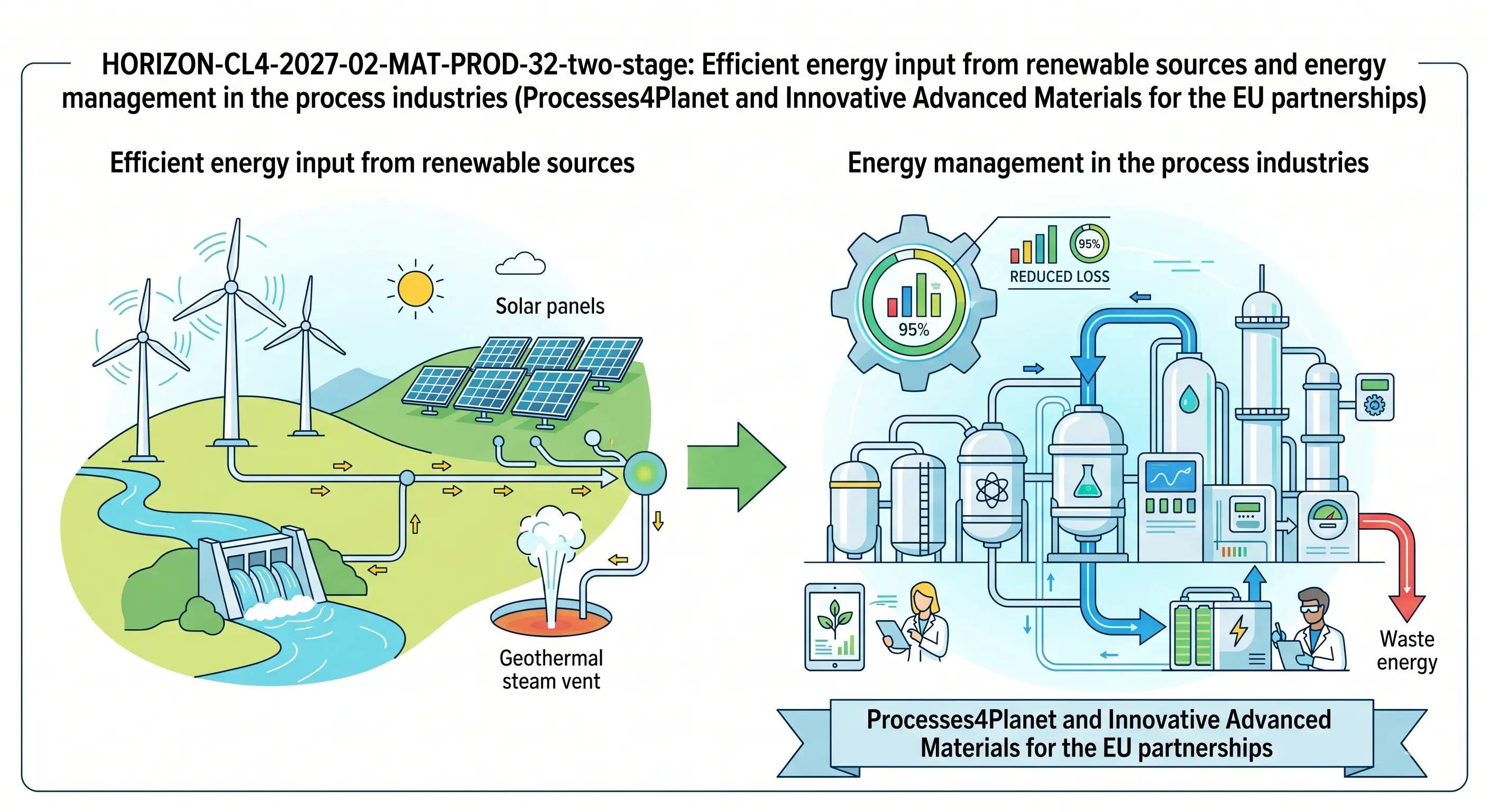
HORIZON-CL4-2027-02-MAT-PROD-32-two-stage: Efficient energy input from renewable sources and energy management in the process industries (Processes4Planet and Innovative Advanced Materials for the EU partnerships)
Funded projects should provide tested pilot-scale systems for industrial heat supply by renewable means and achieve at least a 20% reduction in greenhouse gas emissions. The Commission seeks technologies that use real sites rather than laboratory-scale ones. On top of that, it anticipates tangible means of coping with energy flows amid fluctuations in the renewable electricity grid.
Download the MIC Horizon Europe 2026/2027 Calls Calendar:
Discover more!
Administrative facts: what do we know about the HORIZON-CL4-2027-02-MAT-PROD-32-two-stage call?
Which call is it, and when is the opening and the deadline?
- Call name: HORIZON-CL4-2027-02-two-stage (INDUSTRY-two-stage)
- Topic identifier: HORIZON-CL4-2027-02-MAT-PROD-32-two-stage
- Destination: Leadership in materials and production for Europe
- Topic: Efficient energy input from renewable sources and energy management in the process industries
- Opening date: 22 September 2026
- First-stage deadline: 2 February 2027 (blind evaluation)
- Second-stage deadline: 2 September 2027
- Type of action: Research and Innovation Action (RIA)
What about the budget and estimated size of the project?
- Total indicative budget for this topic: EUR 52.5 million
- Indicative number of projects funded: 6
- Expected EU contribution per project: EUR 7 to 9 million
- Funding form: lump sum
What are the key eligibility and evaluation conditions?
- First-stage proposals evaluated blindly: no organization names, acronyms, logos or personnel names in the abstract or Part B of the first-stage application
- TRL entry: 4-5; TRL target at project end: 6-7
- The page limit in Part B was extended by 3 pages at the second stage to accommodate the mandatory business case and exploitation strategy.
- Chinese universities linked to the MIIT ministry are not eligible.
- Implements the Processes4Planet and Innovative Advanced Materials for the EU co-programmed European Partnerships
- GHG avoidance methodology recommended, with detailed baseline descriptions
Scientific range: what does the Commission expect from the HORIZON-CL4-2027-02-MAT-PROD-32-two-stage grant?
What outcomes are expected?
Funded projects should deliver validated pilot-scale systems for industrial heat supply from renewable sources, with measurable greenhouse gas reductions of at least 20%. The Commission wants technologies that work on real sites, not just lab-scale setups. On top of that, it expects concrete tools to manage energy flows in the face of the variability of the renewable electricity grid.
What is within scope?
- Industrial heating Electrification: resistive and induction heating, electric boilers, high temperature processes powered by electricity, high voltage electricity.
- Hybrid power systems that gradually reduce reliance on fossil fuels in areas where complete electrification is not feasible.
- Preheating systems based on solar thermal, geothermal and heat pump.
- Phase change materials, chemical heat carriers, high-temperature thermal storage beyond e-fuels: energy storage technologies.
- Scale-based heat capture, storage, and insulation using innovative advanced materials and reducing the use of critical raw materials.
- A combination of energy management systems between production and renewable supply.
- Lab demonstrations on actual industry locations.
Nor in scope: demand-side management purely, through adjusting production schedules to the availability of electricity. Scheduling workarounds is not what the Commission desires but technology-level solutions. That is clearly delineated.
What are the specifically proposed research directions?
- Enhancing productivity and introducing renewable energy in manufacturing operations, with quantifiable CO2 savings throughout the entire system.
- Combined energy systems with new storage components that would level out fluctuations in renewable supplies.
- Solutions: Low to medium temperature (100 to 500 °C): hybrid solutions, heat upgrading, gradual fossil phase-out.
- High-temperature (greater than 500 °C): electrified operations and high-temperature thermal storage.
- Heat storage and insulation materials, which were originally developed to be scaled and recycled.
Scientific strategy: how can you enhance your chances of being funded through HORIZON-CL4-2027-02-MAT-PROD-32-two-stage?
What scientific choices matter most?
- Prove a 20% GHG cut using a plausible baseline. The employment plan is clear. Any suggestion that cannot be measured persuasively will not pass the review.
- Design intermittently, at the outset. The evaluators will indicate proposals that consider renewable fluctuation as a minor issue. It is the engineering issue at the center of this call.
- Do not pursue full electrification when it is not feasible for your industry. The hybrid solutions are more than welcome. They are likely the more plausible way in a number of process industries.
- Relate materials invention to implementation early. If your proposal includes new storage or insulation materials, demonstrate how they can be designed and used. Scalability and industrial requirements should not be an afterthought; they should be incorporated into the design phase.
- Incorporate an actual industrial facility. The computation is open-loop, and actual work on-site is desirable. The difference is familiar to the reviewers.
- Be ready to compile the exploitation plan early, prior to the second-stage submission. The additional pages are there for a purpose.
Consortium & proposal-writing plan: what works best with this type of call?
- Two-stage submission refers to two bites. At the first stage, the evaluation is blind. Take out all the names of the organizations, the acronym, logo, and the names of the staff in the abstract and part B. This is an ensnarement of more consortia than you’d have thought.
- Target between ten and fourteen partners. Process industries include chemicals, steel, cement, and glass – you most likely require sector breadth and geographic spread.
- Industrial partners with actual locations are virtually a choice requirement. Acquire at least two who can conduct pilot demonstrations.
- Academia is a field that deals with materials science and modeling energy systems. You have to have the two sides.
- Incorporate a new SME with expertise in thermal management or energy storage. When the role of an SME is decorative rather than substantive, evaluators will be aware of this.
- This call refers to both co-programmed partnerships (Processes4Planet and IAM to the EU). If the consortium partners are already operational in these partnerships, that should be mentioned.
- If you have never engaged in these partnerships, the first thing you should do is probably find out who has.
How would microfluidics contribute to this topic?
Traditional lab systems are slow when screening new phase change materials or chemical heat carriers under operating conditions. Each experiment produces a single data point, and project cycles do not align with the timelines. Microfluidic systems alter it. It is possible to execute hundreds of formulations under thermal gradients that a chip can control in the time it takes a traditional device to run one trial.
- You would like to understand whether a new phase-change material will remain stable through hundreds of thermal cycles before you are willing to invest in kilogram-scale production. A microfluidic cycling system provides you with that in a few days. Such a speed of iteration is even within the project’s schedule.
- You can use microfluidic high-throughput screening by your materials group to down-select among large collections of insulation candidates prior to any pilot-scale work. Quick and less expensive than the traditional characterization.
- Flow-based platforms. The thermal interface properties and heat transfer coefficients at the small scale are well characterized by flow-based platforms and directly guide the selection of materials for scale-up.
- The microreactor modules can be used to determine chemical heat carrier reaction kinetics, decomposition limits, and reversibility under realistic operating conditions, thereby eliminating unexpected behavior during the pilot stage.
In the case of a consortium dealing with HORIZON-CL4-2027-02-MAT-PROD-32-two-stage, the Microfluidics Innovation Center can facilitate the materials characterization and pre-pilot validation steps, which the Commission is requesting directly in the scope. The ability to evaluate in that manner in the team makes your proposal more credible on the materials-to-deployment pipeline, which is a well-defined evaluator focus in this call.
The MIC already brings its expertise in microfluidics to Horizon Europe:
H2020-NMBP-TR-IND-2020

Microfluidic platform to study the interaction of cancer cells with lymphatic tissue
H2020-LC-GD-2020-3

Toxicology assessment of pharmaceutical products on a placenta-on-chip model

About the author

Céleste Chidiac, PhD
Scientific writer and digital marketing specialist
Céleste Chidiac holds a doctorate in neuroscience and molecular biology from the University of Strasbourg. Since joining the Microfluidics Innovation Center in 2023, she has combined scientific writing with website management. For MIC’s Horizon Europe topic pages, she draws on her research background to explain scientific challenges and clarify funding priorities. Her writing helps prospective applicants understand each topic’s scope, expected outcomes and research directions.
FAQ – HORIZON-CL4-2027-02-MAT-PROD-32-two-stage
So what is it that this call is all about?
This call targets European process industries (chemicals, steel, cement, glass and similar) that need to decarbonise their heat supply through renewable sources. Researchers in materials science, energy systems engineering, thermal storage and process engineering will fit naturally. Industrial actors with real production sites are essential, since the Commission wants pilot demonstrations on actual sites rather than lab-scale work.
Who is supposed to apply and how much money is available?
Two-stage means there are two distinct submissions. The first stage is shorter and evaluated blindly, with no organisation names or logos visible to evaluators. If selected, you submit a full second-stage proposal by 2 September 2027. The second stage gets three additional pages in Part B for the business case and exploitation strategy.
What are the infections that are in scope?
Hybrid power systems are explicitly within scope. The Commission accepts that complete electrification is not always feasible for high-temperature processes. Hybrid approaches that gradually phase out fossil fuels are welcome and probably more credible for many process industries.
Which four outcomes are the evaluators really seeking?
Two ranges. Low to medium temperature (100 to 500 °C) calls for hybrid solutions, heat upgrading and gradual fossil phase-out. High-temperature (above 500 °C) needs electrified operations combined with high-temperature thermal storage. Both ranges are explicitly addressed.
In what way ought we to arrange the scientific work intelligently?
A GHG avoidance methodology with detailed baseline descriptions is recommended. Your baseline must be plausible and the calculation transparent. Vague claims will not survive review. The reduction is measured at system level, accounting for the full process the technology serves.
What is the microfluidics value-added in this case?
Pure demand-side management is explicitly out of scope. Scheduling production to renewable availability is not what the Commission wants here. The call is after technology-level solutions: actual hardware, materials, and integration architectures.
What is the true competition of a consortium?
Two co-programmed partnerships: Processes4Planet and Innovative Advanced Materials for the EU. If your consortium already includes partners active in either partnership, flag it. If not, identifying who in your network is engaged is one of the first useful moves.
What is strictly in and out of scope?
At first stage you remove every trace of organisational identity from your abstract and Part B. No names of institutions, no acronyms, no logos, no staff names. Many consortia get caught here because the practice is not standard across calls.
What are the pitfalls that usually destroy Health RIA proposals?
TRL 4 to 5 at project start, TRL 6 to 7 at project end. The work moves from validated lab components to pilot demonstrations on real industrial sites. Bring partners who can host that progression credibly.
What do timelines and milestones show in terms of credibility?
An SME with hands-on engineering capability strengthens both credibility and execution. For materials characterisation, thermal screening and pre-pilot validation, an experienced microfluidics SME like the Microfluidics Innovation Center can provide concrete value rather than decorative participation. Evaluators read role descriptions carefully.