Tips & Tricks for a successful HORIZON-CL6-2027-02-CLIMATE-01-two-stage proposal
Opening
04 February 2027
Deadline
Keywords
sustainable industry
Water Resilience Strategy
waste water
circular water
ecosystem restoration
Water-smart economies
Multi-actor approach
IA
Your microfluidic SME partner for Horizon Europe
We take care of microfluidic engineering, work on valorization and optimize the proposal with you
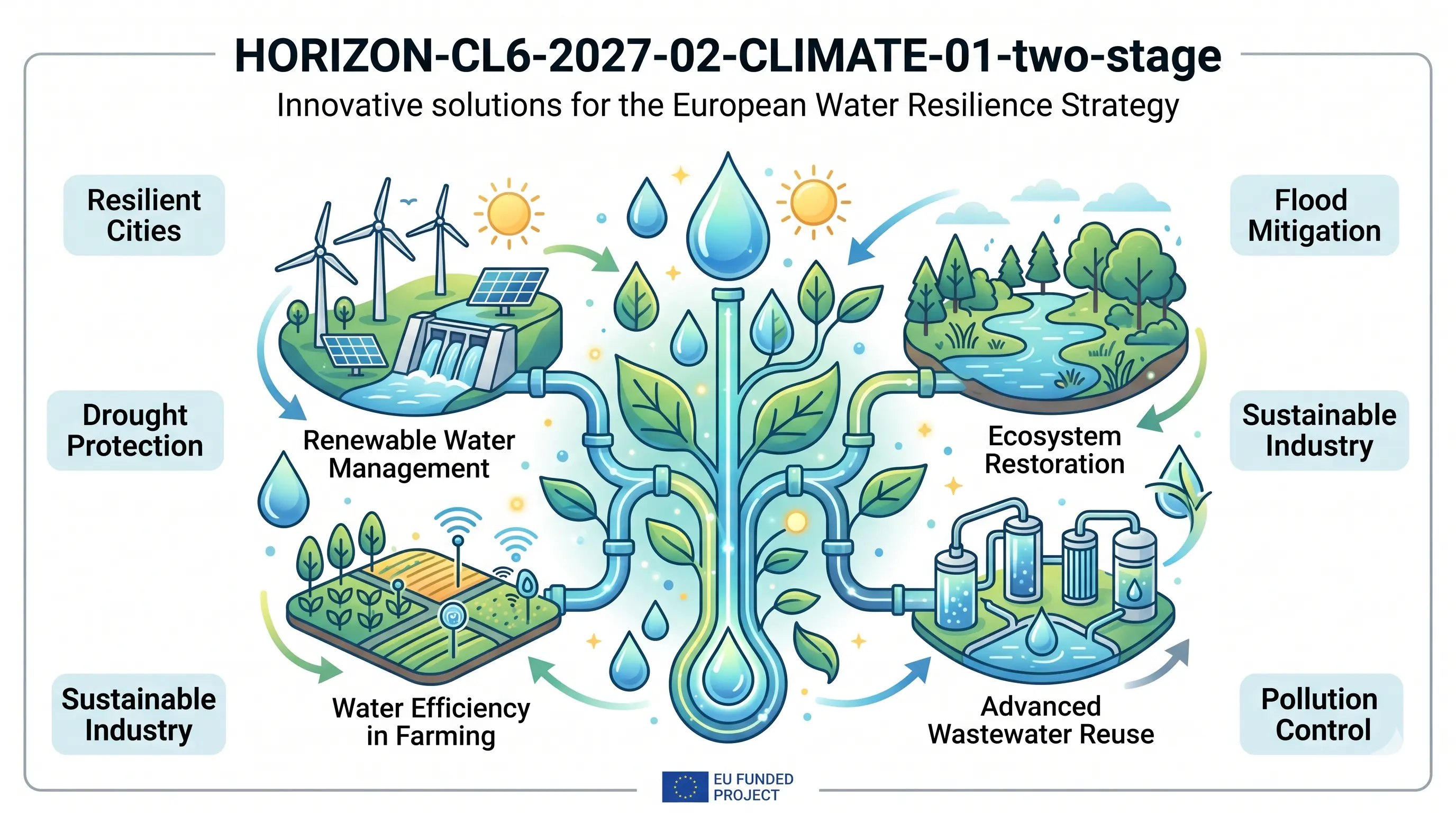
HORIZON-CL6-2027-02-CLIMATE-01-two-stage: Open topic: Innovative solutions for the European Water Resilience Strategy
The Commission has embraced the European Water Resilience Strategy and is now interested in funding projects that would put it into practice. Do not analyze it. Do not map it. Implement it. This is a free subject, meaning it is mostly up to the applicant to frame scientifically, but the three strategic pillars of the Strategy provide a hard point for each proposal. Two projects will be chosen from a large field, so it is not possible to choose based on innovation ambition.
Download the MIC Horizon Europe 2026/2027 Calls Calendar:
Discover more!
Administrative facts: what do we know about the HORIZON-CL6-2027-02-CLIMATE-01-two-stage call?
Which call is it, and when is the opening and the deadline?
- Call name: Call 02 – two-stage (2027)
- Call identifier: HORIZON-CL6-2027-02-two-stage
- Topic: HORIZON-CL6-2027-02-CLIMATE-01-two-stage
- Destination: Land, ocean and water for climate action
- Opening date: 04 February 2027
- Deadline: first stage: 08 April 2027
- Deadline, second stage: 14 September 2027
- Type of action: Innovation Action (IA)
What about the budget and estimated size of the project?
- Overall budget for this topic: €11.00 million
- Indicative number of projects: 2
- Budget per project: around €5.50 million
What are the key eligibility and evaluation conditions?
- General thresholds apply as per General Annex D
- A multi-actor approach is a mandatory eligibility requirement; proposals that do not apply it will be deemed ineligible.
- JRC may participate as a beneficiary with zero funding or as an associated partner; JRC does not participate in proposal preparation
- First-stage proposals are evaluated blindly: no organisation names, acronyms, logos, or staff names in the abstract or Part B at stage one (worth checking twice)
- Lump sum funding rules apply under General Annex G
- If satellite data is used, Copernicus and/or Galileo/EGNOS must be the primary source
- Proposals must include a specific task for cross-project collaboration with other funded projects under this topic
- Legal entities established in China are not eligible
Scientific range: what does the Commission expect from the HORIZON-CL6-2027-02-CLIMATE-01-two-stage grant?
What outcomes are expected?
The Commission desires projects that would transform the European Water Resilience Strategy on paper to practice. At the conclusion of the project, there ought to be something proven to work: a restored water cycle in a specified territory, a water-sensitive economic framework tested with real industries, or a tangible mechanism that makes clean water more accessible and affordable. The Commission is not seeking generic frameworks and policy recommendations in this case.
What is within scope?
It is a broad subject, pegged to three strategic pillars. The proposals can be related to one or more of the following ways:
- Recycling the water cycle: retention of groundwater, renaturalization of rivers, agriculture that uses less water, source-to-sea management, drought and flood warning systems.
- Water-smart economies: water efficiency by sector, pricing systems, certification systems, digital and technological systems of water services, reuse of water circles and applications of potable water.
- Providing clean and affordable water to everyone: the systems of participation of the population, the equal access of vulnerable populations, the approaches to water footprint based on consumption processes.
Suggestions that encompass more than one action do not require creating connections among them when they do not occur naturally.
What are the specifically proposed research directions?
The intentionally open work program here provides you with greater freedom than most calls. With that being said, the implied priorities can be read quite well:
- Demonstration, testing or validation of the solutions: not desk research; the Commission wants actual demonstration of concept.
- Upscaling pathways: solutions are to be proposed for how they move from local pilots to national or EU levels.
- Reuse of water and circular water applications such as in cases of potable reuse where it is technically feasible.
- Electronic water monitoring, control, and pricing.
- Hydrological systems that share data across the borders.
Scientific strategy: how can you enhance your chances of being funded through HORIZON-CL6-2027-02-CLIMATE-01-two-stage?
What scientific choices matter most?
- Either choose one pillar and dive in, or connect two pillars and make it real and practical. Proposals that attempt to hit all three with no logical thread are likely to have a lower score on ambition.
- Frame deployment barriers, not performance technology. Evaluators are given answers to the questions of why this solution has not scaled yet and how we are going to fix that, and not a list of features.
- Have at least one real live demonstration site. The TRL progression of Innovation Actions will be approximately 4 to 6 at the project completion (confidence: based on IA norms; check on the portal).
- Develop the upscaling story. The Commission explicitly requests plans on future uptake on local, national and EU level. Do not regard this as a concluding book. It must influence the entire proposition.
- Where necessary, use Copernicus data. Proposals that combine Earth observation signals to monitor or provide early warning are likely to do better in this destination.
- Incorporate gender and intersectional aspects as far as your solution touches on the access to water or the involvement of the population. It is not mandatory unless there is a reason to do so, but relevant more frequently than the applicants suppose.
Consortium & proposal-writing plan: what works best with this type of call?
- It is likely that ten or fifteen partners will be the ideal number for an IA at this budget level, perhaps one or two more if you are dealing with multiple pillars.
- The hard eligibility requirements include the multi-actor requirement. Establish this into the building at the day one: the farmers, water managers, local authorities and industries should be more than advisory. They must be working partners with practical activities.
- Incorporate an innovative SME. Water technology SMEs are able to offer product-level credibility which cannot be offered by a research institute and evaluators are aware of the difference.
- Academic hydrologists and environmental engineers are the scientific heart of the back bone, but the proposal requires somebody who is aware of water governance and economics. The social science capacity is not an option here.
- Write stage one proposal blindly. This is what catches people off guard there are no names, no logos, no recognizable acronyms in the abstract nor Part B at the stage one.
- The open topic format is a two-edged sword. There is greater space to construct the scientific narrative, but it also implies that evaluators are framing your work right against that of your competitors. Be a judgmental person on why and why now you are solving this problem.
How would microfluidics contribute to this topic?
Traditional water quality management is based on centralised labs, protracted sample-to-result turnaround times and equipment that is more expensive to maintain than is affordable to many small municipalities. Fluidic systems that are miniaturised eliminate that dependency. They take analysis up to the location of the water.
- Detection of contaminants at the point of sampling. Lab-on-chip systems have the capability of identifying pesticides, micropollutants, heavy metals and the emerging contaminants in ground water or river water within minutes. Your consortium will not require a portable laboratory. A field cartridge and a smartphone interface can take you 90 percent of the way.
- Suppose you would like to prove the idea of circular potable water reuse in a pilot city. To control the treated water, you must compare it in real time at various points in the distribution system to a shifting contaminant profile. Conventional sensors fail to capture highs. Microfluidic sensors don’t. That is the common-sense argument.
- Water pricing and water efficiency indicators require sound consumption and quality information. Distributed microfluidic sensors can supply that data at a fixed point of monitoring which cannot be supplied by granular data.
- Equity pillar: low-cost, portable field sensors based on microfluidic principles can be used to measure the quality of drinking water in under-resourced communities, rural locations, or post-flood emergency response situations where there is no laboratory facility present.
MIC has a track record of building microfluidic sensors to monitor environmental and water matrices, making it a tangible technical actor in any proposal that aims to address any of the three Strategy pillars. In the event that your consortium is constructing a water monitoring/treatment demonstration as part of this call, microfluidics should be included in the technical workpackage.
The MIC already brings its expertise in microfluidics to Horizon Europe:
H2020-NMBP-TR-IND-2020

Microfluidic platform to study the interaction of cancer cells with lymphatic tissue
H2020-LC-GD-2020-3

Toxicology assessment of pharmaceutical products on a placenta-on-chip model

FAQ - HORIZON-CL6-2027-02-CLIMATE-01-two-stage
So what is HORIZON-CL6-2027-02-CLIMATE-01-two-stage really about?
It is an Innovation Action for Cluster 6 to develop the European Water Resilience Strategy into applications. The Commission does not want a report or another mapping exercise. It wants something to be operational at the end of the project in some territory, delivering on one or more of the Strategy pillars.
Who can apply and what is the budget per project?
The destination follows the General Annex B with two additional requirements, including a multi-actor approach and a prohibition on legal entities in China (for this destination). The topic has a budget of €11.00 million, with funding for two projects at approximately €5.50 million each.
Which three pillars of the Water Resilience Strategy can my proposal address?
This can be one or more of: Restore the Water Cycle (groundwater retention, river renaturalisation, source-to-sea), Water-smart economies (efficiency, pricing, reuse, digital), and Clean and affordable water for all (equitable access, public engagement, water footprint). There’s no need to artificially link pillars in your proposal if it addresses more than one.
What does blind evaluation at stage one actually mean?
At first stage your abstract and Part B should not contain names, acronyms, logos or staff names. Consortia are frequently tripped up by acronyms in titles of projects or on figures. Double-check before you submit. Check the Funding and Tenders Portal for more information.
Why is the multi-actor approach mandatory and how do I implement it?
The Commission wants the solution’s end users and managers to be involved in its development. Farmers, water managers, local authorities, water-intensive industries: not as consultants, but with budget and hands-on work. No partners, no proposal.
What kind of demonstration is the Commission expecting?
Demonstration, testing, or validation in practice. Typically, the TRL of an IA is 4 to 6. Proposals based purely on modeling or desk studies, or only a literature review, will not be considered.
Where does microfluidics actually fit in this call?
Wherever the proposal needs real-time water-quality data on site: pesticide and micropollutant sensors, potable reuse safety monitoring, distributed monitoring for pricing and efficiency models and low-cost sensing in the disadvantaged world. The MIC can deliver microfluidic sensors as a technical demonstration.
What is in scope and what is out?
In scope: solutions that can be deployed, and linked to one or more of the Water Resilience Strategy pillars – with demonstration. Out: general policy frameworks, mapping studies, or desk studies with no validation. Out too: any role for legal entities in China.
What pitfalls should we avoid in our proposal?
Three we see often: trying to cover all three pillars without a real thread, viewing the upscaling plan as an afterword, and forgetting that phase one is blind. A fourth: inviting stakeholders just as advisory board members. That breaks the multi-actor rule.
How do upscaling plans influence the evaluation?
The work program explicitly asks for plans on future uptake and upscaling at local, national, and EU levels. Evaluators read this against the rest of the proposal, so the upscaling logic must shape the work plan, not just the impact section.