
Tips & Tricks for a successful HORIZON-CL5-2027-03-D5-05 proposal
Opening
15 December 2026
Deadline
Keywords
Modular battery
high voltage
2ZERO Partnership
Heavy Duty Vehicles
modular powertrain
Megawatt Charging System
Electronic infrastructures
Your microfluidic SME partner for Horizon Europe
We take care of microfluidic engineering, work on valorization and optimize the proposal with you
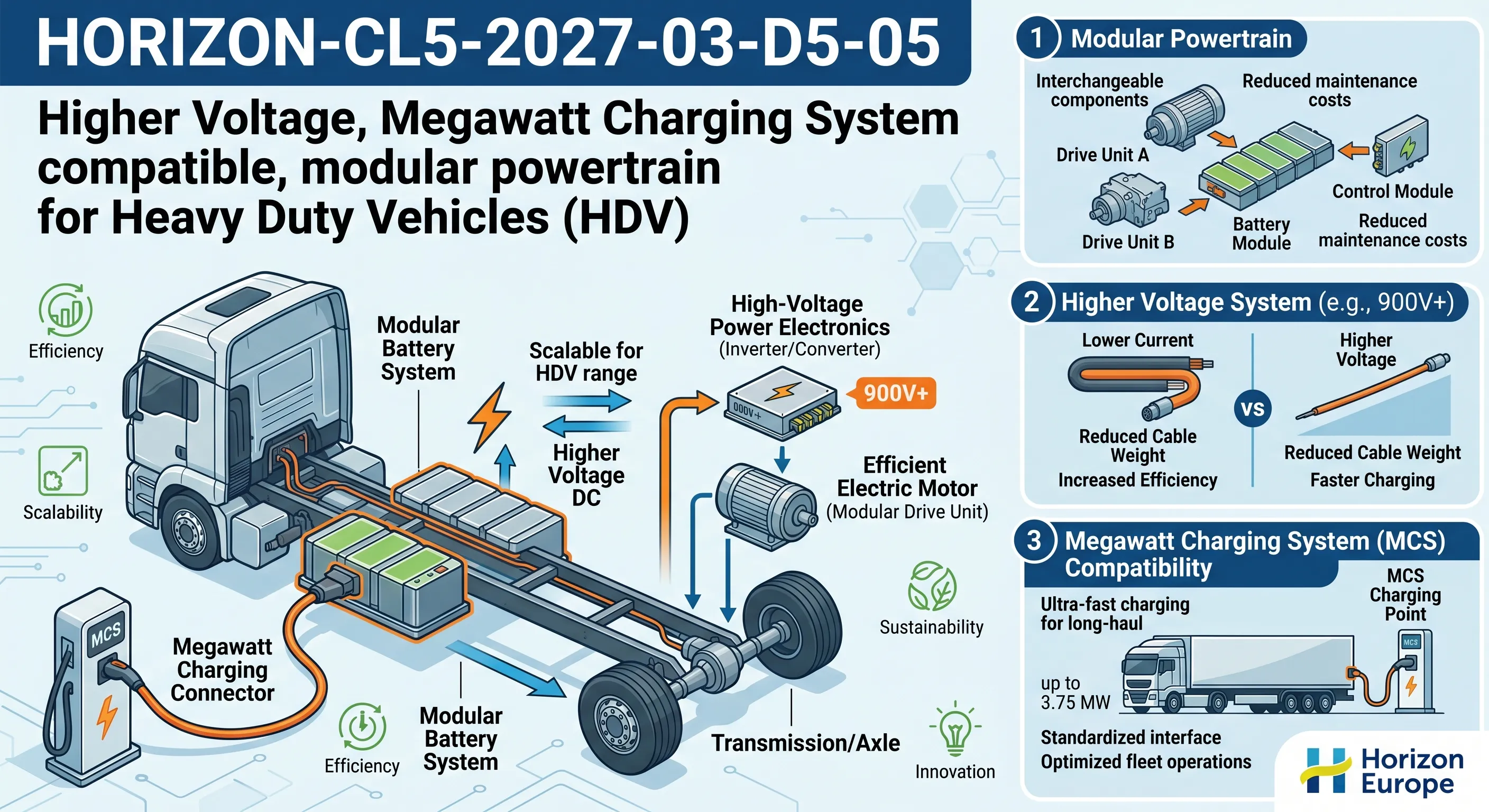
HORIZON-CL5-2027-03-D5-05: Higher Voltage, Megawatt Charging System compatible, modular powertrain for Heavy Duty Vehicles (HDV) (2ZERO Partnership)
The Commission is interested in high-voltage powertrain designs that will actually reduce the cost of heavy-duty electric trucks and make Megawatt Charging Systems practical. This is not a case of minimal additions to already existing 800 V platforms. It is all about going beyond that voltage point, showing modularity between vehicle segments, and showing that it is possible to charge faster at a smaller loss at scale.
Download the MIC Horizon Europe 2026/2027 Calls Calendar:
Discover more!
Administrative facts: what do we know about the HORIZON-CL5-2027-03-D5-05 call?
Which call is it, and when is the opening and the deadline?
- Call name: MOBILITY
- Call identifier: HORIZON-CL5-2027-03
- Destination: Clean and competitive solutions for all transport modes
- Topic: HORIZON-CL5-2027-03-D5-05
- Opening date: 15 December 2026
- Deadline: 14 April 2027
- Type of action: Innovation Action (IA), lump sum funding
What about the budget and estimated size of the project?
- Overall budget for this topic: EUR 16.00 million
- Number of projects expected to be funded: 2
- Budget per project: around EUR 8.00 million
What are the key eligibility and evaluation conditions?
- Standard Horizon Europe eligibility (General Annex B)
- TRL 7 expected by end of project; activities may start at any TRL
- If satellite-based data is used, Copernicus and/or Galileo/EGNOS must be included
- Subject to restrictions for the protection of European communication networks
- IP restriction: the granting authority may object to transfer of ownership or exclusive licensing of results up to 4 years after the end of the action
- Part of the co-programmed 2ZERO Partnership; projects must report on 2ZERO KPIs
Scientific range: what does the Commission expect from the HORIZON-CL5-2027-03-D5-05 grant?
What outcomes are expected?
The Commission seeks to show evidence that exceeding 800 V in fact operates effectively with heavy-duty vehicles, not only in cost saving, but also in flexibility. At the project conclusion, you were expected to demonstrate that it is possible to integrate modular high-voltage powertrain systems with various vehicle types in the commercial sector, that losses during the charging process within the vehicle are reduced by at least 10%, and that the entire system can be used with Megawatt Charging Systems. Not a paper study. Actual automobiles in actual surroundings.
What is within scope?
- Architectures of powertrains Post-800 V that were designed on efficiency, affordability, performance, and MCS compatibility.
- Modular powertrain systems are used to provide customized applications and maintain a degree of flexibility to wider applications, such as specific hardware and software interfaces.
- Removable and modular battery systems that have the potential to allow second-life uses.
- Standardized system designs in an effort to economize on scale and increase component life cycles.
- Interaction with novel Electrical/Electronic (E/E) infrastructures and thermal administration plans.
- The analysis of life-cycle cost in relation to past low voltage systems.
- Relevant environment (not laboratory only) demonstration.
What are the specifically proposed research directions?
- Raise voltage to more than 800 V to determine the optimal position on the curve between efficiency, cost and compatibility with MCS and a quantified 10% drop in vehicle-side charging losses.
- Show the advantage of high-voltage platforms to auxiliary components (thermal management is the one the Commission continues to refer to, and modular interchangeability is one feature of it)
- Design and exhibit modular powertrain structures in a range of applications, not only to one type of truck but applicable to the HDV segment.
- Consider the possibility of opening second-life pathways with removable battery modules, a step toward the goal of a circular economy.
Scientific strategy: how can you enhance your chances of being funded through HORIZON-CL5-2027-03-D5-05?
What scientific choices matter most?
- The Commission specifically requests an optimum level, or in other words, you have to explain why your determined voltage would be the one that is the sweet spot in terms of safety, efficiency and cost. Those reviews will see whether you omit such an analysis.
- Modularity must have a connotation. Specify the interfaces, software and hardware. Any proposal that simply refers to the powertrain as modular without specification of the plugs into the plugs will not do well.
- It should include a life-cycle cost comparison with existing 800 V systems. It is directly requested in the work programme. We have seen suggestions evade this and miss on hitting.
- Showcase in the pertinent settings. The objective is TRL 7. It will not suffice to have lab prototypes only.
- MCS compatibility is not voluntary. You have to make your charging demonstration out of it, not as an appendix.
- Even though they may not be the primary focus of the proposal, the considerations that apply to second-life batteries should be mentioned at the beginning of the proposal. It is discussed by the Commission, and neglecting it entirely would create a vacuum.
Consortium and proposal-writing plan: what works best with this type of call?
- Achieve around 8 to 12 partners or so. Funding will be made on two projects and hence the competition will be stiff yet not impossible.
- An HDV OEM or Tier 1 supplier (at least one of them) is required; otherwise, the demonstration component is not convincing. The better the modularity argument is, the more two OEMs that are in different segments of the vehicle.
- Inclusiveness of a power electronics specialist, ideally a specialist with high-voltage automotive experience. A creative SME that has a particular understanding of MCS interfaces or thermal control would give the consortium an extra boost and introduce the flexibility that big partners may lack at times (this one surprises people during evaluation).
- This is enhanced by a research institute or university in the design and life-cycle cost assessment of the E/E architecture. Do not stuff the consortium with academia though.
- As long as you have a charging infrastructure provider in your consortium, it will assist in making the MCS demonstration credible without the need to rely on the third-party availability.
- Prepare the impact section concerning a reduction in cost of the European HDV industry. The reviews react to specific numbers on the TCO improvement, rather than vague decarbonisation statements.
How would microfluidics contribute to this topic?
At voltages over 800 V and Megawatts of Charging, thermal control ceases to be an incidental consideration. It turns out to be the bottleneck in the engineering. The traditional cooling loops with large size heat exchangers have difficulties in extracting the heat at these power levels, particularly when there is an MCS fast-charging session where thermal peaks are brief but intense.
- Your power electronics reached 60 °C in less than four minutes when charging 1 megawatt. A cold plate microfluidic device, which has channels less than a millimeter long, pulls out that heat at the point of origin, prior to its distribution to other elements. Footprint, about three times the cooling density.
- Battery modules that will be used in second-life must have uniform thermal histories. The pack has microfluidic cooling that maintains the difference in temperature between cells at a few degrees. The thermal profile is identical in all the cells and that is precisely what increases the cycle life as well as resale value.
- In the case of a modular powertrain, a modular cooling system must be used. Microfluidic thermal management units can be developed as self-contained units that will be connected and unconnected to the powertrain module itself. Each vehicle variant does not have any custom plumbing.
- Busbars and connectors used in high voltages produce heat at contact. That is done locally by microfluidic channels that are incorporated into the busbar structure, but does not increase the weight or volume of the system.
Microfluidics will not be mentioned in the work programme text, whereas thermal management is, over and over again. Then your proposal is further reinforced as you are able to demonstrate to the evaluators that you have a cooling architecture that is scaling with voltage and charging as fast as MCS will permit them to be. This is what this technology provides to a HORIZON-CL5-2027-03-D5-05 consortium.
The MIC already brings its expertise in microfluidics to Horizon Europe:
H2020-NMBP-TR-IND-2020

Microfluidic platform to study the interaction of cancer cells with lymphatic tissue
H2020-LC-GD-2020-3

Toxicology assessment of pharmaceutical products on a placenta-on-chip model

About the author

Julia Sepulveda Diaz, PhD
Chief Executive Officer, Microfluidics Innovation Center
Julia holds a PhD in glycobiology and neurobiology from Université Paris-Est Créteil. Before moving into microfluidics, she spent several years as a postdoctoral researcher at the Paris Brain Institute, on Parkinson’s disease, neuroinflammation, and the role of heparan sulfate in protein aggregation. Today she leads the Microfluidics Innovation Center as CEO, steering its researchers and engineers and its collaborative research and innovation projects.
FAQ – HORIZON-CL5-2027-03-D5-05
What is the HORIZON-CL5-2027-03-D5-05 topic about?
HORIZON-CL5-2027-03-D5-05 aims at creating and testing higher voltage (above 800 V) and Megawatt compatible Charging System, modular powertrains on Heavy Duty Vehicles. The Commission desires integration potential, modularity, and demonstration that fast charging can scale, not laboratory prototypes.
What type of action and budget does this call use?
It is an Innovation Action (IA) that is lump sum funded. The overall budget of the topic is EUR 16.00 million and two projects should be financed, meaning that each project will have approximately EUR 8.00 million.
When does the call open and when is the deadline?
The call is open from 15 December 2026 to 14 April 2027 at 17: 00 Brussels time. It is one stage submission.
Who should coordinate a proposal under this topic?
The appropriate profile is a coordinator that has a high level of experience in HDV powertrain-integration and management of European consortiums. This role can be credibly played by a Tier 1 supplier or a research institute supported by an industrial co-leader.
What is the required Technology Readiness Level?
Are there restrictions on participating entities?
The rules of Standard Horizon Europe are applicable (General Annex B). The subject also has limitations to safeguard the European communication networks. When you rely on services with satellites, you need to depend on Copernicus and/or Galileo/EGNOS.
Why is Megawatt Charging System (MCS) compatibility so important?
The only viable line of action to charge heavy-duty trucks at an accelerated rate is MCS, and within a manageable time frame. The Commission requests a 10% cut in vehicle-side charging losses and complete compatibility with hardware, thus MCS preparedness is no longer a choice.
How does this topic connect to the 2ZERO Partnership?
The subject puts into practice the co-programmed 2ZERO Partnership. Projects should report 2ZERO KPIs and abide by the Partnership roadmap of zero emission road transport.
How can microfluidic thermal management strengthen a proposal?
Conventional cooling is challenged at post-800 V and at charging power levels in the megawatt range. Microfluidic cooling removes heat from the source with significantly greater density, ensures uniform temperature across battery cells, and enables modular integration of powertrains without custom plumbing per variant.
Why include an innovative SME like MIC in the consortium?
A new SME offers agility, particular technical know-how (in microfluidic thermal management, say), and a plausible exploitation route. Assessors are positively oriented towards consortia which integrate big industrial players and agile partners.