Tips & Tricks for a successful HORIZON-CL4-2026-02-MAT-PROD-21-two-stage proposal
Opening
16 December 2025
Deadline
Keywords
toxicology testing
substances of concern
alternatives
SSbD framework
sustainable materials
value chain
chemical substitution
Ecodesign Regulation
IA
Your microfluidic SME partner for Horizon Europe
We take care of microfluidic engineering, work on valorization and optimize the proposal with you
HORIZON-CL4-2026-02-MAT-PROD-21-two-stage: Development of safe and sustainable alternatives to substances of concern - Stage 2 preparation
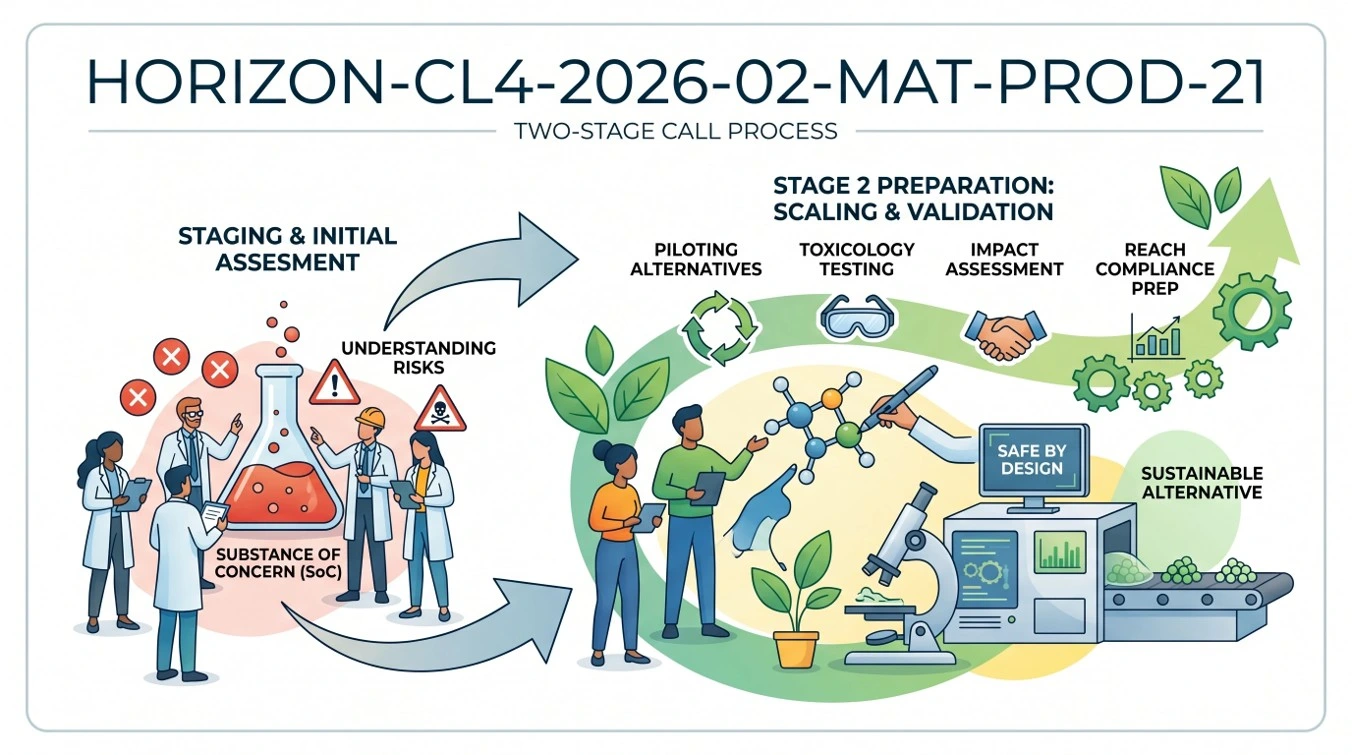
Stage 1 closed on 17 March 2026. Suppose your consortium has delivered, by today, until 13 October 2026 you have to transform a short, anonymous concept note into a full, assessable proposal. Stage 2 is another exercise. The blind assessment rule is eliminated. There are three criteria which are fully weighted. The Commission envisions a fully detailed replacement program, a demonstrative power of at least one industrial sector, and implementation plan that will not fall apart on scrutiny. Six months would be nice. It is not, especially, when industrial pilot access, SSbD evidence, and a plausible business case have to be locked down before you write a word of Part B.
Download the MIC Horizon Europe 2026/2027 Calls Calendar:
Discover more!
Administrative facts: what do we know about the HORIZON-CL4-2026-02-MAT-PROD-21-two-stage call? What changes at Stage 2?
Key Stage 2 dates and conditions
- Stage 2 deadline: 13 October 2026
- Budget per project: EUR 6.00 to 7.50 million
- Total available: EUR 38.00 million for approximately 6 projects
- Type of action: Innovation Action (IA)
- The blind evaluation rule no longer applies: organisation names, acronyms, logos, and personnel names can now appear throughout the proposal
- TRL target: entry at TRL 5, exit at TRL 7 by end of project
- Lump sum funding applies
- Page limit extended by 3 pages in Part B to accommodate the mandatory business case and exploitation strategy
- JRC may now be formally named as a beneficiary with zero funding or as associated partner – it could not participate in Stage 1 preparation
- Transfer or exclusive licensing of results: granting authority may object up to 4 years after project end
- Important restriction: legal entities established in China are not eligible for this topic
What the Stage 2 evaluation covers
- Three criteria: Excellence, Impact, Implementation – all three scored, all three thresholds must be met
- Implementation now carries full weight: work plan coherence, team track records, partner roles, and budget allocation are all scored
- Read your Stage 1 Evaluation Summary Report line by line before writing a single word of Stage 2
Scientific range: what does the Commission expect from the HORIZON-CL4-2026-02-MAT-PROD-21-two-stage grant?
What outcomes are expected?
The Commission wants safer, cleaner substitutes to substances of concern that are in reality within industry by the end of the project, not simply in a report. Their requested innovation cycle involves (re)design, modification of production processes, to the incorporation into real manufactured products. The expected results are regulatory cost saving, supply chain security, and a believable journey under the Safe and Sustainable by Design framework, rather than aspirations.
What is within scope?
- New chemical substance, new advanced materials, or technologies that must be used instead of the existing substance of concern (SoCs) as outlined in the Ecodesign for Sustainable Products Regulation
- Major target areas: energy, mobility, building, electronics, technical textiles, and medical equipment. One or more of these should be the subject of proposals
- Developments of related processes and technology required to integrate the alternative in the current or modified industrial manufacturing lines
- Recognition of substitution obstacles in the selected application and value chain, and tangible mechanisms to address them
- Indication of evident use case, rational market and expansion possibility of the proposed alternative
- The use of the Safe and Sustainable by Design (SSbD) framework to steer the innovation pathway and reduce the utilisation of hazardous substances
- Cross-cutting issues – cluster activities with other selected projects
What specifically needs to be developed in Stage 2?
- Substitution demonstration plan (concrete): what SoC, what application area, what production processes are impacted, what performance equivalence or improvement of the alternative can be measured
- SSbD compliance case: the way the alternative scores are going to be created in the framework, and the way that evidence will be created by the project
- A substitution barrier study with special mitigation measures. General barriers are insufficient
- Clear TRL 5 to TRL 7 development, with milestones indicating validation at larger scale, e.g. lab-scale to a relevant industrial or pilot-scale
- The value chain integration model: who does the line adjustment, and how uptake after the project is guaranteed
- The work plan is where the stakeholder integration is integrated in, not as a communication activity in the end
Scientific strategy: how can you enhance your chances of being funded through HORIZON-CL4-2026-02-MAT-PROD-21-two-stage?
What does Stage 2 demand that Stage 1 did not?
- Something to be done on your Stage 1 Evaluation Summary Report. Reviewers flagged something. Explain each of them, albeit briefly, in corresponding Stage 2 parts. Ignoring feedback is noted.
- Make the idea a set option. Stage 1 was conceptual. Stage 2 requires: characterisation information of your alternative, initial comparison of its performance to that of the SoC it is replacing, and initiation of the safety and sustainability assessment. Excellence criterion scores plausibility and not promise.
- Insert the Implementation criterion. Here the good science money goes to waste. Work packages, milestones, risk mitigation, partner roles, budget allocation. Everyone needs to be united within. This trip has been made up the consortium more than one.
- SSbD is not unnecessary decoration. It is explicit in the scope. A proposal will include in the introduction and neglect in the experimental design will get a lower score in Excellence. Make it part of the work plan in the form of a structured assessment activity with deliverables.
- Sector choice matters. There are six application areas in the call. Select the one that your consortium can show substitution at TRL 7. A superficial two-sector proposal will not be able to compete with a one-sector proposal with an in depth value chain engagement.
- Right-size the budget. EUR 6 to 7.50 million/project. Build it downwards on your actual work plan and verify the total is within the range.
- There is no reason why three extra pages on the business case section are not provided. Find likely industrial adopters, find the regulatory milestone that your alternative will enable them to attain, and demonstrate the cost reduction pathway. This is the reaction of the reviewers.
- Is JRC a potential contributor at Stage 1, formalise the relationship now. They are on-call in the field of SSbD assessment expertise and chemicals regulation.
Consortium & proposal-writing plan: what to consolidate for Stage 2?
- Stage 2 involves the paper work of real names, CVs and track records. Seal the consortium today, not in September, in the event that any of the partners was a dummy in Stage 1.
- The number of partners between 8 and 12 is probably the best, and potentially a little more, can be justified in case value chain coverage in design, synthesis, testing, and even industrial integration really requires it.
- Only include partners in case there is a gap in science or industry. Evaluators are able to observe when a consortium starts to develop between levels without apparent reason.
- There must be at least one core beneficiary, a real work plan task, industrial end-user or manufacturer in the target application sector. It is they who are showing real substitution in a relevant production context. Associate position will not be satisfactory to reviewers at Stage 2.
- Include an innovative SME. A company engaged in the development of alternative materials, sustainable chemistry, or testing and certification of the target sector is a credible contribution to the pathway of exploitation and generally increases the Implementation score.
- The value chain must be considered holistically: the alternative has to be synthesized or formulated, performance and safety testing, a change in the production process, and its integration into the final product. Make sure that the mix of your partner is in fact four stages.
- Have someone who has already written an Implementation section write it. The difference between funded and well-intended proposals lies in the part.
- Suppose that the relationship was not formalised at Stage 1, do it now. A reference in the introduction is less powerful than a coordination work package.
How would microfluidics contribute to Stage 2?
Stage 2 reviewers like to hear technology choices in the real world, not enumerated. Much characterisation, safety testing, and performance benchmarking is needed to develop and demonstrate an alternative to a substance of concern, and must be done within a timeline that enables delivery of TRL 7 within the project timeline. Conventional forms of analysis are cumbersome and sample-intensive. The microfluidics argument in the Stage 2 work plan is put into practice there.
- Imagine that your substitute is a novel polymer or chemical compound that is designed to substitute a substance of concern in the production of electronics or medical devices. Before developing a pilot scale production, you are supposed to screen some variants of formulations under relevant conditions. With microfluidic platforms, even at small volumes, those screens can be run in parallel, in a fraction of the time that traditional wet chemistry requires. Same science question, faster response. The initial information on which your Excellence argument draws is obtained.
- The SSbD analysis entails toxicological and ecotoxicological characterisation of the alternative. The mechanistic toxicity information that can be provided by microfluidic organ-on-chip and cell-based assay systems in early developmental stages do not require animal testing or extensive generation of samples. This information provides first-hand, concrete evidence to the SSbD compliance case.
- In practice, such as in medical devices or electronics, where the substitute material is exposed to complex process streams and/or biological environments, inline microfluidic measuring devices can be used to describe the behaviour of the material under realistic operating conditions in real time. Your demonstration plan Stage 2 becomes concrete, rather than abstract.
- The consortium would assign a particular microfluidics partner to carry out the screening and initial characterisation studies, with a set of defined deliverables and milestones in the work plan. Not a common technology capability in the partner table. Specificity Stage 2 evaluators are seeking.
In HORIZON-CL4-2026-02-MAT-PROD-21-two-stage, microfluidics will speed up the characterisation pipeline that all substitution projects need, and give the early safety assessment information that the SSbD framework requires. It allows your Stage 2 experimental design to be faster, more nuanced and realistic than a conventional laboratory method. MIC has been involved in platform development and application specific testing to provide that position in your consortium.
The MIC already brings its expertise in microfluidics to Horizon Europe:
H2020-NMBP-TR-IND-2020

Microfluidic platform to study the interaction of cancer cells with lymphatic tissue
H2020-LC-GD-2020-3
Toxicology assessment of pharmaceutical products on a placenta-on-chip model

FAQ – HORIZON-CL4-2026-02-MAT-PROD-21-two-stage
What is the Stage 2 deadline for HORIZON-CL4-2026-02-MAT-PROD-21-two-stage?
Stage 2 deadline: 13 October 2026, 17:00 local time in Brussels. Stage 1: Consortia that provided Stage 1 by 17 March 2026 have approximately six months to produce their complete proposal using the concept note.
What is the difference between Stage 2 assessment and Stage 1?
Stage 1 was blindly rated on the basis of Excellence and Impact only – no names of the organizations, no logos, or no names of the staff members were provided. Stage 2 employs all three standards of Excellence, Impact, and Implementation. The nature of the organizations is fully revealed, and the entire scheme of work, the budget justification, and the team’s records are taken into consideration.
What budget range should a Stage 2 proposal target?
The Commission estimates the project costs per project in the EU to be EUR 6.00-7.50 million. Going far beyond this would most probably raise efficiency flags. Build the bottom-up budget based on your actual plan of work, and ensure it falls within the range.
Which application sectors are in scope?
What TRL level is expected at project end?
It is assumed that by the end of the project, activities will begin at TRL 5 and progress to TRL 7. This is higher than most subjects in the same call, with a higher exit TRL. The Stage 2 proposal must include well-defined milestones that reflect how the validation shall be conducted at the lab scale and in a suitable industrial/pilot-scale environment.
What is the SSbD framework and why does it matter for Stage 2?
The commission’s strategy to focus on chemical and materials innovation to minimize risks in the design stage and later stages is the Safe and Sustainable by Design (SSbD) framework. It is specifically referred to in the context of the current issue. This will reduce the Excellence score, it is necessary to suggest this as a disciplined evaluation activity with set deliverables in the work plan, rather than merely mentioning it in the introduction.
Can the JRC join the consortium at Stage 2?
Yes. The JRC may now be engaged as a beneficiary without funding or as a partner. It was not given an opportunity to participate in Stage 1 preparation and entry. Suppose that JRC’s participation has been declared in Stage 1; formalize it. They have experience in SSbD analysis and chemical control.
How should the consortium be structured at Stage 2?
8-12 partners. The industry application sector should include at least one industrial end-user or production site with actual work-plan activities. Integrate a new SME in materials development, sustainable chemistry, or testing and certification. Covering all the value chain: synthesis or formulation, performance and safety tests, process refining, and incorporation of the final product.
How important is the Implementation criterion in Stage 2?
Excellence and Impact are not as important as implementation, and the three thresholds should be obtained. All measures are work package format, milestones, risk reduction, role clarity of partners, and budget allocation. It is the criterion according to which scientifically strong proposals are most often not passed at Stage 2.
What can microfluidics contribute to a Stage 2 substitution proposal?
Microfluidic systems enable simultaneous screening of several variants of formulations in small scale (small volumes), and generate initial data within shorter timeframes than other wet-chemistry techniques. A microfluidic organ-on-chip or cell-based assay system provides mechanistic toxicity measurements in an early developmental stage, which is a first support to the SSbD compliance case. Online microfluidic analytical devices are used in real time to describe the material behavior under realistic operating conditions. Stage 2 evaluators prefer to be specific rather than generic, i.e. to name a particular microfluidics with definite deliverables in the work plan instead of listing it as a general capability.