
Tips & Tricks for a successful HORIZON-CL3-2027-01-BM-01 proposal
Opening
05 May 2027
Deadline
Keywords
HORIZON-CL3-2027-01-BM-01
Open topic
Border management
EU external borders
Civil Security for Society 2027
RIA
TRL 4-5
Your microfluidic SME partner for Horizon Europe
We take care of microfluidic engineering, work on valorization and optimize the proposal with you
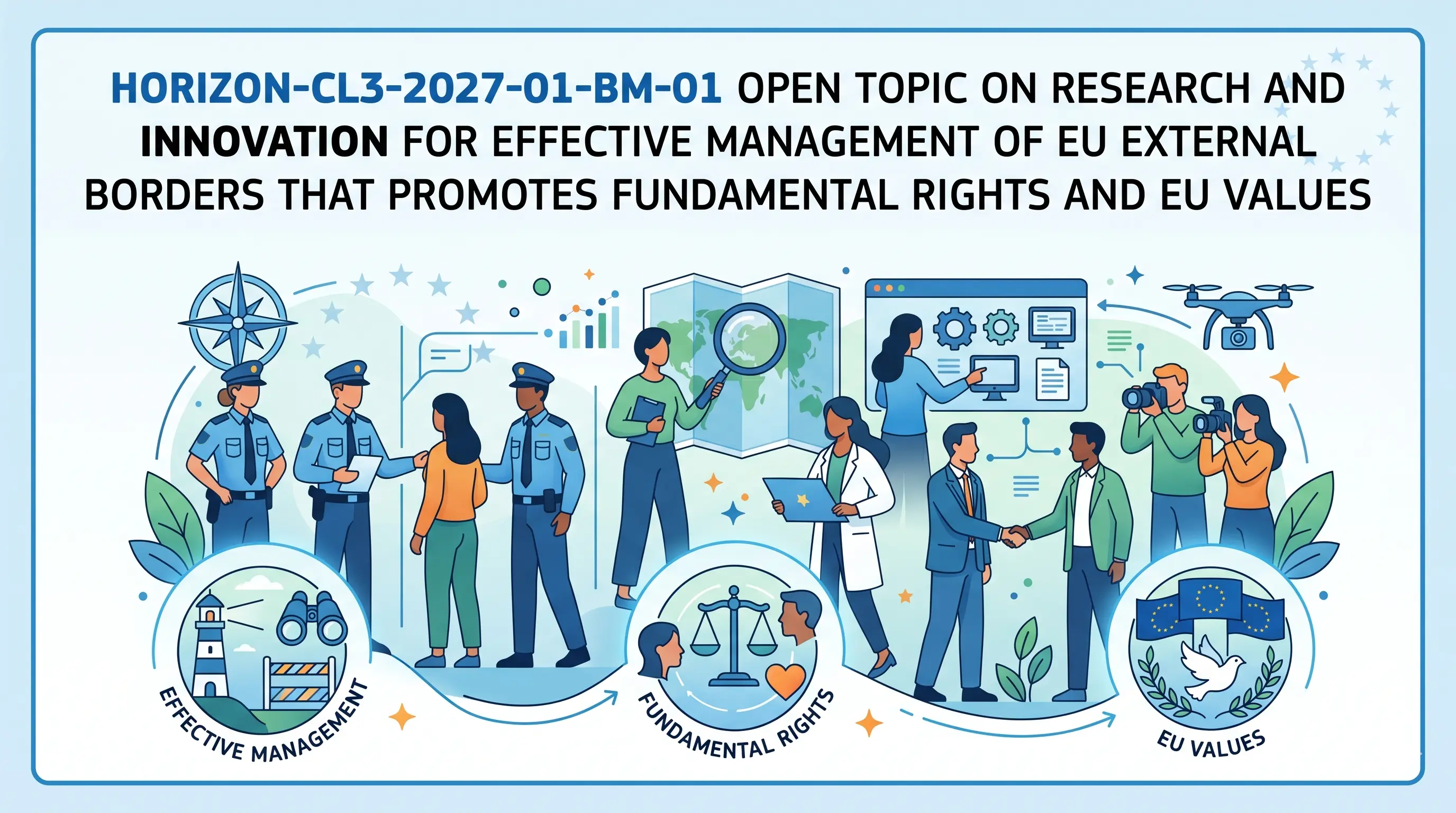
HORIZON-CL3-2027-01-BM-01: Open topic on research and innovation for effective management of EU external borders that promotes fundamental rights and EU values
This is an open topic, which makes it both more flexible and trickier to position. The Commission isn’t prescribing a specific solution here. What it wants is proposals that tackle new or unforeseen border management challenges, with a clear commitment to fundamental rights for everyone involved, EU citizens and third-country nationals alike. The framing is deliberate: security and rights are not presented as a trade-off. The call expects projects that treat both as design constraints from day one.
Download the MIC Horizon Europe 2026/2027 Calls Calendar:
Discover more!
Administrative facts: what do we know about the HORIZON-CL3-2027-01-BM-01 call?
Which call is it, and when is the opening and the deadline?
- Call name: Civil Security for Society 2027
- Call identifier: HORIZON-CL3-2027-01
- Destination: Effective management of EU external borders
- Topic: HORIZON-CL3-2027-01-BM-01
- Opening date: 05 May 2027
- Deadline: 04 November 2027 (17:00:00 Brussels time)
- Type of action: Research and Innovation Action (RIA)
What about the budget and estimated size of the project?
- Overall indicative budget: EUR 8.00 million
- Indicative number of projects: 2
- Estimated EU contribution per project: around EUR 4.00 million
- Eligible costs are structured as lump sum contributions.
What are the key eligibility and evaluation conditions?
- At least 2 Border, Coast Guard or Customs Authorities from at least 2 different EU Member States or Associated Countries must be active beneficiaries (not observers)
- Applicants must complete the “Eligibility information about practitioners” table in the application form.
- If satellite-based earth observation is used, projects must rely on Copernicus and/or Galileo/EGNOS.
- Subject to restrictions for the protection of European communication networks
- TRL target: TRL 4-5 by the end of the project
- Security-sensitive activities may apply (EUCI and SEN provisions)
- The granting authority may object to ownership transfers or exclusive licensing up to 4 years after the project end.
- JRC involvement: not specified for this topic
Scientific range: what does the Commission expect from the HORIZON-CL3-2027-01-BM-01 grant?
What outcomes are expected?
The Commission wants improved border management solutions that genuinely protect and promote fundamental rights for EU citizens and third-country nationals. Projects should demonstrate, test and validate tools and approaches and lay out a credible path to national or EU-level uptake. Publication series are not what the Commission is after. Demonstrable, testable results are.
What is within scope?
This is an open topic, so the scope is deliberately wide. The work program names four areas explicitly:
- Border surveillance technologies and processes
- Border checks and crossing point management
- Customs and supply chain security
- Civilian maritime and aviation security as part of border management
Proposals must embed intersectional perspectives: gender, sex, age, disability, ethnicity, sexual orientation, and migrant status should all be considered in how solutions are designed and validated. Projects that ignore these dimensions will struggle at evaluation.
What are the specifically proposed research directions?
The work program is, by design, vague on specific directions here. That’s the point of an open topic. But reading between the lines, the commission seems to be pointing toward the following:
- Challenges or solution types not covered by the 2026 and 2027 topics in this Destination (worth checking those sibling topics carefully before writing yours)
- Novel or disruptive approaches rather than incremental improvements on known systems
- Solutions that address upcoming or unforeseen challenges such as instrumentalisation of irregular migration, hybrid threats, or new evasion techniques
- Approaches that combine technological and social research, not just engineering alone
- Realistic pathways to upscaling, not just lab-level proof of concept
Scientific strategy: how can you enhance your chances of being funded through HORIZON-CL3-2027-01-BM-01?
What scientific choices matter most?
- Check the sibling topics first: The open topic explicitly funds what the other 2026-2027 BM topics don’t cover. If your idea overlaps with BM-02 or BM-03, you’ll need to differentiate clearly. Evaluators will notice.
- Design for rights, not just security: The call says this more than once. Your system or process should integrate fundamental rights as a technical constraint, not a box to tick in the ethics section. Show what happens when the two objectives conflict and how your solution handles it.
- Include social science: The Commission specifically mentions social research alongside technology. A purely technical consortium will look incomplete for this topic. Someone who understands migration law, civil liberties, or public administration should be in the team.
- Plan your validation method carefully: TRL 4-5 means lab or controlled environment demonstration. Be specific about what you will test, where, and with whom. Vague plans for “future pilots” won’t cut it.
- Show what’s new: This is an RIA, not an IA. You’re not just scaling known solutions. The novelty of the approach should be front and center, especially since evaluators will ask why this couldn’t fit into the non-open topics.
- Proposals that mention Copernicus or Galileo/EGNOS for earth observation components will be better positioned than those that ignore EU space infrastructure.
Consortium & proposal-writing plan: what works best with this type of call?
- The eligibility rule is firm: you need at least 2 border, coast guard, or customs authorities as full beneficiaries. Start with those partners. Everything else is built around them.
- Aim for somewhere between eight and twelve partners, maybe a couple more if operational diversity requires it. This is an RIA with a EUR 4 million budget, so lean structures work better than large consortia where coordination overhead eats the science budget.
- You’ll want legal or human rights expertise in the consortium. Not just as an ethics adviser, but as a genuine scientific contributor shaping the research design.
- An innovative SME with a security technology background can fill the gap between academic proof of concept and something border agencies would actually consider deploying.
- If your solution touches on data sharing across EU systems, plan for eu-LISA and Frontex as observers during demonstrations. The work program signals this explicitly.
- On proposal writing: open topics attract more diverse submissions. Your proposal needs a very clear “why this topic and not the specific ones” narrative. That framing usually belongs in the opening pages, not buried in the work plan.
How would microfluidics contribute to this topic?
Border management doesn’t immediately suggest microfluidics. But look more carefully at what the Commission is actually asking for, and there are at least two areas where the technology becomes relevant.
The first is detection. Standard chemical sensing systems at border points are slow, bulky, and often require trained staff to interpret results. Microfluidic platforms can change that dynamic significantly.
- Say you want to screen luggage or cargo for trace biological or chemical markers associated with illicit trafficking, without pulling every bag out of the queue. A miniaturized lab-on-chip system can do rapid, low-cost screening in minutes. Your consortium would be proposing something far more deployable than a benchtop analyzer.
- Microfluidic biosensors can be designed for environmental sampling too: water at port entry points and aerosol collection at crowded crossing points. The sensitivity is there, and the form factor is compatible with field conditions that conventional instruments aren’t built for.
- Point-of-care-style identification tools built on microfluidic cartridges could support document verification workflows. Biometric or biochemical markers on physical or digital credentials can be cross-checked rapidly without centralized processing, which matters for data protection compliance.
The second area is less obvious but worth mentioning: wearable or embedded monitoring for border staff. These are people working in difficult conditions, sometimes for long shifts. Microfluidic-based physiological sensors have been explored in occupational health contexts, and the application to practitioner safety, which the Commission explicitly mentions, is real.
For a BM-01 proposal, microfluidics won’t be the headline technology. But it fits naturally as a component of a detection or monitoring system developed within the project. Your consortium would benefit from including a partner who can handle that dimension, and the MIC team has experience integrating microfluidic platforms into exactly these kinds of multi-technology security and safety projects.
The MIC already brings its expertise in microfluidics to Horizon Europe:
H2020-NMBP-TR-IND-2020

Microfluidic platform to study the interaction of cancer cells with lymphatic tissue
H2020-LC-GD-2020-3

Toxicology assessment of pharmaceutical products on a placenta-on-chip model

FAQ – HORIZON-CL3-2027-01-BM-01
What is HORIZON-CL3-2027-01-BM-01?
HORIZON-CL3-2027-01-BM-01: Open topic on research and innovation to manage effectively EU external borders, which facilitate fundamental rights and EU values. It is an open topic, thus more flexible and challenging to position. In this case, the Commission is not providing a specific solution.
When does the HORIZON-CL3-2027-01-BM-01 call open and close?
- Opening date: 05 May 2027
- Deadline: 04 November 2027 (17:00:00 Brussels time)
What is the budget for HORIZON-CL3-2027-01-BM-01?
- EUR 8.00 million overall indicative budget.
- Indicative number of projects: 2.
- EU contribution per project: approximately EUR 4.00 million.
- Eligible expenses are organized as lump-sum contributions.
How many projects will be funded under HORIZON-CL3-2027-01-BM-01?
Indicative number of projects: 2.
What type of action is HORIZON-CL3-2027-01-BM-01?
Type of action: Research and Innovation Action (RIA).
Who can apply to HORIZON-CL3-2027-01-BM-01?
- There must be at least 2 Border, Coast Guard, or Customs Authorities of at least 2 different EU Member States or Associated Countries that must be active beneficiaries (but not observers)
- Applicants will have to fill in the eligibility information table for practitioners in the application form.
What TRL is expected at the end of a HORIZON-CL3-2027-01-BM-01 project?
TRL goal: TRL 4-5 upon project completion. Check the Funding and Tenders Portal for more information.
What is within scope of HORIZON-CL3-2027-01-BM-01?
The work program identifies four areas:
- Border surveillance mechanisms and technologies.
- Border control and crossing-point control.
- Supply chain security and traditions.
- Civilian marine and air security as border management.
The solutions ought to internalize intersectional perceptions; gender, sex, age, disability, ethnicity, sexual orientation, and migrant status should all be considered during solution development and testing.
How many partners should a HORIZON-CL3-2027-01-BM-01 consortium have?
Depending on the needs of the operations and operational diversities, a target of 13 to 20 partners should be set. It is an RIA with a budget of EUR 4 million; thus, lean structures are more efficient than large consortia, where coordination overheads can eat up the science budget.
How can microfluidics contribute to a HORIZON-CL3-2027-01-BM-01 proposal?
Microfluidics will not be the shining star technology for a BM-01 proposal. Nonetheless, it fits well into the detection or monitoring system developed in the project. Your consortium would benefit from having a partner to handle this aspect, and the MIC team has been engaged in the deployment of microfluidic platforms for such multi-technology security and safety applications.