
Tips & Tricks for a successful HORIZON-HLTH-2027-03-TOOL-08 proposal
Opening
03 June 2027
Deadline
Keywords
Healthcare
Artificial General Intelligence
CSA
foundation models
EHDS
AI Act
AI Factories
drug discovery
pan-European community
prevention
Your microfluidic SME partner for Horizon Europe
We take care of microfluidic engineering, work on valorization and optimize the proposal with you
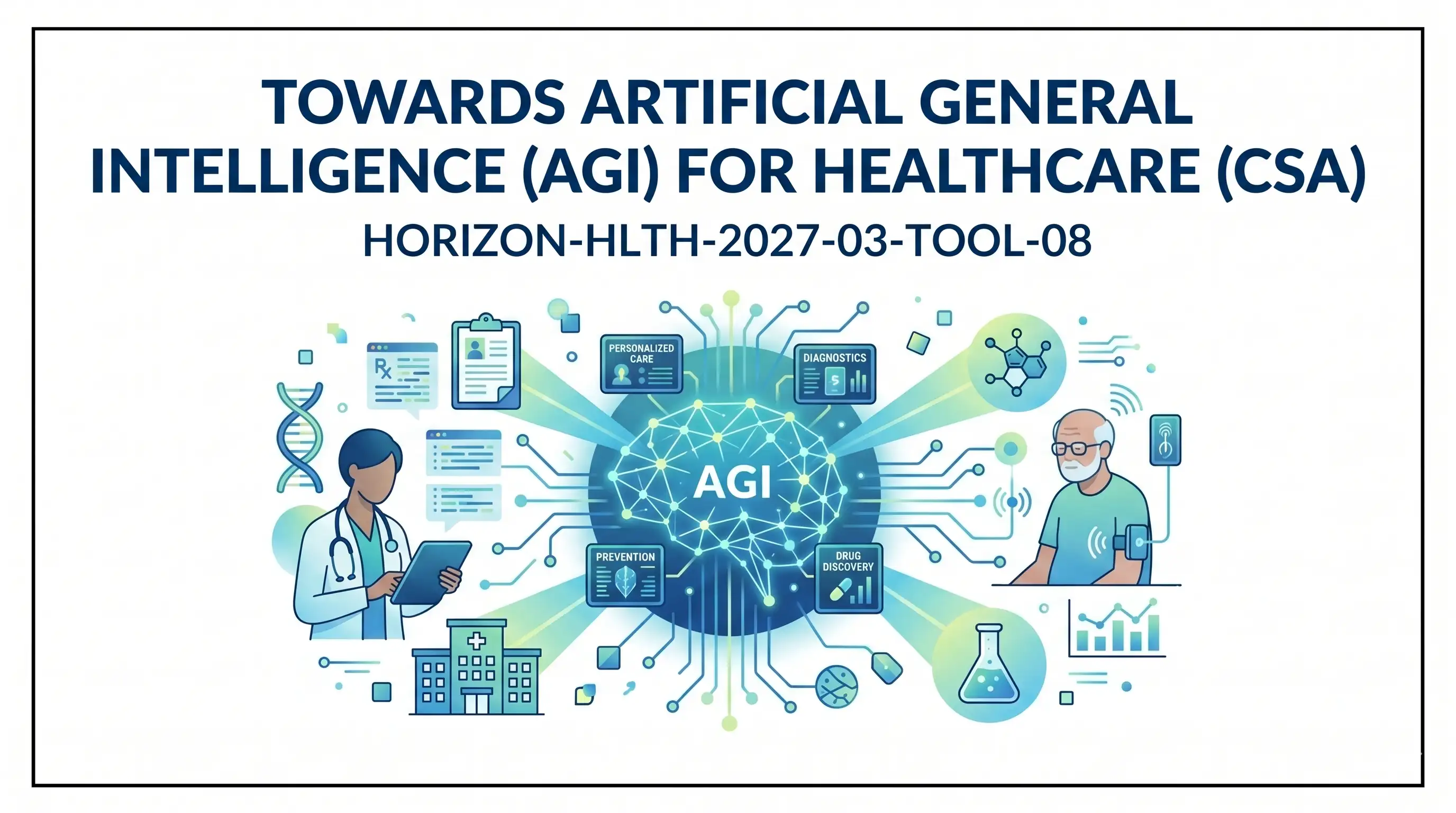
HORIZON-HLTH-2027-03-TOOL-08: Towards Artificial General Intelligence (AGI) for healthcare
In this case, AI research is not funded by the Commission at least not directly. The subject of the topics is regarding establishing the groundwork: the construction of the pan-European community and the mutual roadmap, which will enable the next generation of frontier AI models in healthcare. Relate it to the scaffolding of the institutions prior to actual construction. A single consortium, a single project, and a single shot.
Download the MIC Horizon Europe 2026/2027 Calls Calendar:
Discover more!
Administrative facts: what do we know about the HORIZON-HLTH-2027-03-TOOL-08 call?
Which call is it, and when is the opening and the deadline?
- Call name: Cluster 1 – Health (Single stage – 2027/2)
- Call identifier: HORIZON-HLTH-2027-03
- Destination: Developing and using new tools, technologies and digital solutions for a healthy society
- Topic: HORIZON-HLTH-2027-03-TOOL-08
- Opening date: 03 June 2027
- Deadline: 22 September 2027 (17:00 Brussels local time)
- Type of action: Coordination and Support Action (CSA)
What about the budget and estimated size of the project?
- Total topic budget: EUR 2.90 million
- Number of projects expected: 1
What are the key eligibility and evaluation conditions?
- Standard Horizon Europe eligibility applies (General Annex B)
- Award thresholds: 4 (Excellence), 4 (Impact), 4 (Implementation); cumulative threshold 12
- SSH (social sciences and humanities) expertise is required, not optional
- Proposals are expected to include clinical studies; use of the dedicated annex is strongly encouraged
- The action must build on and connect with existing EU-funded projects, especially the two GenAI4EU topics from 2025
Scientific range: what does the Commission expect from the HORIZON-HLTH-2027-03-TOOL-08 grant?
What outcomes are expected?
In this project, the researchers and innovators will be able to see the way to the next level of frontier AI models in healthcare and how to use AI Factories and merge foundation models to personalized medicine in a much more precise way. There ought to be a common, practical roadmap of AGI in healthcare that is available to multidisciplinary stakeholders in Europe.
What is within scope?
- Multimodal integration of health data: electronic health records, imaging, laboratory, molecular, and omics data.
- Life sciences and healthcare delivery Foundation models, combined to more advanced AI.
- Data use and interoperability that protect privacy, which is in compliance with the EHDS regulation.
- AI Factories and supercomputers.
- AI development that is ethically and trustfully developed in accordance with the AI Act.
- Community building amongst healthcare providers, patients, AI developers, data engineers, ethics experts.
Original research to come up with new AI models is out of scope. This is merely preparatory work of coordination (better to check twice before you begin writing).
What are the specifically proposed research directions?
- Community building on a pan-European level, which has the potential to turn into a long-term EU tool.
- Methodical literature review of available AI models: finding potential promising methods, their safety, regulatory appropriateness, and evidence base.
- Dataset curation and interoperability work: identification, validation, and preparation of datasets to be used in frontier model development, EHDS is in prospect in 2029.
- Mapping training and evaluation strategies of frontier AI models, particularly in combining foundation models towards personalized medicine.
The suggested priority, between the lines, is governance and infrastructure of communities as opposed to technology itself.
Scientific strategy: how can you enhance your chances of being funded through HORIZON-HLTH-2027-03-TOOL-08?
What scientific choices matter most?
- Place the roadmap as an actual tool, rather than a review of literature. The evaluators desire something that is capable of guiding the future RIA calls credibly. This is what has caused coordination proposals to fail, as the roadmap remained vague.
- Establish the AI Factory relationship. Name of facilities you intend to contract. This is assumed in the work programme: proposals which make it abstract score less.
- Do not overlook the SSS requirement. This must not be a work package added at the end of the project, but rather ethics and social science should be incorporated at the beginning.
- Bacterial GenAI4EU. Name those two 2025 projects. Discuss the ways that your work expands or complements them, and speak specifically of it.
- The compliance to Trustworthy AI and AI Act should not be a box to tick but rather implemented throughout. The evaluators observe the difference.
- Address all the four pillars of coordination: community, roadmap, dataset work, model preparatory activities. A scoring risk is in missing one of them.
Consortium & proposal-writing plan: what works best with this type of call?
- A consortium shape is something that a CSA cares about unlike normal. You are developing a community and as such you require partners who already come with communities.
- A target of between ten and fourteen partners, perhaps a few more should the clinical or geographic coverage dictate.
- At least one AI developer who can be associated with an AI Factory, two or three healthcare institutions where the data can be accessed, an ethicist since the first day and patient representatives.
- It is almost imperative that a legal expert who is well acquainted with AI Act and EHDS. This move cuts through live regulatory terrain.
- A creative SME with AI tools, experience in health data management can be a distinction in the consortium and introduce an aspect of deployment that academic partners do not often offer.
- Do not write it in the style of a research proposal. The Commission is aware that it is CSA. Position the story within the context of the coordination gap: Europe possesses the data, the computing capacity and the regulatory structure. The absence of an organized community and a roadmap to assemble them is what it lacks. Your proposal solves that.
How would microfluidics contribute to this topic?
The future of AI coordination in healthcare is pure informatics. However, the point is that the multimodal health data to which this roadmap relies on, are more and more provided by lab-on-a-chip systems, organ-on-a-chip platforms, and microfluidic assay devices. Traditional laboratory processes produce data that is inconsistent across locations and difficult to standardize. Microfluidics changes that.
- Organ-on-a-chip systems generate structured, reproducible biological data , precisely what dataset curation efforts require. Suppose you wish to learn the behavior of a compound in the tissue of the liver and in the tissue of the kidney. A chip platform allows you to execute that in controlled conditions, and the consistency of the data analysis can be used to train AI models in a way that is tractable.
- Microfluidic sensors and point-of-care devices make the molecular and cellular data, which is directly fed into omics pipelines. This is the center of the multimodal integration issue.
- To expand the data expansion workstream, your consortium would be interested in a partner with expertise in assay standardization and the ability to address cross-site data consistency. MIC carries with it precisely that.
In the context of a team building a roadmap to AGI in healthcare, microfluidics can give something tangible, which is a source of controlled, biologically significant data that the AI community desperately needs to do its job right. See also the AI-based microfluidics overview.
The MIC already brings its expertise in microfluidics to Horizon Europe:
H2020-NMBP-TR-IND-2020

Microfluidic platform to study the interaction of cancer cells with lymphatic tissue
H2020-LC-GD-2020-3

Toxicology assessment of pharmaceutical products on a placenta-on-chip model

FAQ – HORIZON-HLTH-2027-03-TOOL-08
What is HORIZON-HLTH-2027-03-TOOL-08 actually about?
The topic supports the precept of the forthcoming generation of frontier AI models in European healthcare. Not the models, per se. The project must establish a pan-European community, develop a common roadmap, and develop datasets and evaluation strategies, such that future RIA calls can develop frontier AI in a responsible manner. A single consortium, single project, single shot.
Why is it a CSA and not a RIA?
Since the Commission is not funding AI model development in this case. It is paying to be coordinated. CSA (Coordination and Support Action) funds community building, roadmapping, dataset curation, and and literature review. Present your proposal as research, and it will have a low score. Institutionalize it.
What is the budget and how many projects are funded?
The overall budget for the topic is EUR 2.90 million, and the Commission plans to finance a single project. That implies that a single consortium gets the entire envelope. Stakes are high; weak framing is unacceptable.
What is in scope and what is not?
In scope: community building, literature review of current models of AI, dataset curation in line with EHDS, multimodal combination of health data (EHR, imaging, labs, omics), mapping of training and evaluation strategies of foundation models, and coordination of AI Factories. Out of scope: original research to come up with new AI models. This is preparatory coordination work, not model development.
How does it connect to the GenAI4EU projects?
The work program makes it clear that the action should be based on and in relation to already-funded EU projects, in particular the two GenAI4EU topics, which were financed in 2025. Name them. Demonstrate, in particular, how your work builds on or complements them. Evaluators consider vague references here as a red flag.
What role does SSH play here?
SSH is not optional; it is a necessity. Ethics, social science, patient perspectives, and regulatory studies. Incorporate them at the beginning of the project. The typical error with this type of topic is to tack on a work package at the end.
How should the consortium be shaped?
What about AI Factories and compute access?
In the work program, AI Factories are listed as the scope. What you intend to engage with, how, and what preparatory data or model work, should be specified in your roadmap. Abstract AI Factories treatment is likely to get costly.
What does the EHDS regulation add to the picture?
The legal and technical framework of cross-border health data use in Europe is the European Health Data Space (EHDS) regulation. In 2029, it is projected. This project must involve dataset curation work, as expected. All of them should be EHDS-compatible: privacy, interoperability, metadata, and access models.
How can microfluidics contribute to this topic?
Lab-on-a-chip, microfluidic platforms and organ-on-a-chip platforms generate structured, reproducible biological data. Such data is exactly what dataset curation of frontier AI models requires. MIC, a creative SME in microfluidic engineering, has an opportunity to contribute to the dataset and interoperability workstreams and provide the cross-site consistency expertise to the consortium.