
Tips & Tricks for a successful HORIZON-CL5-2027-05-D2-08 proposal
Opening
05 May 2027
Deadline
Keywords
BATT4EU
long-duration storage
redox flow batteries
market deployment
grid stabilization
thermal storage
renewable energy
European supply chain
SSD
Your microfluidic SME partner for Horizon Europe
We take care of microfluidic engineering, work on valorization and optimize the proposal with you
HORIZON-CL5-2027-05-D2-08 - Demonstration for long-duration battery energy storage systems (BATT4EU Partnership)
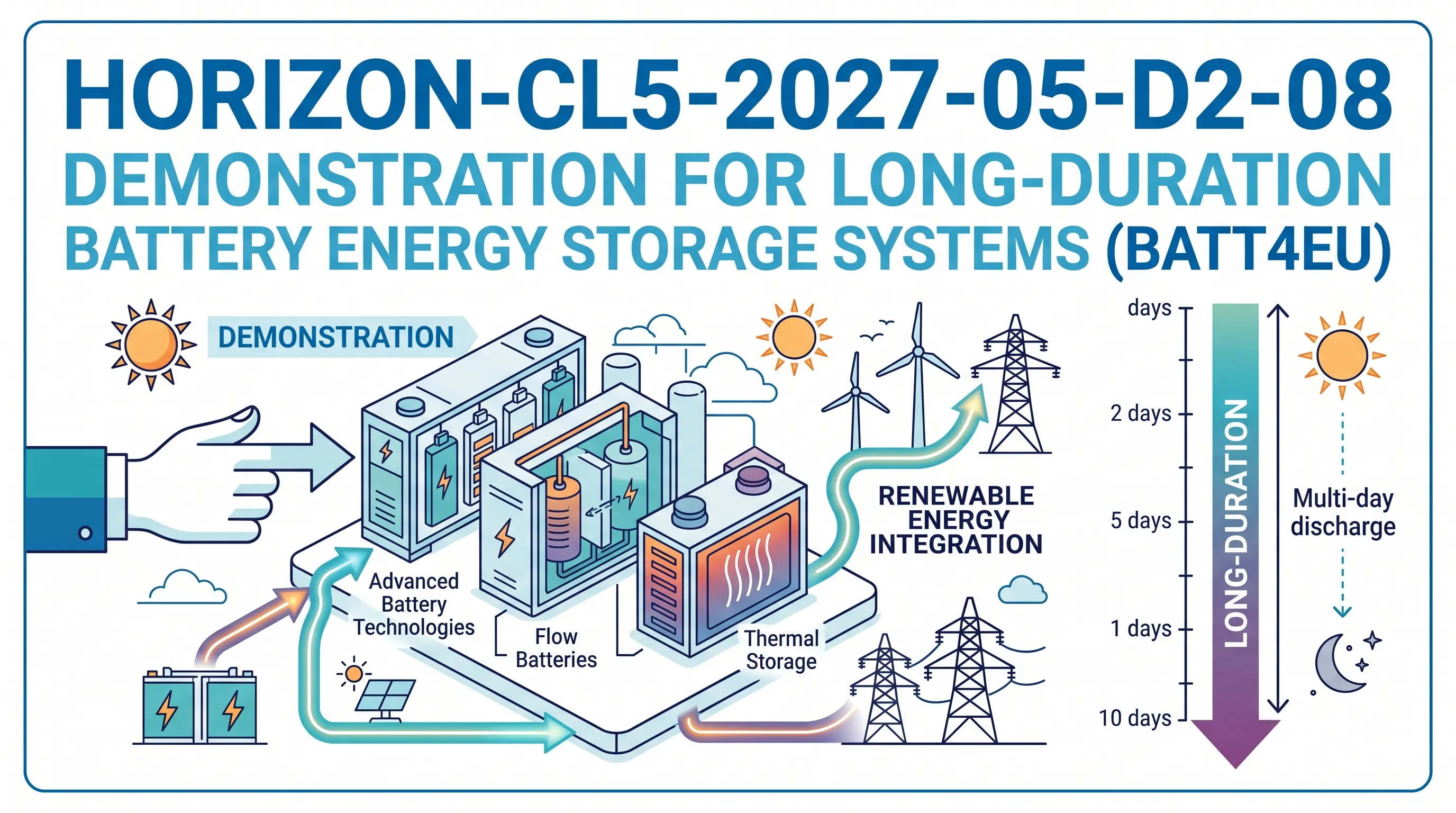
Europe has a storage deficit. We are installing renewables onto the grid faster than we can absorb them, and the missing piece of the puzzle is effective, viable, long-duration storage. And that’s exactly the premise of this call. It asks for functioning, real-world, operational battery energy storage system demonstrations capable of delivering 8 hours of storage with European-sourced components. The call is under the BATT4EU partnership, which requires reporting and adherence to the European Battery Partnership KPIs.
Download the MIC Horizon Europe 2026/2027 Calls Calendar:
Discover more!
Administrative facts: what do we know about the HORIZON-CL5-2027-05-D2-08 call?
Which call is it, and when is the opening and the deadline?
- Call name: BATTERIES and ENERGY
- Call identifier: HORIZON-CL5-2027-05
- Destination: D2 – Cross-sectoral solutions for the climate transition
- Topic: HORIZON-CL5-2027-05-D2-08
- Opening date: 05 May 2027
- Deadline: 15 September 2027
- Type of action: Innovation Action (IA)
What about the budget and estimated size of the project?
- Overall topic budget: EUR 18.80 million
- Number of projects expected: 2
- EU contribution per project: around EUR 9.40 million
What are the key eligibility and evaluation conditions?
- Eligibility: General Annex B applies; no specific consortium size threshold stated
- Satellite data exception: if satellite-based earth observation, positioning, or navigation data is used, beneficiaries must use Copernicus and/or Galileo/EGNOS
- JRC: may join as a beneficiary with zero funding or as associated partner; cannot participate in proposal preparation or submission
- TRL: activities expected to reach TRL 6-7 by end of project; may start at any TRL
- Exploitation obligations: proposals must include a plan for scalability, commercialisation, deployment, and indicate potential use of the Innovation Fund
- IP restriction: the granting authority may, for up to 4 years after action end, object to ownership transfers or exclusive licensing of results (worth checking twice)
- BATT4EU alignment: projects must report results to the BATT4EU partnership in support of its KPI monitoring
Scientific range: what does the Commission expect from the HORIZON-CL5-2027-05-D2-08 grant?
What outcomes are expected?
At the end of the project, the commission want to see operating, system-level demonstrations of long-duration battery energy storage for grid stabilization and flexibility. This translates to real, deployed systems, real data and believable technoeconomic numbers. Not a stack of papers. Instead, the commission is after deployable technology with a clear market pathway, supported by a sound business case.
What is within scope?
- Novel Redox Flow Batteries (either standard or mediated electrolyte)
- High Temperature Battery Systems
- Metal Air Battery systems
- Multivalent systems (aqueous and organic)
- Any non-commercialised LDES systems not yet available on the market
- Use cases (front-of-meter grid scale storage, industrial users, or firming renewables)
- Hybrid systems of multiple storage technologies (Redox Flow with Supercapacitors, etc.)
- Advanced BMS and EMS with SOC and SOH predictions, predicting lifetime
- Comprehensive Technoeconomic analysis (CAPEX, OPEX, round-trip efficiency, self-discharge and cycle life)
- Safety analysis of the systems (toxicity, flammability and explosion hazards)
Materials used in projects should be sourced through an established, reliable and European supply chain. Projects reliant on critical raw materials where a clear European supply chain is not available will struggle.
What are the specifically proposed research directions?
- Demonstrations of systems, not optimization of components. The EU emphasis on the system scale is undeniable.
- System components should focus on the abundance and cost of materials used, and chemistries will target minimal use of critical and rare elements.
- Digital integration of systems should be considered in the system from the start. It’s not an added element in a BMS/EMS but part of the fundamental design.
- The benefits of hybridization compared to single systems should be considered.
- Quantifiable grid impacts (grid resilience, emission reductions, cost/kWh storage).
- A clear, realistic pathway to production, including a supply chain and business case from the very beginning.
- Adherence to a Safe and Sustainable by Design framework from the beginning to end of project lifetime.
Scientific strategy: how can you enhance your chances of being funded through HORIZON-CL5-2027-05-D2-08?
What scientific choices matter most?
- Avoid chemistries that are already close to market deployment. The purpose of this call is the demonstration of technology in the pre-commercialization phase; technologies close to market are unlikely to be considered for funding.
- Be application-driven rather than technology-driven. What problem is the storage solving, for whom and why? The intended application of the storage technology should be clearly defined from the start to help determine its overall impact.
- Develop a credible technoeconomic model from the beginning. The submission of preliminary capital and operational expenditure estimates, in addition to round-trip efficiency, would be greatly beneficial for evaluation.
- Consider the supply chain when choosing materials for use in battery chemistries. Emphasis is given in this call on European materials and the use of critical raw materials should be avoided where there is no clear alternative European source.
- Embrace a robust and convincing approach to Safety and Sustainability by Design throughout the lifetime of the project rather than as an add-on analysis.
- Assess the potential for hybridization of different storage technologies where appropriate. This may lead to more synergistic benefits than those achieved with a single storage technology and performance should be benchmarked against a single technology.
- Include an exploitation plan that demonstrates an explicit and realistic pathway to commercialization, and consider the use of the Innovation Fund for potential follow-on funding, aiming to have the system “Innovation Fund-ready”.
Consortium & proposal-writing plan: what works best with this type of call?
- The proposed consortia should consist of 8-12 partners; more if necessitated by an industrial use case. The project itself should be framed as a demonstration; operational focus is essential.
- A leading university or battery research institution should head the research aspects of the project. Attention, however, will be given to the entity that is responsible for the operational demonstration of the system at full scale.
- An industrial partner, such as an energy utility, grid operator, or large industrial energy consumer, must be an essential part of the consortium to demonstrate the technology and guarantee market demand.
- A creative SME operating in BMS, power electronics or digital monitoring technology should be included. It plays an integral role in delivering state-of-the-art systems and developing profitable commercial exploitation.
- Material suppliers with an operational presence within the EU are almost mandatory, owing to the requirement of an EU supply chain. Securing a supply agreement or letter of intent at an early stage would help substantiate claims relating to the supply chain.
- A potential route to future exploitation via the Innovation Fund should be defined and, where possible, the technology should be “Innovation Fund ready”.
- Inclusion of the JRC in a work package concerning safety or testing, among others, will enhance credibility.
- The focus of the impact section should be on the reduction of deployment barriers, not merely scientific advancements. The evaluators at this TRL are interested in evidence demonstrating how the pathway to the market can be paved in the next five years.
How would microfluidics contribute to this topic?
Standard battery testing fails to fully provide the granular data regarding individual cell reactions. Although values for voltage and temperature are readily available, a comprehensive understanding of fluid flow and electrochemical interactions between electrodes and electrolytes in a redox flow battery is often lacking in a standard test bench. Microfluidics however, offers the following advantages:
- Novel chemistries for redox flow batteries can be quickly developed and tested through real-time observation and by replicating cell degradation after N cycles, compared to using bulk tests at regulated temperature and flow rates, significantly reducing test time and material consumption.
- Early diagnosis of failure mechanisms in the batteries prior to larger-scale tests. Recreating experiment conditions more precisely feeds credible data into technoeconomic models.
- Organ-on-chip analogs of electrode degradation systems, like metal air, could be simulated by studying changes in material structure at the electrode over time; knowledge that is unobtainable from bulk measurements alone.
- Rapid screening of hazardous new chemistries and reactive components could greatly aid Safe and Sustainable by Design criteria, reducing the time and risk of unknown chemical analysis at a system level.
MIC possesses experience in electrolyte characterization, microfluidic design and electrochemical microscale testing, all of which could form an attractive component within a proposal for HORIZON-CL5-2027-05-D2-08 by extending the scope beyond pure battery engineering and offering more in-depth materials validation and digital monitoring options.
The MIC already brings its expertise in microfluidics to Horizon Europe:
H2020-NMBP-TR-IND-2020

Microfluidic platform to study the interaction of cancer cells with lymphatic tissue
H2020-LC-GD-2020-3

Toxicology assessment of pharmaceutical products on a placenta-on-chip model

FAQ – HORIZON-CL5-2027-05-D2-08
What is HORIZON-CL5-2027-05-D2-08 actually about?
The HORIZON-CL5-2027-05-D2-08 topic requires full system-level demonstrations of long-duration battery energy storage systems capable of providing at least 8 hours of energy. The Commission is not seeking component optimization or other lab-scale prototypes. It desires actual systems operating under actual conditions, and European-supplied components and plausible numbers underneath them. This comes under the BATT4EU partnership and therefore, KPI reporting is not an option.
Who should apply and how much funding is on the table?
Which battery chemistries are in scope?
The call includes Redox Flow Batteries (standard or mediated electrolyte), High Temperature Battery Systems, Metal-Air systems, multivalent chemistries (aqueous and organic), and any non-commercialized LDES tech not already on the market. Hybrid systems with multiple storage technologies are also welcome. What’s out: anything close to commercial deployment.
What does the Commission really mean by long-duration storage?
Eight hours minimum. That’s the operational benchmark. The Commission desires storage that irons out daily renewable cycles, rather than 30-minute frequency response devices. Anything below that is not suitable. The use case (grid-scale front-of-meter, industrial users, firming renewables) must be directly connected to the 8-hour operation window described in the proposal phase.
How important is the European supply chain in this call?
It matters a lot. The sources of materials are supposed to be known and trustworthy European sources. Projects that use critical raw materials whose source is not clearly European will not be convincing to evaluators. Early signing of letters of intent or supply agreements with EU-based suppliers helps to prove the claim a long way. It is among the most scrutinized areas of assessment.
What role can microfluidics play in a battery demonstration project?
Microfluidics enables rapid iteration of new electrolytes, real-time visualization of electrode-electrolyte interactions, and early failure diagnostics prior to scaling. In the case of redox flow, information on cause and effect that bulk testing can never provide is available. It also inputs plausible numbers into your technoeconomic model. Handy when you are attempting to persuade assessors that the chemistry is in fact, functioning.
What kind of consortium has the best shot?
Target 8-12 partners. One of the foremost research institutions on the science side, an industrial partner (utility, grid operator, or large industrial consumer) to lead the demonstration, EU-based material suppliers, an innovative SME on the BMS / power electronics/digital side, and, preferably, the JRC in a safety or testing work package. Additional partners, only when there is a real need in an industrial use case.
What is the difference between this call and earlier battery topics?
Previously, the trend was to develop components or conduct component-level chemistry research. This one clearly requires system-scale demonstration. The TRL target is 6-7 at project end, i.e., the system must be operational in a relevant operational setting. Another fundamental study is not part of the Commission’s quest. It seeks pre-commercial technology with a deployment vision.
What pitfalls usually sink IA proposals at this TRL?
Several recurring ones:
- Downplaying the technoeconomic model.
- Taking Safety and Sustainability by Design as a back-of-the-napkin treatment.
- Vague exploitation plans.
- Selection of materials disregarding the EU supply chain realities.
- Selecting a use case that is not within the 8-hour storage window.
- The consortia still appear punitive toward those who are academically strong but have weak industrial strength.
How do BATT4EU KPIs and Innovation Fund readiness fit in?
BATT4EU KPIs will require projects to report during the action. Moreover, the Commission anticipates that you will mark the possible follow-on funding using the Innovation Fund. Implementing the system in a manner that makes it innovation fund-ready at its inception is a strong indicator to evaluators. It demonstrates that you have gone beyond the end of the grant. Value explicitly included in the impact section.