
Tips & Tricks for a successful HORIZON-CL5-2027-05-D4-06 proposal
Opening
05 May 2027
Deadline
Keywords
IT rooms
Energy Efficiency Directive
BMS integration
waste Heat recovery
Edge data centers
energy use
energy optimization
Thermal management
buildings
Your microfluidic SME partner for Horizon Europe
We take care of microfluidic engineering, work on valorization and optimize the proposal with you
HORIZON-CL5-2027-05-D4-06: Thermal energy optimization and waste heat recovery of high energy demand IT rooms in buildings or small edge data centers
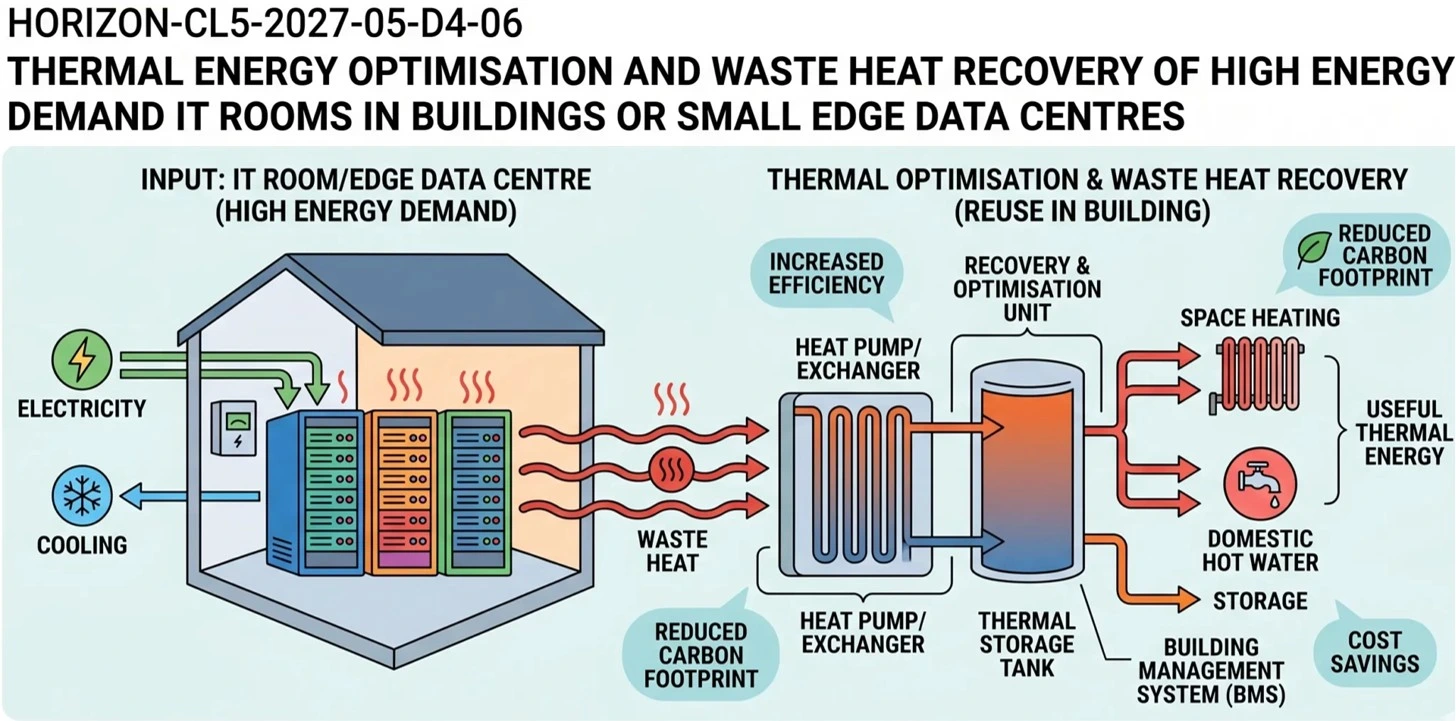
This call seeks solutions that address a problem for the Commission: a certain percentage of a building’s energy consumption goes towards cooling IT rooms, but these are not covered by the latest Energy Efficiency Directive. Currently, no one requires the operator to account for wasted heat. Therefore, the Commission is offering funding to demonstrably feasible, building-scale projects (i.e., not large hyperscale systems) that aim to improve thermal management systems. A functional prototype and a feasible, replicable business case must be presented, and the evaluators are looking for impact rather than the sophistication of the underlying technology.
Download the MIC Horizon Europe 2026/2027 Calls Calendar:
Discover more!
Administrative facts: what do we know about the HORIZON-CL5-2027-05-D4-06 call?
Which call is it, and when is the opening and the deadline?
- Call name: BATTERIES and ENERGY
- Call identifier: HORIZON-CL5-2027-05
- Destination: D4 – Efficient, sustainable and inclusive energy use
- Topic: HORIZON-CL5-2027-05-D4-06
- Opening date: 05 May 2027
- Deadline: 15 Sep 2027
- Type of action: Innovation Action (IA)
What about the budget and estimated size of the project?
- Total indicative topic budget: EUR 15.75 million
- Number of projects expected: 3
- Budget per project: around EUR 5.25 million
- Eligible costs take the form of a lump sum contribution.
What are the key eligibility and evaluation conditions?
- Standard eligibility conditions apply per General Annex B
- If satellite-based earth observation, positioning, navigation, or timing data is used: mandatory use of Copernicus and/or Galileo/EGNOS
- TRL target: activities expected to achieve TRL 6-7 by the end of the project; may start at any TRL
- Granting authority may object to the transfer of ownership or exclusive licensing of results up to 4 years post-action
- No clustering or JRC involvement requirements are explicitly stated for this topic.
Scientific range: what does the Commission expect from the HORIZON-CL5-2027-05-D4-06 grant?
What outcomes are expected?
There are two key expected outcomes. Firstly, demonstrations of fully integrated thermal management and heat recovery systems within a mix of existing (building-based) and new-build (edge, 100-500 kW) IT rooms operating under various climate conditions across Europe. Secondly, complete business cases demonstrating the added value of the heat recovery system, either through space heating or feeding local heating networks. Open access to data and knowledge for IT operators and building owners will be another crucial output for any proposal.
What is within scope?
This call focuses on the under-regulated small-scale IT sector and specifically targets IT rooms and edge data centers ranging from 100 to 500kW of power:
- Existing and small edge IT data centers based within buildings and which need thermal management systems
- Heat recovery and utilization system development, possibly integrated with heat storage or a complementary heating device (e.g. Heat pump)
- Integration of the proposed system with existing BACS and BMS systems
- Use of simulation tools and digital twin to perform a thermal analysis of the system
- Inclusion of smart building-level self-assessment and self-optimization functionality
- Utilization of the recovered heat for space heating/cooling within the building, domestic hot water or district heating/cooling networks
- One cold climate and one warm climate EU region or country associated to the EU to perform demonstrations
The exclusion is the large data centers which will be subject to new Energy Efficiency Directive rules.
What are the specifically proposed research directions?
The Work Programme also identifies some explicit and desirable research avenues:
- Cost-effective integrated thermal management systems – focus is not just on the heat recovery, but also the whole system which would include building envelope and control aspects
- Business cases for excess heat recovery, with realistic plans for economic benefits of heat recovery along with suitable financial analysis, taking into account different climate and building specificities.
- Integration with BMS systems, with the scope of development of an additional service above a standard BMS through utilizing its data and function of the thermal system
- Climate-specific benchmarking to show performance differences across various climates, and identification of specific needs for both cold and warm climates
It would also seem beneficial to focus on the implementation of open data, which the commission places a high priority on.
Scientific strategy: how can you enhance your chances of being funded through HORIZON-CL5-2027-05-D4-06?
What scientific choices matter most?
- The proposal should clearly feature real site-based demonstrations, not just simulation. Working proof of concept in a building environment is critical.
- One demonstration in both cold and warm climate conditions is mandatory, and will be verified during eligibility check.
- A heat reuse value chain must be evident. Who will use the heat? What additional value would they get? What other energy sources would be replaced? Abstract efficiency will be less valuable than a concrete solution.
- BMS integration planning should start from the outset, with the demonstration that a correct understanding of the topic has been achieved. The self-optimization requirement needs careful attention.
- A scalable and reproducible business case should be put forth in the proposal, which will serve as proof of concept to scale out across various IT rooms/buildings.
- Use of a digital twin, simulation approach or other similar methods is required for analysis of the building envelope thermal behavior.
- Also investigate links with the call HORIZON-CL4-2027-04-DATA-09, which covers energy efficiency and sustainability of AI processing, as overlap may lead to greater research impact.
Consortium & proposal-writing plan: what works best with this type of call?
- For an Innovation Action, an ideal team size would be in the range of 8-12 partners. A slightly higher number of partners could be considered to cover different climates.
- Two partners are required to have access to real-life demonstration buildings in a cold and warm climate (building owner/operators).
- At least one research institute or technical university is needed, experienced in building energy, thermal systems and digital twinning approaches to lead scientific aspects.
- An SME with proven expertise in BMS/energy monitoring will provide valuable contribution towards technology commercialization and market uptake (strongly recommended).
- The project should also include participants with proven expertise on IT infrastructure, not solely on buildings.
- If relevant to the use case, district heating providers/utilities should be invited.
- Expected outcomes in the proposal should directly reflect those stipulated in the work program and avoid broad and vague language.
- Since a lump sum grant is expected, realistic budget calculation and realistic time allocation for tasks are necessary.
How would microfluidics contribute to this topic?
Currently, the use of air cooling for IT rooms leads to a lot of heat being rejected, which becomes very difficult to reuse. Microfluidics has become the key to resolving thermal issues due to the fact that they offer on chip cooling, thereby enabling higher concentrations of energy at lower levels and reducing energy waste.
The use of microfluidics cooled plates will reduce the cooling energy required for compute intensive small edge data centers, which will enable more heat at higher temperatures to be utilized and this could contribute towards space heating or building heating. A range of 50-70° C is typical from the cooled plates, whereas the temperature of an air-cooled building at 25° C becomes harder to utilize efficiently.
- Microchannel heat exchangers are ideal for detailed thermal maps to show a precise thermal profile for each IT rack. This would be beneficial for modeling accurate heat loads needed to developing the digital twins and are identified in the work program.
- Quick reaction to changes in computing load through fine control over the flow within microchannels could negate some of the delayed responses from room based HVAC systems, helping to support smart building features mentioned in the work program.
- Continuous flow and temperature readings from a microfluidic system will give the BMS precise data to help it manage and exploit the heat at building level, which will benefit energy recovery and integrate with building systems.
- Retrofitting of microfluidic heat exchangers into IT rooms is not problematic due to their small size and would assist in demonstrating scalability, the business case, and the potential for replication.
MIC would provide a groundbreaking solution by addressing the primary challenge put forward by the call: at-source heat recovery for efficient utilization at higher temperature.
The MIC already brings its expertise in microfluidics to Horizon Europe:
H2020-NMBP-TR-IND-2020

Microfluidic platform to study the interaction of cancer cells with lymphatic tissue
H2020-LC-GD-2020-3

Toxicology assessment of pharmaceutical products on a placenta-on-chip model

FAQ – HORIZON-CL5-2027-05-D4-06
What is this call about?
This call seeks solutions to address a problem for the Commission: a certain percentage of a building’s energy consumption is used for cooling IT rooms, but these are not covered by the latest Energy Efficiency Directive. The Commission is providing funding to building scale projects that are provably viable and seek to enhance thermal management systems.
When does the call open and close?
Opening date: 05 May 2027. Deadline: 15 Sep 2027. It is a BATTERIES and ENERGY call (HORIZON-CL5-2027-05) called Innovation Action (IA).
What is the total budget and how many projects will be funded?
Comprehensive indicative topic budget: EUR 15.75 million. Number of projects expected: 3. Budget per project: around EUR 5.25 million. Payable expenses are contributions in the form of lump sum.
What size of IT rooms is targeted?
This call targets the under-regulated small-scale IT sector and specifically IT rooms and edge data centers between 100 and 500kW. Hyperscale data centers are not in scope.
What are the two key expected outcomes?
First of all, the exhibitions of complete thermal management and heat recovery system in a combination of old and new-build IT rooms under different climatic conditions in Europe. Secondly, entire business cases of the value added heat recovery system, be it in space heating or local heating network feeding. Check the Funding and Tenders Portal for more information.
Why is a demonstration in both cold and warm climates mandatory?
Mandatory one of the demonstrations will be in cold and warm climate conditions, and will be confirmed in the course of the eligibility check. The work program involves one cold and one warm EU region or country to conduct the demonstrations.
What is excluded from the scope?
The big data centers, will be excluded and will be governed by the new Energy Efficiency Directive. This call specifically appeals to the unregulated middle ground of hyperscale facilities and small installations.
What type of consortium is recommended?
An optimal team size with respect to an Innovation Action is 8-12 partners. There should be two partners who can have access to the demonstration buildings (in real life) both in cold and warm climate. It requires at least one research institute or technical university and an SME with established knowledge in BMS/energy monitoring (highly encouraged), participants with expertise in IT infrastructure, and, where applicable, district heating providers/utilities.
How does microfluidics contribute to this topic?
Microfluidics has also become the solution to the thermal problem, providing on-chip cooling that facilitates higher energy density and reduces energy waste. Microfluidic-cooled plates will minimize the amount of cooling energy needed to cool compute-intensive small edge data centers and allow additional heat to be used at higher temperatures.
What temperature range can microfluidic cooled plates deliver?
Microfluidics-cooled plates typically operate at 50-70° C, and at 25° C (a common air-cooled building temperature), heating a building is less efficient. This increased heat output allows recovered heat to be used in space heating or to supply district heating networks.