
Tips & Tricks for a successful HORIZON-CL4-2027-04-DATA-09 proposal
Opening
17 November 2026
Deadline
Keywords
graphene-enhanced batteries
Sustainable computing
energy use
data centres
Energy efficiency
On-chip cooling
AI data processing
carbon footprint
Your microfluidic SME partner for Horizon Europe
We take care of microfluidic engineering, work on valorization and optimize the proposal with you
HORIZON-CL4-2027-04-DATA-09: Energy efficiency and sustainability of AI data processing in Data Centres
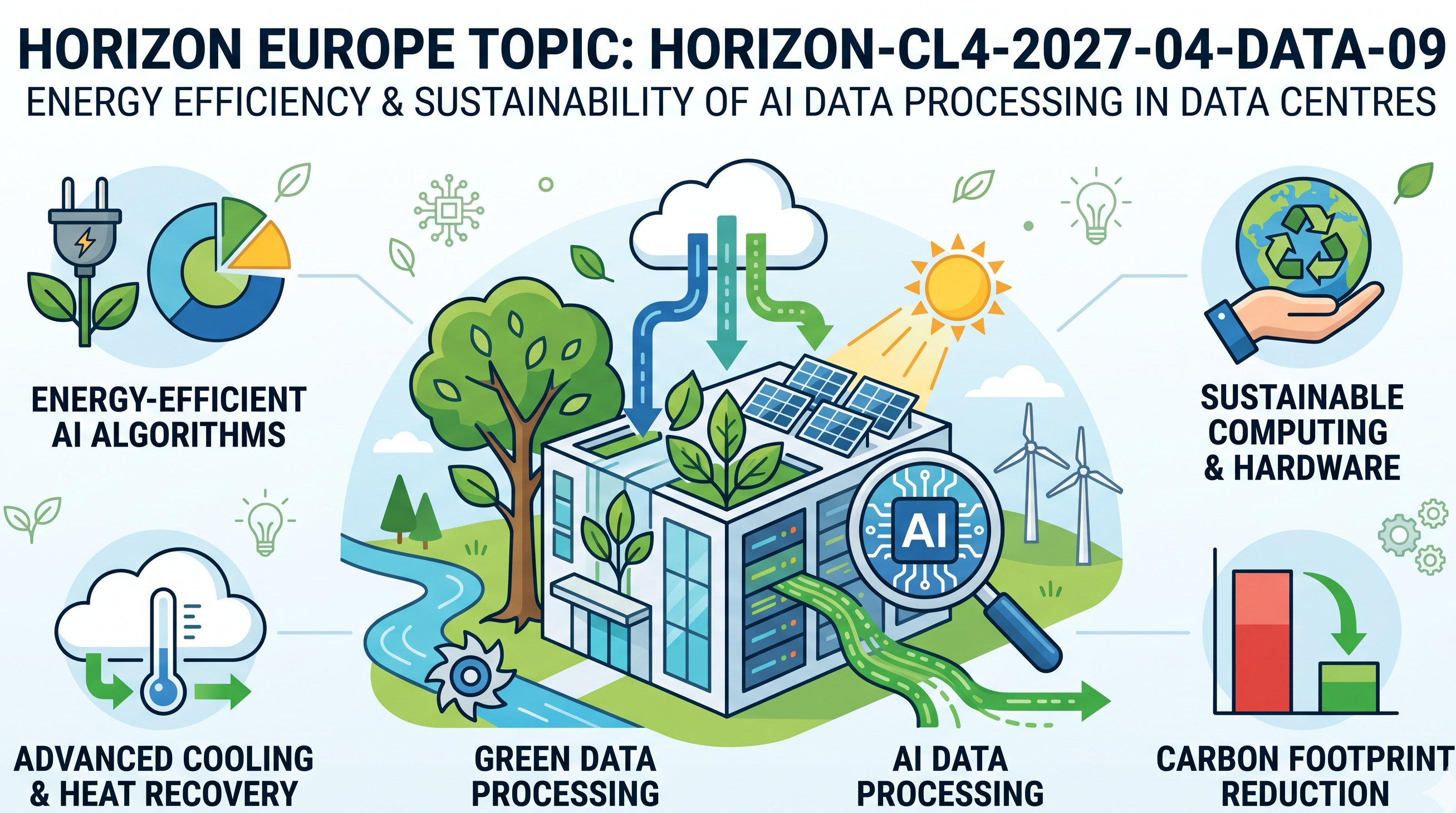
The Commission desires that the AI data centres in Europe become non-energy black holes. The subject matter invests in pilot technologies and a demonstration location to reduce the power and cooling expenses of implementing AI workloads at scale. The angle is not a research project in itself: this is the deployment of near-market solutions, which demonstrate themselves in real data centre settings. The two drivers behind this call are EU strategic autonomy and climate targets.
Download the MIC Horizon Europe 2026/2027 Calls Calendar:
Discover more!
Administrative facts: what do we know about the HORIZON-CL4-2027-04-DATA-09 call?
Which call is it, and when is the opening and the deadline?
- Call name: DIGITAL
- Call identifier: HORIZON-CL4-2027-04
- Destination: Developing an agile and secure single market and infrastructure for data services and trustworthy artificial intelligence services
- Topic: HORIZON-CL4-2027-04-DATA-09: Energy efficiency and sustainability of AI data processing in Data Centres
- Opening date: 17 November 2026
- Deadline: 18 March 2027
- Type of action: Innovation Action (IA)
What about the budget and estimated size of the project?
- Overall topic budget: EUR 39 million
- Number of projects expected to be funded: 4 (three addressing technology outcomes, one for the open pilot demonstration site; note that the call overview table lists 3, but the detailed scope explicitly says 4)
- Estimated EU contribution per project: around EUR 10 million
What are the key eligibility and evaluation conditions?
- Standard Horizon Europe thresholds apply
- Entities controlled directly or indirectly by China are not eligible (restriction on control in IAs in critical technology areas)
- Subject to restrictions for the protection of European communication networks
- TRL entry: 6-7. TRL exit: 8
- Balanced portfolio: grants will be awarded to at least three proposals for expected outcomes 1-3, plus one proposal for the open pilot demonstration site, not only by ranking
- Projects addressing outcomes 1-3 must include at least two use cases in different domains
- Beneficiaries must notify DG-CNECT and HaDEA before any transfer of ownership or exclusive licensing of results; the granting authority can object up to four years after the action ends
- Synergies encouraged with Cluster 5 topic HORIZON-CL5-2027-05-D4-06 (waste heat recovery in buildings and small edge data centres)
Scientific range: what does the Commission expect from the HORIZON-CL4-2027-04-DATA-09 grant?
What outcomes are expected?
The Commission is seeking concrete pilot demonstrations, and not paper research. At the conclusion of the project, you are expected to have working prototypes: improved cooling of AI chips that actually avoid thermal throttling, backup power systems that do not require heavy cooling themselves, and data center optimization systems that reduce actual energy use. To top it all, there is a fourth project that will install an open pilot demonstration site that will combine the outcomes of the other three and become a reference to the data centre industry in Europe. The use of power and waste heat should be measured and enhanced.
What is within scope?
- On-chip cooling and thermal management: liquid cooling, heat spreaders, thermal interface materials, advanced packaging, multi-scale approaches.
- Efficient backup power and storage: graphene-enhanced batteries, supercapacitors, new chemistries, net-zero backup.
- Sustainable data centre designs: AI-based workload scheduling, dynamic power, adaptive resource, data centre heat capture and reuse .
- Research in energy efficiency materials: novel materials and components to help with thermal management, specifically applied to a data centre environment.
- Data centre operation optimisation: AI computing architecture, virtualisation, carbon and environmental footprint reduction.
- Integration to energy systems: solutions relating data centres to energy system planning and regional energy networks.
- The open pilot demonstration site: integrating, benchmarking and demonstrating outcomes of the other funded projects to the European data centre and collocation industry, cloud and edge computing providers.
The demarcation here is straight: this is data centres, not small IT rooms or edge micro-facilities (that falls under the CL5 topic).
What are the specifically proposed research directions?
- Chip-level thermal control allowing dense AI tasks without throttling (the Commission specifically singles out direct liquid cooling and thermal interface materials)
- New battery technology, particularly graphene-enhanced, to support collateral power with low cooling requirements.
- Job scheduling and power capping of the equipment to minimize energy consumption and peak temperatures.
- Plans on how to incorporate on-site and off-site renewables into data centre activity.
- Recapture and reuse waste heat in external processes, in line with carbon neutral heating objectives.
- A demonstration site that the European industry is able to physically visit and compare (this one leaves people surprised: it is a project in itself, not a work package within a project)
Scientific strategy: how can you enhance your chances of being funded through HORIZON-CL4-2027-04-DATA-09?
- Choose your path early. Four projects in four different areas of outcomes are funded by the call. Choose between chip cooling, backup power, data centre optimization, or the pilot site. Attempting to do it all waters down the proposal.
- Display actual data centre partners. Evaluators will seek colocation providers, cloud operators or hyperscalers within the consortium. Any proposal that lacks an actual data centre operator is likely to be killed at birth.
- Quantify PUE improvement. The power usage effectiveness is mentioned in the work programme. Assign numbers, even projections, of how you expect to improve on your baseline.
- The use cases are important, a lot. Every project (except the pilot site) must have two use cases in other domains. We have observed in vain suggestions that collapsed as the application cases seemed to be a different version of the same situation.
- Waste heat reuse should not be neglected. This is what the Commission is associating with European levels of carbon-neutral heating and cooling. Although you may be primarily selling chip cooling, a display of a way to reuse heat matters.
- Discuss strategic autonomy. In your proposal, you are to show the coverage of the key components by European supply chain.
- The target is not TRL 6, but TRL 8. This is an IA. The forecast is almost market-based. This is not the call to make in case your technology is yet to be substantially validated.
Consortium and proposal-writing plan: what works best with this type of call?
- Eight to twelve partners, possibly fewer, depending on how narrow the pilot site project is. In the three technology projects, you desire sufficient breadth to address two plausible use cases. For the pilot site, you require something that can support the infrastructure.
- Have at least one data centre operator or colocation provider. Not in the nature of an advisory board. Being a full beneficiary.
- A novel SME with a specific technology (advanced thermal interface materials, AI-based scheduling software, novel battery chemistry) will be more credible and better aligned with the Commission’s preference for technology transfer.
- The materials science, thermodynamics or AI/ML workload expertise should be brought by academic partners. Do not pile the consortium with universities, but have two or three.
- Should you go to the pilot site, ensure the hosting entity agrees on open access by way of benchmarking and demonstrating. There are several instances where the Commission refers to the word open.
- Create the impact section based on the measurable KPIs: PUE reduction, watts saved per rack, tonnes of CO2 avoided. General weather descriptions will not pass the test.
- The balanced portfolio system implies that your proposal does not have to compete with all applicants, just within its outcome track. Position your proposal in stark contrast to one of the categories of outcomes and do not confuse lines (we have made more proposals than one consortium undermine).
How would microfluidics contribute to this topic?
Where microfluidics is concerned, direct on-chip cooling is the place where it fits in. Traditional air-based or even single-phase liquid cooling is not particularly effective at cooling down the heat density of the current AI accelerators. Microfluidic channels etched directly into chip substrates or interposers may eliminate heat at its origin, prior to its diffusion and making the entire rack cooling system respond.
- Suppose your AI chip has a power consumption of 700W and the heat is concentrated in a few square centimetres. That thermal load can be managed more effectively by a microfluidic cold plate using engineered channel geometries than by a bulky heatsink, as the coolant flows millimetres away at the junction. Same chip, reduced junction temperature, no throttling.
- One of the six scope areas is the thermal interface materials. Microfluidic integration alters the operation of thermal interfaces: rather than an inert paste layer between chip and heatsink, you have a working cooling layer. This would be an advantage to your consortium.
- Microfluidic cooling to two phases (partial evaporation of the liquid within the channels) is more efficient in extracting heat per unit of coolant flow. In dense AI racks where space is at a premium, this translates to smaller, lighter cooling modules.
- High-temperature waste heat is more helpful. Microfluidic cooling retains the heat nearer to its source, at a higher quality, which is more feasible in downstream use in district heating or industrial processes.
- And in the case of microfluidic cooling module, pilot demonstration site, the modules are small enough to be retrofitted to current server architectures. You do not even have to redesign the entire rack.
To a proposal to this call, microfluidics will provide you with a plausible solution to the thermal management on a chip-level that the Commission is specifically seeking, as well as enhance the quality of the waste heat that you collect. Two areas of outcome, but one technology platform.
The MIC already brings its expertise in microfluidics to Horizon Europe:
H2020-NMBP-TR-IND-2020

Microfluidic platform to study the interaction of cancer cells with lymphatic tissue
H2020-LC-GD-2020-3

Toxicology assessment of pharmaceutical products on a placenta-on-chip model

FAQ - HORIZON-CL4-2027-04-DATA-09
What is HORIZON-CL4-2027-04-DATA-09 all about?
The topic funds Innovation Actions to bring down the power and cooling costs of running AI workloads in European data centres. It is aimed at chip level cooling, backup power, data centre optimisation and open pilot demonstration site. The Commission is seeking almost market solutions that have demonstrated themselves in actual data centres, rather than paper research.
When does the call open and when is the deadline?
The reference time and date are 17 November 2026 and 18 March 2027 at 17:00 Brussels time. It is a one stage call.
What budget is available and how many projects will be funded?
The overall topic budget is EUR 39 million with around EUR 10 million per project. It is anticipated that there will be four projects: three focusing on technology outcomes 1-3, and one that focuses on the open pilot demonstration site.
Who is eligible to apply and who is not?
Standard Horizon Europe eligibility is valid, and the control limitation on IAs in critical technology sectors: the entities that are directly or indirectly controlled by China are not eligible. There are also restrictions to safeguard the European communication networks.
What Technology Readiness Level is required?
Activities should start at TRL 6-7 and reach TRL 8 by the end of the project. It is an Innovation Action and as such, near market maturity is anticipated.
What are the four expected outcomes the evaluators are looking for?
Four deliverables: heat dissipation of high-power AI chips significantly enhanced, new backup power systems with low cooling requirements, architectures that optimise the overall data centre to be energy-efficient AI processing, and an open pilot demonstration laboratory that brings all the above together.
What type of consortium works best for this call?
How can microfluidics contribute to this topic?
The microfluidics is especially applicable to direct-on-chip cooling and innovative thermal interface materials, which are explicitly mentioned in the scope. Two-phase microfluidic cooling also enhances quality of waste heat captured and this assists heat reuse targets.
What synergies with other Horizon Europe calls are encouraged?
Projects are encouraged to build synergies with Cluster 5 topic HORIZON-CL5-2027-05-D4-06 on thermal energy optimisation and waste heat recovery in small edge data centres and IT rooms in buildings.
What are the most common mistakes that sink proposals on this topic?
Attempting to address the four outcomes within a single proposal. Forgetting to include a real data centre operator. Omitting projections on quantified PUE improvement. Overlooking reuse of waste heat. Handing in at TRL 5 with the call requiring TRL 8 by the deadline.