Tips & Tricks for a successful HORIZON-CL6-2027-01-CIRCBIO-08 proposal
Opening
20 April 2027
Deadline
Keywords
EU Carbon Removals
Carbon Capture and Use
TRL 6-7
Clean Industrial Deal
sustainability
biotechnology
synthetic biology
gas fermentation
circular economy
Your microfluidic SME partner for Horizon Europe
We take care of microfluidic engineering, work on valorization and optimize the proposal with you
HORIZON-CL6-2027-01-CIRCBIO-08: Biotechnology application for Carbon Capture and Use (CCU)
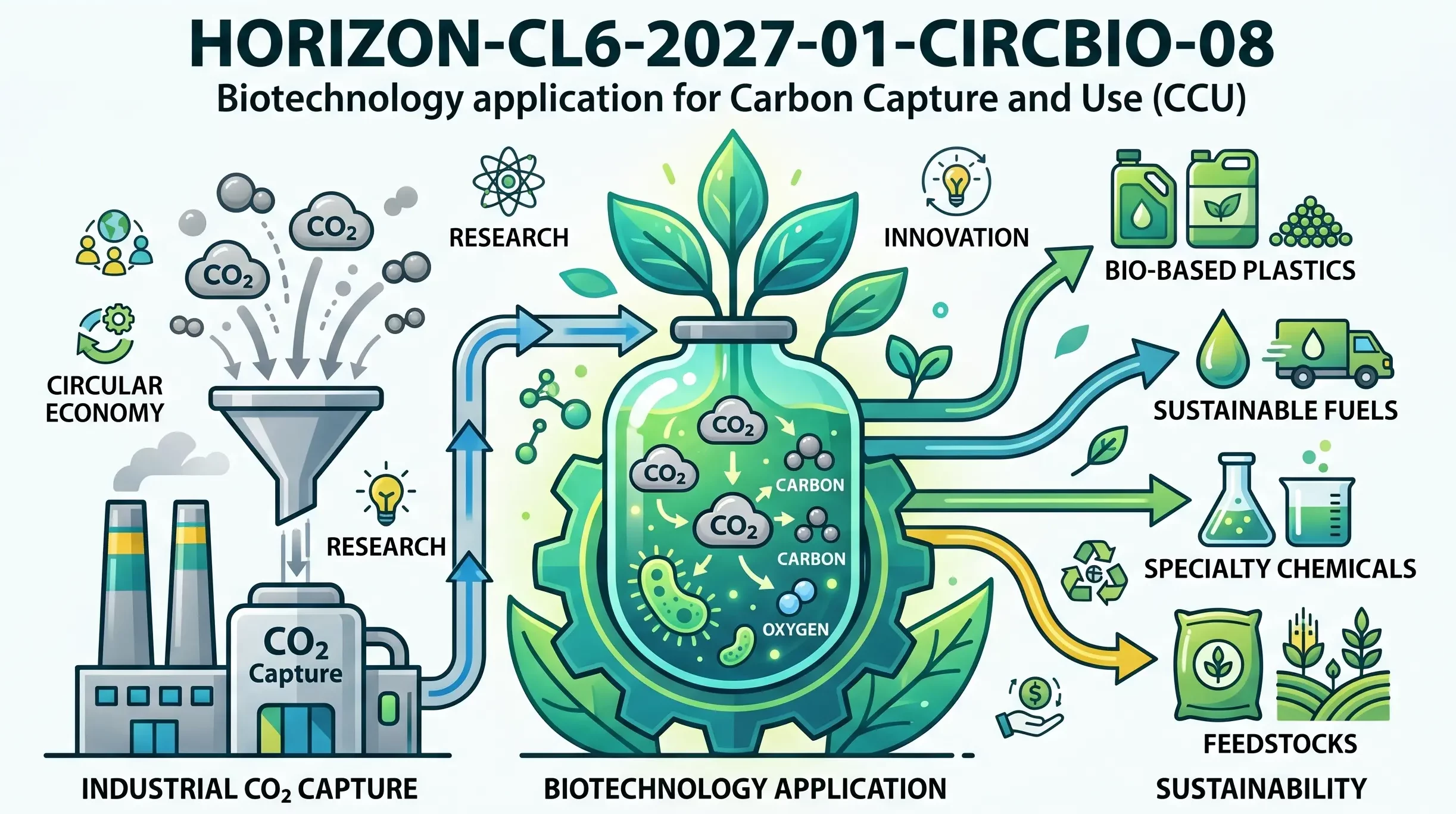
The Commission is keen on using life sciences technologies to capture and use carbon in a scale that is way beyond the laboratory. It is focused on the conversion of gaseous carbon in the industrial emissions or the atmosphere into useful feedstock to products, through synthetic biology or living microorganisms. This is an Innovation Action, and therefore, there is no expectation of exploration, just demonstration. When your consortium is unable to demonstrate a plausible route between captured CO2 and an actual product at anything like a marketable stage, then this is not your game.
Download the MIC Horizon Europe 2026/2027 Calls Calendar:
Discover more!
Administrative facts: what do we know about the HORIZON-CL6-2027-01-CIRCBIO-08 call?
Which call is it, and when is the opening and the deadline?
- Call name: Call 01, single stage (2027)
- Call identifier: HORIZON-CL6-2027-01
- Destination: Circular economy and bioeconomy sectors
- Topic: HORIZON-CL6-2027-01-CIRCBIO-08: Biotechnology application for CCU
- Opening date: 20 April 2027
- Deadline: 22 September 2027, 17:00 Brussels local time
- Type of action: Innovation Action (IA)
What about the budget and estimated size of the project?
- Overall topic budget: EUR 12.00 million
- Expected number of projects funded: 2
- EU contribution per project: around EUR 6.00 million
- Eligible costs: lump sum
What are the key eligibility and evaluation conditions?
- Standard eligibility conditions as per General Annex B
- TRL target: activities are expected to reach TRL 6 to 7 by end of project; may start at any TRL
- The granting authority may object to transfer of ownership or exclusive licensing of results up to 4 years after the action ends
- Award criteria as per General Annex D
- International cooperation is encouraged
- Synergies with Cluster 5 activities and the Circular Bio-based Europe (CBE) Joint Undertaking are encouraged
- Projects funded under this topic should collaborate on IP exploitation and dissemination activities
Scientific range: what does the Commission expect from the HORIZON-CL6-2027-01-CIRCBIO-08 grant?
What outcomes are expected?
The Commission seeks two things, and they both refer to industrial impact. The initial one is the large scale purification and transformation of gaseous carbon into feedstock that can be utilized in the industry processes. Second, evidence of the potential of life sciences and biotech to play any significant role in climate neutrality in an industrial environment. The call has explicitly been connected to the EU Carbon Removals and Carbon Farming Certification (CRCF) Regulation and Clean Industrial Deal, and therefore the framing must always be directed to policy convergence, and not necessarily scientific success.
What is within scope?
- Technologies, based on life sciences, in all stages of carbon capture and use: capture of gaseous carbon (any of the industrial emissions or directly in the atmosphere), purification, and conversion into products.
- Synthetic biology methods and /or using living microorganisms to concentrate, purify and transform gaseous carbon into appropriate feedstock.
- Examination of the existing R&I developments on biotech-based CCU such as evaluation of technological maturity, strengths, weaknesses, and storage capacity of carbon in products.
- Initial environmental impact study, as well as social and economic suitability of the developed technologies.
- This requires that at least one of the developed technologies has been demonstrated, and that the technology has the best environmental, economic and social sustainability profile.
- Replication potential estimation and distribution, technical and financial advice to SMEs and industrial operators, in particular.
- However, it depends on feasibility analysis to form a spin-off to apply the findings of the best demonstration(s).
One obvious limit: food, feed, biofuels and syngas are clearly not a product. There is no need to extend the call to those places.
What are the specifically proposed research directions?
- Gas fermentation and microbial transformation of CO2 and CO into chemical intermediates or bio-based products.
- Development of synthetic biology platforms to convert gaseous carbon to high value product (not fuels, not food) pathways.
- Capture, purification and biological conversion are integrated in one streamlined process and not considered as separate processes as they were treated before.
- Scalability testing: the Commission would prefer you to proceed through concept, demonstration and then to replication potential, including a real spin-off feasibility study embedded in it.
- The work programme is somewhat ambiguous regarding the types of products it prefers in which case it leaves consortia with the flexibility to choose their own output goals (polymers, specialty chemicals, platform molecules, construction materials, etc.) as long as they can support it with a business case.
Scientific strategy: how can you enhance your chances of being funded through HORIZON-CL6-2027-01-CIRCBIO-08?
What scientific choices matter most?
- Choose wisely your product. The call provides you freedom on the output side, however on the evaluators will seek a product with a realistic market and not necessarily a technically feasible conversion. Proposals have been accredited to fail here since there was no clear signal of demand of the bio-based product.
- Demonstrate, don’t just develop. This is an IA of TRL 6-7. In your proposal, you should demonstrate at least one complete illustration of the most promising technology. It will not be enough to have a collection of lab-scale experiments.
- Develop the spin-off story. In the work programme, a spin-off is specifically requested to have its feasibility assessment. Take this seriously, do not attach it to the butt of the WP7 as an afterthought. Evaluators notice.
- Confront the head of economics. Preliminary viability analysis must be done on real cost comparisons to fossil-based alternatives. The quickest way of losing points on contact is to avoid the cost question.
- Prove that you are familiar with what is already in the market. R&I review which is part of the first work package is not ornamental. Evaluators would like to notice that your consortium has surveyed the landscape and has placed your technology squarely in it, with sincere recognition of the weaknesses that are present.
- Sought synergies with Cluster 5 and CBE JU. This is indicated in the work programme. Talk about current or completed projects in those spaces and describe how your work augments/completes those.
- Arrange the two financed projects to work together. This is not an implication but a necessity. Assign a certain task to inter-project coordination.
Consortium and proposal-writing plan: what works best with this type of call?
- A consortium of between eight and twelve partners would be reasonable in case of an Innovation Action with EUR 6 million target and a TRL 6-7. Perhaps a few more should you be required to visit a few demonstration locations or a technical regulatory know-how in the various markets.
- You must have at least one good industrial biotechnology partner that is able to run bioreactors on pilot or pre-commercial levels. Synthetic biology academic groups are also welcome but cannot do the demonstration by themselves.
- Add a carbon capture expert, preferably a partner with real or access to a live industrial source of emissions. The simulated gas mixtures will be suitable at the initial levels of work, but they will not impress the evaluators at this level of TRL.
- A scaling-up experience, downstream product development capacity, and an innovative SME is a great asset in this case. The Commission is obviously making a case of spin-off possibilities and commercial feasibility, and thus a smaller company with actual market dynamism reinforces that message.
- Having an environmental LCA expert and techno-economic assessment team as independent partners (not subcontracted within the work package of a single academic laboratory) is an indication of seriousness on the viability analysis.
- The partners of international cooperation contribute value particularly in the case of the R&I review and replication assessment. But retain the main performance in Europe.
- On proposal writing: get down to business. The initial question that will be posed by the evaluator will be whether they can do this or not at TRL 6-7. Respond to it on the first page of Part B. Next to add the R&I perspective, the spin-off strategy, and the policy alignment to the CRCF Regulation and the Clean Industrial Deal.
- Lump sum format implies that your budgeting framework must be clean, justifiable and internally consistent in the first place. There is no room of indeterminate categories.
How would microfluidics contribute to this topic?
Large-scale fermentation for biotech conversion of carbon is not only about bigger fermenters. The process of screening and optimization of microbial strains or synthetic biology constructs prior to reaching pilot scale is one of the bottlenecks that we encounter time and again. Conventional methods involve well plates and shake flasks, that are slow and provide you with little control over the gas-liquid mass transfer, the parameter that is of greatest interest to CCU.
- Microfluidic droplet screening allows screening tens of thousands of microbial variants under controlled CO3 or CO exposure conditions in a run. You discover your strain of best behaviour more quickly, and there is a lot more information available on the gaseous uptake kinetics than any plate based assay will provide you with.
- But suppose you would like to know how a specific engineered pathway would react to changes in the composition of gases, the type of process that occurs at an actual industrial chimney. A microfluidic gas-liquid contactor enables you to recreate those changes on a chip and monitor the microbial reaction in real time. Identical compound, alternate gas mixture, alternate metabolic product.
- To conduct your environmental and viability analysis, microfluidic analytics can run dozens of simultaneous toxicity or degradation tests on the bio-based products emerging from your conversion process. You have reproducible results with replicates and you get them in days and not weeks.
- Another angle is enzyme activity profiling on chip. When your synthetic biology strategy is based on cell-free conversion of CO2 using enzymes, microfluidic platforms allow you to screen enzyme variants and cofactor conditions using the minimum amount of reagents, and this is important when your substrates are costly or difficult to manipulate.
Your plan must demonstrate a plausible route to the laboratory check-up to the demonstration. Microfluidics is at that crossroad and it speeds up the optimization that goes upstream to your pilot-scale work. In the case of a lump-sum budget with a consortium aiming at TRL 6-7, a rapid and data-intensive screening platform is not a luxury. It makes your schedule realistic.
The MIC already brings its expertise in microfluidics to Horizon Europe:
H2020-NMBP-TR-IND-2020

Microfluidic platform to study the interaction of cancer cells with lymphatic tissue
H2020-LC-GD-2020-3

Toxicology assessment of pharmaceutical products on a placenta-on-chip model

About the author
Julia Sepulveda Diaz, PhD
Chief Executive Officer, Microfluidics Innovation Center
Julia holds a PhD in glycobiology and neurobiology from Université Paris-Est Créteil. Before moving into microfluidics, she spent several years as a postdoctoral researcher at the Paris Brain Institute, on Parkinson’s disease, neuroinflammation, and the role of heparan sulfate in protein aggregation. Today she leads the Microfluidics Innovation Center as CEO, steering its researchers and engineers and its collaborative research and innovation projects.
FAQ – HORIZON-CL6-2027-01-CIRCBIO-08
What is the call topic about?
Carbon Capture and Use (CCU) is being implemented through the use of life sciences and biotechnology in Innovation Actions funded by HORIZON-CL6-2027-01-CIRCBIO-08. It aims at harvesting gaseous carbon in the emissions of industries or the atmosphere, cleaning and converting it, using synthetic biology or living microorganisms, into a feedstock to industrial products. Exempt are food, feed, biofuels and syngas.
What is the budget and how many projects will be funded?
The indicative budget in total amounts to EUR 12.00 million. The Commission is expected to finance 2 projects, each receiving around EUR 6.00 million. Payable cost is paid in lump sum.
When does the call open and close?
The call will be open on 20 April 2027 and will be closed on 22 September 2027 at 17:00 local time in Brussels. It is a one-stage call in the HORIZON-CL6-2027-01.
What TRL level is expected?
At the final project, the activities will be TRL 6-7. Any TRL can initiate the activities, although the outcome is a demonstration at a nearly pre-commercial stage. Lab-scale experiments will not suffice to the evaluators. Check the Funding and Tenders Portal for more information.
What kind of consortium is most appropriate?
Innovation Action of this magnitude usually has eight to twelve partners. This combination should include an industrial biotechnology partner that can operate a pilot scale of bioreactors, a carbon capture specialist that can have a real source of emission (industrial) and an innovative SME that can be able to develop new downstream products, and dedicated LCA and techno-economic assessment units.
Why is including an innovative SME important?
The Commission is directly requesting a spin-off viability analysis and advice for SMEs and industrial operators. A smaller firm that is actually market-responsive enhances the spin-off story and indicates grave commercial intent, which assessors are inclined to reward in Innovation Actions targeting TRL 6-7.
What policy frameworks does the call support?
It is also directly linked with the EU Carbon Removals and Carbon Farming Certification (CRCF) Regulation, the Clean Industrial Deal, the Strategy for European Life Sciences, the biotech act, the EU Startup and Scaleup Strategy and the EU strategy on research and technology infrastructure. They are to found their story on these instruments on suggestions.
What products are out of scope?
Product scope of food, feed, biofuels and syngas are evidently absent of the work program. Examples of good targets are polymers, specialty chemicals, platform molecules and construction materials as long as the consortium can support them with a compelling business case.
How does microfluidics contribute to CCU biotechnology projects?
Microfluidics speeds up strain and pathway screening prior to pilot scale-up. Droplet microfluidics enables testing tens of thousands of microbial variants under controlled conditions of gas exposure. Chips of gas-liquid contactors model time-varying industrial gas mixtures. On-chip enzyme profiling identifies cell-free enzyme CO2 conversion with a small amount of reagents.
What synergies should the proposal explicitly address?
Proposals should mention synergies with Cluster 5 activities and with the Circular Bio-based Europe (CBE) Joint Undertaking. Inter-project coordination with the second project, which will be financed under the same topic, should also be planned, and an exclusive task and budget should be assigned to the common IP exploitation and dissemination activities.