Tips & Tricks for a successful HORIZON-HLTH-2027-01-STAYHLTH-01 proposal
Opening
10 February 2027
Deadline
Keywords
Disabilities
Independent living
Life course
care models
Assistive technology
service providers
Deinstitutionalisation
Rehabilitation
social inclusion
Your microfluidic SME partner for Horizon Europe
We take care of microfluidic engineering, work on valorization and optimize the proposal with you
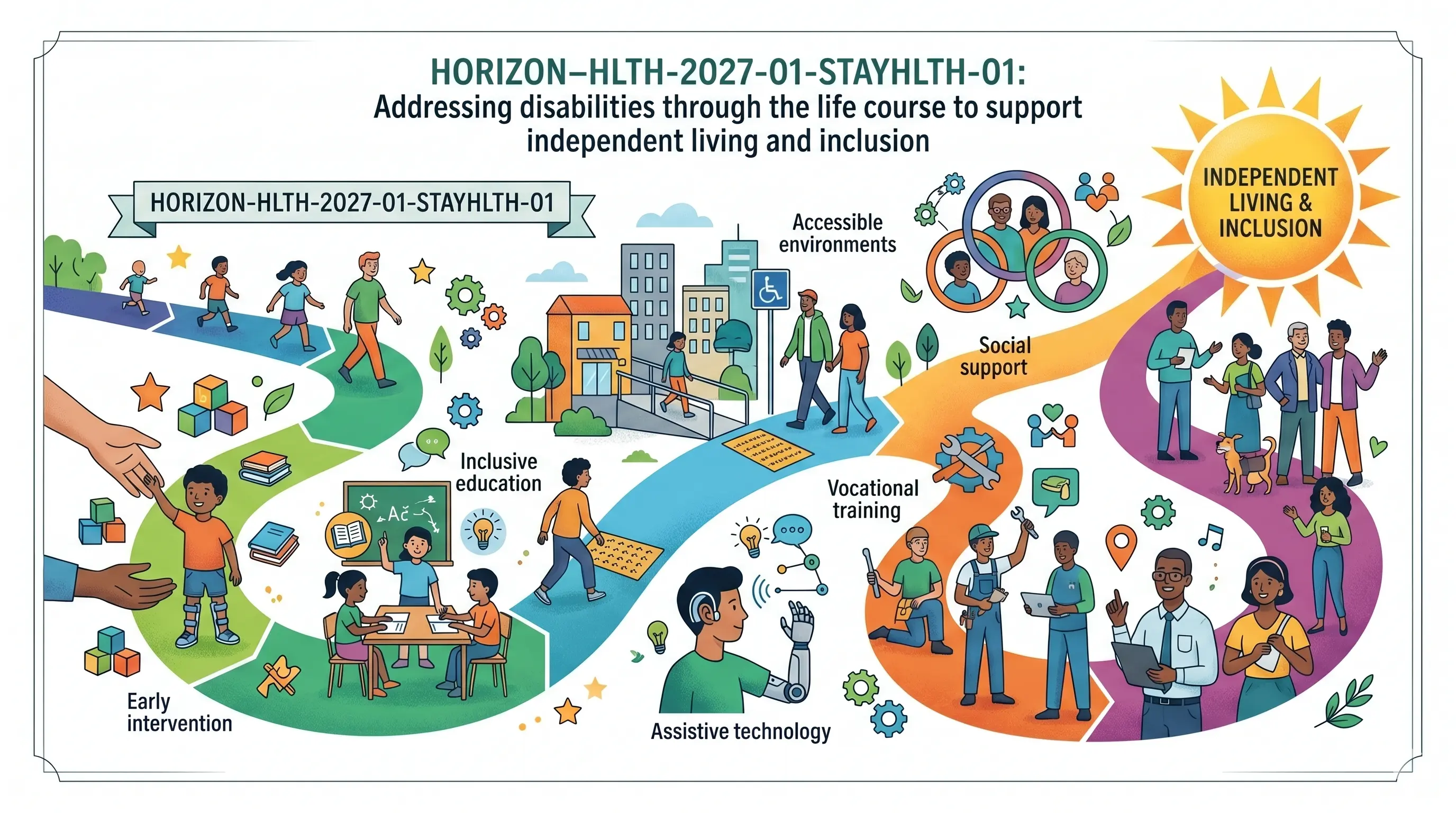
HORIZON-HLTH-2027-01-STAYHLTH-01: Addressing disabilities through the life course to support independent living and inclusion
Approximately 135 million people in Europe live with a disability, and that number is expected to grow due to population aging and the increase in non-communicable chronic diseases. The Commission wants research that actually changes the daily lives of people with disabilities, not just papers outlining the issues. The subject of this call is breaking down barriers, reshaping service delivery, and enabling people to remain in their communities rather than in institutions.
Download the MIC Horizon Europe 2026/2027 Calls Calendar:
Discover more!
Administrative facts: what do we know about the HORIZON-HLTH-2027-01-STAYHLTH-01 call?
Which call is it, and when is the opening and the deadline?
- Call name: Cluster 1 – Health (Single stage – 2027/1)
- Call identifier: HORIZON-HLTH-2027-01
- Destination: Staying healthy in a rapidly changing society
- Topic: HORIZON-HLTH-2027-01-STAYHLTH-01
- Opening date: 10 February 2027
- Deadline: 13 April 2027 at 17:00 Brussels local time
- Type of action: Research and Innovation Action (RIA)
- Grant type: Lump sum
What about the budget and estimated size of the project?
- Total topic budget: EUR 39.30 million
- Indicative number of funded projects: 5
- Expected EU contribution per project: EUR 6.00 to 8.00 million
What are the key eligibility and evaluation conditions?
- Thresholds: 4 (Excellence), 4 (Impact), 4 (Implementation); cumulative threshold of 12
- US entities are eligible (in recognition of NIH openings to European researchers)
- SSH disciplines are required; SSH experts and institutions must be actively involved
- Persons with disabilities and their representative organizations must be involved in the research process
- If satellite-based data is used, Copernicus and/or Galileo/EGNOS must be the primary source
- Clinical studies require a dedicated annex in the submission system
- JRC: No specific exception mentioned; standard rules apply
- Proposals must address at least three of the defined research areas listed in the topic scope
Scientific range: what does the Commission expect from the HORIZON-HLTH-2027-01-STAYHLTH-01 grant?
What outcomes are expected?
The Commission is seeking outcomes that enable people with disabilities to have genuine choice and agency in their independent lives and in their participation in the community. In practical terms, the Commission expects that this call will lead to concrete solutions in services, tools, and care models, delivered to people in a disaggregated way (across disability, age, and sex) at the ground level. Public authorities and service providers shall draw actionable evidence from the call, not just a simple report.
What is within scope?
People with long-term disabilities (physical, mental, intellectual, or sensory) across their entire life course are the target of this topic. It is not about a technology demonstration as such. Integrated human-centered approaches, which combine health research with assistive technology, community-based services, policies, etc. They are within scope. Covered fields are:
- Health research on the causes, diagnosis, treatments (medicines, protocols, etc.) of conditions that cause or are related to a disability, and on low-tech tools that facilitate their daily lives
- Children from the perinatal period to young adults and older adults (over 60, by UN definition)
- Access to habilitation and rehabilitation services, including through psychology-based therapy and assistive technologies
- Prevention strategies across the life course for disabling conditions (obesity, physical inactivity, smoking, loneliness, psychiatric disorders, socio-economic factors)
- Transition from institution to community living (needs assessment, services, financing, monitoring, tools to support de-institutionalization)
- Person-centered models and self-care strategies should be made available to people, offering real choices throughout their life course
- Harmonized data collection based on Eurostat standards (disaggregated by Member States, with known gaps in data across Member States identified as a problem area)
What are the specifically proposed research directions?
The work program is a bit more prescriptive than it may appear at first glance. Through the wording of the work program, one can implicitly distinguish three clearly intended life-stage areas: childhood, transition to adulthood, and aging. Furthermore, two themes implicitly or explicitly appear as very important: overcoming the transition between institutions and community, and the problem of benefit traps. Explicit or implied research directions are:
- Disease to disability pathways: looking into causes for the condition and testing treatments that support autonomy preservation or recovery
- Innovation in rehabilitation techniques that use new rehabilitation paradigms, supported by assistive technology, and possibly combining assistive technology with psychology-based support, with a particular focus on disabled people with limitations in functioning
- Benefit traps and social security research: to identify where current benefit systems discourage participation and employment of disabled people, this issue will be directly covered by research conducted under this topic, due to a link with Cluster 2 topic areas
- Infrastructure in the community for independent living: models of personal assistance services, digital or non-digital community support, and accessibility of the built environment
- Life stages research: childhood to adulthood, transition from institution to community and transition to old age are expected to be studied as specific points of a broader life-course approach
Scientific strategy: how can you enhance your chances of being funded through HORIZON-HLTH-2027-01-STAYHLTH-01?
What scientific choices matter most?
- Address at least three research areas mentioned in the list. If not, your proposal is ineligible. Show how each area in your consortium plan is addressed.
- Embrace co-research. People with disabilities are partners, not only the target population. If they are only the subjects of research, your proposal will lose ground. Plan collaborative research from the beginning.
- Integrate SSH disciplines throughout. It shouldn’t be a last-minute work package. Sociologists, ethicists, lawyers, and people specialized in disability rights, these disciplines must shape research questions.
- Genuine life course consideration is critical. Proposals that superficially span all life stages are often problematic during review. Focus on doing two or three life stages properly, rather than all five superficially.
- Contribute to data harmonization. As the work program highlights gaps in Member States data, proposals that incorporate Eurostat-compatible data collection and country comparability will score highly for impact.
- Keep de-institutionalization in focus. Proposals that do not somehow address or account for systemic transition from institutional to community-based care risk appearing behind the curve relative to the EU Disability Strategy 2021-2030.
- Make use of the data ecosystems of EHDS and EOSC, explicitly encouraged by the work program and desired by health-focused reviewers.
Consortium & proposal-writing plan: what works best with this type of call?
- An ideal number of partners is 10 to 14, possibly more if you need clinical partners across many countries and disability types.
- SSH partners are essential, not a supplementary component. Include specialists in the sociology of disability, ethics of care, and EU Disability Strategy expertise.
- Clinical partners are needed. Consider rehabilitation centers, hospital neurology/pediatric units, and geriatric services to cover the life span appropriately.
- Ensure there is at least one disability representative organization as a partner, not just an advisory member; this is what the Commission calls involvement.
- Including an innovative SME that works with assistive technology or accessible digital solutions is beneficial both for the technology and exploitation aspects of the proposal.
- If a US partner is included, mention their eligibility status, especially their association with NIH, in the eligibility check section. Some reviewers find this unusual.
- Emphasize the impact and changes this research will make for people with disabilities, rather than focusing on what your consortium will produce. The test of X in Y, in an actual community setting, about Z people with disabilities… at month 36 is beating around the bush.
- The preparation of the clinical studies annex should be comprehensive, given the broader definition of clinical studies in the work program relative to the usual clinical trial.
How would microfluidics contribute to this topic?
Despite the fact that standard biomolecular research provides a certain understanding of how an individual responds to treatment over a period of time, it is not always enough for a person with a physical or neurological disability. It is here that organ-on-chip platforms, which are miniaturized, would be essential, and the microfluidics provided by MIC would be especially well applied to this theme.
- Consider that you are conducting research on a neurodegenerative condition that causes progressive physical impairment. To understand how the illness develops biologically and test potential drugs that can delay it, organ-on-chip systems can simulate this process using human tissue, thereby reducing many of the uncertainties of animal models and helping develop clearer cause-and-effect relationships.
- Microfluidic neuromuscular junction models are especially useful for addressing diseases such as muscular or neurological disorders. They can depict the deterioration of nerve-muscle communication that results in the condition, and the degree of that deterioration that a particular drug can undo. On another tissue platform, you can test various effects using the same drug.
- In studies of neurological conditions or injuries, brain-on-chip models with an intact blood-brain barrier would be applicable to understanding how conditions progress and the efficacy of treatments in the central nervous system. These are not fringe research tools, but they are included in many translational research pipelines.
- Microfluidic-based biomarker profiling can provide a major benefit in cases where longitudinal studies of people with disabilities are required. It only requires small samples to be examined over time and yields the same results across the board, which lessens the burden on participants, especially those who already have people with significant healthcare needs.
- It is particularly handy in pediatric disability studies, where sample sizes may be small, since microfluidic tests require very small amounts of biological sample.
In this topic, microfluidics would be an additional technology in your proposal, not a core focus. It provides methodological richness and shows the assessors the tools you have in your consortium to go beyond correlation to identify underlying causes and processes, whether in a biomedical or rehabilitation branch of research. MIC has been involved in several Horizon consortia and would be pleased to discuss its incorporation into your research proposal.
The MIC already brings its expertise in microfluidics to Horizon Europe:
H2020-NMBP-TR-IND-2020

Microfluidic platform to study the interaction of cancer cells with lymphatic tissue
H2020-LC-GD-2020-3

Toxicology assessment of pharmaceutical products on a placenta-on-chip model

FAQ – HORIZON-HLTH-2027-01-STAYHLTH-01
What is the exact scope of HORIZON-HLTH-2027-01-STAYHLTH-01?
This subject deals with long-term disabilities, physical, mental, intellectual, or sensory disabilities through the life course. It emphasizes on facilitating independent living and community integration, integrating health research, assistive technology, rehabilitation, and social services. The work program specifies three areas of research that must be covered in proposals.
Who can apply and are US organisations eligible?
Eligibility rules of Standard Horizon Europe apply. US organizations can receive funding through the EU on this topic, as a reward to the opening of NIH programs to European researchers. Associated countries have legal entities that adhere to the standard rules. Check the Funding and Tenders Portal for more information.
What is the budget and how many projects will be funded?
The indicative budget of this topic is EUR 39.30 million. The Commission estimates an EU contribution of between EUR 6.00 and 8.00 million per project. Five projects will be financed. The type of grant is a lump sum.
What does ‘at least three research areas’ mean in practice?
Six research areas are provided in the work program: health research on disability-causing conditions; focus on children and older persons; access to rehabilitation services; prevention across the life course; transitioning from institutional to community living; and person-centered care models. You should substantively discuss at least three of these, rather than merely state them.
How should persons with disabilities be involved in the research?
Individuals with disabilities should be directly involved in the research process, not merely research subjects. The project should have partners as their representative organizations. Families, carers and civil society organizations can also be involved in research. This may also include policymakers and public authorities.
What role do SSH disciplines play in this call?
Explicitly, knowledge from the social sciences and humanities (SSH) is needed. The SSH professionals should not only contextualize the findings but also form the research questions and methodology. Engage a sociologist, ideally a legal expert on disability rights, as active partners.
How important is deinstitutionalisation in the proposal?
Very important. The Commission’s framing is consistent with the EU Disability Strategy 2021-2030, which focuses on shifting institutional care towards community-based care. Proposals that fail to address deinstitutionalization can be seen as falling behind the current EU policy. Be competent in understanding systemic transition, though it may not be the focus of your studies.
What data standards should the consortium follow?
It is recommended that applicants apply Eurostat standards and already existing international sets of questions to guarantee harmonized data collection, disaggregated by disability type, sex, and age. The work program clearly recognizes that data comparability across Member States is an identified problem area.
Can clinical studies be included and what does that imply?
Yes. Clinical studies are in scope. The understanding of clinical studies in this work program is more inclusive than the conventional definition of clinical trials – look at it keenly before making your decision on whether your protocol meets the definition. For any clinical studies, a special annex with the submission system template is required.
How can microfluidics support disability research under this call?
The biomedical research proposals in this topic can be supported by microfluidic platforms, such as organ-on-chip systems. They have been used in neuromuscular junction models, in blood-brain barrier chip applications to study neurological diseases, and in microfluidic biomarker profiling to longitudinally study patients with small sample volumes. MIC can become a creative SME partner.