Tips & Tricks for a successful HORIZON-HLTH-2027-01-DISEASE-10 proposal
Opening
10 February 2027
Deadline
Keywords
NCD prevention
GACD
Implementation research
Children & youth
LMIC
Chronic diseases
Pediatric diagnostics
non-communicable diseases
Your microfluidic SME partner for Horizon Europe
We take care of microfluidic engineering, work on valorization and optimize the proposal with you
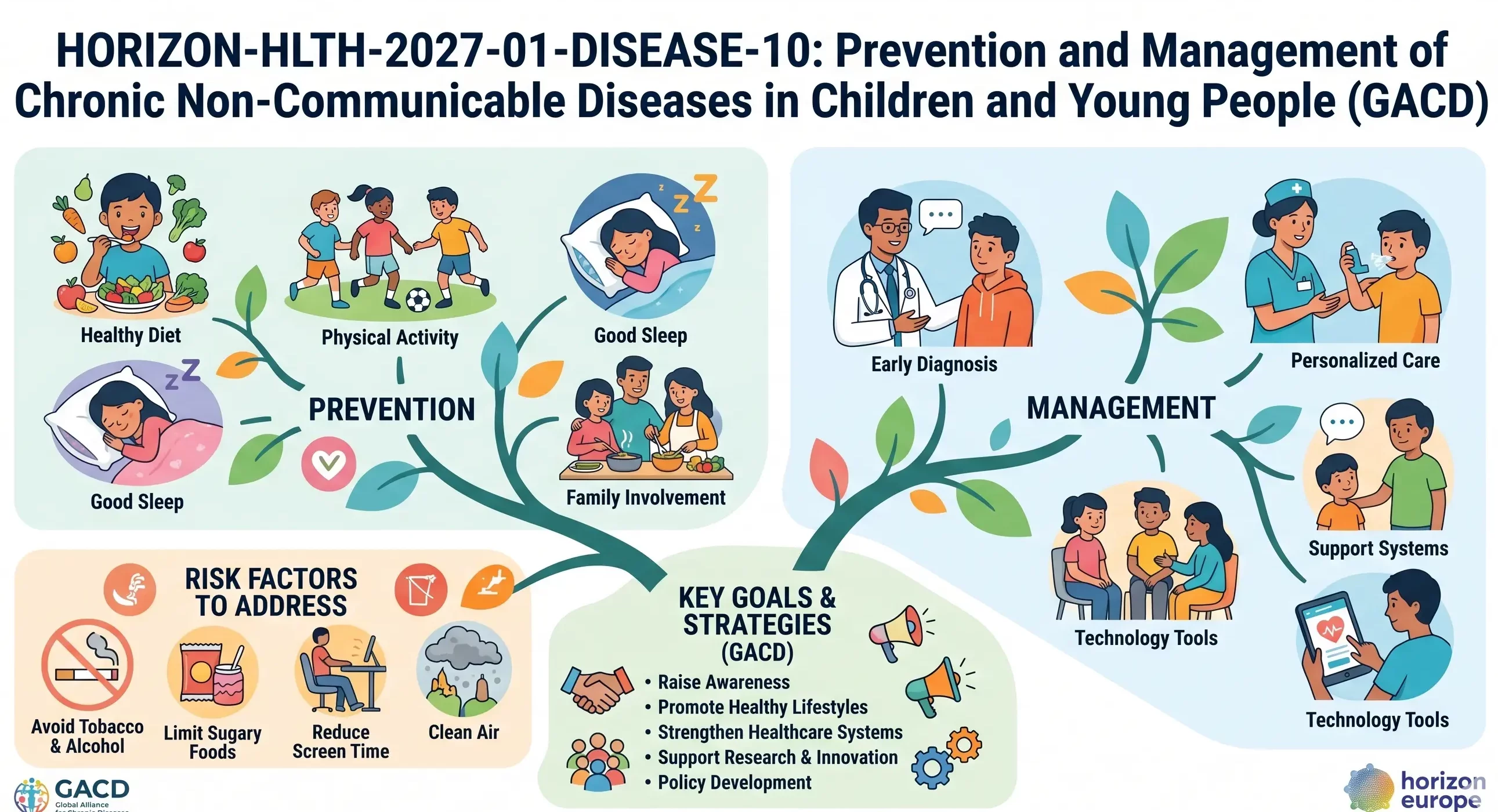
HORIZON-HLTH-2027-01-DISEASE-10: Prevention and management of chronic non-communicable diseases in children and young people (GACD)
This call is the Global Alliance for Chronic Diseases (GACD) initiative which is being financed with international funding agencies and is alongside the 12th GACD call. The Commission desires action, not demonstrations lodged in some corner on the shelf. It is restricted to children and young people of 1-24 years in low- and middle-income countries (LMICs) or the disadvantaged communities in high-income countries (HICs) who are living with one or more non-communicable diseases (NCDs). This is because up to 70% of the NCD-related deaths in adulthood are a result of early exposure to risks in life and this is what this call seeks to address.
Download the MIC Horizon Europe 2026/2027 Calls Calendar:
Discover more!
Administrative facts: what do we know about the HORIZON-HLTH-2027-01-DISEASE-10 call?
Which call is it, and when is the opening and the deadline?
- Call name: Cluster 1 – Health (Single stage – 2027/1)
- Call identifier: HORIZON-HLTH-2027-01
- Destination: Tackling diseases and reducing disease burden
- Topic: HORIZON-HLTH-2027-01-DISEASE-10
- Opening date: 10 February 2027
- Deadline: 13 April 2027, 17:00 Brussels local time
- Type of action: Research and Innovation Action (RIA)
What about the budget and estimated size of the project?
- Total indicative budget for the topic: EUR 11.80 million
- Indicative number of projects: 3
- Expected EU contribution per project: EUR 3.00 to 4.00 million
- Eligible costs: lump sum financing
What are the key eligibility and evaluation conditions?
- General eligibility: as per General Annex B, with the following exception: any legal entity established in the United States of America is eligible to receive Union funding, in recognition of NIH programme reciprocity
- If satellite data is used (earth observation, positioning, navigation, timing): Copernicus and/or Galileo/EGNOS must be used
- Subject to restrictions for the protection of European communication networks
- Legal entities established in China are not eligible for RIA actions under this destination
- Award thresholds: 4 (Excellence), 4 (Impact), 4 (Implementation); cumulative threshold: 12
- Granting authority may object to transfer of ownership or exclusive licensing of results up to 4 years after project end
- No specific JRC or clustering requirements noted for this topic
Scientific range: what does the Commission expect from the HORIZON-HLTH-2027-01-DISEASE-10 grant?
What outcomes are expected?
The Commission wants you to demonstrate how the implementation of NCD-related intervention strategies is feasible at the population level in populations that are pertinent to the age criteria and the outcomes that are desired at the conclusion of the grant through the establishment of tangible policy and service interventions, and other evidence products that can be adopted by the decision-makers and healthcare providers. Community participation and caregiver involvement should be real and tangible, not symbolic.
What is within scope?
This is directly related to implementation research, and no fundamental science or initial intervention development would be conducted. The Work Program clearly states that the proposed research must expand on the existing interventions with a certain amount of prior evidence, and that the development of novel interventions in isolation is not the aim.
- Prevention of NCDs through the adoption of intervention measures to address children and youth (such as educational interventions, vaccination measures, behavioral or lifestyle change interventions etc.)
- NCDs or risk factors screening and diagnosis in children and young people with particular reference to digital technologies.
- Cost-effective, patient-centered NCD management, such as access to medicines/devices to treat the condition, an integrated care pathway and a continuum of care among adolescents who leave pediatrics care.
- Policy assessment of social, economic, structural and commercial factors of childhood NCDs.
- In scope includes all chronic non-communicable diseases (including mental health, auto-immune, musculoskeletal, neurological disorders, sleep disorders etc.)
- Application of life-course approaches to interventions.
What are the specifically proposed research directions?
The Work Program also emphasizes the research hybrid studies in which both the effectiveness and implementation aspects are to be investigated, as well as other significant directions:
- Implementation research to assess effectiveness and research outputs (together with formative research assessing implementation readiness).
- Interventions adopted at various levels: individuals, families, communities (schools, workplaces), populations, and structures.
- The contribution of citizen science and caregiver input in management approaches.
- Incorporating stakeholders, especially the youth, at the start of the project design.
- Building the capacity of young scholars in LMICs or disadvantaged groups (a critical and widely neglected factor about this call: a co-investigator in his or her early professional life needs to be part of the team).
- Building fair relationships between HIC and LMIC institutions by having joint governance structures.
Scientific strategy: how can you enhance your chances of being funded through HORIZON-HLTH-2027-01-DISEASE-10?
What scientific choices matter most?
- Evidence-based intervention: The proposal should demonstrate the effectiveness, cost-effectiveness, and scalability of the intervention to fulfill the Excellence criteria.
- Hybrid designs with a strong rationale are significant: Applicants must provide a rationale for choosing a hybrid design to test both effectiveness and implementation using one of the suggested frameworks, such as CFIR, RE-AIM, PRISM, or MRC/NIHR. You don’t have to pick one and exclude others, but a justification of the methodology is expected.
- Apply to LMICs or underserved populations: General equity statements will not be adequate; a specific knowledge of the target populations and environments, with identified local partners, will be required to meet the Excellence criteria.
- Plan for formative research where appropriate: In the case where an intervention is not implemented and tested on a large scale in the intended target populations or in similar settings, the Work Program implicitly permits the use of formative research to refine and contextualize an intervention to fit the local context before any further testing or implementation is done.
- The partnership governance strategy should be clear: it should have a clearly spelled-out approach to co-leadership of the project between the HIC and LMIC partners, particularly in terms of co-decision-making on priorities and research focus. Here, studies in LMICs would potentially be highly relevant to the reviewers.
- The study design must include sustainability pathways: The proposal should demonstrate how to make the intervention sustainable in the long term, even after GACD funds have been exhausted.
- Diversity is an issue of concern: Sex, age, ethnicity, disability, and vulnerability must be specifically addressed in the research approach and methods in line with the areas where the diversity can be pertinent, or not addressed at all as irrelevant to the intervention or the research.
Consortium & proposal-writing plan: what works best with this type of call?
- The number of partners on a call at this level of budget will likely be between six and ten (possibly a little higher if needed to cover the necessary geographical areas, but do not over-resource it).
- LMIC institutions cannot simply be beneficiaries, but the actual partnership is an obligation that the proposal should capture by making sure there is actual shared leadership.
- Direct community access through a pediatrician or a public health researcher on the team to enhance the proposal’s impact.
- This kind of call requires a good social scientist or implementation scientist, and the basic scientists are usually secondary.
- An SME engaged as a partner, particularly one specializing in innovative screening devices such as wearables, point-of-care diagnostics, or data analysis systems for children, can offer significant value to the commercialization perspective, as appreciated by the Commission, thereby enhancing the overall consortium’s diversity and commercialization capacity.
- When targeting underserved populations in HICs, identify communities and demonstrate their relationships with these populations by presenting evidence in the proposal. It should give what will be done in that specific community and also how the community has been involved in the planning of the project.
- Indication of evident policy impact and the manner in which such an indication will be created is crucial; the Work Program focuses on the way you will apply the project findings to policy decisions in the contexts of relevance. This is more important than any lengthy description in an annex.
- Here, lump sum financing is used. Ensure a prudent distribution of the budget among the various work packages; clearly divide the work packages by the work planned, deliverables, what is to be given, and what is to be paid.
How would microfluidics contribute to this topic?
Pediatric patients are characterized by an extreme inability to be tested and monitored using standard medical equipment. Venipuncture on small volumes is an issue in low-resource contexts where laboratory facilities are less available. Microfluidics comes into play in such situations.
- NCD diagnosis with low-volume samples: with chip-based diagnostics, you can diagnose NCDs (blood glucose, lipids, and inflammatory markers) with small fingerprick volumes without using venous blood samples. This type of diagnostics can be performed in the community with no laboratory environment whatsoever.
- Understanding the pathogenesis of childhood NCDs on an organ-on-a-chip basis: by defining the various phenotypic differences between child and adult-onset NCDs on organ-on-chip models and how they pathogenically respond differently at a tissue level than their animal counterparts.
- Saliva or sweat diagnostics of mental illnesses: it is now possible to check cortisol, inflammatory cytokines, and other biomarkers in saliva or sweat, without the need for venipuncture, and which may be a far more acceptable sample in children.
- Enabling digital screening and diagnostics: microfluidics-based lab-on-chip assays can facilitate direct testing at the point of care, with the potential to deliver instant results and support the digital screening model presented by the Commission. It is possible to suggest microfluidics as one of the main elements in the implementation plan.
Microfluidics may not be the sole technology solution to all issues; however, its ability to overcome a specific, critical barrier in child NCD management in resource-limited settings, obtaining timely and relevant biological data with minimal equipment, is exactly what a proposal seeking to address practical problems needs.
The MIC already brings its expertise in microfluidics to Horizon Europe:
H2020-NMBP-TR-IND-2020

Microfluidic platform to study the interaction of cancer cells with lymphatic tissue
H2020-LC-GD-2020-3
Toxicology assessment of pharmaceutical products on a placenta-on-chip model

About the author

Julia Sepulveda Diaz, PhD
Chief Executive Officer, Microfluidics Innovation Center
Julia holds a PhD in glycobiology and neurobiology from Université Paris-Est Créteil. Before moving into microfluidics, she spent several years as a postdoctoral researcher at the Paris Brain Institute, on Parkinson’s disease, neuroinflammation, and the role of heparan sulfate in protein aggregation. Today she leads the Microfluidics Innovation Center as CEO, steering its researchers and engineers and its collaborative research and innovation projects.
FAQ – HORIZON-HLTH-2027-01-DISEASE-10
What is the GACD and why does it matter for this call?
The Global Alliance for Chronic Diseases (GACD) is a group of funding agencies worldwide, including the EU, NIH, CIHR, and MRC, among others. It organizes implementation research on non-communicable diseases (NCDs) worldwide. It is one of the issues discussed with the other members of the GACD and per the 12th GACD call. In practice, not only the European Commission, but also international standards of the GACD community evaluate your proposal.
Who are the eligible applicants for HORIZON-HLTH-2027-01-DISEASE-10?
Any legal entity in a country eligible for Horizon Europe can participate. However, there is one exception: legal entities established in the United States of America may be counted for Union financing, as one of the signs of European researchers’ openness to NIH programs. Legal entities that have established themselves in China under this destination are not subject to RIA activities. Otherwise, the general eligibility rules for Annex B standards would apply.
What does implementation research mean in practice?
The implementation research is interested in the methods for translating evidence-based interventions into real-life contexts. It is different from efficacy research. In the context of this call, interventions that have already shown promising results and test plans for their application to large populations in LMICs or underserved populations should be proposed. The work program mentions the CFIR, RE-AIM, PRISM, and the MRC/NIHR complex intervention frameworks.
Can proposals include basic science components?
No. Implementation research is specifically allocated in this call. Plans cannot aim to create new mechanistic knowledge or new interventions. An intervention proven effective should be used as a starting point. Where formative research is needed, it is allowed to adapt or localize an existing intervention to a specific population or situation.
How should HIC-LMIC partnerships be structured?
The work program is succinct: the partnerships between high-income and low- and middle-income countries (HICs and LMICs, respectively) should be based on equal joint leadership, not token involvement. Research priorities, shared governance and co-investigator roles will be co-decided with the LMIC partners. It is also proposed to provide capacity-building to early-career researchers in the LMICs or disadvantaged communities and specifically NCDs.
What NCD conditions can this call address?
This call entails all chronic non-communicable diseases of children and youths between 1 and 24 years. The details of the mental health disorders, autoimmune disorders, musculoskeletal disorders, neurological disorders, sleep disorders and any risk factor, or combination of risk factors, are all narrowly focused. There is a lump-sum approach to life course development from early childhood to young adulthood.
How is the budget distributed and what is lump sum financing?
The indicative budget for this topic is EUR 11.80 million, shared among approximately Lump-sum sectors. The amount the EU would contribute is estimated at EUR 3.00 to 4.00 million. Lump-sum financing applies, whereby qualified costs are provided as a lump sum stipulated in each work package, rather than actual cost reimbursement. Budget proposals should be well-designed around deliverables and work, since a lump sum is not paid until predetermined outputs have been successfully delivered.
What role should young people play in the research?
The work program, in particular, emphasizes the meaningful involvement of youth in the project, not necessarily as research subjects. It entails participation in design, engagement and translation of knowledge. The youths must be approached in a manner appropriate to their age and the study context. It is not box-ticking; the reviewers will consider how real the engagement strategy is and how it is incorporated into the project design.
Are US institutions eligible to participate?
Yes. An exception is clearly stated: any legal entity created in the United States of America may receive Union funding within the scope of this topic. This is written in respect of the US National Institutes of Health (NIH) programs that are open to European researchers. This exception applies only to the topics of the GACD framework, not to all Horizon Europe topics.